Predictive SEO AI models analyze historical data and social signals to forecast search demand, but their autonomy introduces operational risk. Model governance is the framework that ensures these systems remain accurate, ethical, and aligned with business goals. Without it, you face model drift, performance decay, and unaccountable automated decisions that can damage SEO performance and brand trust. This guide provides the technical blueprint for implementing that critical oversight.

Guide
Setting Up Governance for Predictive SEO AI Models
A technical guide to implementing operational and ethical governance for predictive SEO AI. Learn to monitor model drift with Weights & Biases, set confidence thresholds, and create audit logs for all predictions.
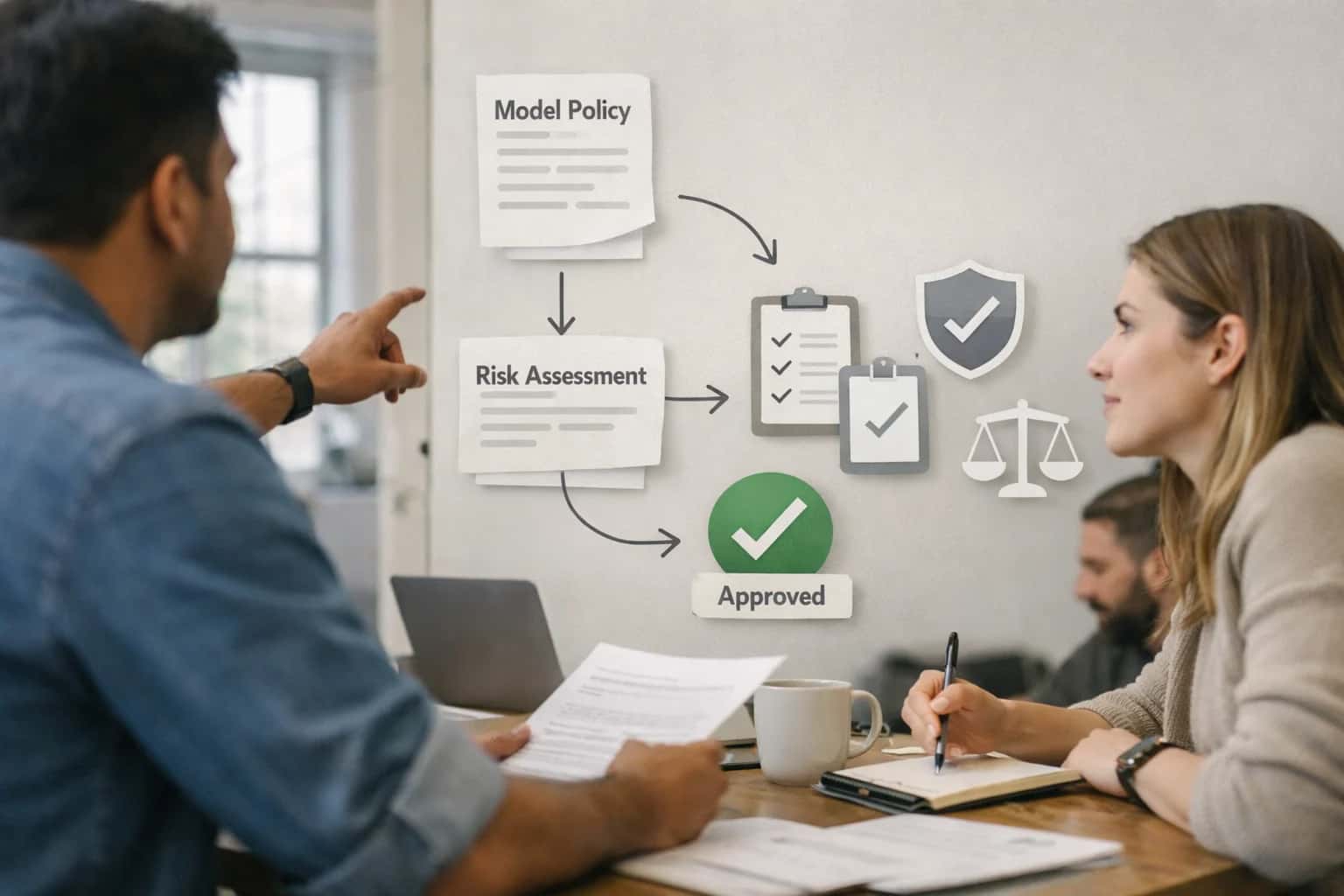
This guide establishes the operational and ethical framework required to deploy predictive AI in SEO responsibly and reliably.
You will learn to implement three core governance pillars. First, establish continuous monitoring for model drift using tools like Weights & Biases to track prediction accuracy against live search data. Second, set confidence thresholds that determine when a prediction is reliable enough to trigger an automated action, like generating a content brief. Third, create immutable audit logs for every prediction and action, providing a traceable record for debugging and demonstrating responsible AI compliance.
COMPARISON
Core Governance Components and Tools
Essential tools and frameworks for monitoring, auditing, and controlling predictive SEO AI models to ensure reliability and ethical compliance.
| Governance Component | Monitoring & Observability | Audit & Compliance | Control & Intervention |
|---|---|---|---|
Performance & Drift Tracking | Weights & Biases, MLflow | Model cards, Experiment logs | Automated retraining triggers |
Prediction Confidence Thresholds | Real-time scoring dashboards | Decision audit logs | Human-in-the-Loop (HITL) gates |
Bias & Fairness Monitoring | Aequitas, Fairlearn | Bias audit reports | Automated model quarantine |
Data Lineage & Provenance | Data Version Control (DVC) | Software Bill of Materials (SBoM) | Approval workflows for data changes |
Explainability & Traceability | SHAP, LIME for model outputs | Reasoning path logs for compliance | Override flags for low-confidence predictions |
Security & Access Control | Role-based access in MLOps platform | Actionable audit trails for all predictions | API rate limits, Prompt injection guards |
Enabling Efficiency, Speed & Accuracy
Intelligent Analysis, Decision & Execution
We build AI systems for teams that need search across company data, workflow automation across tools, or AI features inside products and internal software.
Talk to Us
Search across company data
Give teams answers from docs, tickets, runbooks, and product data with sources and permissions.
Useful when people spend too long searching or get different answers from different systems.
Enterprise searchRAGPermissions
Read more
Automate internal workflows
Use AI to route work, draft outputs, trigger actions, and keep approvals and logs in place.
Useful when repetitive work moves across multiple tools and teams.
AI agentsWorkflow automationGovernance
Read more
Add AI to products and internal tools
Build assistants, guided actions, or decision support into the software your team or customers already use.
Useful when AI needs to be part of the product, not a separate tool.
AI integrationDecision supportModel routing
Read moreGOVERNANCE
Common Mistakes
Deploying predictive SEO AI without proper governance leads to unreliable models and business risk. Avoid these critical errors to ensure your models remain accurate, ethical, and aligned with business goals.
Model performance decays due to concept drift—where the relationship between your input data (e.g., social signals) and the target (search demand) changes over time. This is inevitable in SEO, where user behavior and algorithms constantly evolve.
Fix it by implementing continuous monitoring. Use a platform like Weights & Biases (W&B) to track key metrics:
- Prediction Drift: Monitor the statistical distribution of your model's outputs.
- Data Drift: Track changes in the distribution of input features.
- Performance Metrics: Log accuracy, precision, and recall on a held-out validation set.
Set automated alerts for significant drift and establish a retraining trigger, such as when prediction drift exceeds a 5% KL divergence threshold. Integrate this pipeline with your MLOps workflow for automated retraining.

About the author
Prasad Kumkar
CEO & MD, Inference Systems
Prasad Kumkar is the CEO & MD of Inference Systems and writes about AI systems architecture, LLM infrastructure, model serving, evaluation, and production deployment. Over 5+ years, he has worked across computer vision models, L5 autonomous vehicle systems, and LLM research, with a focus on taking complex AI ideas into real-world engineering systems.
His work and writing cover AI systems, large language models, AI agents, multimodal systems, autonomous systems, inference optimization, RAG, evaluation, and production AI engineering.
LinkedIn
Limited slotsGet a Free AI Consultation
Partnered with leading AI, data, and software stack.





How We Work
Custom AI workflows for your Business
One-fit-all AI don't work for modern businesses. At Inferensys, we aim to understand your business & custom requirements; which we use to define most efficient agentic workflows, the data, and the tools for your business.
01
Review the use case
We understand the task, the users, and where AI can actually help.
Read more02
Pick the right approach
We define what needs search, automation, or product integration.
Read more03
Build the first useful version
We implement the part that proves the value first.
Read more04
Improve from there
We add the checks and visibility needed to keep it useful.
Read moreThe first call is a practical review of your use case and the right next step.
Talk to Us