Establishing a data governance framework for clinical AI models is the process of implementing technical and procedural controls to manage sensitive health data from acquisition to inference. This is not a compliance checkbox but a core engineering discipline that enables trustworthy AI. It involves defining data ownership, implementing access policies with role-based controls, and enforcing data quality standards to prevent bias and error propagation in models used for patient stratification.

Guide
How to Establish a Data Governance Framework for Clinical AI Models
A step-by-step technical guide to building data governance into clinical AI pipelines. Implement access policies, audit logging, data lineage tracking, and compliance controls for HIPAA and GDPR.
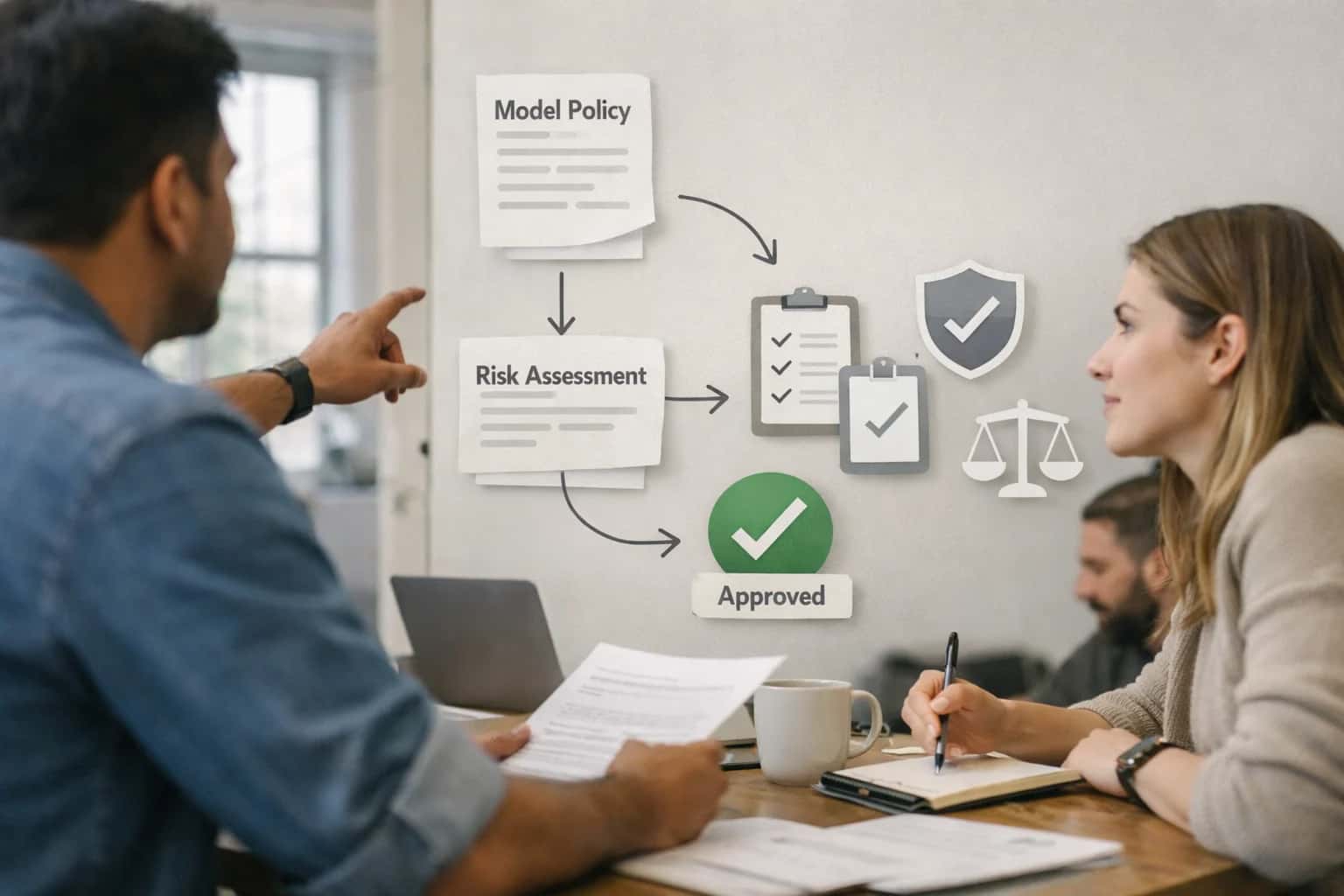
PRECISION MEDICINE AND PATIENT STRATIFICATION
Introduction
A robust data governance framework is the foundational bedrock for any clinical AI initiative, ensuring data integrity, security, and regulatory compliance throughout the model lifecycle.
A practical framework integrates governance directly into your MLOps pipelines. You will implement audit logging for all data accesses, track data lineage with tools like OpenLineage to understand provenance, and embed checks for HIPAA and GDPR compliance. This guide provides the actionable steps to build these controls, ensuring your precision medicine models are both powerful and principled. For foundational concepts, see our guide on How to Design a Secure and Compliant Data Lake for Omics Data.
TOOL CATEGORIES
Data Governance Tools Comparison
A comparison of core data governance tool categories essential for managing sensitive health data in clinical AI development, focusing on compliance, lineage, and access control.
| Core Capability | Data Lineage & Provenance | Access Policy & Audit | Unified Data Catalog |
|---|---|---|---|
Primary Function | Tracks data origin, transformations, and movement | Enforces role-based access and logs all data interactions | Central metadata repository for discovery and classification |
HIPAA/GDPR Compliance | Provides audit trail for data processing activities | Manages consent, minimum necessary access, and breach detection logs | Supports data tagging for PII/PHI identification |
Integration with MLOps | Native connectors for ML pipelines (e.g., MLflow, Kubeflow) | API-driven policy enforcement for training/inference jobs | Links model artifacts to source datasets and features |
Clinical Data Specificity | Supports healthcare standards (HL7 FHIR, DICOM) for lineage | Pre-built policies for common clinical roles (e.g., researcher, clinician) | Ontology management for medical terminologies (SNOMED CT, LOINC) |
Real-time Monitoring | Streaming lineage updates for real-time data pipelines | Real-time alerting on policy violations or anomalous access | Automated metadata extraction from new data sources |
Deployment Model | Typically agent-based or library-integrated (e.g., OpenLineage) | Cloud-native service or on-premise appliance | SaaS or self-managed open-source (e.g., Amundsen, DataHub) |
Key Tool Example | OpenLineage, Marquez, Collibra Lineage | Immuta, Privacera, Apache Ranger | Alation, Informatica EDC, AWS Glue Data Catalog |
Cost Model | Often open-source core with enterprise features | Subscription-based per user/data source | Seat-based licensing or compute/storage consumption |
Enabling Efficiency, Speed & Accuracy
Intelligent Analysis, Decision & Execution
We build AI systems for teams that need search across company data, workflow automation across tools, or AI features inside products and internal software.
Talk to Us
Search across company data
Give teams answers from docs, tickets, runbooks, and product data with sources and permissions.
Useful when people spend too long searching or get different answers from different systems.
Enterprise searchRAGPermissions
Read more
Automate internal workflows
Use AI to route work, draft outputs, trigger actions, and keep approvals and logs in place.
Useful when repetitive work moves across multiple tools and teams.
AI agentsWorkflow automationGovernance
Read more
Add AI to products and internal tools
Build assistants, guided actions, or decision support into the software your team or customers already use.
Useful when AI needs to be part of the product, not a separate tool.
AI integrationDecision supportModel routing
Read moreDATA GOVERNANCE
Common Mistakes
Avoid these critical technical and procedural errors when building a data governance framework for clinical AI. These pitfalls can compromise patient privacy, model integrity, and regulatory compliance.
The most common mistake is treating data governance as a pre-deployment audit. For clinical AI, governance must be an integrated, automated system within your MLOps pipeline. This means implementing:
- Automated policy enforcement at data ingress (e.g., scanning for PHI in free-text fields).
- Continuous audit logging for all data access and model interactions using tools like OpenTelemetry.
- Automated lineage tracking with frameworks like OpenLineage to map data from source to model prediction.
Without this automation, manual processes fail at scale, creating gaps where sensitive data can be mishandled or unaccounted for.

About the author
Prasad Kumkar
CEO & MD, Inference Systems
Prasad Kumkar is the CEO & MD of Inference Systems and writes about AI systems architecture, LLM infrastructure, model serving, evaluation, and production deployment. Over 5+ years, he has worked across computer vision models, L5 autonomous vehicle systems, and LLM research, with a focus on taking complex AI ideas into real-world engineering systems.
His work and writing cover AI systems, large language models, AI agents, multimodal systems, autonomous systems, inference optimization, RAG, evaluation, and production AI engineering.
LinkedIn
Limited slotsGet a Free AI Consultation
Partnered with leading AI, data, and software stack.





How We Work
Custom AI workflows for your Business
One-fit-all AI don't work for modern businesses. At Inferensys, we aim to understand your business & custom requirements; which we use to define most efficient agentic workflows, the data, and the tools for your business.
01
Review the use case
We understand the task, the users, and where AI can actually help.
Read more02
Pick the right approach
We define what needs search, automation, or product integration.
Read more03
Build the first useful version
We implement the part that proves the value first.
Read more04
Improve from there
We add the checks and visibility needed to keep it useful.
Read moreThe first call is a practical review of your use case and the right next step.
Talk to Us