
Automations
Agentic Underwriting Orchestration
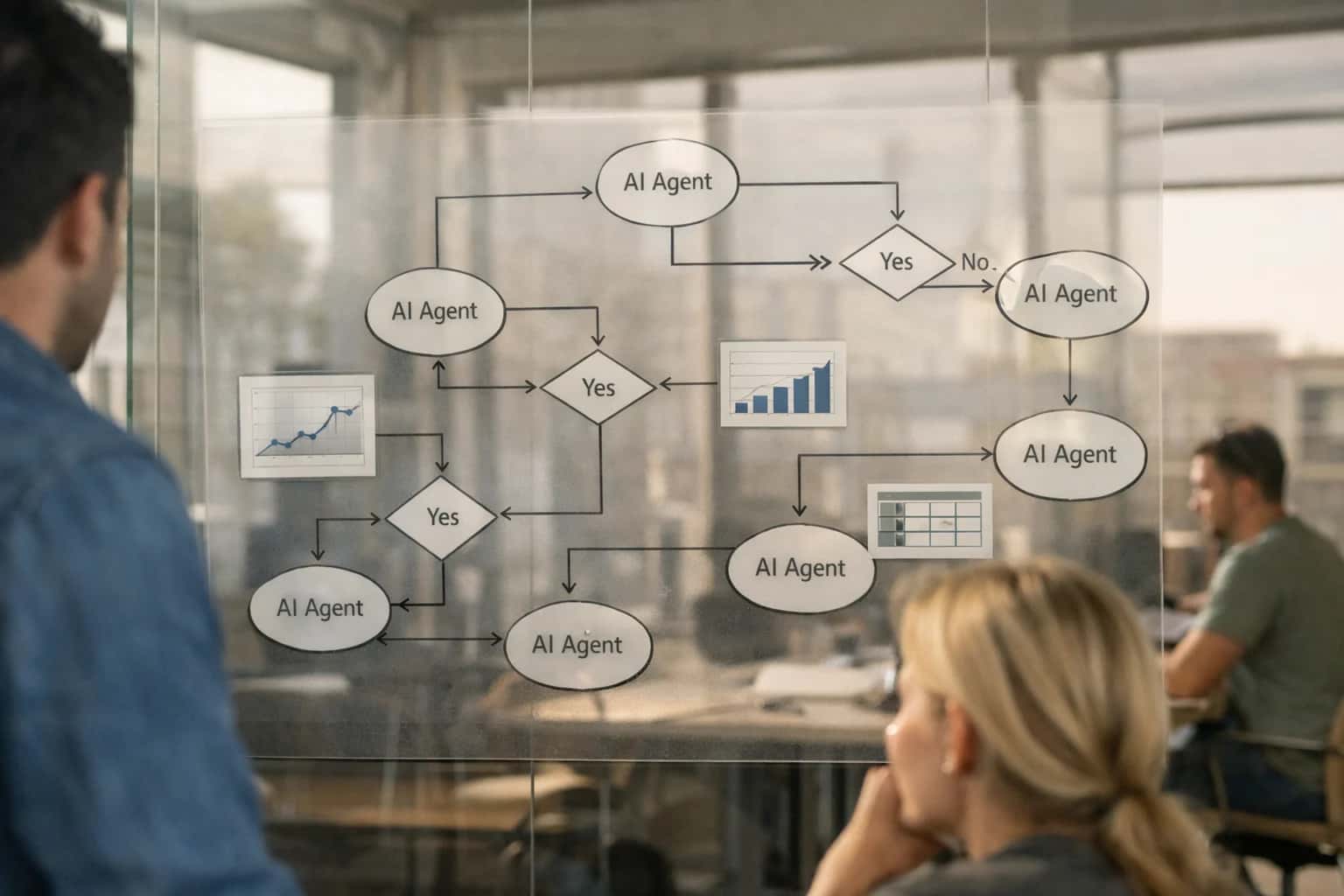
Agentic Underwriting Orchestration
This pillar focuses on custom underwriting workflows that ingest medical records, property data, broker submissions, and historical loss signals to evaluate and bind policies with minimal manual intervention. Content under this pillar should show insurers what a production-grade underwriting architecture looks like across policy systems, document AI, rules engines, and human escalation layers, while tying the build to cycle-time reduction, higher quote throughput, and better underwriting economics.
AI Automation Workflow for Agentic Underwriting Orchestration
This foundational page details the architecture for a custom, end-to-end underwriting workflow that orchestrates document ingestion, risk scoring, guideline validation, and policy binding with minimal human intervention. It explains how to connect specialized agents for data extraction, decision logic, and system integration to reduce cycle times from weeks to hours, directly improving underwriter throughput and quote-to-bind ratios for commercial and specialty lines.
Automation Workflow for Broker Submission Triage and Data Extraction
This page outlines a custom workflow that automatically ingests and classifies incoming broker submissions, extracts structured data from unstructured PDFs and emails, and routes them to the appropriate underwriting queue. It covers the multi-agent architecture for document decomposition, validation against submission checklists, and integration with CRM or PAS systems to eliminate manual data entry and accelerate initial triage by over 70%.
AI Agentic Workflow for Medical Record Ingestion and Summary
This page explains a custom workflow for life and health insurers where agents ingest complex medical records, parse physician notes and lab results, and generate concise risk summaries for underwriters. It details the architecture for handling HIPAA-compliant data, using LLMs for clinical concept extraction, and presenting findings in a structured format, cutting medical underwriting review time from hours to minutes per case.
Multi-Agent Based Automation of Property Risk Scoring
This page describes a custom workflow where coordinated agents pull data from inspection reports, satellite imagery, geospatial models, and third-party vendors to automatically generate a composite property risk score. It covers the integration logic, confidence scoring, and exception routing needed to replace manual assessment, enabling faster and more consistent underwriting for commercial property and homeowners' lines.
Automated Initial Quote Generation and Eligibility Screening
This page details a workflow where an agentic system performs real-time eligibility checks against underwriting guidelines and generates a preliminary quote immediately upon submission. It explains the architecture for integrating rules engines, rating logic, and external data APIs to provide instant indications, improving broker experience and capturing more qualified submissions before competitors.
AI Workflow for Third-Party Data Verification (MVRs, CLUE, etc.)
This page outlines a custom automation workflow that orchestrates API calls to multiple external data vendors (e.g., for motor vehicle records, claims history, credit) to verify application information and flag discrepancies. It covers the agent logic for parallel data fetching, result reconciliation, and alert generation, reducing the manual follow-up work required for personal and commercial lines underwriting.
Agentic Workflow for Human-in-the-Loop Escalation and Exception Handling
This page focuses on the critical control layer of an automated underwriting system: designing workflows that intelligently detect edge cases, ambiguous data, or high-risk signals and route them to human underwriters with full context. It explains the decision logic, queue management, and feedback loops required to maintain auditability and underwriting quality while maximizing straight-through processing.
Automation Workflow for Post-Bind Audit Trail and Compliance Logging
This page details a workflow that automatically captures every data point, decision rationale, and external query used during an automated underwriting process to create a defensible, searchable audit trail. It explains the architecture for immutable logging, integration with document management systems, and report generation for internal audits and regulatory examinations, ensuring governance in high-volume automated environments.
AI Workflow for Renewal Underwriting and Pre-Fill
This page describes a custom workflow that proactively analyzes expiring policies, pulls updated loss runs and exposure data, and pre-fills renewal applications with recommended terms. It covers the agentic logic for change detection, profitability analysis, and generating underwriter-ready packets, significantly reducing renewal handling time and improving retention rates.
Automation Workflow for Commercial Auto Fleet Underwriting
This page outlines a specialized workflow for fleet underwriting, where agents ingest vehicle lists, driver records, telematics data, and loss history to assess aggregate risk and generate tiered pricing. It details the architecture for handling large, heterogeneous datasets and integrating with fleet management systems to move from spreadsheet-based analysis to automated, dynamic risk evaluation.
AI Workflow for Workers' Compensation Risk Assessment
This page explains a custom workflow that automates the evaluation of workers' comp applications by analyzing payroll classifications, OSHA history, safety program documentation, and prior claims. It details the multi-agent system for extracting risk factors from manuals and contracts, scoring employer safety culture, and generating experience mod adjustments, enabling more accurate and consistent pricing.
Agentic Workflow for Cyber Insurance Risk Scoring
This page details a workflow where agents interact with an applicant's IT systems (via API or questionnaire), analyze external attack surface data, and score cybersecurity posture in real time. It covers the architecture for integrating security scanning tools, interpreting results against underwriting frameworks, and generating tailored coverage recommendations and pricing for a rapidly evolving risk class.
AI Workflow for Professional Liability (E&O) Application Analysis
This page outlines a custom workflow for parsing complex professional liability applications, where agents extract details on services, contracts, limits of liability, and prior claims from lengthy narrative responses. It explains the NLP and reasoning logic needed to assess firm-specific exposures, benchmark against industry standards, and flag high-risk clauses for underwriter review.
Automation Workflow for High-Net-Worth Personal Lines Underwriting
This page describes a workflow tailored for valuable homes, collections, and liability risks, where agents consolidate data from appraisals, security system reports, and client profiles. It details the architecture for valuing unique assets, assessing lifestyle risks, and coordinating with specialty carriers to streamline the placement process for affluent clients.
Multi-Agent Based Automation of Reinsurance Placement Support
This page explains an internal workflow where agents assist primary underwriters by analyzing large risks, preparing cession summaries, and identifying optimal reinsurance markets based on current treaties and capacity. It covers the system integration and logic needed to automate bordereau creation and submission, reducing the administrative burden on underwriting teams for facultative and treaty placements.
AI Workflow for Unstructured Submission Packet Decomposition
This page dives deep into a foundational data-ingestion workflow where a multi-agent system breaks down complex, multi-document submission packets (e.g., Acord forms, financials, contracts) into structured, related data points. It details the use of layout-aware OCR, LLM classification, and entity linking to transform broker-provided PDFs into a normalized risk profile, eliminating the most tedious step in underwriting.
Automation Workflow for Financial Statement Analysis and Ratio Calculation
This page outlines a workflow for commercial lines where agents extract income statements and balance sheets from PDFs, calculate key financial ratios (e.g., debt-to-equity, current ratio), and benchmark them against industry norms. It explains the validation logic, trend analysis, and integration with financial risk models to provide underwriters with an instant financial health assessment.
Multi-Agent Based Automation of Inspection Report (Drone/Satellite) Analysis
This page details a workflow where agents process imagery and narrative from third-party property inspections, using computer vision to identify roof condition, vegetation overgrowth, and proximity hazards. It covers the orchestration of vision models, geospatial data fusion, and the generation of actionable risk findings, turning raw inspection data into underwriting-ready insights for property and agribusiness.
AI Workflow for Geospatial Catastrophe Risk Modeling and Zoning
This page explains a workflow that automatically evaluates property locations against live catastrophe models for flood, wildfire, and earthquake zones. It details the integration with geospatial APIs, the logic for calculating probable maximum loss (PML), and the automatic application of corresponding underwriting guidelines or surcharges, enabling proactive portfolio risk management.
Agentic Workflow for Legal Contract Review in Underwriting (e.g., COIs, Contracts)
This page outlines a workflow where agents review certificates of insurance (COIs), hold-harmless agreements, and other contracts submitted with applications to verify compliance with underwriting requirements. It details the use of legal NLP to extract parties, dates, coverage terms, and indemnification clauses, flagging non-standard language for human review and reducing legal back-office workload.
Automation Workflow for Underwriting Queue Prioritization and Load Balancing
This page focuses on an operational efficiency workflow where agents analyze incoming submission volume, complexity, and underwriter capacity to dynamically prioritize and assign work. It explains the scoring logic, integration with workforce management tools, and real-time dashboarding that helps underwriting managers optimize throughput and reduce average handling time.
AI Workflow for Real-Time Underwriting Capacity and Workload Forecasting
This page describes a predictive workflow that analyzes submission pipelines, seasonal trends, and team velocity to forecast future underwriting workload and capacity gaps. It details the data sources, forecasting models, and alerting mechanisms that enable operations leaders to proactively adjust staffing or temporary help, avoiding bottlenecks and service-level breaches.
Agentic Workflow for Competitive Rate Benchmarking and Analysis
This page outlines a workflow where agents continuously scrape or ingest competitor rate filings and publicly available premium data to benchmark an insurer's own pricing. It explains the architecture for data normalization, trend analysis, and generating alerts when market positioning drifts, providing underwriters and actuaries with data-driven insights for portfolio strategy.
Automation Workflow for Underwriting Guideline Knowledge Base Query and Retrieval
This page details a workflow that creates a conversational interface for underwriters to query a vast corpus of internal guidelines, bulletins, and precedent files. It covers the RAG (Retrieval-Augmented Generation) architecture, access controls, and integration with the underwriting workstation, reducing time spent searching for answers and improving guideline adherence.
AI Workflow for Automated Producer (Broker) Communication and Status Updates
This page explains a workflow where agents automatically generate and send status updates, follow-up questions, and declination letters to brokers via email or portal integration. It details the personalization logic, approval gates for sensitive communications, and tracking mechanisms to improve broker experience and free underwriters from routine administrative communication.
Multi-Agent System for Internal Underwriting Referral and Consultation Routing
This page describes an internal workflow that automates the process of referring complex risks to subject matter experts (e.g., legal, engineering, actuarial). It outlines the logic for identifying referral triggers based on risk characteristics, routing cases to the appropriate internal queue with full context, and tracking resolution to ensure no referral falls through the cracks.
Automation Workflow for Portfolio Concentration Risk Alerts
This page details a workflow that continuously monitors the underwriting portfolio for emerging concentrations of risk by geography, industry, or peril. It explains the integration with policy administration systems, the logic for setting and triggering alert thresholds, and the generation of management reports, enabling proactive risk mitigation before a catastrophic event.
AI Agentic Workflow for Interactive, Real-Time Quote Negotiation Support
This page outlines a broker-facing workflow where an AI co-pilot assists underwriters during live negotiations by simulating alternative terms, calculating the impact on loss ratios, and retrieving comparable bound policies. It details the real-time analytics, conversational interface, and guardrails needed to provide dynamic support without ceding underwriting authority.
Automation Workflow for Personalized Policy Endorsement and Rider Recommendations
This page describes a workflow that analyzes a bound policy and the insured's profile to automatically identify and recommend relevant endorsements or additional coverages. It covers the logic for cross-referencing exposure data with product catalogs, generating personalized proposals, and streamlining the upsell process at renewal or mid-term.
Multi-Agent Based Automation of Broker Portal Integration and Data Sync
This page explains a technical workflow where agents facilitate seamless data exchange between an insurer's underwriting engines and multiple broker portal platforms. It details the API orchestration, data mapping, and synchronization logic required to receive clean submissions and send back quotes without manual re-keying, a critical integration for digital distribution.
AI Workflow for Explanation of Underwriting Decisions (Explainable AI)
This page focuses on a compliance and trust-building workflow where agents automatically generate plain-language explanations for underwriting decisions, whether an approval, modification, or declination. It details the architecture for tracing decision logic through multiple models and rules, assembling a coherent rationale, and presenting it to brokers and insureds to reduce disputes and support fair lending practices.
Automation Workflow for OFAC Sanctions and AML Screening During Underwriting
This page outlines a compliance workflow that integrates real-time sanctions list screening and anti-money laundering checks directly into the underwriting process flow. It explains the agentic orchestration of screening APIs, handling of potential matches, and the secure routing of flagged cases to a compliance officer, embedding regulatory checks into the operational workflow.
AI Workflow for State-Specific Regulatory Compliance Checking (50-State)
This page details a workflow for multi-state insurers where agents automatically verify that policy forms, rates, and underwriting rules comply with the specific regulations of the insured's location. It covers the integration with a regulatory knowledge base, the logic for applying jurisdictional rules, and flagging mismatches before binding, reducing compliance risk and potential fines.
Agentic Workflow for Fair Lending and Anti-Bias Testing in Risk Models
This page explains a governance workflow where agents conduct ongoing, automated testing of underwriting and pricing models for potential disparate impact or bias. It details the statistical testing logic, integration with model risk management (MRM) frameworks, and the generation of audit-ready reports, helping insurers proactively meet regulatory expectations around algorithmic fairness.
Automation Workflow for Model Risk Management (MRM) and Validation Support
This page describes an operational workflow that automates key aspects of model risk management for underwriting AI, including tracking model versions, monitoring performance drift, and assembling validation packets. It explains the architecture for logging model inputs/outputs, integrating with validation tools, and streamlining the evidence collection process for internal and external model auditors.
AI Agentic Workflow for Predictive Loss Ratio Modeling at Submission
This page outlines an advanced analytics workflow where agents use predictive models to estimate the future loss ratio of a submission based on its risk characteristics and broader portfolio context. It details the integration of submission data with historical loss trends, the explanation of model predictions, and how this insight can be used to triage risks or adjust terms at the point of underwriting.
Automation Workflow for Anomaly Detection in Submission Patterns
This page details a workflow that uses machine learning to monitor incoming submission streams for anomalous patterns that could indicate fraud, data errors, or emerging systemic risks. It explains the architecture for real-time feature analysis, alert generation, and case routing to special investigation units, allowing underwriters to focus on genuine risks.
AI Workflow for Parametric Insurance Trigger Evaluation
This page explains a specialized workflow for parametric or index-based insurance, where agents ingest real-time data feeds (e.g., weather stations, seismic sensors) to automatically evaluate if a policy trigger has been met. It covers the architecture for data verification, calculation of payout amounts, and initiation of the claims process, enabling instant binding and settlement for this growing product category.
Agentic Workflow for Fine Art and Collectibles Appraisal & Underwriting
This page outlines a niche workflow for valuable articles underwriting, where agents coordinate the collection of appraisal documents, provenance records, and storage condition reports. It details the logic for validating authenticity sources, assessing market value trends, and generating customized coverage terms, automating a process traditionally reliant on specialist knowledge and manual review.
Automation Workflow for Clinical Trial Liability Insurance Underwriting
This page describes a complex workflow for the life sciences sector, where agents analyze clinical trial protocols, investigator backgrounds, and patient safety plans to assess liability risk. It explains the multi-agent system for extracting key risk variables from lengthy regulatory documents and generating structured underwriting memos, accelerating placement for time-sensitive trials.
AI Workflow for Core Policy Administration System (PAS) Integration
This page focuses on a critical technical workflow: the bi-directional integration between an agentic underwriting orchestration layer and legacy policy administration systems like Guidewire or Duck Creek. It details the patterns for data mapping, transaction orchestration, and error handling required to bind policies and endorse them automatically without manual downstream processing.
Automation Workflow for Legacy Mainframe and System of Record Synchronization
This page addresses the challenge of integrating modern AI workflows with legacy mainframe systems common in large insurers. It outlines the architecture for using robotic process automation (RPA) and API wrappers to enable agents to read from and write to green-screen systems, ensuring the system of record is updated without a costly core replacement.
Agentic Workflow for Claims System Pre-Notification and Risk Flagging
This page details a proactive workflow where, upon binding a high-risk policy, the underwriting system automatically creates a pre-notification or risk flag in the claims management system. It explains the logic for determining which risks warrant flagging, the data payload transferred, and how this prepares claims adjusters for potential complex losses, improving inter-departmental handoffs.
Automation Workflow for Document Management System (DMS) Tagging and Archiving
This page explains an operational workflow where agents automatically classify, tag, and file all documents generated during the underwriting process (submissions, quotes, binders) into the enterprise DMS (e.g., SharePoint, OnBase). It covers the metadata extraction logic, compliance with records retention policies, and creation of a searchable audit trail, eliminating manual filing and improving records management.
Partnered with leading AI, data, and software stack.





How We Work
Custom AI workflows for your Business
One-fit-all AI don't work for modern businesses. At Inferensys, we aim to understand your business & custom requirements; which we use to define most efficient agentic workflows, the data, and the tools for your business.
01
Review the use case
We understand the task, the users, and where AI can actually help.
Read more02
Pick the right approach
We define what needs search, automation, or product integration.
Read more03
Build the first useful version
We implement the part that proves the value first.
Read more04
Improve from there
We add the checks and visibility needed to keep it useful.
Read moreThe first call is a practical review of your use case and the right next step.
Talk to Us