
Comparisons
Small Language Models (SLMs) vs. Foundation Models
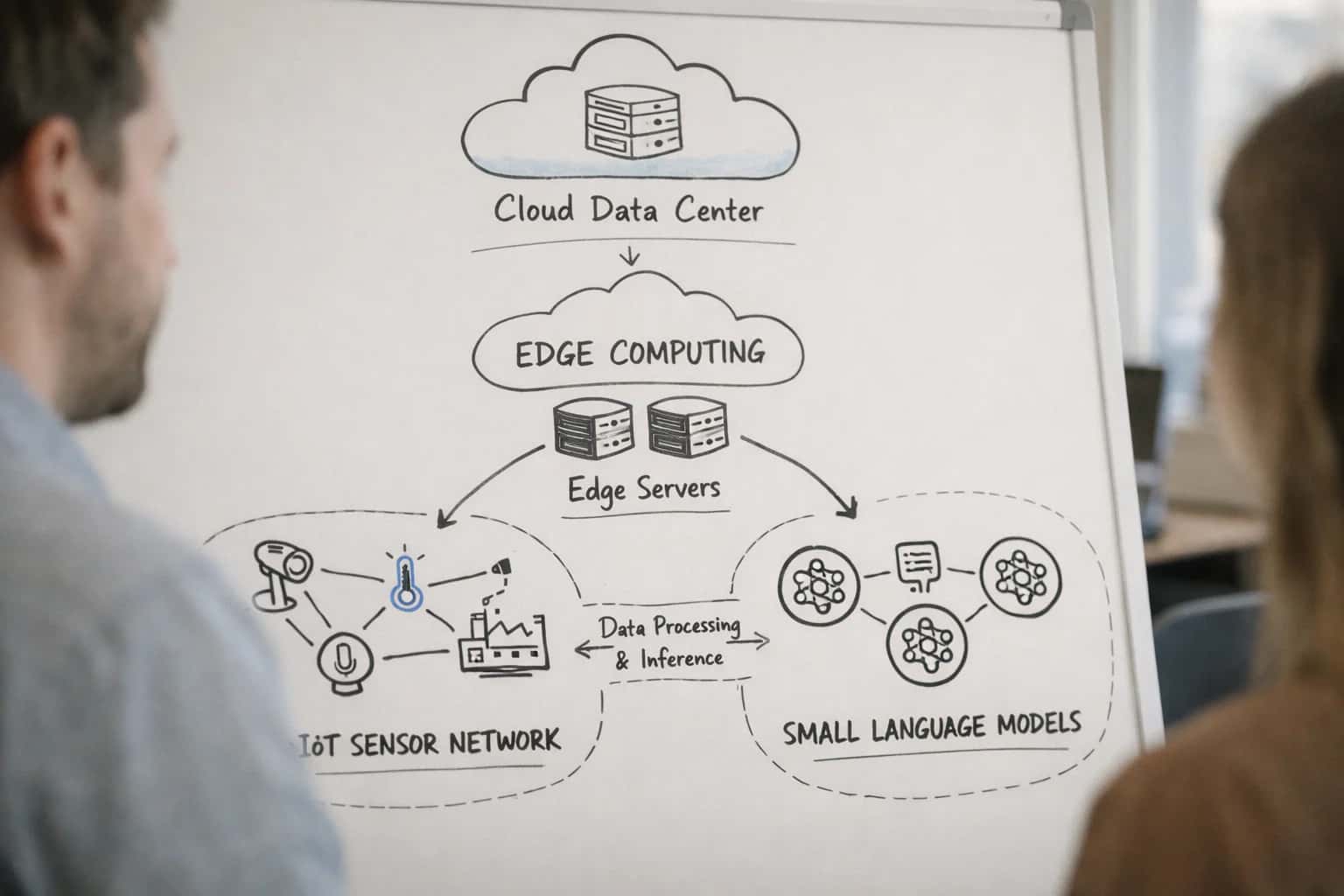
Small Language Models (SLMs) vs. Foundation Models
The shift toward domain-specific AI has made SLMs a preferred choice for routine requests to manage cost and latency. This pillar compares the deployment of small, task-specific models (like Phi-4 or Llama-mini) against larger 'frontier' models. Comparisons focus on 'inference placement,' 'quantization' methods, and 'edge deployment' trade-offs for smart routing architectures.
Phi-4 vs GPT-4
Direct comparison of Microsoft's efficient 14B-parameter SLM against OpenAI's frontier model, focusing on cost-per-token, latency for edge deployment, and reasoning capability trade-offs for smart routing architectures in 2026.
Llama-mini vs Llama 3
Evaluating Meta's smallest Llama variant against its flagship 70B+ parameter model for on-device applications, covering quantization support, fine-tuning efficiency, and the accuracy vs. size trade-off for enterprise RAG pipelines.
Gemma 2B vs Gemini Ultra
Comparing Google's lightweight, open Gemma model against its largest multimodal foundation model, analyzing inference placement strategies, API cost differentials, and suitability for high-volume vs. high-complexity tasks in 2026.
Qwen2.5-Coder-7B vs Claude 3.5 Sonnet
Benchmarking Alibaba's specialized coding SLM against Anthropic's generalist reasoning model for software development, focusing on SWE-bench scores, context window efficiency, and per-request cost for CI/CD integration.
CodeLlama-7B vs CodeLlama-70B
Analyzing Meta's code-specific models at different scales to determine the optimal size for local development environments versus cloud-based batch code generation, including throughput and fine-tuning resource requirements.
Whisper-tiny vs Whisper-large-v3
Comparing OpenAI's speech recognition models for real-time transcription on edge devices versus high-accuracy batch processing, evaluating WER (Word Error Rate), latency, and memory footprint for different deployment scenarios.
DistilBERT vs BERT Large
Classic comparison of Hugging Face's distilled model against the original transformer, focusing on embedding quality for semantic search, inference speedup, and the trade-off in downstream task performance for production NLP systems.
T5-small vs T5-XXL
Evaluating Google's Text-to-Text Transfer Transformer family across the size spectrum for task-specific fine-tuning, comparing training data efficiency, prompt engineering responsiveness, and operational costs for text generation and summarization.
Falcon-7B vs Falcon-180B
Benchmarking the TII's open-source models to illustrate the dramatic trade-offs between a deployable mid-size model and a state-of-the-art large model in terms of hardware requirements, licensing, and reasoning depth for enterprise use.
Phi-3-Vision vs Gemini 1.5 Pro Vision
Comparing Microsoft's compact multimodal SLM against Google's large-context vision-language model for document understanding and visual QA, focusing on token efficiency for long images, accuracy on chart parsing, and cloud vs. local hosting costs.
Wav2Vec 2.0 Base vs Wav2Vec 2.0 Large
Analyzing Facebook AI's self-supervised speech models for on-device versus server-side ASR, measuring accuracy on noisy data, fine-tuning data requirements, and the impact of model size on real-time transcription latency.
MobileNetV2 vs Vision Transformer (ViT-L)
Contrasting efficient CNN architectures designed for mobile deployment against large-scale transformer models for computer vision, evaluating accuracy on ImageNet, inference speed on edge TPUs, and suitability for real-time video analysis.
TinyLlama vs Mistral Large
Comparing a 1.1B parameter chat-optimized SLM against a leading 7B+ parameter model from Mistral AI, focusing on conversational quality, tool-calling capability, and the decision point for cost-sensitive chatbot deployment versus advanced agentic workflows.
DeepSeek-Coder-1.3B vs DeepSeek-Coder-33B
Evaluating DeepSeek's coding models to determine the optimal parameter count for integrated development environment (IDE) plugins versus dedicated code review agents, based on benchmark performance, memory usage, and licensing.
Partnered with leading AI, data, and software stack.





How We Work
Custom AI workflows for your Business
One-fit-all AI don't work for modern businesses. At Inferensys, we aim to understand your business & custom requirements; which we use to define most efficient agentic workflows, the data, and the tools for your business.
01
Review the use case
We understand the task, the users, and where AI can actually help.
Read more02
Pick the right approach
We define what needs search, automation, or product integration.
Read more03
Build the first useful version
We implement the part that proves the value first.
Read more04
Improve from there
We add the checks and visibility needed to keep it useful.
Read moreThe first call is a practical review of your use case and the right next step.
Talk to Us