The reality gap breaks models. AI trained in pristine simulations fails on real construction sites due to sensor noise, material variance, and unpredictable human activity, creating a multi-billion dollar deployment bottleneck.

Blog
The Future of Autonomous Construction Is a Simulation-First Strategy
The chaotic, unstructured reality of a construction site is the ultimate test for AI. This article argues that a simulation-first strategy, using physically accurate digital twins, is the only viable path to scalable, safe, and cost-effective autonomous construction.
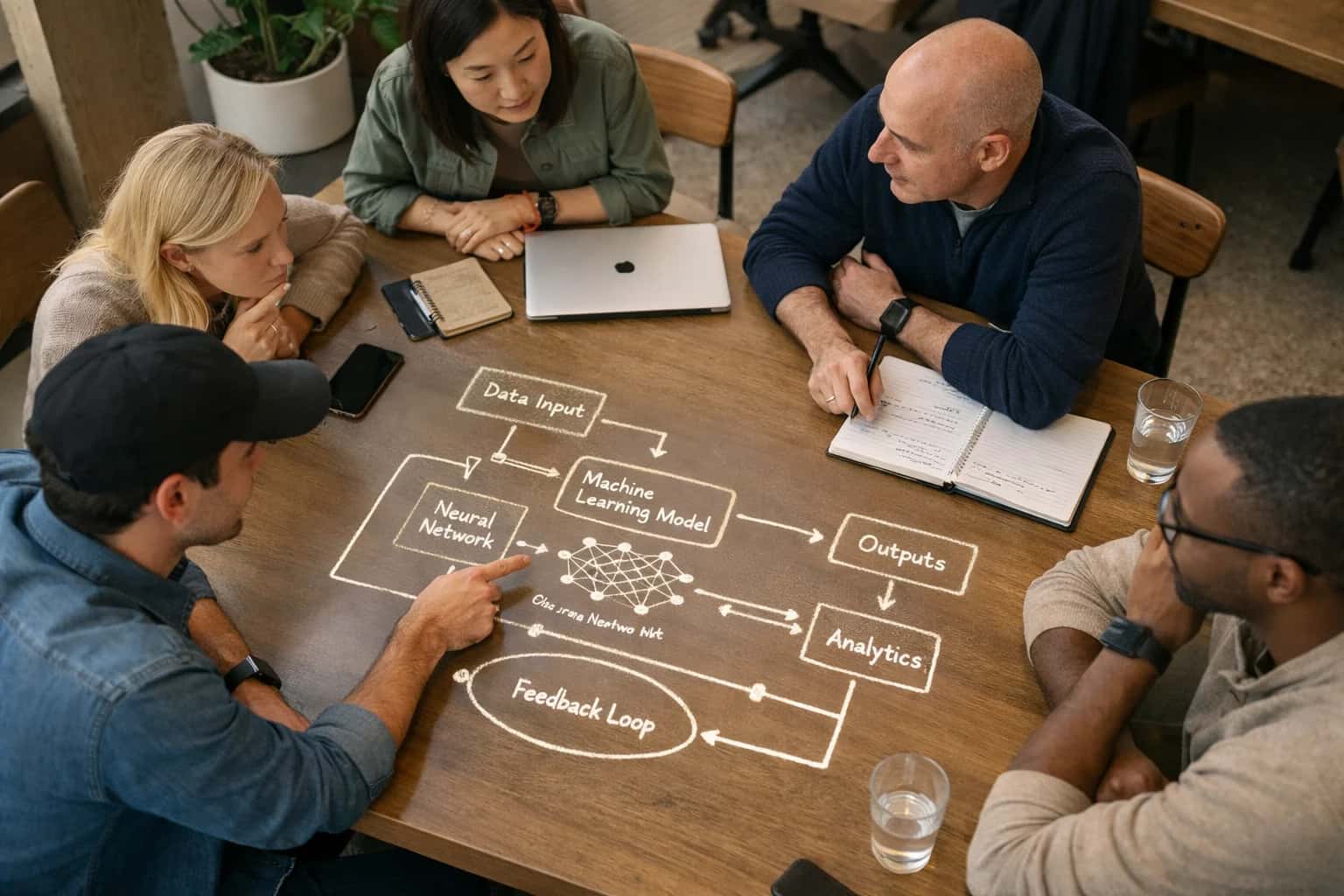
THE SIMULATION IMPERATIVE
The Billion-Dollar Reality Gap in Construction AI
The only viable path to training robust AI for chaotic construction sites is through physically accurate digital twins, not real-world trial and error.
Simulation is the only scalable training ground. Physically accurate platforms like NVIDIA Omniverse, built on OpenUSD, generate the millions of labeled data points needed for robust perception and control models, a scale impossible with manual site data collection.
Real-world deployment is for validation, not training. The strategy is 'sim-to-real,' where models master tasks in a digital twin before a single controlled field test, drastically reducing the cost and danger of on-site machine learning.
Evidence: Research shows that models pre-trained in high-fidelity simulation environments require up to 90% fewer real-world examples to achieve operational performance, turning years of data collection into months of synthetic generation.
THE DATA FOUNDATION IMPERATIVE
Three Trends Forcing the Simulation-First Shift
The chaotic, high-stakes reality of construction sites makes real-world AI training impossible. These three converging trends make simulation the only viable path to autonomy.
01
The Unstructured World Problem
Real-world environments like construction sites are geometrically and semantically chaotic. Collecting and labeling the terabytes of multi-modal sensor data needed for robust perception is economically and logistically impossible.\n- Data Collection Bottleneck: Manual labeling of LiDAR, camera, and radar feeds for a single task can cost >$1M and take 6-12 months.\n- Edge Case Proliferation: Weather, lighting, and dynamic obstacles create infinite permutations that break brittle, real-data-trained models.
>1M
Labeling Cost
6-12mo
Time Delay
02
The Reality Gap
The discrepancy between synthetic training data and real sensor inputs causes catastrophic sim-to-real transfer failure. Models trained in pristine virtual environments fail upon deployment due to sensor noise and unmodeled physics.\n- Sensor Domain Randomization: Closing the gap requires injecting realistic noise, blur, and calibration errors into synthetic data streams.\n- Physics-Accurate Rendering: Tools like NVIDIA Omniverse and OpenUSD are critical for generating physically plausible interactions and material properties.
~90%
Performance Drop
10x
Iterations Needed
03
The Cost of Real-World Failure
Trial-and-error learning with multi-ton machinery is prohibitively expensive and dangerous. A single mistake can cause millions in damage and critical project delays, making reinforcement learning in the physical world a non-starter.\n- Zero-Risk Exploration: Simulation allows for billions of training episodes in parallel, exploring failure modes safely.\n- Scenario Stress-Testing: Models can be validated against rare but catastrophic events—like structural collapse or hydraulic failure—before ever touching a jobsite.
$10M+
Risk Mitigated
100%
Safe Training
CONSTRUCTION AI STRATEGY
Real-World vs. Simulation-First: A Cost-Benefit Breakdown
A quantitative comparison of two foundational approaches for developing autonomous construction systems, highlighting why a simulation-first strategy is critical for overcoming the Data Foundation Problem.
| Feature / Metric | Real-World Trial-and-Error | Simulation-First (NVIDIA Omniverse) |
|---|---|---|
Time to 1M Training Scenarios |
| < 72 hours |
Cost per Scenario (Avg.) | $500 - $5,000 | $0.10 - $2.00 |
Scenario Diversity & Edge Cases | Limited by site access & safety | Infinite, procedurally generated |
Sensor Failure & Noise Injection | Uncontrolled, sporadic | Programmatically controlled (LiDAR dropout, camera glare) |
Model Iteration Cycle (Train-Test) | Weeks to months | Minutes to hours |
Safety-Critical Failure Testing | Prohibitively dangerous & expensive | Zero-risk, exhaustive stress testing |
Sim-to-Real Transfer Fidelity | N/A (no simulation) |
|
Required Data Labeling Effort | Manual, exorbitant cost for LiDAR & video | Automatic, pixel-perfect ground truth |
THE ARCHITECTURE
Building the Simulation-First Stack: From Omniverse to the Edge
A simulation-first strategy for autonomous construction requires a specialized software and hardware stack that bridges high-fidelity digital twins with real-time edge deployment.
The simulation-first strategy is the only viable path to train AI for chaotic construction sites because real-world trial-and-error is too costly and dangerous. Physically accurate digital twins in platforms like NVIDIA Omniverse provide a safe, scalable training ground where AI can master complex tasks like excavation or crane operation millions of times before a single physical machine moves. This directly addresses the core challenge of the Data Foundation Problem.
Omniverse is the core simulator, but it is not the entire stack. The stack begins with synthetic data generation using frameworks like NVIDIA Isaac Sim, which creates labeled training data for perception models at a scale impossible with manual collection. This data trains models for tasks like material classification and obstacle detection, which are then optimized for deployment.
The critical bridge is simulation-to-reality (Sim2Real) transfer. Models trained in pristine simulation environments often fail when faced with real-world sensor noise and unpredictable conditions. Techniques like domain randomization—randomizing textures, lighting, and physics parameters in simulation—are essential to build robustness and close this 'reality gap' before deployment.
Deployment happens at the edge on specialized hardware like the NVIDIA Jetson AGX Orin or the upcoming Jetson Thor. These systems run the optimized AI models for real-time perception and control, ensuring low-latency decisioning without reliance on unreliable cloud connectivity. This validates the principle that The Future of Embodied Intelligence Is Not in the Cloud.
The final layer is the body-brain API. A unified software interface, such as NVIDIA Isaac ROS, is required to seamlessly connect the AI 'brain' (the perception and planning models) to the 'body' (the actuators, grippers, and sensors of the physical machine). This abstraction is critical for integrating diverse robotic components and enabling over-the-air updates to the AI stack.
PHYSICAL AI REALITY CHECK
Where Simulation-First Strategies Fail (And How to Fix Them)
Digital twins are essential, but a naive simulation-first approach will break upon contact with the real world. Here are the critical failure modes and engineering fixes.
01
The Reality Gap Breaks Your Models
Pristine synthetic data from tools like NVIDIA Omniverse fails to capture sensor noise, material variance, and unpredictable human activity. This gap causes catastrophic sim-to-real transfer failure.
- Fix: Implement domain randomization during training, injecting noise, lighting changes, and texture swaps into the simulation.
- Deploy a shadow mode system where the real robot runs the simulation-trained model in parallel with a legacy controller, collecting failure data to retrain.
~70%
Accuracy Drop
10x
Data Needed
02
Black-Box Controllers Are a Legal Liability
Neural network motion planners are inscrutable. When a 20-ton excavator makes an unexpected move, you cannot explain why. This violates emerging operational safety standards and creates unacceptable product liability risk.
- Fix: Architect for explainable AI (XAI). Use physics-informed neural networks (PINNs) as a verifiable prior or implement causal tracing in the planning stack.
- Integrate a robust Agent Control Plane to log decision rationale and enable human-in-the-loop overrides, a core component of AI TRiSM.
$10M+
Liability Exposure
0%
Audit Trail
03
Static Sims Can't Handle Dynamic Sites
Construction and factory floors are fluid. A digital twin built on a static blueprint is obsolete the moment a pallet is moved or a trench is dug. Your AI has no context for these changes.
- Fix: Build a continual learning pipeline. Fuse real-time LiDAR and camera feeds to update the twin, creating a living digital model.
- Employ multi-agent systems (MAS) where perception agents continuously map changes and planning agents dynamically replan robot trajectories, a strategy explored in our piece on multi-agent robotic systems.
-40%
Uptime Loss
~500ms
Replan Latency
04
The Compute Bottleneck Stalls Deployment
High-fidelity physics simulation is computationally prohibitive for iterating on thousands of training scenarios. This slows development to a crawl and makes real-time simulation for predictive maintenance or digital twin visualization impractical.
- Fix: Adopt a hybrid cloud architecture. Use cloud bursts for massive parallel training runs, but keep the lightweight inference model and critical sensor fusion logic on edge AI processors like NVIDIA Jetson for deployment.
- Optimize for Inference Economics by using model distillation to create smaller, faster models from the large cloud-trained teacher.
$100k+
Cloud Cost
>1s
Step Time
05
Overfitting to Simulation Creates Fragile Intelligence
Models that excel in a closed, perfect simulation environment develop brittle strategies that fail under real-world entropy. They lack the generalization required for the unstructured world.
- Fix: Mandate self-supervised learning on real sensor data. Use contrastive learning on unlabeled LiDAR point clouds or camera images to build robust foundational representations.
- Augment sim data with synthetic data generation techniques that mimic rare but critical edge cases (e.g., sensor occlusion, extreme weather).
95%
Sim Accuracy
<50%
Real-World Robustness
06
Ignoring the Data Foundation Sinks the Strategy
A simulation-first strategy assumes you can generate all necessary data synthetically. This is false for learning material-aware AI or actuator intelligence, which require real-world force, vibration, and thermal data.
- Fix: Solve the Data Foundation Problem first. Instrument your physical prototypes with a dense sensor suite to collect machine motion trajectory and soil interaction data.
- Use this real data to calibrate and validate your simulation parameters, closing the loop and creating a virtuous cycle of improvement, as detailed in our analysis of the data foundation problem.
$2M+
Prototype Cost
12+ months
Project Delay
THE SIMULATION
The Next Frontier: Multi-Agent Systems in Synthetic Sites
Multi-agent systems trained in physically accurate digital twins are the only viable path to mastering the chaotic, high-stakes environment of a construction site.
Multi-agent systems (MAS) are the core architecture for autonomous construction because a single AI cannot manage the concurrent, interdependent tasks of earthmoving, logistics, and safety monitoring. These systems require a simulation-first strategy to train safely and at scale.
Training in synthetic sites built on platforms like NVIDIA Omniverse is non-negotiable. Real-world trial-and-error is prohibitively expensive and dangerous. A digital twin provides an infinite, risk-free training ground where agents can learn complex physical interactions, from soil compaction to crane load dynamics.
The reality gap between simulation and the physical world remains the primary technical hurdle. Bridging it demands domain randomization—varying material properties, lighting, and weather in the synthetic environment—and sensor fusion models that process noisy LiDAR and radar data as reliably as perfect synthetic camera feeds.
Evidence: Research from NVIDIA and Boston Dynamics shows that simulation-to-reality (Sim2Real) transfer can reduce real-world training data requirements by over 80% for robotic manipulation tasks, making large-scale multi-agent coordination economically feasible. For a deeper dive into the foundational challenges of this approach, see our analysis on why simulation-to-reality transfer is the biggest bottleneck in Physical AI.
This simulation layer becomes the Agent Control Plane, governing permissions, hand-offs, and conflict resolution between specialized agents (e.g., an excavator agent and a dump truck agent). This orchestration is the subject of our pillar on Agentic AI and Autonomous Workflow Orchestration.
THE DIGITAL TWIN ADVANTAGE
Key Takeaways: The Simulation-First Imperative
Physically accurate digital twins in NVIDIA Omniverse are the only viable training ground for AI to master chaotic, high-stakes construction tasks.
01
The Problem: The Reality Gap
The chasm between pristine synthetic data and messy, real-world sensor inputs breaks most machine learning models upon deployment. Simulation-to-reality transfer is the primary bottleneck.
- ~90% failure rate for models trained purely on synthetic data without domain adaptation.
- Real-world trial-and-error is prohibitively expensive and dangerous for heavy equipment.
- This gap creates an insurmountable data collection and labeling bottleneck, as detailed in our analysis of the Data Foundation Problem.
~90%
Failure Rate
10x
Cost Multiplier
02
The Solution: Physically Accurate Digital Twins
NVIDIA Omniverse, built on OpenUSD, provides a deterministic, physics-based simulation environment. It's the only viable training ground for embodied AI.
- Enables billions of safe, accelerated training cycles for reinforcement learning agents.
- Provides a closed-loop testing suite for perception, planning, and control stacks before a single physical machine moves.
- This approach is foundational for solving the perception-action loop in industrial environments.
1000x
Training Speed
-100%
Real-World Risk
03
The Imperative: Material-Aware AI
Construction autonomy requires models that understand soil dynamics, concrete curing, and structural load, not just geometric path planning. Simulation is the only way to encode this physics.
- Predictive models for excavator bucket fill and soil compaction reduce rework by >30%.
- Enables AI-driven grippers that sense material compliance and slip for handling infinite part variations.
- This moves beyond simple automation to true context-aware intelligence, a core tenet of Physical AI and Embodied Intelligence.
>30%
Rework Reduced
24/7
Training Uptime
04
The Architecture: The Simulation-to-Edge Pipeline
A robust deployment pipeline moves validated models from Omniverse to edge processors like NVIDIA Jetson Thor, creating a continuous learning flywheel.
- On-device learning allows for continual adaptation to tool wear and site-specific conditions without cloud latency.
- The pipeline enforces explainable motion planning, providing causal reasoning for every AI-generated trajectory for safety audits.
- This architecture is critical for building hybrid human-AI systems governed by a robust control plane.
<100ms
Inference Latency
Zero-Touch
OTA Updates
Enabling Efficiency, Speed & Accuracy
Intelligent Analysis, Decision & Execution
We build AI systems for teams that need search across company data, workflow automation across tools, or AI features inside products and internal software.
Talk to Us
Search across company data
Give teams answers from docs, tickets, runbooks, and product data with sources and permissions.
Useful when people spend too long searching or get different answers from different systems.
Enterprise searchRAGPermissions
Read more
Automate internal workflows
Use AI to route work, draft outputs, trigger actions, and keep approvals and logs in place.
Useful when repetitive work moves across multiple tools and teams.
AI agentsWorkflow automationGovernance
Read more
Add AI to products and internal tools
Build assistants, guided actions, or decision support into the software your team or customers already use.
Useful when AI needs to be part of the product, not a separate tool.
AI integrationDecision supportModel routing
Read moreTHE PARADIGM SHIFT
Stop Piloting, Start Simulating
The future of autonomous construction is a simulation-first strategy, where physically accurate digital twins replace costly, dangerous real-world piloting.
Simulation is the only viable training ground for AI to master chaotic, high-stakes construction tasks. Real-world piloting is too slow, dangerous, and expensive to generate the scale of failure data needed for robust machine learning. Platforms like NVIDIA Omniverse create physically accurate digital twins where AI agents can experience millions of hours of operational scenarios, from soil interaction to collision avoidance, in compressed time.
The simulation-to-reality transfer gap is the primary bottleneck that breaks most models upon deployment. Bridging it requires a sensor-realistic simulation that injects noise, occlusion, and hardware latency identical to on-site LiDAR and cameras. This approach, known as domain randomization, trains models to be robust to the unpredictable conditions of a live construction site, a core challenge we detail in our analysis of simulation-to-reality transfer.
Evidence from industry leaders is definitive. Companies like Built Robotics train their autonomous excavator systems entirely in simulation before the first machine touches dirt. This strategy reduces the time to a validated, site-ready AI model from years to months and slashes the risk of catastrophic pilot failure by orders of magnitude.
This strategy directly solves the data foundation problem. Instead of struggling to collect and label petabytes of unstructured, real-world sensor data, engineers generate infinite, perfectly annotated synthetic data within the simulation. This is the prerequisite for developing the material-aware AI that excavators and compactors need to understand soil dynamics, not just geometric paths.

About the author
Prasad Kumkar
CEO & MD, Inference Systems
Prasad Kumkar is the CEO & MD of Inference Systems and writes about AI systems architecture, LLM infrastructure, model serving, evaluation, and production deployment. Over 5+ years, he has worked across computer vision models, L5 autonomous vehicle systems, and LLM research, with a focus on taking complex AI ideas into real-world engineering systems.
His work and writing cover AI systems, large language models, AI agents, multimodal systems, autonomous systems, inference optimization, RAG, evaluation, and production AI engineering.
LinkedIn
Limited slotsGet a Free AI Consultation
Partnered with leading AI, data, and software stack.





How We Work
Custom AI workflows for your Business
One-fit-all AI don't work for modern businesses. At Inferensys, we aim to understand your business & custom requirements; which we use to define most efficient agentic workflows, the data, and the tools for your business.
01
Review the use case
We understand the task, the users, and where AI can actually help.
Read more02
Pick the right approach
We define what needs search, automation, or product integration.
Read more03
Build the first useful version
We implement the part that proves the value first.
Read more04
Improve from there
We add the checks and visibility needed to keep it useful.
Read moreThe first call is a practical review of your use case and the right next step.
Talk to Us