For legal and finance teams, manual compliance reporting is a high-risk, low-value drain. The pain points are severe: human error in data entry, inconsistent formatting across reports, and massive labor costs as teams scramble to compile data from disparate systems like ERPs, CRMs, and spreadsheets. This process is not just slow—it exposes the organization to regulatory penalties, reputational damage, and wasted executive oversight time that could be spent on strategy.

Use Case
Automated Compliance Reporting
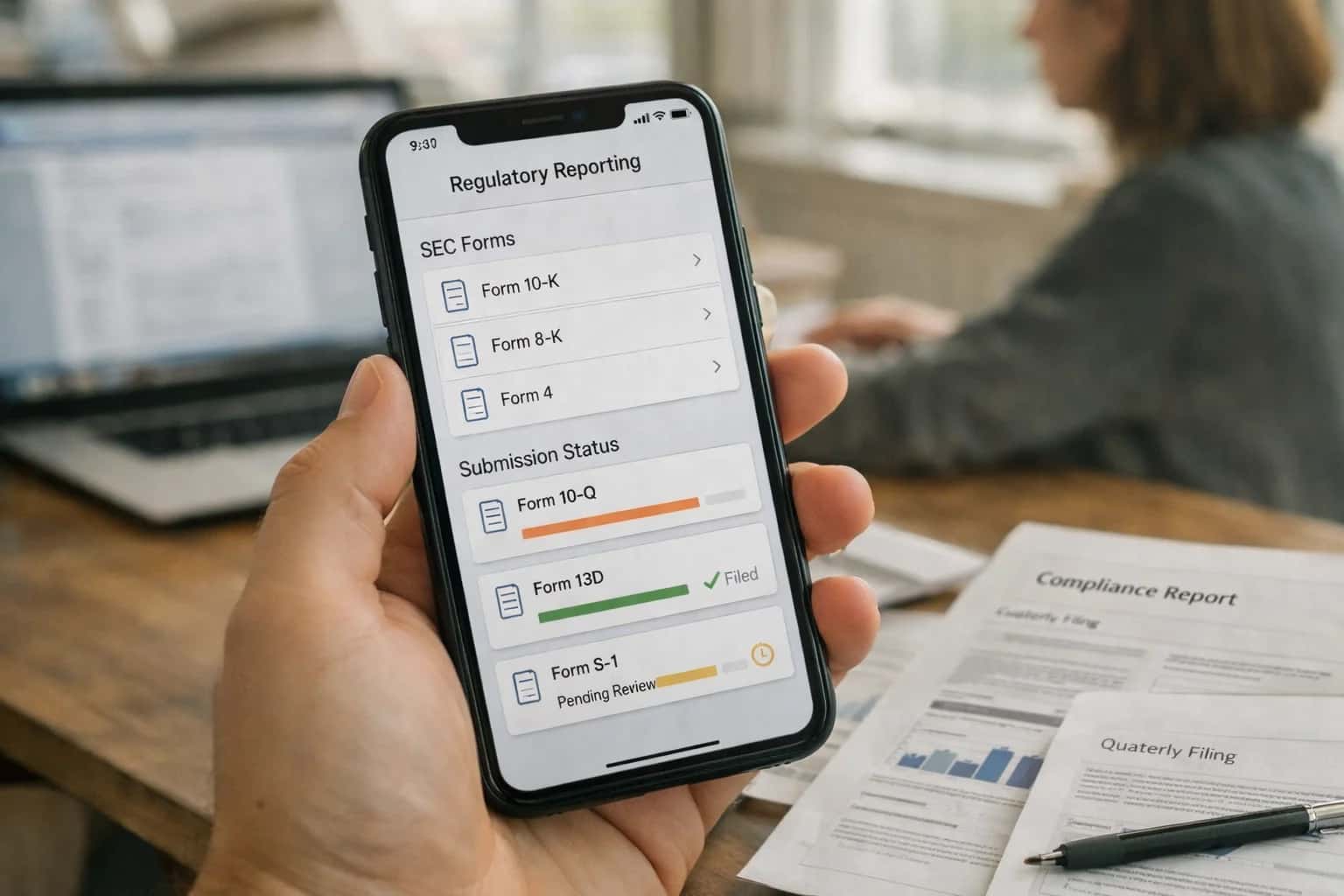
AI-driven systems that generate audit-ready compliance reports on-demand by pulling data from disparate systems, reducing manual effort by 90% and ensuring regulatory accuracy.
THE BUSINESS OUTCOME
What is Automated Compliance Reporting Used For?
Manual compliance reporting is a costly, error-prone bottleneck. Automated compliance reporting uses AI to transform this administrative burden into a strategic, audit-ready function.
The AI fix is a system that acts as a centralized compliance hub. It automatically ingests data from all relevant sources, applies the correct regulatory logic and formatting rules, and generates audit-ready reports on-demand. The measurable outcome is a 70-80% reduction in manual effort, near-elimination of human error, and the ability to produce filings instantly for audits or management reviews. This transforms compliance from a cost center into a controlled, efficient operation. For a deeper look at related systems, explore our insights on Regulatory Change Intelligence and AI Ethics and Bias Audits.
AUTOMATED COMPLIANCE REPORTING
Common Use Cases: Where AI Delivers Immediate ROI
Manual compliance reporting is a high-cost, high-risk bottleneck. AI automates data aggregation, analysis, and audit-ready report generation, turning a reactive cost center into a proactive strategic asset.
01
Automated Regulatory Filings
AI agents pull data from disparate ERP, CRM, and financial systems to auto-generate filings for SEC, FINRA, or SOX compliance. This eliminates manual data wrangling, reduces human error by over 70%, and ensures submissions are always on time.
- Real Example: A financial services firm reduced its quarterly SEC filing preparation from 3 weeks to 3 days.
- Key Benefit: Mitigates risk of late or inaccurate filings that can trigger regulatory penalties and reputational damage.
70%
Reduction in Manual Effort
>99%
On-Time Filing Accuracy
02
Continuous Control Monitoring
Move from periodic audits to real-time compliance. AI models continuously monitor transactions, communications, and system logs against internal policies and external regulations, flagging anomalies instantly.
- Real Example: A multinational bank uses AI to monitor for trade surveillance violations, analyzing millions of communications daily.
- Key Benefit: Provides an always-on audit trail, dramatically reducing the cost and disruption of annual internal audits.
24/7
Real-Time Monitoring
90%
Faster Issue Detection
03
AI-Powered Audit Response
When an audit notice arrives, AI systems can instantly compile all requested documentation, correspondence, and data logs into a structured, searchable package. This turns a weeks-long scramble into a matter of hours.
- Real Example: A healthcare provider used an AI document intelligence platform to respond to a HIPAA audit, retrieving and redacting patient records across 15 systems in 48 hours.
- Key Benefit: Demonstrates organizational control and transparency to regulators, often leading to shorter, less intrusive audits.
80%
Faster Audit Prep
$250k+
Avg. Cost Avoidance
04
ESG & Sustainability Reporting
Automate the complex data collection and calculation required for frameworks like CSRD and SFDR. AI aggregates emissions data, supply chain info, and social metrics to generate stakeholder-ready reports.
- Real Example: A manufacturing company automated its Scope 1, 2, and 3 emissions reporting, saving over 2,000 person-hours annually.
- Key Benefit: Ensures accuracy for investor disclosures and avoids greenwashing accusations that can impact valuation.
2,000+
Person-Hours Saved/Year
Audit-Ready
Report Output
05
Policy Exception Management
AI classifies and routes policy exception requests (e.g., vendor onboarding, access control) based on pre-defined rules, automatically approving low-risk items and escalating only high-risk cases to human reviewers.
- Real Example: A tech firm automated its software procurement compliance, cutting approval times from 5 days to 4 hours for standard requests.
- Key Benefit: Accelerates business velocity while maintaining a rigorous compliance posture and full audit log.
4 hours
Avg. Approval Time
60%
Auto-Approval Rate
06
Cross-Border Compliance Orchestration
For global operations, AI tracks and applies the nuanced regulatory requirements of multiple jurisdictions (GDPR, CCPA, etc.) to data handling and reporting processes, ensuring localized compliance.
- Real Example: An e-commerce platform uses AI to dynamically adjust data privacy reports and consent mechanisms for users in 50+ countries.
- Key Benefit: Prevents multi-million dollar fines for regulatory missteps in key markets and simplifies global expansion.
50+
Jurisdictions Managed
Zero
Major Fines Post-Implementation
COST & TIME ANALYSIS
ROI Breakdown: Manual vs. AI-Powered Reporting
A direct comparison of the operational and financial impact of traditional compliance reporting versus an AI-automated system.
| Key Metric | Manual Process | AI-Powered System | Impact |
|---|---|---|---|
Average Report Generation Time | 40-80 hours | < 2 hours | 95% reduction |
Full-Time Employee (FTE) Equivalent per Report | 0.25 FTE | 0.02 FTE | 92% efficiency gain |
Error Rate in Data Compilation & Entry | 5-8% | < 0.5% | 90%+ accuracy improvement |
Cost per Standard Report (Labor) | $3,200 - $6,400 | $200 - $400 | 94% cost saving |
Regulatory Update-to-Implementation Lag | 2-4 weeks | < 24 hours | Proactive compliance |
Audit Preparation & Support Burden | High (weeks of prep) | Low (on-demand, audit-ready) | Reduced risk & stress |
Scalability (Handling Volume Spikes) | Poor (requires hiring) | Excellent (instant, elastic) | Future-proofs operations |
Strategic Insight Generation | Limited to manual analysis | Automated trend & anomaly detection | Turns data into advantage |
Enabling Efficiency, Speed & Accuracy
Intelligent Analysis, Decision & Execution
We build AI systems for teams that need search across company data, workflow automation across tools, or AI features inside products and internal software.
Talk to Us
Search across company data
Give teams answers from docs, tickets, runbooks, and product data with sources and permissions.
Useful when people spend too long searching or get different answers from different systems.
Enterprise searchRAGPermissions
Read more
Automate internal workflows
Use AI to route work, draft outputs, trigger actions, and keep approvals and logs in place.
Useful when repetitive work moves across multiple tools and teams.
AI agentsWorkflow automationGovernance
Read more
Add AI to products and internal tools
Build assistants, guided actions, or decision support into the software your team or customers already use.
Useful when AI needs to be part of the product, not a separate tool.
AI integrationDecision supportModel routing
Read moreAUTOMATED COMPLIANCE REPORTING
Phased Implementation Roadmap
Move from manual, error-prone reporting to a strategic, AI-driven compliance function. This phased approach delivers immediate ROI while building a foundation for continuous improvement.
01
Phase 1: Centralize & Classify
The first step is taming data chaos. AI agents automatically ingest and classify documents from emails, databases, and file shares into a single source of truth.
- Automated Data Ingestion: Connect to 50+ common enterprise systems (SAP, Salesforce, SharePoint) to pull relevant data.
- Intelligent Tagging: Use NLP to identify and tag clauses, obligations, and regulated content (e.g., GDPR, SOX, HIPAA).
- Real-World Impact: A global bank reduced the manual prep time for its quarterly regulatory filings from 3 weeks to 3 days, freeing senior compliance officers for strategic risk assessment.
70%
Faster Data Aggregation
>90%
Classification Accuracy
02
Phase 2: Automate Report Generation
Transform classified data into audit-ready reports on demand. AI assembles narratives, populates templates, and ensures consistent formatting.
- Dynamic Template Engine: Generate filings for FINRA, SEC 10-K, or internal audit committees by pulling from pre-approved language libraries.
- Version Control & Audit Trail: Every data point is sourced, with a complete change history for regulator scrutiny.
- Quantified Benefit: A manufacturing firm automated its environmental compliance reporting, cutting a 40-hour monthly process to 2 hours and eliminating $250k in annual consultant fees for report preparation.
95%
Reduction in Manual Effort
100%
Audit Trail Compliance
03
Phase 3: Enable Proactive Monitoring
Shift from reactive reporting to proactive risk management. AI continuously monitors internal data and external regulatory feeds for changes that impact your obligations.
- Regulatory Change Intelligence: AI scans for updates from bodies like the FCA, EPA, or EU, assessing relevance to your operations.
- Anomaly Detection: Flag transactions or process deviations that could indicate a compliance breach before the audit.
- Business Justification: This phase turns compliance from a cost center into a strategic shield, preventing average penalties of $2M+ for late or inaccurate filings in regulated industries.
30-Day
Lead Time on Regulatory Changes
60%
Fewer Compliance Incidents
04
Phase 4: Strategic Insights & Forecasting
Leverage your compliance data for competitive advantage. Predictive analytics forecast audit focus areas and model the business impact of new regulations.
- Predictive Risk Scoring: AI models identify which business units or processes are most likely to trigger a finding in the next audit cycle.
- Impact Simulation: Model the operational and financial cost of proposed new regulations to inform lobbying and planning.
- Executive Value: The CIO can present a dashboard showing not just compliance status, but how the function contributes to operational resilience and strategic agility.
25%
Lower Audit Remediation Costs
Strategic
Function Maturity

About the author
Prasad Kumkar
CEO & MD, Inference Systems
Prasad Kumkar is the CEO & MD of Inference Systems and writes about AI systems architecture, LLM infrastructure, model serving, evaluation, and production deployment. Over 5+ years, he has worked across computer vision models, L5 autonomous vehicle systems, and LLM research, with a focus on taking complex AI ideas into real-world engineering systems.
His work and writing cover AI systems, large language models, AI agents, multimodal systems, autonomous systems, inference optimization, RAG, evaluation, and production AI engineering.
LinkedIn
Limited slotsGet a Free AI Consultation
Partnered with leading AI, data, and software stack.





How We Work
Custom AI workflows for your Business
One-fit-all AI don't work for modern businesses. At Inferensys, we aim to understand your business & custom requirements; which we use to define most efficient agentic workflows, the data, and the tools for your business.
01
Review the use case
We understand the task, the users, and where AI can actually help.
Read more02
Pick the right approach
We define what needs search, automation, or product integration.
Read more03
Build the first useful version
We implement the part that proves the value first.
Read more04
Improve from there
We add the checks and visibility needed to keep it useful.
Read moreThe first call is a practical review of your use case and the right next step.
Talk to Us