
Guides
Knowledge Distillation and Model Pruning for Sustainability
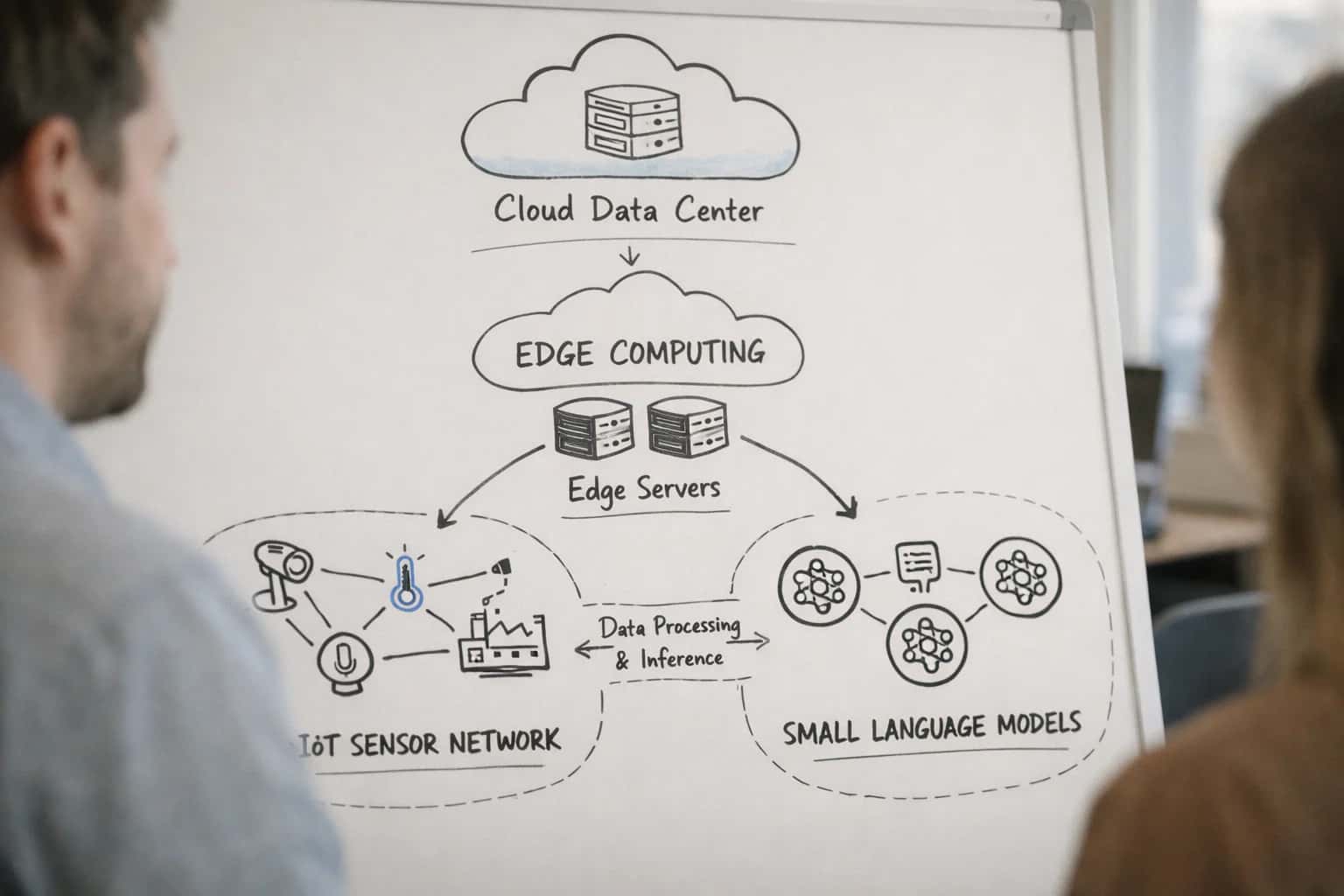
Knowledge Distillation and Model Pruning for Sustainability
These techniques shrink massive models to a fraction of their size without losing significant capability, reducing the energy required for inference. Guides include 'How to use knowledge distillation for model efficiency,' 'Implementing model pruning to reduce power consumption,' and 'Building lean SLMs with high accuracy' as a practical roadmap for environmentally friendly AI.
How to Architect a Knowledge Distillation Pipeline for Model Efficiency
This guide provides a step-by-step framework for designing and implementing a production-grade knowledge distillation pipeline. You'll learn how to structure data flows between teacher and student models, select appropriate loss functions (like KL divergence), and integrate tools like Hugging Face Transformers and PyTorch for efficient training. The focus is on creating a reusable, scalable system that reduces model size and power consumption while maintaining accuracy.
How to Choose Between Structured and Unstructured Pruning
This guide explains the fundamental trade-offs between structured pruning (removing entire neurons or filters) and unstructured pruning (removing individual weights). You'll learn how to evaluate your target hardware, inference latency requirements, and accuracy tolerance to make the correct architectural choice. The guide includes practical benchmarks using frameworks like Torch Prune and guidelines for implementing each strategy effectively.
How to Design a Distillation Training Curriculum
A training curriculum strategically sequences data and adjusts difficulty to improve student model learning. This guide covers how to design progressive training stages, from easy to hard examples, and how to leverage techniques like data augmentation and temperature scaling in the loss function. You'll learn to accelerate convergence and achieve higher final accuracy compared to standard distillation, using libraries like TensorFlow or PyTorch Lightning.
How to Implement Progressive Model Pruning
Progressive pruning removes weights iteratively during training, allowing the model to recover accuracy after each sparsification step. This guide details how to schedule pruning rates, choose scoring criteria (e.g., magnitude, gradient), and integrate the process into your training loop with tools like NVIDIA's Apex or custom PyTorch hooks. The result is a highly sparse model optimized for inference on CPUs or specialized accelerators.
How to Integrate Knowledge Distillation into Your MLOps Pipeline
Moving distillation from experiment to production requires robust MLOps integration. This guide covers automating teacher model selection, versioning student model checkpoints with Weights & Biases or MLflow, and setting up continuous evaluation triggers. You'll learn to design CI/CD workflows that retrain distilled models on new data and deploy them alongside your existing model serving infrastructure, such as KServe or Seldon Core.
How to Benchmark Model Performance Post-Distillation
Validating a compressed model requires more than top-line accuracy. This guide establishes a comprehensive benchmarking protocol covering inference latency, memory footprint, power consumption, and accuracy on edge cases. You'll learn to use profiling tools like PyTorch Profiler, create representative test suites, and establish Key Performance Indicators (KPIs) to prove the efficiency gains of your distilled or pruned model.
How to Determine the Optimal Model Size for Your Use Case
Selecting the right student model architecture is a critical business and technical decision. This guide provides a methodology to analyze your latency, throughput, and accuracy Service Level Agreements (SLAs) against available compute budgets. You'll learn to profile candidate models (e.g., Llama 3.1 8B vs. Phi-3-mini), simulate deployment scenarios, and make a data-driven choice that balances performance with sustainability goals.
How to Manage the Trade-off Between Accuracy and Efficiency
Model compression inherently involves a trade-off. This guide provides a framework for quantifying and managing this trade-off through Pareto frontier analysis. You'll learn to use multi-objective optimization techniques, set acceptable accuracy drop thresholds based on business impact, and communicate the efficiency gains (in reduced CO2e or cost) to stakeholders to justify the selected operating point.
How to Prune Models for Specific Hardware Accelerators
Maximizing inference speed requires hardware-aware pruning. This guide explains how to tailor your pruning strategy for GPUs (leveraging structured sparsity), Google TPUs, or edge AI chips like the NVIDIA Jetson or Intel Movidius. You'll learn about hardware-specific kernel support, how to use compiler tools like TVM or OpenVINO to validate performance, and techniques to achieve optimal latency and power savings on your target platform.
How to Implement Attention Distillation for Transformer Models
Attention distillation transfers knowledge from a teacher transformer's attention maps to a student, capturing rich relational information. This guide walks through implementing attention-based loss functions, such as mimicking key-query distributions, for models like GPT or BERT. You'll learn to use libraries like Hugging Face PEFT and apply these techniques to create highly efficient small language models (SLMs) for tasks like summarization or classification.
How to Ensure Fairness and Bias Mitigation in Compressed Models
Compression can amplify or introduce bias. This guide details how to audit student models for demographic parity, equalized odds, and other fairness metrics using tools like Fairlearn or Aequitas. You'll learn mitigation strategies, including bias-aware pruning, using balanced distillation datasets, and implementing continuous monitoring in your MLOps pipeline to ensure compressed models remain equitable and compliant.
How to Evaluate the Carbon Footprint Reduction of Pruned Models
Quantifying the environmental impact of model compression is key for Green AI initiatives. This guide teaches you how to measure the carbon footprint of training and inference using tools like CodeCarbon or ML CO2 Impact Calculator. You'll learn to create a baseline, calculate savings from reduced FLOPs and memory usage, and translate technical metrics into business-ready reports on CO2e reduction and energy cost savings.
How to Architect a Hybrid System with Large and Small Models
This guide explains how to design a cost-efficient inference system that dynamically routes queries between a large, accurate model and a small, efficient distilled model. You'll learn to implement routing logic based on query complexity, user priority, or confidence scores, using frameworks like Ray Serve or FastAPI. The architecture minimizes energy use for simple requests while retaining high capability for complex tasks.
How to Distill Models for Edge and IoT Deployment
Deploying to resource-constrained edge devices requires extreme optimization. This guide covers the full pipeline: selecting ultra-compact student architectures (like MobileNet or TinyLlama), applying aggressive quantization-aware distillation, and testing for real-world constraints like intermittent connectivity and thermal throttling. You'll learn to use export tools like ONNX Runtime and TensorFlow Lite to create models ready for embedded systems.
Setting Up a Continuous Evaluation System for Pruned Models
Pruned models can degrade over time due to data drift. This guide details how to build a monitoring system that tracks performance, efficiency, and fairness metrics in production. You'll learn to set up automated alerts for efficiency regression using tools like Prometheus and Grafana, design canary deployment strategies, and create feedback loops to trigger retraining when key thresholds are breached.
Partnered with leading AI, data, and software stack.





How We Work
Custom AI workflows for your Business
One-fit-all AI don't work for modern businesses. At Inferensys, we aim to understand your business & custom requirements; which we use to define most efficient agentic workflows, the data, and the tools for your business.
01
Review the use case
We understand the task, the users, and where AI can actually help.
Read more02
Pick the right approach
We define what needs search, automation, or product integration.
Read more03
Build the first useful version
We implement the part that proves the value first.
Read more04
Improve from there
We add the checks and visibility needed to keep it useful.
Read moreThe first call is a practical review of your use case and the right next step.
Talk to Us