Manual regulatory reporting is a costly, error-prone bottleneck. Teams spend weeks collating data from disparate sources—spreadsheets, PDFs, emails—risking fines for missed deadlines or inaccuracies. This process drains resources, creates audit exposure, and distracts from core business strategy. In sectors like finance and energy, where regulations evolve rapidly, keeping pace manually is unsustainable.

Use Case
Automated Regulatory Reporting
AI-powered extraction of required data points from complex source documents to generate accurate, audit-ready regulatory filings, ensuring compliance and reducing manual effort by up to 70%.
USE CASES
What is Automated Regulatory Reporting Used For?
Regulatory reporting is a high-stakes, high-cost burden. Automated solutions transform this compliance function from a manual liability into a strategic asset.
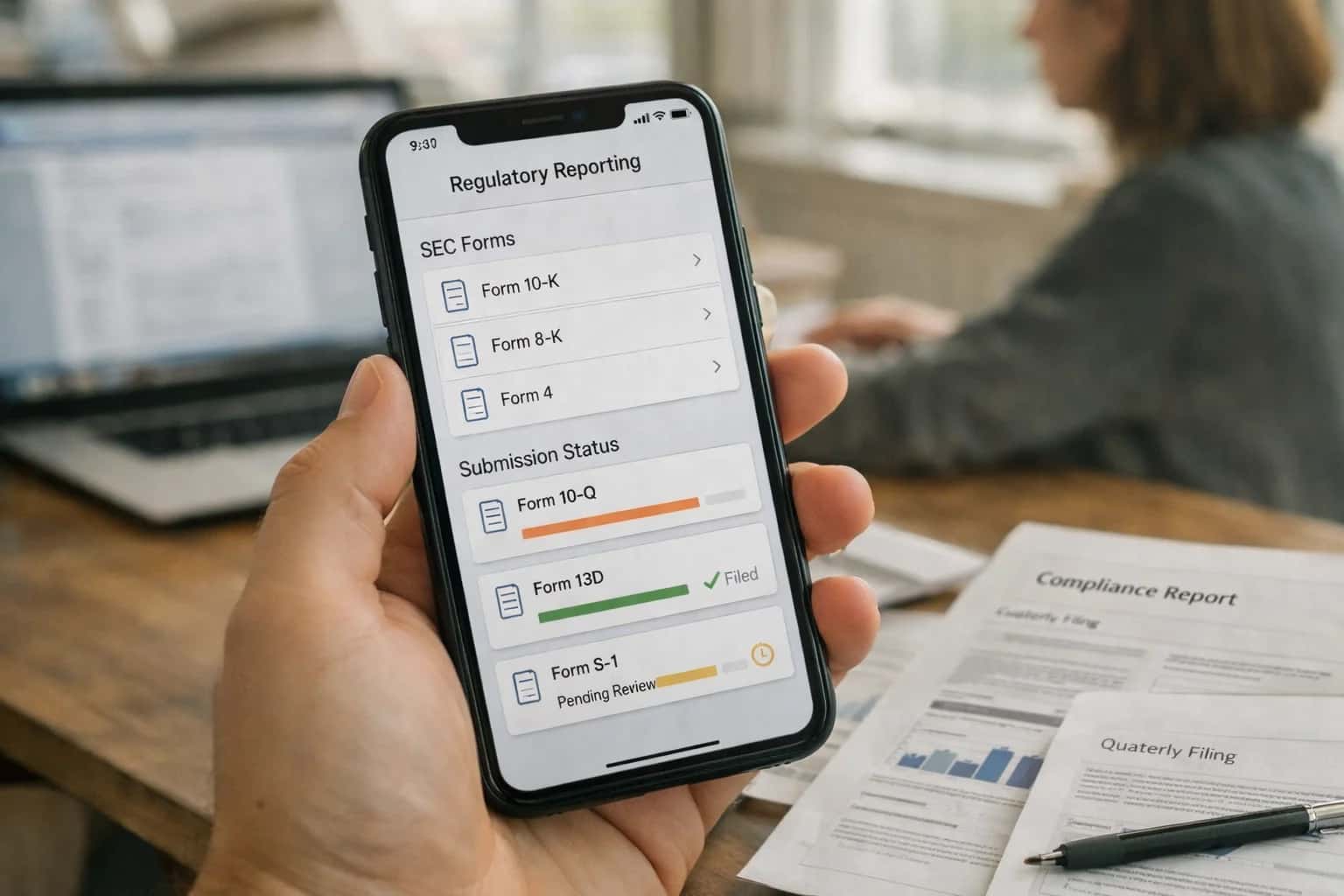
Automated regulatory reporting uses AI-powered document intelligence to extract, validate, and format required data points from complex source documents. This ensures submissions are audit-ready, consistent, and on-time. The measurable outcome is a 70-80% reduction in manual effort, translating directly into lower operational costs, mitigated compliance risk, and the ability to reallocate skilled staff to higher-value analysis. Explore how this fits into a broader Intelligent Content Management strategy.
AUTOMATED REGULATORY REPORTING
Common Use Cases
Transform a high-risk, manual compliance process into a strategic advantage. These use cases demonstrate how AI-driven document intelligence delivers accuracy, speed, and auditability for critical filings.
01
Financial Services: SEC & FINRA Filings
Automate the extraction of complex data points from source documents like trade confirmations, loan agreements, and internal ledgers to generate accurate 10-K, 10-Q, and suspicious activity reports (SARs).
- Key Benefit: Reduces manual compilation effort by over 70%, cutting filing preparation from weeks to days.
- ROI Driver: Mitigates multi-million dollar fines from reporting errors and missed deadlines.
- Real Example: A regional bank used our platform to automate its quarterly Call Report, eliminating 3,000+ hours of manual work annually and achieving 99.9% data accuracy for audit.
02
Pharmaceuticals: FDA Submissions
Accelerate the assembly of New Drug Applications (NDAs) and clinical study reports by intelligently pulling required data from thousands of unstructured documents—patient records, lab results, adverse event reports.
- Key Benefit: Compresses submission timelines by 40%, accelerating time-to-market for critical therapies.
- ROI Driver: Ensures data consistency across volumes, preventing costly regulatory queries that delay approval.
- Real Example: A biotech firm automated its eCTD module assembly, reducing the pre-submission review cycle from 6 months to 10 weeks.
03
Energy & Utilities: Environmental Compliance
Generate mandatory EPA, FERC, and state-level reports by continuously monitoring and extracting data from environmental permits, emissions logs, and inspection reports.
- Key Benefit: Provides a real-time, audit-ready compliance posture, moving from reactive to proactive management.
- ROI Driver: Avoids operational shutdowns and significant penalties from non-compliance.
- Real Example: An oil & gas operator automated its greenhouse gas (GHG) inventory reporting, ensuring 100% accuracy for its annual submission and saving an estimated $500k in consultant fees.
04
Insurance: Solvency II & State Filings
Automate the population of statutory financial statements and risk exposure reports by extracting data from policy documents, claims files, and investment portfolios.
- Key Benefit: Ensures filings are complete, consistent, and traceable back to source documents for auditors.
- ROI Driver: Reduces the cost of compliance operations by up to 60% while improving data quality for strategic risk analysis.
- Real Example: A major insurer streamlined its quarterly state filings, cutting the dedicated team's effort by 50% and reallocating staff to higher-value actuarial work.
05
Manufacturing: Product Safety & Quality Reports
Automate the generation of mandatory reports for agencies like the CPSC (Consumer Product Safety Commission) and FDA by analyzing quality control logs, supplier certifications, and incident reports.
- Key Benefit: Enables rapid, accurate reporting in the event of a recall or safety inquiry, protecting brand reputation.
- ROI Driver: Minimizes liability exposure and avoids costly production halts due to reporting delays.
- Real Example: An automotive supplier automated its material compliance declarations (e.g., REACH, Conflict Minerals), ensuring on-time submissions to OEMs and avoiding supply chain penalties.
06
Cross-Industry: ESG & Sustainability Disclosures
Compile audit-ready ESG reports for frameworks like CSRD and SASB by aggregating and validating data from energy bills, supply chain contracts, HR systems, and internal sustainability audits.
- Key Benefit: Transforms a fragmented, manual data chase into a streamlined, evidence-backed process.
- ROI Driver: Meets investor and regulatory demands efficiently, turning compliance into a competitive differentiator.
- Real Example: A multinational retailer used AI to automate its annual sustainability report, reducing the data collection phase from 4 months to 3 weeks and enhancing its credibility with ESG rating agencies.
AUTOMATED REGULATORY REPORTING
How It Works: A 4-Step Implementation
Transform a costly, manual compliance burden into a streamlined, automated process that ensures accuracy and audit-readiness.
The pain point is immense: regulatory reporting is a high-stakes, low-margin activity. Teams manually sift through thousands of unstructured documents—contracts, invoices, transaction logs—to find specific data points. This process is slow, error-prone, and diverts skilled staff from strategic work. A single mistake can lead to severe fines, reputational damage, and failed audits, making compliance a constant source of operational risk and cost. Our Intelligent Content Management (ICM) platform directly addresses this core vulnerability.
The AI fix is a structured, four-step workflow: 1) Ingest documents from any source, 2) Extract required fields using trained models, 3) Validate data against rules and source documents, and 4) Assemble audit-ready reports. This reduces manual effort by over 70%, cuts error rates to near-zero, and slashes reporting cycle times from weeks to hours. The outcome is predictable compliance, significant cost savings, and the ability to reallocate FTEs to higher-value analysis, turning a cost center into a source of competitive assurance. For related automation, see our solutions for Automated Invoice Data Extraction and Real-Time Compliance Monitoring for Documents.
COST-BENEFIT COMPARISON
ROI Analysis: Manual vs. AI-Powered Reporting
A direct comparison of the operational and financial impact of traditional manual reporting versus an AI-driven platform like our Intelligent Content Management (ICM) solution.
| Key Metric / Capability | Manual Reporting Process | AI-Powered Reporting (ICM Platform) |
|---|---|---|
Average Time per Report | 40-80 hours | 2-4 hours |
Error Rate (Data Entry & Calculation) | 5-15% | < 0.5% |
Audit Preparation Time | Weeks | Hours |
Scalability for Volume Spikes | ||
Real-Time Compliance Rule Updates | ||
Staff Cost (FTE Allocation per $1M in Reports) | $50,000 - $80,000 | $10,000 - $15,000 |
Risk of Late Filing Penalties | High | Negligible |
Actionable Insights from Report Data |
Enabling Efficiency, Speed & Accuracy
Intelligent Analysis, Decision & Execution
We build AI systems for teams that need search across company data, workflow automation across tools, or AI features inside products and internal software.
Talk to Us
Search across company data
Give teams answers from docs, tickets, runbooks, and product data with sources and permissions.
Useful when people spend too long searching or get different answers from different systems.
Enterprise searchRAGPermissions
Read more
Automate internal workflows
Use AI to route work, draft outputs, trigger actions, and keep approvals and logs in place.
Useful when repetitive work moves across multiple tools and teams.
AI agentsWorkflow automationGovernance
Read more
Add AI to products and internal tools
Build assistants, guided actions, or decision support into the software your team or customers already use.
Useful when AI needs to be part of the product, not a separate tool.
AI integrationDecision supportModel routing
Read moreKEY ADOPTION CHALLENGES & MITIGATIONS
Automated Regulatory Reporting
Transitioning from manual, error-prone reporting to AI-driven automation presents significant hurdles. This section addresses the core enterprise objections—from compliance fears to ROI justification—and provides clear, actionable mitigation strategies.
The core fear is that AI will introduce errors leading to regulatory fines. Our approach mitigates this through a multi-layered validation architecture.
- Human-in-the-Loop (HITL) Gates: Critical data points and final reports are flagged for human review before submission, creating an auditable approval chain.
- Explainable AI (XAI): The system provides a clear audit trail, highlighting the source document and exact field from which each data point was extracted, justifying every figure in the filing.
- Continuous Compliance Mapping: The AI's extraction rules are dynamically mapped to regulatory frameworks (e.g., SEC, FINRA, ESMA). Any change in regulation triggers an alert and a required review of the reporting logic, ensuring the system adapts alongside the rules.
This structured approach transforms AI from a 'black box' into a compliant, accountable co-pilot.

About the author
Prasad Kumkar
CEO & MD, Inference Systems
Prasad Kumkar is the CEO & MD of Inference Systems and writes about AI systems architecture, LLM infrastructure, model serving, evaluation, and production deployment. Over 5+ years, he has worked across computer vision models, L5 autonomous vehicle systems, and LLM research, with a focus on taking complex AI ideas into real-world engineering systems.
His work and writing cover AI systems, large language models, AI agents, multimodal systems, autonomous systems, inference optimization, RAG, evaluation, and production AI engineering.
LinkedIn
Limited slotsGet a Free AI Consultation
Partnered with leading AI, data, and software stack.





How We Work
Custom AI workflows for your Business
One-fit-all AI don't work for modern businesses. At Inferensys, we aim to understand your business & custom requirements; which we use to define most efficient agentic workflows, the data, and the tools for your business.
01
Review the use case
We understand the task, the users, and where AI can actually help.
Read more02
Pick the right approach
We define what needs search, automation, or product integration.
Read more03
Build the first useful version
We implement the part that proves the value first.
Read more04
Improve from there
We add the checks and visibility needed to keep it useful.
Read moreThe first call is a practical review of your use case and the right next step.
Talk to Us