AI integration for Zoom meeting summaries connects to three primary surfaces: the Zoom Meeting API for real-time webhooks, the Zoom Cloud Recording API for post-meeting processing, and the Zoom Chat API for in-meeting interactions. The core workflow is event-driven: when a meeting ends, Zoom pushes a recording.completed webhook to your integration layer. This triggers an automated pipeline that fetches the transcript via the API, processes it through an LLM (like GPT-4 or Claude) with a structured prompt, and generates a summary with clear sections for decisions, action items (with owners and dates), and key discussion points.

Integration
AI Integration for Zoom Meeting Summaries
Architect AI to automatically generate structured summaries, action items, and decisions from Zoom recordings and transcripts, posting them to channels, tasks, or CRM systems.
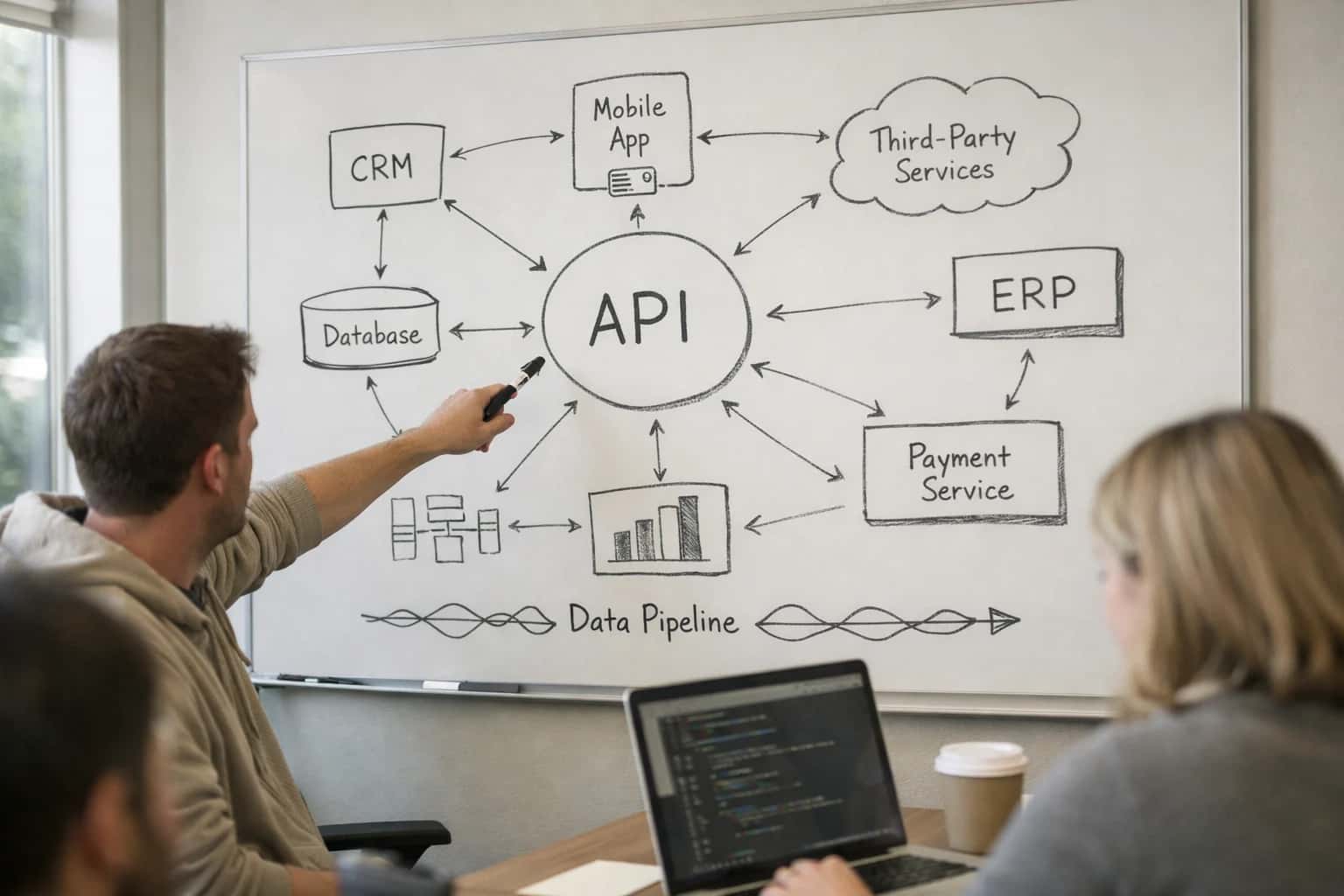
ARCHITECTURE AND IMPLEMENTATION
Where AI Fits into Your Zoom Workflow
A practical guide to integrating AI for automated meeting summaries, action items, and workflow triggers directly into your Zoom operations.
The implementation detail lies in connecting this output to downstream systems. The generated summary isn't just a document; it's structured data. A typical architecture uses a message queue (like RabbitMQ or AWS SQS) to route this data. For example, action items can be posted as tasks to Asana or Jira, decisions can be logged to a Confluence page or SharePoint, and a notification with the summary can be sent to a designated Slack channel or Microsoft Teams chat via their respective webhooks. This turns a passive recording into active, operational data that drives accountability and continuity.
Rollout and governance are critical. Start with a pilot group, using Zoom's webhook validation and OAuth scopes to control access. Implement a human-in-the-loop review step for the first 30 days, where summaries are posted to a private channel for manager approval before broad distribution. Use audit logs to track which meetings were processed and where summaries were sent. Key considerations include data residency (ensuring processing aligns with your Zoom data region), cost management (via transcript chunking and LLM token limits), and defining a clear opt-in/opt-out policy for participants to maintain trust.
AI Integration for Zoom Meeting Summaries
Zoom APIs and Integration Surfaces
Core APIs for Meeting Data
The Zoom API ecosystem provides the primary surfaces for accessing meeting content. The Meeting API (/v2/meetings) allows you to programmatically create, list, and get details for past meetings, including the crucial recording_files array. Once a meeting ends and cloud recording is processed, you can use the Cloud Recording API (/v2/meetings/{meetingId}/recordings) to retrieve the recording file list and download URLs for audio, video, and chat transcripts.
For AI summarization, the most critical endpoint is the Transcript API (/v2/meetings/{meetingId}/recordings/{recordingId}/transcript), which provides the structured JSON transcript with speaker diarization and timestamps. This is the primary payload for feeding into LLMs. You can also use the Meeting Events API via webhooks (/v2/webhooks/events) to listen for meeting.ended and recording.completed events, triggering your AI pipeline automatically without polling.
ZOOM INTEGRATION PATTERNS
High-Value Use Cases for AI-Powered Summaries
Integrating AI with Zoom's APIs and webhooks transforms meeting recordings from passive archives into active workflow triggers. These patterns show where to connect AI to automate summaries, extract decisions, and push structured data into the systems your teams already use.
01
Automated Post-Meeting CRM Updates
AI parses the Zoom transcript to identify deal-related discussions, next steps, and competitor mentions. It then automatically creates or updates Salesforce, HubSpot, or Dynamics 365 records, logging the activity and populating notes fields. This eliminates manual data entry after sales calls.
Same day
CRM update latency
02
Project Task Creation from Action Items
NLP models extract action items, owners, and implied due dates from meeting dialogue. The integration creates corresponding tasks in Asana, Jira, or Monday.com via their APIs, linking back to the Zoom recording. This turns verbal commitments into tracked work items.
Minutes
From meeting end to task creation
03
Compliance & Legal Matter Summarization
For regulated industries, AI generates structured summaries of client meetings, depositions, or board discussions held on Zoom. Summaries are tagged by matter number and securely posted to NetDocuments, iManage, or Clio, creating an auditable record and reducing manual minute-taking.
04
IT Support Ticket Enrichment
When troubleshooting calls are held on Zoom, AI summarizes the problem, attempted fixes, and resolution from the transcript. This summary, along with the recording link, is automatically attached to the corresponding ticket in ServiceNow or Jira Service Management, providing full context for future reference.
Batch -> Real-time
Ticket update workflow
05
Knowledge Base Article Generation
AI transforms Zoom recordings of training sessions, product deep-dives, or Q&As into draft knowledge base articles. Using the transcript and shared screen content, it creates structured markdown ready for review and publishing in Confluence, SharePoint, or Guru, turning meeting content into reusable institutional knowledge.
06
Executive Decision & OKR Tracking
For leadership and board meetings, AI extracts key decisions, vote outcomes, and OKR-related commitments into a standardized template. This executive summary is then distributed via email or posted to a secure SharePoint or Box location, ensuring alignment and accountability without manual note distribution.
PRODUCTION ARCHITECTURE PATTERNS
Example AI Workflows for Zoom Meeting Summaries
These are practical, production-ready workflows for integrating AI summarization into Zoom. Each pattern includes the trigger, data flow, AI action, and system update, providing a blueprint for implementation.
Trigger: Zoom webhook for recording.completed.
Data Flow:
- Webhook payload is received, containing the
meeting_idandrecording_filesURL. - Service fetches the VTT transcript file via the Zoom API using an OAuth token.
- Transcript text, meeting topic, host, and participant list are packaged as context.
AI Action:
- A structured prompt is sent to an LLM (e.g., GPT-4, Claude 3) with instructions to output:
- Executive Summary (3-4 sentences)
- Key Decisions (bulleted list)
- Action Items (with owner and due date if mentioned)
- Follow-Up Questions (unresolved topics)
- The prompt includes grounding rules to avoid hallucination and mark unclear owners as
TBD.
System Update & Human Review:
- The formatted summary is posted to a designated Slack channel or Microsoft Teams channel via their webhook APIs.
- The message includes a link to the original recording and an
Editbutton that allows a team member to correct any errors before the summary is considered final. - Optionally, the corrected summary is then written back to a knowledge base (e.g., Confluence, SharePoint) as a permanent record.
PRODUCTION-READY AI FOR ZOOM
Implementation Architecture: Data Flow and Guardrails
A secure, scalable architecture for turning Zoom meeting content into structured, actionable intelligence.
A production Zoom AI integration is built on a secure, event-driven pipeline. The flow typically starts with Zoom's webhook notifications for events like recording.completed or meeting.ended. A secure listener service captures these events, validates the payload, and initiates a job to fetch the recording file and detailed transcript via the Zoom API. This raw data is then passed through a processing queue where the core AI models—for summarization, action item extraction, and sentiment analysis—operate. The outputs are structured JSON objects containing the summary, decisions, tasks (with owners and due dates inferred), and key topics.
The processed intelligence must be routed to the systems where work happens. This is done via configured post-action connectors. Common destinations include:
- Project Management: Creating tasks in Asana, Jira, or Monday.com via their APIs.
- CRM: Logging call summaries and next steps in Salesforce or HubSpot, linked to the relevant contact or opportunity record.
- Collaboration: Posting the summary to a designated Slack channel or Microsoft Teams channel.
- Knowledge Management: Indexing the transcript and summary in a vector database (like Pinecone or Weaviate) for semantic search, or creating a Confluence page. Each connector handles authentication, payload transformation, and error logging specific to the target system.
Governance is non-negotiable. The architecture must enforce role-based access control (RBAC) so only authorized users or meetings (e.g., based on Zoom group membership) trigger processing. All data flows should be logged for a full audit trail, and personally identifiable information (PII) or sensitive data should be redacted before processing or storage based on policy. For regulated industries, the AI processing itself may need to run in a dedicated, compliant cloud tenant. A key guardrail is the human-in-the-loop review step; before summaries are posted to external systems, they can be routed to the meeting host for approval via a simple web interface, ensuring accuracy and control.
ZOOM INTEGRATION PATTERNS
Code and Payload Examples
Ingesting Zoom Recordings for Processing
When a Zoom meeting ends, the Zoom API sends a recording.completed webhook event. Your integration must securely receive this payload, validate it, and trigger the AI summarization pipeline. The handler should extract the download URLs for the recording and transcript files, which are time-limited and require a valid OAuth token for access.
pythonimport json import requests from your_ai_service import process_recording def zoom_webhook_handler(request): """Cloud Function or FastAPI endpoint for Zoom webhooks.""" # 1. Verify webhook signature for security verify_zoom_signature(request) payload = request.json event = payload.get('event') if event == 'recording.completed': recording_data = payload.get('payload', {}).get('object', {}) meeting_id = recording_data.get('id') download_urls = [] # 2. Extract MP4 and VTT file URLs for file in recording_data.get('recording_files', []): if file.get('file_type') in ('MP4', 'TRANSCRIPT'): download_urls.append({ 'type': file['file_type'], 'url': file['download_url'], 'token': file.get('access_token') # For password-protected meetings }) # 3. Queue for AI processing if download_urls: process_recording.delay(meeting_id, download_urls) return {'status': 'queued'} return {'status': 'ignored'}
This pattern ensures reliable ingestion, handles password-protected meetings, and decouples processing for scalability.
ZOOM MEETING SUMMARIZATION
Realistic Time Savings and Business Impact
How AI integration transforms manual post-meeting workflows into automated, structured outputs that feed downstream systems.
| Workflow Stage | Before AI | After AI | Implementation Notes |
|---|---|---|---|
Meeting Documentation | Manual note-taking or 24-48 hour wait for full transcript review | Structured summary, action items, and decisions generated within 15 minutes of meeting end | Uses Zoom's post-meeting webhook to trigger the AI pipeline automatically |
Action Item Distribution | Manual email to attendees with bullet points; follow-ups to confirm owners/dates | Auto-post to Slack/Teams channel and create tasks in Asana/Jira with @mentions and due dates | Requires mapping speaker diarization to user emails from the Zoom participant list |
CRM/System of Record Update | Sales rep spends 10-15 minutes logging call notes and next steps in Salesforce | AI drafts call notes and updates Opportunity/Contact fields; rep reviews and approves in <2 mins | Human-in-the-loop approval via a Slack modal or lightweight web UI maintains data quality |
Knowledge Capture & Search | Meeting recordings and notes siloed in individual OneDrive/SharePoint folders; difficult to search | Transcripts and summaries indexed in vector database; semantic search by concept, not just keyword | Rollout starts with high-value project teams; requires governance on data retention and access |
Cross-Functional Follow-up | Manual coordination to schedule follow-ups with stakeholders mentioned in the meeting | AI identifies external stakeholders and drafts calendar invites; human approves and sends | Integrates with Microsoft Graph or Google Calendar APIs to check availability |
Compliance & Audit Readiness | Manual sampling of recordings for regulatory review; high risk of missing violations | AI scans all transcripts for compliance keywords (e.g., FINRA, HIPAA); alerts and archives flagged segments | Pilot in regulated departments first (Legal, Compliance); requires strict access logging |
Recurring Status Meetings | PM spends 1-2 hours compiling updates from last week's notes into a pre-meeting deck | AI auto-generates a pre-meeting briefing from prior summaries and current project data | Connects to project management APIs (Jira, Monday.com) to pull latest ticket status |
PRODUCTION ARCHITECTURE
Governance, Security, and Phased Rollout
A practical approach to deploying AI meeting summaries in Zoom with enterprise-grade controls.
A production Zoom AI integration is built on a secure, event-driven pipeline. The core flow uses Zoom's webhooks (like meeting.ended) to trigger an ingestion service. This service fetches the recording and transcript via the Zoom Cloud Recording API or, for higher security, processes audio from your own compliant storage. The transcript is then sent through your AI summarization model—hosted in your VPC or a secured cloud tenant—which generates structured outputs like decisions, action items, and key topics. These summaries are posted to designated systems via their APIs, such as creating a Confluence page, a Salesforce Task, or a Slack message in a project channel. Critical to this architecture is a message queue (e.g., RabbitMQ, AWS SQS) to handle retries and ensure no data loss if downstream systems are unavailable.
Governance starts with data residency and access control. Meeting data should never transit through unauthorized regions. Implement strict RBAC to ensure only authorized users or service accounts can trigger summarization for their meetings, often scoped by Zoom group, user role, or meeting topic. All processing must be logged to an immutable audit trail, capturing the meeting ID, processing timestamp, model version used, and destination system. For regulated industries, you may need a human-in-the-loop step where summaries are reviewed before being shared, or a mechanism to automatically redact sensitive keywords identified in the transcript before AI processing.
Roll this out in phases to manage change and validate value. Phase 1 (Pilot): Enable summarization for a single team's recurring internal meetings, posting outputs to a private Teams or Slack channel. Monitor accuracy and gather feedback on format. Phase 2 (Controlled Expansion): Roll out to department-level meetings, integrating with one business system (e.g., creating Jira issues for technical action items). Implement opt-in/opt-out controls for meeting hosts. Phase 3 (Enterprise Scale): Enable org-wide with automated workflows, such as posting sales call summaries to Salesforce and support call summaries to Zendesk. Establish a centralized dashboard for usage metrics, cost tracking, and model performance monitoring to ensure the system delivers consistent ROI.
Enabling Efficiency, Speed & Accuracy
Intelligent Analysis, Decision & Execution
We build AI systems for teams that need search across company data, workflow automation across tools, or AI features inside products and internal software.
Talk to Us
Search across company data
Give teams answers from docs, tickets, runbooks, and product data with sources and permissions.
Useful when people spend too long searching or get different answers from different systems.
Enterprise searchRAGPermissions
Read more
Automate internal workflows
Use AI to route work, draft outputs, trigger actions, and keep approvals and logs in place.
Useful when repetitive work moves across multiple tools and teams.
AI agentsWorkflow automationGovernance
Read more
Add AI to products and internal tools
Build assistants, guided actions, or decision support into the software your team or customers already use.
Useful when AI needs to be part of the product, not a separate tool.
AI integrationDecision supportModel routing
Read moreIMPLEMENTATION AND OPERATIONS
Frequently Asked Questions
Common technical and operational questions for teams architecting AI-powered meeting summaries with Zoom.
The integration uses Zoom's APIs and webhooks to securely access meeting data. The typical flow is:
- Webhook Subscription: Your Zoom account is configured to send
recording.completedwebhook events to a secure endpoint in your infrastructure or our managed service. - Secure Data Retrieval: Upon receiving the webhook payload (which contains the meeting UUID and recording details), the system calls the Zoom API using OAuth 2.0 credentials with the appropriate scopes (
recording:read) to download the recording file and/or transcript (VTT). - Data Handling: Audio/video files are processed locally or in a secure cloud environment. Transcripts are parsed for structured analysis. No raw media or transcript data is stored longer than necessary for processing.
Key Security Notes:
- API credentials are stored in a secrets manager (e.g., AWS Secrets Manager, Azure Key Vault).
- All data in transit is encrypted via TLS.
- The integration can be configured to process only meetings with specific labels or from certain user groups.

About the author
Prasad Kumkar
CEO & MD, Inference Systems
Prasad Kumkar is the CEO & MD of Inference Systems and writes about AI systems architecture, LLM infrastructure, model serving, evaluation, and production deployment. Over 5+ years, he has worked across computer vision models, L5 autonomous vehicle systems, and LLM research, with a focus on taking complex AI ideas into real-world engineering systems.
His work and writing cover AI systems, large language models, AI agents, multimodal systems, autonomous systems, inference optimization, RAG, evaluation, and production AI engineering.
LinkedIn
Limited slotsGet a Free AI Consultation
Partnered with leading AI, data, and software stack.





How We Work
Custom AI workflows for your Business
One-fit-all AI don't work for modern businesses. At Inferensys, we aim to understand your business & custom requirements; which we use to define most efficient agentic workflows, the data, and the tools for your business.
01
Review the use case
We understand the task, the users, and where AI can actually help.
Read more02
Pick the right approach
We define what needs search, automation, or product integration.
Read more03
Build the first useful version
We implement the part that proves the value first.
Read more04
Improve from there
We add the checks and visibility needed to keep it useful.
Read moreThe first call is a practical review of your use case and the right next step.
Talk to Us