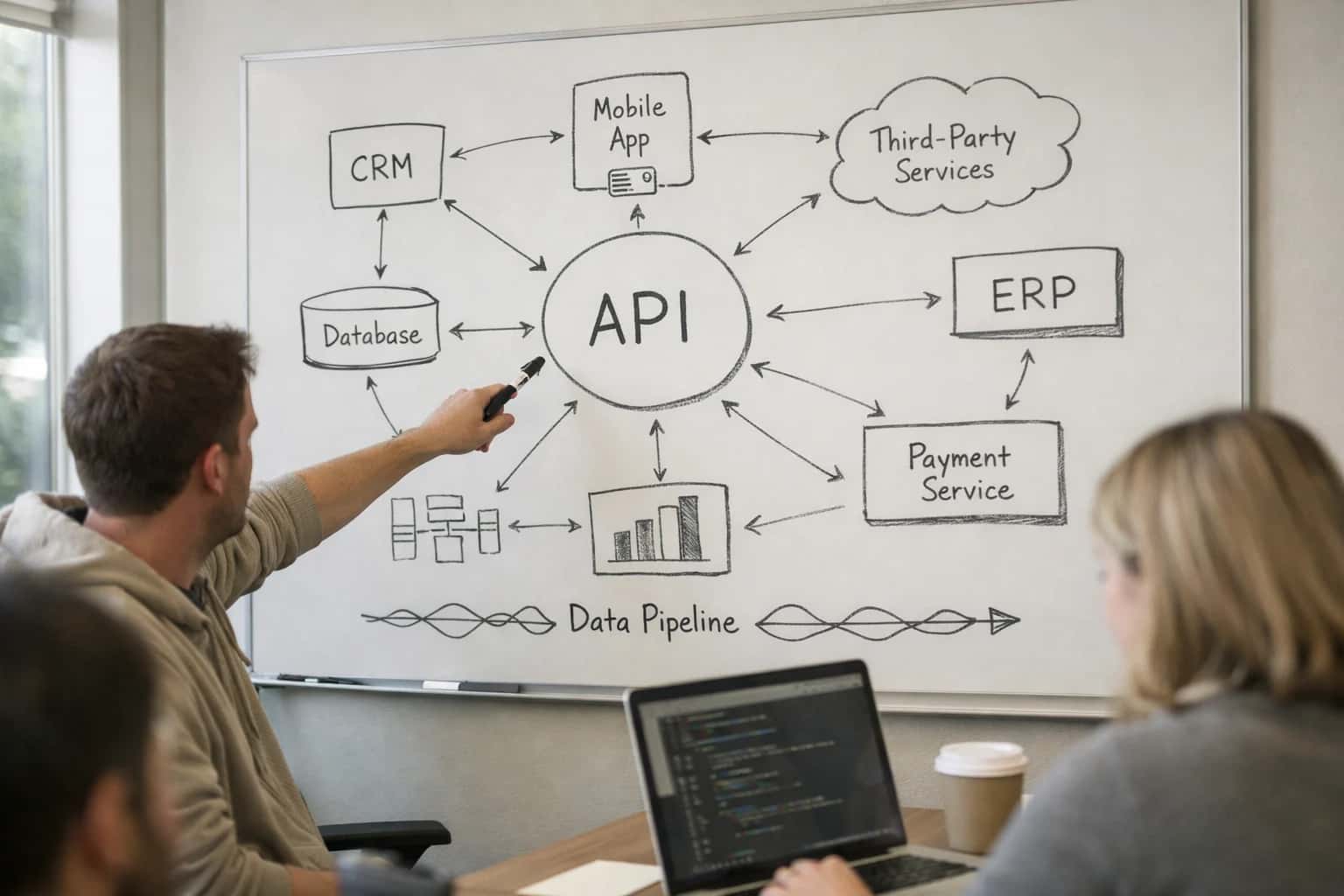
AI integration for Blackbaud SIS Billing focuses on three primary surfaces: the Tuition Management module for calculating charges and generating invoices; the Payment Plans and Agreements engine for managing installments and contracts; and the Family Portal for handling inquiries and communications. The integration connects via Blackbaud's Core API and SKY API to read billing records, student enrollment data, and family contact information, and to write back payment notes, updated agreement statuses, and triggered communication logs. Key objects include BillingSchedules, InvoiceLineItems, PaymentPlans, and Constituent records, which serve as the foundation for AI-driven automation.

Integration
AI Integration with Blackbaud SIS Billing
Automate tuition calculation, invoice generation, and payment plan communication in Blackbaud SIS using AI for exception handling and personalized family financial conversations.
ARCHITECTURE FOR TUITION AUTOMATION AND FAMILY FINANCE
Where AI Fits into Blackbaud SIS Billing
A technical blueprint for embedding AI into Blackbaud SIS billing workflows to automate exception handling, personalize family communications, and streamline financial operations for private and independent schools.
Implementation typically involves an event-driven architecture where webhooks from Blackbaud SIS notify an AI orchestration layer of key events—such as a new invoice being generated, a payment plan falling into arrears, or a family submitting a portal message. An AI agent then processes the event: for a tuition calculation exception (e.g., a partial-year enrollment or sibling discount), it can review the student's EnrollmentRecord and applicable DiscountPolicies, draft a corrected invoice line item with a reasoning summary, and route it for a bursar's approval via a task in Blackbaud. For personalized family financial conversations, the system can analyze a family's payment history, open balances, and past communication to generate a tailored, empathetic message suggesting a revised payment plan, which is then queued for review before being sent via the SIS's integrated email or posted as a secure portal message.
Rollout requires a phased approach, starting with read-only analysis and alerting before progressing to write-back actions with human-in-the-loop approvals. Governance is critical: all AI-generated invoice adjustments, payment plan modifications, and outbound communications must be logged in Blackbaud's audit trail with a clear attribution to the AI agent and the approving staff member. Schools should establish guardrails around monetary thresholds and sensitive family situations (e.g., financial hardship flags) that always require manual review. This approach moves billing operations from reactive, manual exception handling to a proactive, assisted workflow—reducing the time from days to hours for complex billing scenarios and enabling the bursar's office to focus on high-touch family support rather than data entry and routine inquiries.
PLATFORM SURFACES
Key Blackbaud SIS Billing Surfaces for AI Integration
Tuition & Fee Rules Engine
The core logic for calculating charges resides in Blackbaud's tuition and fee rules. AI can integrate here to handle exceptions, automate complex calculations, and provide personalized payment plan recommendations.
Integration Points:
- Rule Evaluation API: An AI agent can be triggered before final invoice generation to review student records (e.g., financial aid awards, sibling discounts, payment history) and suggest rule overrides or adjustments.
- Scenario Modeling: Use AI to simulate different tuition scenarios for families based on variable inputs (e.g., payment frequency, scholarship eligibility) and present optimized options.
- Exception Logging: Automatically categorize and log exceptions handled by AI (e.g., pro-rated charges for mid-year enrollment) into the student's billing notes for auditability.
This moves billing from a rigid, batch-processed system to a dynamic, context-aware operation, reducing manual review for the business office.
TUITION, FEES, AND PAYMENT PLAN AUTOMATION
High-Value AI Use Cases for Blackbaud Billing
Integrate AI directly into Blackbaud SIS billing workflows to automate exception handling, personalize family financial conversations, and reduce manual reconciliation. These patterns connect to core billing objects, payment schedules, and communication logs.
01
Automated Tuition Exception Review
AI reviews billing adjustments, late fees, and payment plan change requests against school policy and family history. Workflow: Agent monitors the BillingAdjustment queue, evaluates requests using payment history and enrollment data, and drafts approval/denial notes for the Bursar. Value: Reduces manual case review from hours to minutes and ensures consistent policy application.
Hours -> Minutes
Case review time
02
Personalized Payment Plan Communication
Generates and sends context-aware payment reminders, plan confirmations, and financial hold explanations. Workflow: Agent triggers on PaymentSchedule updates or low-balance alerts, pulls family communication preferences and past interactions, and drafts personalized emails/SMS via the SIS communication module. Value: Improves on-time payment rates and reduces inbound calls to the business office.
Batch -> Real-time
Communication mode
03
Invoice Anomaly & Discrepancy Detection
AI scans generated invoices against student enrollment records (course loads, extracurriculars, dorm assignments) to flag potential billing errors before distribution. Workflow: After nightly invoice batch runs, agent compares InvoiceLineItem data with active Enrollment and StudentActivity records, creating a discrepancy report for finance team review. Value: Prevents costly corrections and maintains trust with families.
Same day
Error detection
04
Financial Aid & Scholarship Packaging Support
Assists financial aid officers by analyzing application documents and suggesting award packages that align with fund guidelines and institutional priorities. Workflow: Agent ingests PDFs from the FinancialAidDocument table, extracts key data, and cross-references with donor restrictions and available budget to generate packaging scenarios. Value: Accelerates award letter generation and optimizes fund utilization.
1 sprint
Implementation timeline
05
Collections Triage & Workflow Routing
AI prioritizes past-due accounts and recommends the next best action (payment plan offer, external collections, hold placement) based on balance, history, and family engagement. Workflow: Agent analyzes aged AccountsReceivable data daily, scores each account, and creates prioritized task lists in the Bursar's queue within Blackbaud, with suggested communication templates. Value: Focuses staff effort on highest-impact accounts and standardizes collections processes.
Hours -> Minutes
Queue prioritization
06
Contract & Enrollment Agreement Generation
Drafts annual enrollment contracts and financial agreements by merging standardized clauses with family-specific terms (tuition, payment plan, fees). Workflow: Triggered by an admissions decision or re-enrollment milestone, the agent pulls data from the Prospect/Student and BillingSetup tables to populate a contract template, flagging any non-standard terms for legal review. Value: Eliminates manual drafting errors and accelerates the enrollment pipeline.
Batch -> Real-time
Document generation
BLACKBAUD SIS BILLING
Example AI-Powered Billing Workflows
These concrete workflow examples show how AI agents and automation can be wired into Blackbaud SIS's billing and financial aid modules to handle exceptions, personalize communications, and reduce manual administrative tasks.
Trigger: A new enrollment contract is submitted or a family's financial profile is updated in Blackbaud SIS.
Context Pulled: The agent retrieves the student's record, family financial aid application data, any sibling discounts, payment plan history, and the school's tuition schedule and policy rules.
AI Agent Action:
- Calculates the base tuition and applicable fees.
- Applies configured discounts (multi-child, early payment, etc.).
- Key AI Step: Reviews the financial aid application notes and uploaded documents (tax forms, statements) using a document intelligence model to identify special circumstances (e.g., job loss, medical expenses) not captured in standard forms.
- Flags the account for a financial aid officer's review if the AI detects a high-confidence exception or a discrepancy between stated need and documented assets.
- Generates a draft award letter with a personalized explanation of the calculation.
System Update: The draft award package and a summary of the AI's findings (including confidence scores and extracted data points) are posted to the student's financial record in Blackbaud SIS for officer review and approval.
Human Review Point: The financial aid officer reviews the AI's flag, the extracted circumstance data, and the draft award. They can adjust, approve, or send back for recalculation with additional guidance.
CONNECTING AI TO BLACKBAUD SIS BILLING MODULES
Implementation Architecture: Data Flow & Integration Patterns
A production-ready blueprint for integrating AI agents and automation into Blackbaud SIS billing workflows.
The integration connects to Blackbaud SIS's core billing and accounts receivable modules—primarily the Student Billing and Accounts Receivable tables—via its RESTful APIs and webhooks. Key data objects include Tuition Plans, Invoice Line Items, Payment Schedules, and Family Account records. The AI layer acts as an orchestration engine that listens for events like InvoiceGenerated, PaymentPosted, or PlanExceptionFlagged. It then processes the associated data—such as invoice amounts, payment history, and family contact info—to trigger personalized communications, calculate alternative payment scenarios, or route complex exceptions for human review within the SIS interface.
A typical workflow begins when a new invoice is posted. An AI agent analyzes the invoice against the family's payment history and current balance. For standard on-time payments, it can automatically generate and send a personalized payment reminder via the SIS's communication toolkit. For past-due accounts or complex payment plan requests, the agent retrieves the full Family and Student record context, uses a rules engine to evaluate eligibility for adjustments, and drafts a tailored communication for the bursar's office to review and send. This reduces manual follow-up from days to hours and ensures policy consistency. The system logs all AI-generated actions and drafts in a dedicated audit table linked to the SIS's native audit trail for compliance.
Rollout is phased, starting with read-only data analysis and draft generation for staff approval before enabling fully automated, closed-loop communication for low-risk scenarios. Governance is critical: all AI-suggested payment plan adjustments or fee waivers require a human-in-the-loop approval step recorded in the SIS, and prompts are regularly evaluated for fairness and accuracy. This architecture ensures the AI augments—rather than replaces—the nuanced financial conversations essential in independent school communities. For related patterns on integrating AI with core SIS academic data, see our guide on AI Integration with Blackbaud SIS Academic Operations.
BLACKBAUD SIS BILLING AUTOMATION
Code & Payload Examples
Handling Billing Exceptions with AI
When a family's financial situation doesn't fit standard tuition models, AI can review supporting documents and recommend adjustments. This agent workflow connects to Blackbaud's FinancialTransaction API to create credits or payment plan modifications.
Example Agent Logic:
- Trigger: Exception form submitted via Blackbaud SIS webhook.
- Retrieve: Pull student's
FinancialAccountdetails and historical payment data. - Analyze: Use an LLM to review uploaded PDFs (tax forms, letters) and summarize the hardship case.
- Decide: Based on school policy rules (prompt-defined), recommend:
PaymentPlanAdjustment,PartialScholarship, orDeferral. - Act: If approved via human-in-the-loop, call the SIS API to create the adjustment and log the rationale in the
StudentGeneralnotes.
python# Pseudo-code for exception review agent def handle_billing_exception(exception_id): # Fetch data from Blackbaud SIS student_data = blackbaud_api.get(f"financialaccounts?studentId={exception_id}") documents = document_store.get_attachments(exception_id) # AI Analysis context = f"Student: {student_data['name']}. Balance: {student_data['balance']}.\n" context += f"Documents: {summarize_documents_with_ai(documents)}" prompt = f"""Given this student's financial account and hardship documents: {context} School Policy: Tuition adjustments up to 15% for documented hardship. Payment plans can be extended to 24 months. Recommend an action: 'PaymentPlanAdjustment', 'PartialScholarship', or 'Deny'. Provide a one-sentence reason.""" recommendation = llm_call(prompt) return create_review_task(exception_id, recommendation) # Send to Bursar for approval
AI-ASSISTED BILLING OPERATIONS
Realistic Time Savings & Operational Impact
How AI integration transforms manual, exception-heavy billing workflows in Blackbaud SIS, reducing administrative burden and improving family financial experience.
| Billing Workflow | Before AI | After AI | Notes |
|---|---|---|---|
Tuition exception review | Manual case-by-case analysis | AI-assisted flagging & recommendation | Finance officer reviews AI-suggested adjustments for policy compliance |
Invoice generation for complex families | Hours of manual calculation & entry | Minutes with automated draft generation | AI pulls from SIS records, applies discounts, splits by household; human final review |
Payment plan communication | Generic email blasts or manual calls | Personalized, scenario-based messaging | AI drafts messages based on balance, history, and preferred contact channel |
Financial hold resolution | Reactive, student-initiated inquiries | Proactive outreach with resolution options | AI identifies holds, suggests next steps (e.g., payment plan, document submission), triggers workflow |
Fee waiver & scholarship application triage | Paper/PDF intake, manual eligibility check | Document intake & initial eligibility scoring | AI extracts data from submitted forms, checks against SIS records; officer makes final award decision |
Billing inquiry response | Staff researches SIS and finance modules | AI-powered assistant provides instant context | Chatbot answers common questions using real-time SIS data; complex cases escalated with full context |
End-of-term reconciliation & reporting | Days of spreadsheet work and cross-checking | Automated anomaly detection & report drafting | AI highlights discrepancies (e.g., unpaid balances vs. expected), generates narrative for board reports |
IMPLEMENTATION BLUEPRINT
Governance, Security & Phased Rollout
A practical guide to deploying AI for Blackbaud SIS billing with controlled risk and measurable impact.
A production-grade AI integration for Blackbaud SIS billing must operate within the platform's existing security model. This means AI agents should authenticate via dedicated service accounts with role-based access control (RBAC) scoped strictly to the necessary Tuition Plans, Student Billing Accounts, and Payment records. All AI-generated outputs—like personalized payment plan explanations or exception summaries—should be written to a custom object or note field with a clear audit trail, linking back to the source data and the prompting logic used. This ensures every AI-suggested action is traceable and reversible, maintaining the integrity of your financial records.
We recommend a phased rollout to de-risk implementation and demonstrate value incrementally. Phase 1 focuses on read-only analysis: deploy an AI agent to review batches of Invoice records for common anomalies (e.g., duplicate charges, misapplied discounts) and generate exception reports for human review. Phase 2 introduces assisted communication: the agent drafts personalized messages for families with past-due balances or complex payment plans, which are queued in a Communication History object for advisor approval and sending via Blackbaud's built-in tools. Phase 3 enables conditional automation, where the agent can execute low-risk actions—like applying a standard late fee waiver based on a verified policy—but only after logging a proposed action for a configurable approval window.
Governance is maintained through a centralized Prompt Registry and regular quality audits. Key billing logic and family-facing language are codified in version-controlled prompts, not buried in code. Weekly, finance leads should review a sample of AI-handled cases against a checklist: Was the calculation correct? Was the communication tone appropriate? Was the action justified? This closed-loop feedback is used to refine the agents. By anchoring the integration to specific Blackbaud SIS objects and adopting a human-in-the-loop approach for sensitive financial actions, schools can automate tedious work while preserving oversight, ultimately shifting staff focus from transaction processing to strategic family financial counseling.
Enabling Efficiency, Speed & Accuracy
Intelligent Analysis, Decision & Execution
We build AI systems for teams that need search across company data, workflow automation across tools, or AI features inside products and internal software.
Talk to Us
Search across company data
Give teams answers from docs, tickets, runbooks, and product data with sources and permissions.
Useful when people spend too long searching or get different answers from different systems.
Enterprise searchRAGPermissions
Read more
Automate internal workflows
Use AI to route work, draft outputs, trigger actions, and keep approvals and logs in place.
Useful when repetitive work moves across multiple tools and teams.
AI agentsWorkflow automationGovernance
Read more
Add AI to products and internal tools
Build assistants, guided actions, or decision support into the software your team or customers already use.
Useful when AI needs to be part of the product, not a separate tool.
AI integrationDecision supportModel routing
Read moreIMPLEMENTATION AND WORKFLOW DETAILS
Frequently Asked Questions
Practical questions about integrating AI into Blackbaud SIS billing operations, covering architecture, security, rollout, and specific automation workflows.
AI integrations connect to Blackbaud SIS via its REST APIs and webhooks using a dedicated service account with granular, role-based permissions.
Typical Security Pattern:
- A service principal is created in Blackbaud SIS with permissions scoped only to the necessary objects:
Student billing records,Payment plans,Financial transactions, andFamily contact information. - The AI service runs in a secure VPC, never storing raw SIS data long-term. It uses the service account's OAuth 2.0 tokens for API calls.
- All data updates (e.g., applying a payment, adjusting a plan) are performed via idempotent API calls and logged to a separate audit trail. The AI system proposes changes; a human-in-the-loop or automated rule can approve them before the API call is executed.
- For document processing (e.g., scanning uploaded bank statements), files are processed in a transient, encrypted workspace and deleted after data extraction.
This ensures compliance with FERPA and school data governance policies while enabling automation.

About the author
Prasad Kumkar
CEO & MD, Inference Systems
Prasad Kumkar is the CEO & MD of Inference Systems and writes about AI systems architecture, LLM infrastructure, model serving, evaluation, and production deployment. Over 5+ years, he has worked across computer vision models, L5 autonomous vehicle systems, and LLM research, with a focus on taking complex AI ideas into real-world engineering systems.
His work and writing cover AI systems, large language models, AI agents, multimodal systems, autonomous systems, inference optimization, RAG, evaluation, and production AI engineering.
LinkedIn
Limited slotsGet a Free AI Consultation
Partnered with leading AI, data, and software stack.





How We Work
Custom AI workflows for your Business
One-fit-all AI don't work for modern businesses. At Inferensys, we aim to understand your business & custom requirements; which we use to define most efficient agentic workflows, the data, and the tools for your business.
01
Review the use case
We understand the task, the users, and where AI can actually help.
Read more02
Pick the right approach
We define what needs search, automation, or product integration.
Read more03
Build the first useful version
We implement the part that proves the value first.
Read more04
Improve from there
We add the checks and visibility needed to keep it useful.
Read moreThe first call is a practical review of your use case and the right next step.
Talk to Us