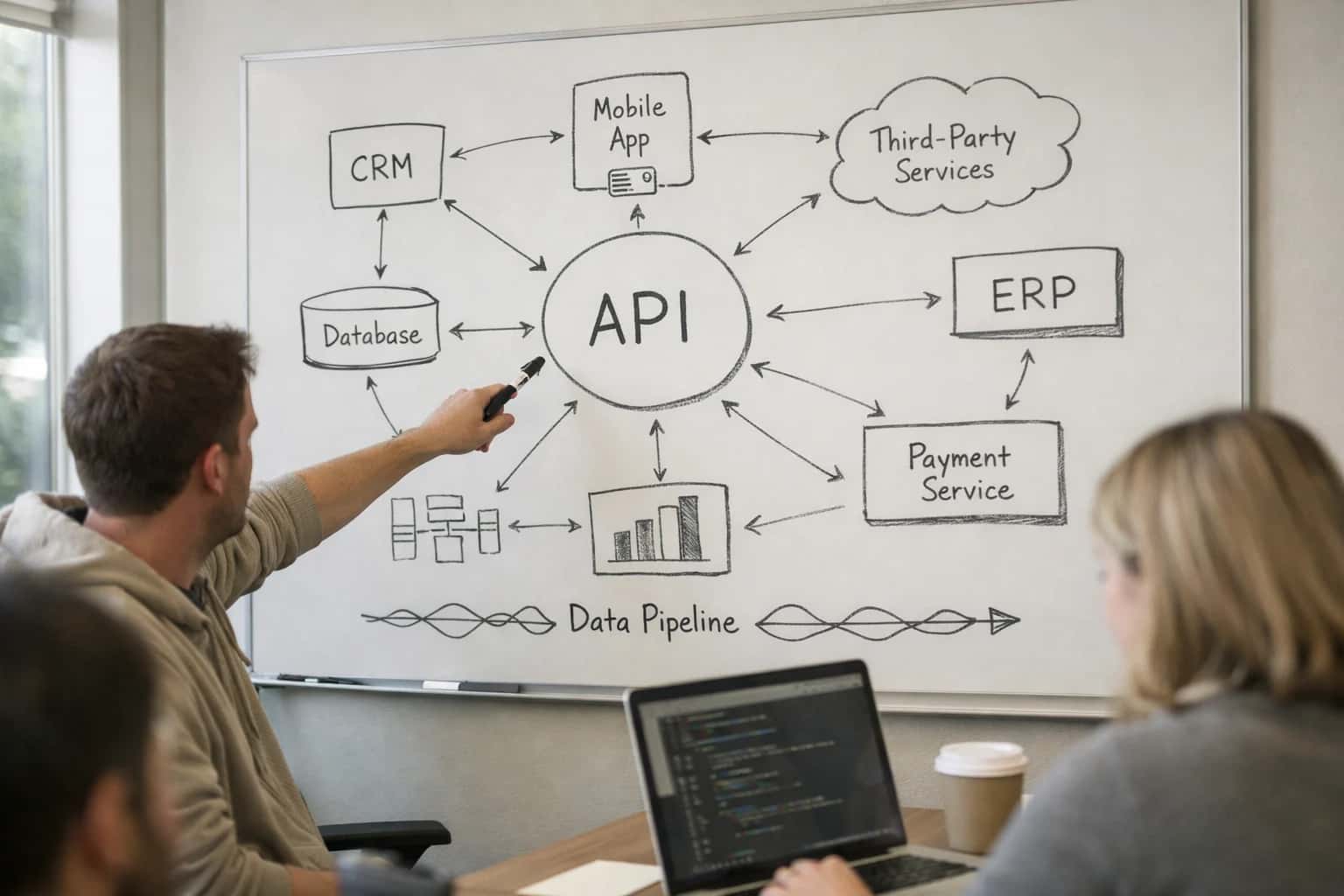
For multi-location or franchise operations, AI cannot be deployed in silos. A centralized integration architecture connects to the API endpoints and webhook streams of each location's software instance, creating a single intelligence layer. This layer aggregates data—client profiles, appointment patterns, inventory levels, staff performance—into a unified vector store or data lake. From this central hub, AI models power workflows that require cross-location context, such as predicting regional demand spikes, identifying clients who frequent multiple locations, or optimizing staff transfers based on real-time booking pressure across your portfolio.

Integration
AI Integration for Multi-Location Salon Management
Architecture for enterprise-grade AI that centralizes intelligence across multiple software instances or franchise units, enabling consistent guest experiences and aggregated performance analytics.
ENTERPRISE ARCHITECTURE
Centralizing AI Across Your Salon or Spa Locations
A technical blueprint for deploying a unified AI layer across multiple instances of Fresha, Zenoti, Mangomint, or Vagaro.
Implementation requires a gateway service that normalizes API calls and data models across different platforms (e.g., Zenoti's enterprise objects vs. Fresha's RESTful endpoints). Core workflows include: - Centralized Waitlist Management: An AI agent monitors cancellations and no-show risk scores across all locations, automatically offering freed-up slots to waitlisted clients at nearby studios. - Aggregated Performance Analytics: A natural language interface allows regional managers to ask questions like "Which locations had the highest retail attachment last week?" against combined data. - Consistent Guest Experience: AI-generated communications (confirmations, feedback requests) follow brand voice and compliance rules across all units, managed from a single prompt library and approval workflow.
Rollout is phased, starting with read-only data synchronization and non-critical workflows like aggregated reporting. Governance is critical: define role-based access controls (RBAC) so location managers only see insights for their units, while corporate can view trends. Audit logs must track every AI-generated action back to the source location and user. This architecture, built by Inference Systems, ensures your AI investment scales with your business, providing franchise-wide intelligence without sacrificing local operational autonomy or overloading individual software instances.
AI ARCHITECTURE FOR ENTERPRISE SALON & SPA CHAINS
Integration Surfaces for Multi-Location Platforms
Unify Intelligence Across Locations
For multi-location chains, the first integration surface is a centralized data aggregation layer. This hub ingests standardized data feeds from each franchise or corporate unit's instance of Zenoti, Fresha, or Mangomint via their reporting APIs or webhook ecosystems.
Key integration points include:
- Daily performance extracts: Revenue, appointments, client counts, and average ticket value.
- Aggregated client profiles: Anonymized visit history, service preferences, and lifetime value across locations.
- Unified inventory levels: Product stock and consumable usage across all warehouses and backbars.
- Staff performance metrics: Productivity, retention, and cross-location utilization.
This hub enables AI models to train on enterprise-wide patterns, identifying regional trends, predicting chain-wide demand, and benchmarking location performance against aggregated norms. Governance is critical: implement role-based access so a regional manager sees only their territory's data, while corporate analytics get the full picture.
MULTI-LOCATION OPERATIONS
High-Value Use Cases for Chains and Franchises
For salon and spa chains, AI integration centralizes intelligence across disparate software instances, enabling consistent guest experiences, aggregated analytics, and scalable operational automation.
01
Centralized Guest Experience Orchestration
Deploy a unified AI layer that connects to the booking, client, and communication APIs of each location's instance (e.g., Fresha, Zenoti). This agent standardizes welcome sequences, post-visit follow-ups, and loyalty communications across the brand, ensuring a cohesive guest journey regardless of the local franchisee's software configuration.
Batch -> Real-time
Communication Sync
02
Aggregated Performance & Anomaly Detection
Build an AI analytics pipeline that ingests daily performance data (sales, traffic, no-show rates) from each location's reporting APIs. The system identifies underperforming units, flags anomalous transactions for fraud, and provides regional managers with automated, comparative insights, moving from manual spreadsheet consolidation to proactive intelligence.
1 sprint
Insight Delivery
03
Cross-Location Waitlist & Capacity Optimization
Integrate AI with the real-time calendar APIs of adjacent locations. When one salon is fully booked, the AI can suggest nearby availability to the client, automatically manage inter-location waitlists, and even facilitate therapist transfers based on skill matching and demand forecasting, maximizing overall chain utilization.
Hours -> Minutes
Client Rebooking
04
Unified Inventory & Procurement Intelligence
Connect AI to product and vendor modules across all franchise software instances. The system aggregates retail and consumable usage data to predict chain-wide stock-outs, automate bulk purchase orders with negotiated pricing, and identify top-selling products for centralized marketing campaigns, turning fragmented inventory into a strategic advantage.
Same day
Reorder Alerts
05
Standardized Compliance & Audit Workflows
Implement AI agents that monitor booking data, service notes, and staff certifications from each location against regional regulatory requirements. The system automates audit trail generation, flags expired licenses for renewal, and ensures consistent safety protocol adherence across all units, reducing corporate liability and manual oversight.
06
Corporate Training & Knowledge Dissemination
Leverage a RAG-based AI copilot trained on centralized training manuals, SOPs, and marketing playbooks. This agent integrates with location-level staff communication tools (or the platform's internal notes) to answer procedural questions, guide new promotion rollouts, and ensure consistent service execution and brand messaging franchise-wide.
CENTRALIZED INTELLIGENCE FOR ENTERPRISE CHAINS
Example Multi-Location AI Workflows
For multi-location salon and spa groups, AI integration must work across separate software instances or franchise units. These workflows demonstrate how to centralize intelligence, enforce brand standards, and unlock aggregated analytics while respecting local autonomy.
Trigger: A client cancels an appointment at Location A.
Context/Data Pulled:
- The AI agent receives a webhook from the salon platform (e.g., Zenoti) with the canceled appointment details (service, time, therapist).
- It queries a central vector database containing anonymized client profiles and preferences from all locations.
- It checks real-time availability for the same service type at nearby locations (B, C) via their respective platform APIs.
Model/Agent Action:
- The AI matches the canceled slot against a ranked list of waitlisted clients from any location who have expressed willingness to travel and whose preferences align with the service/therapist.
- It generates a personalized SMS/email offer: "A slot just opened with a master colorist at our Downtown location, 10 minutes from you. Would you like to claim it?"
System Update/Next Step:
- If the client accepts via reply, the AI agent uses the target location's API to book the appointment and remove them from the central waitlist.
- The original location's calendar is updated to reflect the filled slot, protecting revenue.
Human Review Point: A regional manager dashboard flags any cross-location fills for revenue attribution analysis.
CENTRALIZED AI FOR DISTRIBUTED OPERATIONS
Implementation Architecture: Hub, Spoke, and Sync
A practical blueprint for deploying enterprise-grade AI across a multi-location salon or spa brand without disrupting local software instances.
For chains using platforms like Zenoti, Fresha, or Mangomint, the core challenge is enabling consistent AI-driven guest experiences and aggregated analytics while respecting local autonomy. The 'Hub, Spoke, and Sync' model addresses this by deploying a central AI Hub—a cloud service that hosts your AI models, agents, and a unified data layer—that connects via secure APIs to each location's Spoke (the individual software instance). The Hub ingests key data streams (appointments, client profiles, transactions) on a scheduled or event-driven basis using platform-specific webhooks and sync APIs. This creates a 'single pane of glass' for AI without requiring a disruptive platform migration.
The AI Hub executes workflows that span locations, such as predicting chain-wide demand for a new service or identifying high-value clients who visit multiple sites. It then syncs actionable intelligence back to the Spokes. For example, a centralized no-show prediction model can score appointments across all locations; when a high-risk booking is detected, the Hub triggers a personalized confirmation sequence via the local platform's communication APIs. Similarly, a centralized RAG system can power a brand-wide FAQ agent on your website, which queries the Hub for real-time availability pulled from all location calendars, then books directly into the correct local Spoke.
Rollout is phased: start with a single high-value workflow (e.g., centralized waitlist management) in a pilot location. Governance is critical: implement role-based access in the Hub so franchisees only see their data, and maintain detailed audit logs of all AI-generated actions (like sent messages or booked appointments) for compliance. This architecture future-proofs your investment, allowing you to add new AI capabilities—like a chain-wide personalization engine or predictive inventory—to the Hub without modifying each local software instance.
ARCHITECTURE FOR CENTRALIZED INTELLIGENCE
Code and Payload Examples
Aggregating Data for Centralized AI
A multi-location architecture requires a unified data layer. This typically involves a scheduled ETL job or streaming pipeline that pulls key records from each franchise's separate software instance into a central data warehouse. The AI models then operate on this aggregated dataset.
Example Python payload for a batch aggregation job:
python# Pseudo-code for aggregating daily sales from multiple Zenoti instances import requests locations = [ {'instance_id': 'salon_nyc_01', 'api_key': 'key_abc', 'base_url': 'https://nyc01.api.zenoti.com'}, {'instance_id': 'salon_la_02', 'api_key': 'key_xyz', 'base_url': 'https://la02.api.zenoti.com'} ] aggregated_sales = [] for loc in locations: headers = {'Authorization': f'Bearer {loc["api_key"]}'} # Fetch sales for the last 24 hours response = requests.get( f"{loc['base_url']}/v1/reports/sales/daily", headers=headers, params={'date': '2024-05-15'} ) data = response.json() for sale in data['sales']: sale['source_instance'] = loc['instance_id'] aggregated_sales.append(sale) # Send aggregated data to central AI service for forecasting ai_payload = { 'analysis_type': 'demand_forecast', 'locations_data': aggregated_sales } # ai_service.predict(ai_payload)
This pattern enables training models on consolidated business performance, client behavior, and inventory trends across the entire chain.
ENTERPRISE MULTI-LOCATION OPERATIONS
Realistic Time Savings and Business Impact
How AI integration centralizes intelligence and automates workflows across franchise units or software instances, shifting effort from manual coordination to strategic oversight.
| Metric | Before AI | After AI | Notes |
|---|---|---|---|
Cross-location performance reporting | Weekly manual export and spreadsheet consolidation | Daily automated dashboard with anomaly alerts | Aggregates data from all software instances; flags outliers for regional managers |
Brand-wide marketing campaign execution | Manual brief distribution and inconsistent local execution | Central AI generates localized content; deploys via platform APIs | Ensures brand consistency while personalizing for local clientele |
Multi-unit staff scheduling and coverage | Phone calls and emails to coordinate shift swaps across locations | AI-powered internal marketplace suggests and approves swaps | Uses aggregated demand forecasts to maintain service levels |
Enterprise-wide inventory reordering | Individual location managers place orders; no bulk discount leverage | AI predicts aggregate demand, suggests centralized purchase orders | Negotiates better supplier rates; prevents stock-outs at high-volume locations |
Guest experience consistency monitoring | Mystery shopper programs and sporadic review checks | AI analyzes all location reviews and feedback in real-time | Provides comparative sentiment scores and identifies training gaps |
Pricing and promotion strategy rollout | Manual updates to service menus in each software instance | AI tests pricing bundles; pushes approved changes via bulk API | Enables rapid, data-driven experimentation across the portfolio |
New location or franchisee onboarding | Weeks of manual data entry and process documentation | AI clones configured workflows and automates data migration | Reduces launch time and ensures operational standards from day one |
ENTERPRISE ARCHITECTURE FOR FRANCHISES AND CHAINS
Governance, Security, and Phased Rollout
A secure, controlled approach to deploying AI across multiple software instances, locations, and franchise units.
For multi-location operations, AI governance starts with a centralized orchestration layer that connects to individual instances of your salon management platform (e.g., separate Zenoti or Fresha databases per location). This layer acts as a secure control plane, managing API keys, enforcing data access policies, and maintaining a unified audit log of all AI interactions across the brand. Each location's client data, appointment books, and transaction records remain siloed in their respective software instances, while the AI system queries and acts upon them through strictly scoped, role-based API tokens. This architecture ensures that a salon in Miami cannot access the data or trigger automations for a salon in Seattle, unless explicitly configured for cross-location reporting or corporate oversight.
A phased rollout is critical for adoption and risk management. Phase 1 typically targets a single, high-value workflow like AI-powered booking confirmations or front-desk FAQ deflection in a pilot location. This allows you to validate the integration's data flows, measure impact on no-show rates or staff efficiency, and refine prompts and business logic without brand-wide exposure. Phase 2 expands to a cohort of locations, often enabling a second use case like aggregated performance analytics or predictive inventory alerts, while introducing location-specific configuration (e.g., custom greeting messages, local service menus). Phase 3 rolls out the full suite of AI capabilities—such as centralized customer sentiment analysis, dynamic cross-location staff scheduling, and franchise-wide marketing personalization—governed by corporate policies set in the orchestration layer.
Security is non-negotiable. All integrations must use OAuth 2.0 or API key authentication with the principle of least privilege, scoped to specific endpoints (e.g., GET /appointments, POST /sms). AI-generated actions, like sending a marketing email or modifying a booking, should pass through an approval queue or human-in-the-loop step for high-stakes or high-value transactions during initial rollout. Data sent to LLM providers for processing should be pseudonymized where possible, and all prompts, responses, and tool calls should be logged to a tamper-evident audit trail for compliance. This enables you to trace any AI-driven decision back to the source client record and API call, which is essential for franchise agreements and data privacy regulations like GDPR or CCPA.
Ultimately, this governance model turns a fragmented multi-location tech stack into a cohesive intelligence network. Franchisees benefit from localized AI automation that respects their operational autonomy, while corporate gains a unified view of trends, risks, and opportunities across the entire portfolio. For a detailed technical blueprint on connecting to specific platform APIs, see our guide on AI Integration for Zenoti or our architectural overview of API Integration with Salon Platforms.
Enabling Efficiency, Speed & Accuracy
Intelligent Analysis, Decision & Execution
We build AI systems for teams that need search across company data, workflow automation across tools, or AI features inside products and internal software.
Talk to Us
Search across company data
Give teams answers from docs, tickets, runbooks, and product data with sources and permissions.
Useful when people spend too long searching or get different answers from different systems.
Enterprise searchRAGPermissions
Read more
Automate internal workflows
Use AI to route work, draft outputs, trigger actions, and keep approvals and logs in place.
Useful when repetitive work moves across multiple tools and teams.
AI agentsWorkflow automationGovernance
Read more
Add AI to products and internal tools
Build assistants, guided actions, or decision support into the software your team or customers already use.
Useful when AI needs to be part of the product, not a separate tool.
AI integrationDecision supportModel routing
Read moreMULTI-LOCATION IMPLEMENTATION
Frequently Asked Questions
Common technical and operational questions for deploying centralized AI across a franchise or chain using platforms like Zenoti, Fresha, or Vagaro.
The standard pattern is a centralized AI service layer that connects via each location's API.
Architecture:
- API Gateway: A single, secure gateway (e.g., Kong, Apigee) manages connections to each location's instance of Zenoti, Fresha, etc., using location-specific API keys.
- Data Sync: A background process (e.g., using Airbyte or Fivetran) periodically pulls key entities—appointments, clients, transactions—into a central data store (like a data warehouse or vector database). This powers aggregated analytics and cross-location models.
- Real-Time Actions: For workflows requiring immediate action (e.g., booking a client), the AI service calls the specific location's API directly via the gateway.
Key Consideration: Ensure your AI service respects the rate limits and data isolation of each individual platform instance.

About the author
Prasad Kumkar
CEO & MD, Inference Systems
Prasad Kumkar is the CEO & MD of Inference Systems and writes about AI systems architecture, LLM infrastructure, model serving, evaluation, and production deployment. Over 5+ years, he has worked across computer vision models, L5 autonomous vehicle systems, and LLM research, with a focus on taking complex AI ideas into real-world engineering systems.
His work and writing cover AI systems, large language models, AI agents, multimodal systems, autonomous systems, inference optimization, RAG, evaluation, and production AI engineering.
LinkedIn
Limited slotsGet a Free AI Consultation
Partnered with leading AI, data, and software stack.





How We Work
Custom AI workflows for your Business
One-fit-all AI don't work for modern businesses. At Inferensys, we aim to understand your business & custom requirements; which we use to define most efficient agentic workflows, the data, and the tools for your business.
01
Review the use case
We understand the task, the users, and where AI can actually help.
Read more02
Pick the right approach
We define what needs search, automation, or product integration.
Read more03
Build the first useful version
We implement the part that proves the value first.
Read more04
Improve from there
We add the checks and visibility needed to keep it useful.
Read moreThe first call is a practical review of your use case and the right next step.
Talk to Us