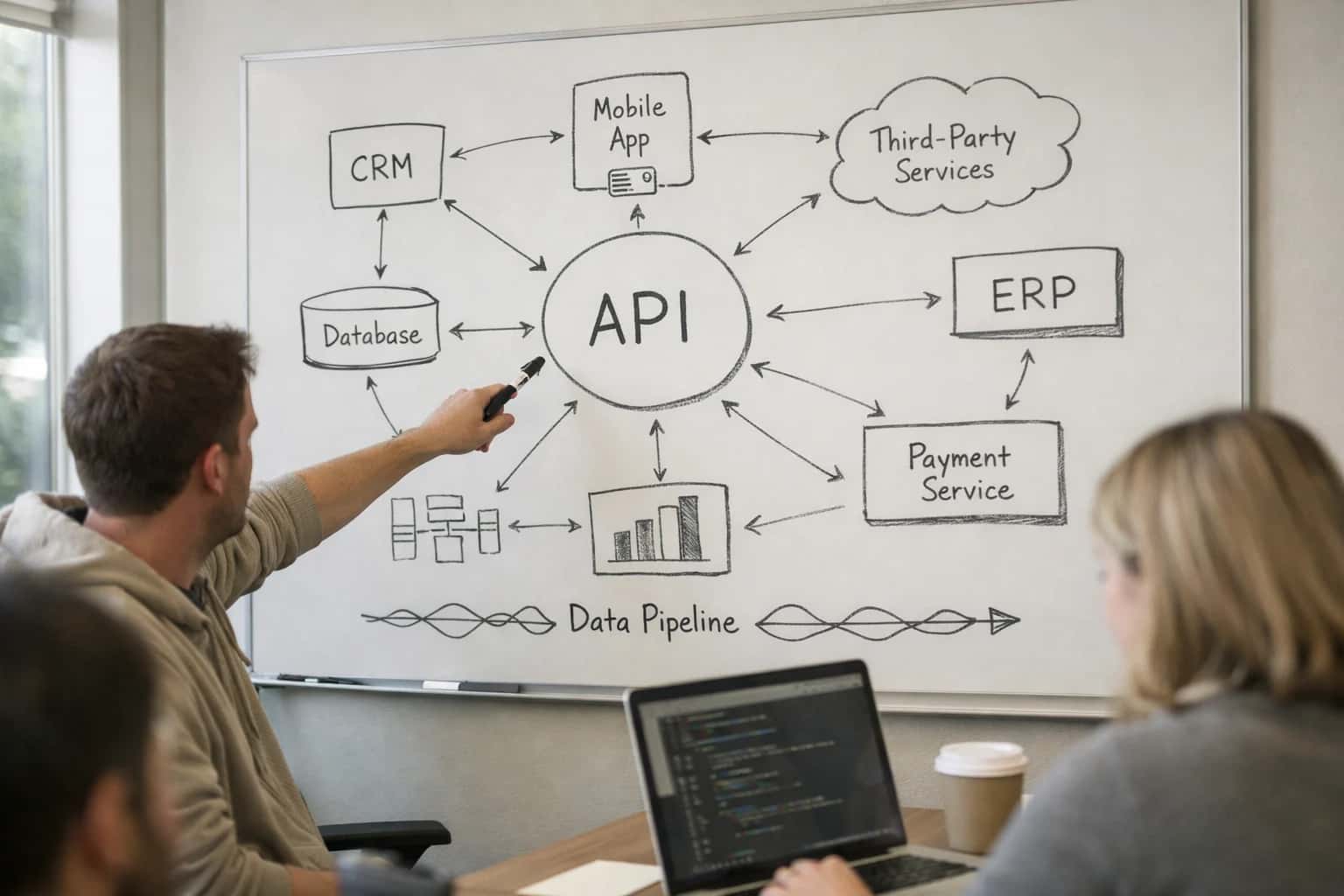
AI integration for inventory management connects to three primary surfaces within McKesson EnterpriseRx: the Inventory Master File, the Purchase Order/Receiving module, and the Supplier Catalog/API integrations. The AI agent acts as a co-pilot to the inventory manager, analyzing historical dispensing data (pulled from RxTransaction tables), current stock levels, and supplier lead times to generate daily demand forecasts and reorder suggestions. This is not a rip-and-replace; it's an augmentation layer that writes suggested purchase orders into a staging table or queue for human review and approval before being committed to the live PO system via EnterpriseRx's APIs or database extensions.

Integration
AI Integration for McKesson EnterpriseRx Inventory Management
A technical blueprint for embedding AI-driven predictive inventory and automated procurement workflows into McKesson EnterpriseRx, using its APIs and data layer to forecast demand, suggest substitutions, and generate purchase orders.
ARCHITECTURE & ROLLOUT
Where AI Fits into McKesson EnterpriseRx Inventory
A practical blueprint for integrating predictive AI into McKesson EnterpriseRx's inventory data model and purchase workflows.
The high-value workflow begins with the AI model processing a daily feed of ItemMovement and OnHandQuantity data. It correlates this with external signals like local flu trends, upcoming manufacturer rebate changes, or wholesaler allocation notices (ingested via webhook). For each SKU, it calculates a dynamic reorder point and a recommended order quantity, flagging items for potential substitution if a primary NDC is on backorder. These recommendations are surfaced in a custom dashboard or injected as alerts directly into the inventory manager's workflow within EnterpriseRx. Upon approval, the system can automatically generate a draft PO in the platform, populate line items, and even submit it to the supplier's portal via integrated APIs, logging all actions back to the AuditLog for compliance.
Rollout is typically phased, starting with a pilot on non-controlled, high-velocity generics to build trust in the model's accuracy. Governance is critical: all AI-generated orders require a pharmacist-in-the-loop approval step before submission, and the system must maintain a clear audit trail linking each PO to the AI recommendation and the approving manager. The integration uses role-based access controls (RBAC) aligned with EnterpriseRx's existing permissions, ensuring only authorized staff can view or act on suggestions. Success is measured by a reduction in stockouts of critical medications and a decrease in excess inventory carrying costs, moving from reactive ordering to a predictive, data-driven model. For related integration patterns, see our guides on AI Integration for Pharmacy Management Platform Supplier Coordination and AI Integration with PioneerRx Inventory Support.
INVENTORY MANAGEMENT
Key Integration Surfaces in McKesson EnterpriseRx
Core Data Objects and APIs
AI models for predictive inventory require real-time access to McKesson EnterpriseRx's core data layers. The primary integration surfaces are its inventory tables and supplier connectivity APIs.
Key Data Objects:
DrugMasterandInventoryOnHandtables for current stock levels, NDC details, and lot/expiry information.PurchaseHistoryandMovementTransactionlogs for historical demand patterns and seasonality.SupplierCatalogandContractPricingfeeds for cost, availability, and lead time data.
API Endpoints:
- The Inventory Web Service provides real-time stock queries and update capabilities for reorder points.
- The Purchasing API allows for the creation of purchase orders and transmission to primary wholesalers like McKesson's own distribution network.
- Event Hooks can be configured to trigger AI analysis on events like a prescription fill, a manual stock adjustment, or a received shipment.
Integrating at this layer allows AI to build a dynamic forecast model, moving beyond static min/max settings to a demand-driven replenishment system.
PREDICTIVE INTELLIGENCE & AUTOMATION
High-Value AI Use Cases for EnterpriseRx Inventory
Move beyond reactive stock management. Integrate AI directly with McKesson EnterpriseRx's inventory data model and supplier APIs to forecast demand, automate purchasing, and reduce clinical and financial waste.
01
Predictive Demand Forecasting
AI models analyze EnterpriseRx prescription history, seasonal trends, and local health data to predict medication demand 4-6 weeks out. Integrates with the platform's inventory tables to generate daily shortage risk scores for key therapeutic categories, enabling proactive ordering before stockouts impact patient care.
Stockouts → Proactive Alerts
Risk mitigation
02
Automated Purchase Order Generation
AI agents monitor reorder points and predicted demand within EnterpriseRx, then draft and submit purchase orders via McKesson's supplier APIs. The system incorporates contract pricing, generic substitution rules, and minimum order quantities. Orders are routed for pharmacist review/approval within the platform before final submission, creating a closed-loop, audit-ready workflow.
Batch → Real-time
Order cadence
03
Expiry & Waste Reduction Intelligence
Connects to EnterpriseRx's lot number and expiry date fields to provide early warnings on slow-moving inventory. AI suggests return-to-wholesaler opportunities, identifies drugs approaching expiry for priority dispensing in applicable patients, and optimizes shelf placement based on turnover rates. Reduces write-offs and improves inventory turnover ratio.
Same-day insights
Waste visibility
04
Therapeutic Substitution Guidance
When a drug is out of stock, AI scans the EnterpriseRx formulary and inventory in real-time to suggest clinically appropriate alternatives based on patient history and drug class. Presents the pharmacist with options during the verification workflow, including on-hand stock levels and cost differentials, accelerating the resolution of stock-related delays.
Minutes saved per incident
Workflow acceleration
05
Multi-Site Inventory Optimization
For health systems or chains, AI aggregates inventory data across multiple EnterpriseRx instances to enable smart inter-store transfers. Models identify surplus at one location and shortage at another, suggesting transfers to balance stock and avoid external orders. Integrates with the platform's transfer module to automate request creation and tracking.
Reduce excess stock
Capital efficiency
06
Supplier Performance & Contract Analytics
AI analyzes order fulfillment data from supplier APIs and reconciles it with EnterpriseRx purchase orders. Tracks metrics like fill rate, backorder frequency, and shipping accuracy. Evaluates contract compliance and identifies cost-saving opportunities by comparing actual spend against formulary tiers and preferred generic lists, reporting insights within the platform's admin dashboard.
Actionable reporting
Negotiation leverage
MCKESSON ENTERPRISERX
Example AI-Driven Inventory Workflows
These workflows demonstrate how AI agents integrate directly with McKesson EnterpriseRx's inventory data model and supplier APIs to automate forecasting, ordering, and exception handling, reducing stockouts and waste.
Trigger: Daily batch job scans McKesson EnterpriseRx Inventory table for items below a static reorder point.
Context Pulled: For each low-stock item, the AI agent queries:
- 90-day prescription
FillHistoryfor demand patterns. - Upcoming
ScheduledRefillsfrom the patient profile queue. - Local
SeasonalTrenddata (e.g., flu season, allergy season). - Supplier lead times from the integrated
SupplierCatalogAPI.
AI Action: A forecasting model analyzes the data to:
- Predict the dynamic reorder quantity needed to cover lead time + safety stock.
- Flag items where a generic substitution is available and preferred based on payer formulary rules stored in EnterpriseRx.
- Identify items approaching expiry that should be depleted before reordering.
System Update: The agent creates a draft PurchaseOrder record in EnterpriseRx via its PurchasingAPI, pre-populated with the AI-recommended quantities and substitution notes. The PO is routed to a pharmacist for final approval via the platform's standard workflow.
Human Review Point: Pharmacist reviews the suggested order, adjusts quantities if needed, and submits. All AI recommendations are logged in an AuditTrail linked to the PO.
AI-ENHANCED INVENTORY OPERATIONS
Implementation Architecture: Data Flow & System Design
A production-ready blueprint for integrating predictive AI into McKesson EnterpriseRx inventory workflows.
The integration architecture connects to three primary data surfaces within McKesson EnterpriseRx: the Inventory Master File for real-time stock levels and item attributes, the Purchase Order History for demand patterns, and the Supplier Catalog APIs for live availability and pricing. An AI inference layer, deployed as a containerized service, polls these sources via EnterpriseRx's RESTful APIs or direct database connections (where permitted) to maintain a synchronized operational data store. This store powers models that forecast demand at the NDC level, factoring in seasonality, local prescription trends, and supplier lead times.
Actionable outputs are delivered back into the pharmacy workflow through two key channels. First, low-stock alerts and substitution suggestions are injected into the platform's inventory management console via custom UI extensions or webhook-triggered notifications, allowing pharmacists to review and approve AI-generated purchase orders with one click. Second, for fully automated scenarios, approved reorder logic can trigger the creation of draft POs within EnterpriseRx's native purchasing module, following existing approval hierarchies and audit trails. This closed-loop design ensures AI recommendations are grounded in actual platform data and respect established operational controls.
Rollout follows a phased governance model, starting with a pilot on non-critical SKUs to validate forecast accuracy and system stability. A human-in-the-loop review step is mandatory in initial phases, with AI suggestions logged in a separate audit table linked to the prescription and inventory records for traceability. Post-pilot, the integration scales to cover broader formulary categories, with continuous monitoring for model drift against actual usage data. This approach minimizes operational risk while systematically unlocking efficiency gains—shifting inventory management from reactive stock checks to a proactive, data-driven operation.
AI-ENHANCED INVENTORY OPERATIONS
Code & Payload Examples
Predictive Reorder Triggers
Integrate AI models with McKesson's InventoryTransaction API to analyze historical fill rates, seasonal trends, and local script volume. The model outputs a daily forecast, which can be used to generate suggested purchase orders or adjust reorder points within the platform.
Example Python payload to fetch transaction data and call a forecasting service:
pythonimport requests import pandas as pd # 1. Pull recent inventory movement from McKesson API mckesson_api_url = "https://api.mckesson.com/enterpriserx/v1/inventory/transactions" headers = {"Authorization": "Bearer YOUR_API_KEY"} params = { "locationId": "PHARM123", "startDate": "2024-01-01", "endDate": "2024-03-31", "limit": 1000 } transactions = requests.get(mckesson_api_url, headers=headers, params=params).json() # 2. Prepare data for forecasting model df = pd.DataFrame(transactions['data']) # Aggregate daily usage by NDC usage_data = df.groupby(['ndc', 'transactionDate']).agg({'quantity': 'sum'}).reset_index() # 3. Call Inference Systems forecasting endpoint forecast_payload = { "historical_usage": usage_data.to_dict('records'), "forecast_horizon_days": 30, "confidence_level": 0.95 } forecast = requests.post("https://api.inferencesystems.com/forecast", json=forecast_payload).json() # 4. Map forecast back to McKesson inventory items for item in forecast['predictions']: # Update suggested reorder quantity in McKesson update_payload = { "ndc": item['ndc'], "suggestedReorderQty": item['predicted_need'], "forecastedShortageDate": item['shortage_date'] } # POST to custom field or external inventory planning table
AI-ENHANCED INVENTORY OPERATIONS
Realistic Time Savings & Operational Impact
This table illustrates the tangible workflow improvements and time savings achievable by integrating predictive AI models directly with McKesson EnterpriseRx's inventory data and supplier APIs.
| Inventory Workflow | Before AI Integration | After AI Integration | Implementation Notes |
|---|---|---|---|
Daily Stock-Out Risk Review | Manual review of 100+ SKUs, 1-2 hours daily | Automated alert dashboard, <15 minute review | AI flags 5-10 high-risk items; human confirms action |
Purchase Order Generation | Reactive, based on low-stock alerts or weekly counts | Proactive, system-suggested POs with one-click approval | Integrates with supplier catalogs via API; reduces emergency orders by ~30% |
Generic Substitution Suggestion | Manual lookup in supplier portal or reference guide | AI suggests alternatives at point of order, with cost/availability | Pulls from real-time supplier data; requires pharmacist final approval |
Expiry Date & Waste Management | Monthly manual audit, high risk of missed short-dated items | Weekly automated report highlighting items within 60-day window | Triggers return authorization workflows or promotional bundling suggestions |
Demand Forecasting for Seasonal Items | Based on last year's sales + gut feel, often inaccurate | Model-driven forecast using script volume, local trends, and seasonality | Pilot: 2-4 weeks of historical data sync; improves forecast accuracy by 20-40% |
Supplier Communication & Order Tracking | Phone/email follow-ups for backorders and shipment ETA | AI agent monitors supplier portals, updates EnterpriseRx status automatically | Reduces manual follow-up by 50-70%; logs all communication in platform notes |
Inventory Reporting for Management | Manual compilation from multiple platform screens, 3-4 hours weekly | Automated, insight-driven report generated daily | Highlights trends like slow-movers, margin changes, and ideal reorder points |
ARCHITECTING FOR PRODUCTION
Governance, Security, and Phased Rollout
A secure, governed implementation plan for integrating AI into McKesson EnterpriseRx inventory workflows.
Production integration with McKesson EnterpriseRx requires a zero-trust data architecture. AI agents operate via dedicated service accounts with RBAC scoped to read-only access for inventory tables (DrugInventory, PurchaseOrderHistory, SupplierCatalog) and write access only to specific suggestion fields or work queues. All API calls to McKesson's DataLink or Connect APIs are logged with full audit trails, and AI-generated purchase suggestions are treated as recommendations requiring pharmacist approval before any system-of-record update is committed. Vector embeddings of historical purchase patterns are stored in an isolated, encrypted vector database, never commingling with Protected Health Information (PHI).
A phased rollout minimizes operational risk. Phase 1 is a silent pilot: AI models run in parallel, generating demand forecasts and substitution suggestions logged to a separate dashboard without touching live workflows, allowing validation against actual stock-outs and manual orders. Phase 2 introduces human-in-the-loop automation: approved suggestions appear within the EnterpriseRx UI as click-to-confirm actions, automating the creation of draft purchase orders in the PO_Workspace module. Phase 3 expands to closed-loop automation for low-risk, high-frequency items (e.g., fast-moving generics), where AI can auto-submit POs to pre-approved suppliers, with a daily reconciliation report sent to the pharmacy manager.
Governance is continuous. We establish a pharmacy AI steering committee (pharmacist-in-charge, inventory manager, IT) to review model performance weekly, focusing on key metrics like reduction in emergency orders, decrease in expired waste, and time saved from manual counting. Prompt chains and reasoning logic are version-controlled, and any change to clinical logic (e.g., therapeutic substitution rules) triggers a formal review. This structured approach ensures the AI augments—never disrupts—the critical inventory operations within McKesson EnterpriseRx.
Enabling Efficiency, Speed & Accuracy
Intelligent Analysis, Decision & Execution
We build AI systems for teams that need search across company data, workflow automation across tools, or AI features inside products and internal software.
Talk to Us
Search across company data
Give teams answers from docs, tickets, runbooks, and product data with sources and permissions.
Useful when people spend too long searching or get different answers from different systems.
Enterprise searchRAGPermissions
Read more
Automate internal workflows
Use AI to route work, draft outputs, trigger actions, and keep approvals and logs in place.
Useful when repetitive work moves across multiple tools and teams.
AI agentsWorkflow automationGovernance
Read more
Add AI to products and internal tools
Build assistants, guided actions, or decision support into the software your team or customers already use.
Useful when AI needs to be part of the product, not a separate tool.
AI integrationDecision supportModel routing
Read moreIMPLEMENTATION DETAILS
Frequently Asked Questions
Common technical and operational questions about integrating AI for predictive inventory and automated purchasing within McKesson EnterpriseRx.
The integration uses a combination of methods to access and update data without disrupting the core platform:
-
Primary: Database Connector
- A secure, read-only replica connection to the McKesson SQL Server database (tables like
Inventory,PurchaseHistory,ItemMaster). - Scheduled or event-driven syncs pull inventory levels, movement history, and item attributes.
- A secure, read-only replica connection to the McKesson SQL Server database (tables like
-
Secondary: EnterpriseRx API
- For actions that require system-of-record updates, we use McKesson's available APIs (e.g.,
PurchaseOrderAPI,ItemAPI). - AI-generated purchase orders are submitted via API, creating native PO records in EnterpriseRx.
- For actions that require system-of-record updates, we use McKesson's available APIs (e.g.,
-
Tertiary: File Export/Import
- For environments with strict API limits, we can use scheduled EnterpriseRx report exports (CSV/XML) dropped to a secure SFTP location.
- The AI system processes these files and can generate import-ready PO files for batch upload.
Security Note: All connections use encrypted channels and service accounts with principle of least privilege (PLP) permissions, scoped only to necessary tables or API endpoints.

About the author
Prasad Kumkar
CEO & MD, Inference Systems
Prasad Kumkar is the CEO & MD of Inference Systems and writes about AI systems architecture, LLM infrastructure, model serving, evaluation, and production deployment. Over 5+ years, he has worked across computer vision models, L5 autonomous vehicle systems, and LLM research, with a focus on taking complex AI ideas into real-world engineering systems.
His work and writing cover AI systems, large language models, AI agents, multimodal systems, autonomous systems, inference optimization, RAG, evaluation, and production AI engineering.
LinkedIn
Limited slotsGet a Free AI Consultation
Partnered with leading AI, data, and software stack.





How We Work
Custom AI workflows for your Business
One-fit-all AI don't work for modern businesses. At Inferensys, we aim to understand your business & custom requirements; which we use to define most efficient agentic workflows, the data, and the tools for your business.
01
Review the use case
We understand the task, the users, and where AI can actually help.
Read more02
Pick the right approach
We define what needs search, automation, or product integration.
Read more03
Build the first useful version
We implement the part that proves the value first.
Read more04
Improve from there
We add the checks and visibility needed to keep it useful.
Read moreThe first call is a practical review of your use case and the right next step.
Talk to Us