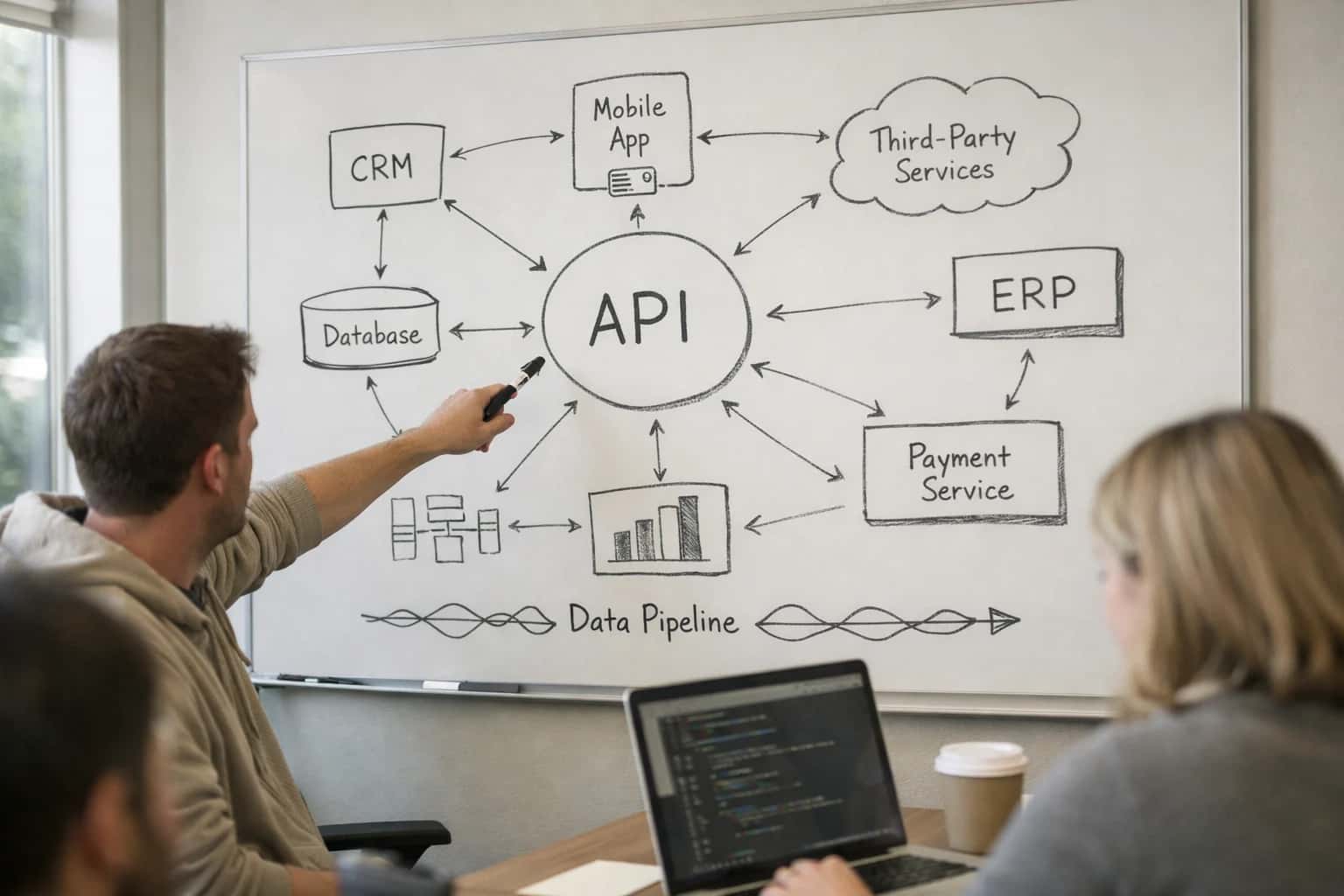
AI integration for Sectra is not a single point solution but a layered strategy that connects to its core architectural components. The primary entry points are the Vendor Neutral Archive (VNA) for data access and the Workflow Orchestrator for process automation. AI models can be triggered via DICOMweb services on study arrival in the VNA or through rules in the orchestrator, enabling automated triage and prioritization before a study even hits a radiologist's worklist. For result delivery, AI findings are embedded as DICOM Structured Reports (SR) or HL7 FHIR observations, which are then consumed by the Sectra IDS7 diagnostic workstation, the Sectra Reporting module, or specialty viewers for radiology, pathology, and cardiology.

Integration
AI Integration for Sectra Enterprise Imaging
A technical blueprint for embedding AI across the Sectra Enterprise Imaging suite—radiology, pathology, cardiology—using its workflow orchestrator and VNA to enable cross-specialty AI-driven prioritization, reporting, and clinical decision support.
ARCHITECTURE AND ROLLOUT
Where AI Fits into the Sectra Enterprise Imaging Stack
A pragmatic integration blueprint for embedding AI into Sectra's modular platform, from the VNA and workflow orchestrator to specialty-specific viewers and reporting tools.
Implementation follows a hub-and-spoke model: a central AI inference service, hosted on-premises or in a compliant cloud, acts as the hub. It connects to Sectra's APIs and listens for HL7 ADT and ORM messages or monitors DICOM destinations. When a relevant study arrives—like a non-contrast head CT for stroke—the service pulls the images, runs inference, and pushes back an SR with findings (e.g., "ASPECTS score: 8, no large vessel occlusion detected"). This SR is stored in the VNA and can be displayed as an overlay in IDS7, auto-populate report macros, or trigger an alert in the Sectra Workflow Dashboard for immediate case escalation. This keeps the radiologist in the loop while significantly accelerating the critical 'time-to-notification' for emergent findings.
Rollout and governance are critical. A phased approach typically starts with a single, high-impact workflow—such as chest X-ray triage for critical findings in the ER—within one department. This allows for validation of the integration's data pipeline, performance under load, and clinician feedback mechanisms. Governance requires tight collaboration with Sectra's professional services to configure the orchestrator rules, hanging protocols in IDS7 to display AI results, and audit trails to track AI-influenced decisions. Successful scaling depends on establishing a repeatable pattern: containerized AI models, standardized DICOM SR templates, and defined feedback loops where radiologist corrections are used to retrain models, managed through an integrated platform like our AI Governance and LLMOps services.
ARCHITECTURE BLUEPRINTS FOR EMBEDDED AI
Key Integration Surfaces in the Sectra EI Suite
The Central Nervous System for AI
The Sectra Workflow Orchestrator is the primary integration hub for AI-driven prioritization. It manages the flow of studies, tasks, and results across the enterprise. AI integration here enables:
- Dynamic Worklist Prioritization: Inject AI-derived urgency scores (e.g., critical finding probability) to reorder the radiologist's reading list in real-time.
- Automated Routing: Route studies based on AI-detected findings (e.g., send all suspected ICH cases to neuroradiology subspecialty worklists).
- Status & Result Coordination: Manage the lifecycle of an AI inference job—from DICOM send, processing, to result delivery back to the PACS viewer and reporting module.
Integration is typically achieved via RESTful APIs or HL7 messages to push/pull study metadata and orchestration commands, creating a closed-loop, AI-informed workflow.
ENTERPRISE IMAGING AI
High-Value AI Use Cases for Sectra Enterprise Imaging
Integrating AI directly into Sectra's unified platform enables cross-specialty prioritization, automated analysis, and enhanced reporting. These use cases connect to specific modules, workflows, and APIs within the Sectra Enterprise Imaging suite to deliver measurable operational impact.
01
Cross-Specialty Study Triage & Prioritization
Integrate AI detection algorithms with the Sectra Workflow Orchestrator to automatically prioritize studies across radiology, cardiology, and pathology worklists. Critical findings (e.g., ICH, PE, large LVOs) from AI pre-reads trigger HL7 ADT messages to elevate case priority, ensuring the most urgent cases are read first.
Hours -> Minutes
Critical case review
02
AI-Assisted Structured Reporting
Embed AI findings directly into Sectra Reporting and speech recognition workflows. AI-generated measurements, lesion characterizations, and differentials auto-populate structured report templates (SR-TID 1500). Radiologists verify and edit, slashing dictation time and improving report consistency.
1 sprint
Template deployment
03
Multi-Modality Correlation & Synthesis
Leverage the Sectra VNA as a unified data layer to run AI models that correlate findings across CT, MRI, and prior studies. AI identifies relevant priors, highlights interval change, and synthesizes a patient-level imaging summary for the reading radiologist, reducing search time.
Batch -> Context
Prior review
04
Pathology Whole-Slide Image Quantification
Connect containerized AI models to Sectra Pathology PACS for automated analysis of digital pathology slides. AI performs tasks like tumor cell counting, Ki-67 indexing, and PD-L1 scoring, embedding quantitative results as DICOM SR annotations directly on the slide for pathologist review.
Same day
Turnaround for stains
05
Cardiology Automated Measurements
Integrate AI contouring and quantification tools into Sectra Cardiology modules for echo and cardiac CT/MR. AI automatically segments chambers, calculates ejection fractions, and measures valve areas, pushing structured data into report drafts and hemodynamic databases.
75% faster
Measurement workflow
06
Enterprise AI Model Governance & Audit
Use Sectra's API framework to build a centralized dashboard for monitoring AI performance across specialties. Track model inference times, result concordance rates, and radiologist feedback, feeding data back to the Sectra Clinical Trials module for continuous validation and model retraining workflows.
Full audit trail
Compliance & MDR
CONCRETE IMPLEMENTATION PATTERNS
Example AI-Enhanced Workflows in Sectra
These workflows illustrate how AI agents and models connect to specific Sectra modules and APIs to automate high-impact clinical and operational tasks. Each pattern is designed for secure, auditable integration within the existing Sectra Enterprise Imaging suite.
Trigger: A new non-contrast head CT study arrives in the Sectra PACS via DICOM.
Context/Data Pulled: The AI orchestration service (e.g., a containerized service in the hospital's private cloud) monitors the Sectra PACS for new studies tagged with specific modalities (CT) and body parts (HEAD). It retrieves the study via DICOMweb WADO-RS.
Model or Agent Action: A validated intracranial hemorrhage (ICH) detection AI model runs inference on the image series. The agent generates a DICOM Structured Report (SR) containing:
- Finding: "Potential Intracranial Hemorrhage"
- Location: Laterality and lobe, if detectable.
- Confidence Score: 0.92
- Urgency Flag:
CRITICAL
System Update or Next Step: The SR is sent back to the Sectra PACS via DICOMweb STOW-RS. A Sectra Workflow Orchestrator rule is triggered by the arrival of an SR with a CRITICAL flag. This rule:
- Immediately elevates the study to the top of the designated "ER/STAT" reading worklist.
- Sends an HL7 ADT^A31 message to the hospital's middleware, triggering a secure mobile push notification to the on-call neuroradiologist via the hospital's communication platform.
- Logs the AI inference and alerting action in an audit table for governance review.
Human Review Point: The radiologist opens the prioritized study. The AI-generated SR is displayed as an interactive finding card within the Sectra viewer, allowing the radiologist to confirm, reject, or modify the finding, which feeds back into the AI model's continuous learning loop (with appropriate patient privacy safeguards).
SECURE, SCALABLE, AND CLINICALLY INTEGRATED
Implementation Architecture: Data Flow & Integration Patterns
A production-ready blueprint for embedding AI across the Sectra Enterprise Imaging suite without disrupting clinical workflows.
A robust integration for Sectra connects AI inference services to three primary surfaces: the Workflow Orchestrator for study prioritization, the Vendor Neutral Archive (VNA) for on-demand analysis of stored studies, and the specialty-specific viewer modules (Radiology, Pathology, Cardiology) for contextual result presentation. The core pattern uses DICOMweb services and HL7 v2/FHIR messages to create a secure, event-driven pipeline. When a new study arrives in the VNA, a DICOM STOW-RS operation triggers an event, queuing the study for AI processing. The AI service, hosted in a compliant cloud or on-premises environment, retrieves the study via WADO-RS, executes the model (e.g., for triage, detection, or quantification), and returns structured results as a DICOM Structured Report (SR) or FHIR Observation back to the archive. The Workflow Orchestrator then consumes these results to reprioritize the reading worklist, flagging critical cases for immediate review.
For clinician interaction, AI findings are embedded directly into the diagnostic workflow. In Sectra's IDS7 viewer, results are presented as interactive overlays, measurement annotations, or structured finding lists within the same hanging protocol. This tight integration prevents context switching and allows the radiologist or pathologist to accept, modify, or reject AI suggestions within their native reporting tool, whether it's integrated speech recognition or a structured reporting module. For cross-specialty workflows—such as a cardiology MRI informing a radiology chest CT review—AI-generated metadata (e.g., ejection fraction, lesion coordinates) is written to the VNA as DICOM SR, making it discoverable for correlated studies and enabling a unified patient timeline.
Governance and rollout are managed through Sectra's administrative consoles. AI applications are registered as discrete services with defined RBAC, ensuring only authorized users and workflows can trigger inference. An audit trail logs every AI access, inference result, and clinician interaction for compliance and model performance monitoring. A phased rollout typically starts with a single, high-impact use case like pneumothorax detection on chest X-rays in the Emergency Radiology workflow or mitotic figure counting in Sectra Pathology, deployed in a "second read" silent mode to validate performance and build clinical trust before enabling worklist prioritization or draft report generation.
SECTRA ENTERPRISE IMAGING
Code & Payload Examples for Common Integration Tasks
Triggering AI Triage on Study Arrival
When a new DICOM study arrives in the Sectra VNA or PACS, an HL7 ADT or ORM message is typically generated. You can intercept this message to trigger an AI analysis service for immediate worklist prioritization.
Example HL7 ORU^R01 Payload (Simplified):
hl7MSH|^~\&|SECTRA_PACS|HOSPITAL_A|AI_ORCHESTRATOR|INFERENCE|20250410||ORU^R01|MSG12345|P|2.5 PID|||PATIENT_789||DOE^JOHN||19700101|M PV1||I|RADIOLOGY^^^|||||||||||||||||||||||||||||||||||||202504101030 OBR|1||STUDY_456|CT CHEST W CONTRAST||||||||||||||||||||||||||||||||||||| OBX|1|ST|1101-2^LungRADS Category^LN||3||||||F
Python Webhook Handler:
pythonfrom flask import Flask, request import requests app = Flask(__name__) @app.route('/sectra-hl7-webhook', methods=['POST']) def handle_hl7(): hl7_message = request.data.decode('utf-8') # Parse PID, OBR for patient ID, study ID, modality # Call AI inference service (e.g., for Lung-RADS, PE detection) ai_result = call_ai_service(study_accession_number='STUDY_456') # Push priority score back to Sectra Workflow Manager via REST API update_worklist_priority(study_id='STUDY_456', priority_score=ai_result['acuity']) return 'OK', 200
This pattern enables same-minute triage, routing critical chest CTs (e.g., possible PE) to the top of the radiologist's list.
SECTRA ENTERPRISE IMAGING AI INTEGRATION
Realistic Time Savings and Operational Impact
How embedding AI across Sectra's radiology, pathology, and cardiology modules changes daily workflows and operational metrics.
| Workflow / Metric | Before AI Integration | After AI Integration | Implementation Notes |
|---|---|---|---|
Critical Finding Triage (e.g., ICH, PE) | Manual review of all studies in worklist order | AI-prioritized worklist with critical cases flagged first | Uses Sectra Workflow Orchestrator API; radiologist confirms all AI flags |
Report Draft Generation | Radiologist dictates full report from blank slate | AI suggests draft findings based on prior studies and detected anomalies | Integrated into Sectra Reporting; radiologist edits and finalizes |
Quantitative Analysis (e.g., tumor volume) | Manual segmentation and measurement on advanced visualization tools | AI pre-segments volumes; radiologist reviews and adjusts | Leverages Sectra 3D module; results stored as DICOM SR |
Pathology Slide Pre-screening | Pathologist reviews entire whole-slide image | AI highlights regions of interest for pathologist focus | Integrated into Sectra Pathology PACS; supports prostate, breast workflows |
Cross-modality Study Correlation | Manual search and side-by-side comparison of prior exams | AI automatically retrieves and aligns relevant priors from VNA | Uses Sectra VNA indexing; presents correlated series in hanging protocol |
Protocol Compliance & Dose QA | Periodic manual audit by physicist/technologist | AI continuously monitors protocols and flags dose outliers | Triggers alerts via Sectra Dose Monitoring dashboard; enables proactive correction |
Cardiac Function Analysis | Manual contour tracing and calculation on each study | AI automates chamber quantification and ejection fraction calculation | Integrated into Sectra Cardiology module; outputs to structured report |
Study Routing for Sub-specialty Review | Manual assignment by coordinator based on body part | AI suggests routing based on detected findings and sub-specialty rules | Configured in Sectra Workflow Manager; coordinator retains override |
ENTERPRISE DEPLOYMENT
Governance, Security, and Phased Rollout Strategy
A structured approach to deploying AI across the Sectra Enterprise Imaging suite, ensuring clinical safety, data security, and operational stability.
A production AI integration for Sectra requires a governance-first architecture that aligns with clinical and IT policies. This typically involves:
- Secure Data Pipelines: Using Sectra's Vendor Neutral Archive (VNA) and DICOMweb APIs to create read-only, de-identified data streams for AI inference, with results written back as DICOM Structured Reports (SR) or HL7 messages.
- Role-Based Access Control (RBAC): Integrating AI outputs with Sectra's user and role management, ensuring AI findings are only surfaced to authorized radiologists, cardiologists, or pathologists within their respective modules.
- Audit Trails: Logging all AI inference requests, model versions, and user interactions with AI suggestions within Sectra's native audit systems or a separate LLMOps platform for traceability and compliance.
A phased rollout mitigates risk and builds clinician trust. A common pattern is:
- Silent Validation Phase: AI runs in the background on historical studies, comparing its outputs to finalized reports without impacting the live workflow. Metrics on accuracy and drift are monitored.
- Assistive Triage Phase: AI begins to influence the worklist orchestrator in Sectra PACS, prioritizing studies with high-confidence critical findings (e.g., pneumothorax, large vessel occlusion) but requiring radiologist confirmation for all results.
- Integrated Reporting Phase: AI-generated findings are presented as draft text or structured data within the Sectra Reporting module, with the radiologist acting as editor and final signatory. This phase often starts in a single subspecialty (e.g., chest CT) before expanding.
Security is non-negotiable. The integration architecture must ensure PHI never leaves the health system's controlled environment unless using a Sectra-approved, HIPAA-compliant cloud AI service. For on-premises or private cloud deployments, AI models are containerized and deployed within the hospital's secure network, accessing imaging data through internal APIs. All communication is encrypted, and model weights are secured. A formal change control process for model updates, coupled with ongoing performance monitoring against a golden dataset, ensures the AI integration remains a reliable and safe component of the diagnostic workflow.
Successful governance also involves clear operational protocols. Define when and how radiologists should override AI suggestions, establish a feedback loop to flag incorrect AI outputs for model retraining, and integrate AI performance dashboards into existing quality assurance workflows. This structured, incremental approach transforms AI from a disruptive technology into a governed, scalable asset that enhances the Sectra platform without compromising safety or workflow integrity. For related architectural patterns, see our guides on AI Integration for Vendor Neutral Archives (VNA) and AI Integration for Radiology Reporting Platforms.
Enabling Efficiency, Speed & Accuracy
Intelligent Analysis, Decision & Execution
We build AI systems for teams that need search across company data, workflow automation across tools, or AI features inside products and internal software.
Talk to Us
Search across company data
Give teams answers from docs, tickets, runbooks, and product data with sources and permissions.
Useful when people spend too long searching or get different answers from different systems.
Enterprise searchRAGPermissions
Read more
Automate internal workflows
Use AI to route work, draft outputs, trigger actions, and keep approvals and logs in place.
Useful when repetitive work moves across multiple tools and teams.
AI agentsWorkflow automationGovernance
Read more
Add AI to products and internal tools
Build assistants, guided actions, or decision support into the software your team or customers already use.
Useful when AI needs to be part of the product, not a separate tool.
AI integrationDecision supportModel routing
Read moreSECTRA ENTERPRISE IMAGING
FAQ: Technical and Commercial Integration Questions
Answers to common technical, architectural, and commercial questions about integrating AI across the Sectra Enterprise Imaging suite, from initial proof-of-concept to enterprise-wide deployment.
Secure integration uses Sectra's published APIs and follows a sidecar architecture, keeping the primary PACS workflow untouched.
Typical Integration Pattern:
- Trigger: A DICOM study arrives in the Sectra PACS or is assigned to a worklist.
- Orchestration: A lightweight middleware service (often deployed in your data center or cloud) monitors for new studies via DICOMweb or HL7 ORM/ORU messages.
- Data Handling: The service retrieves anonymized or tokenized images via DICOMweb WADO-RS. No PHI is sent to the AI model unless explicitly configured and approved.
- Inference: The service calls the AI inference endpoint (containerized model, cloud API, or on-prem GPU cluster).
- Result Delivery: AI results are packaged as a DICOM Structured Report (SR) or HL7 FHIR Observation and sent back to the Sectra PACS via DICOMweb STOW-RS or HL7. They are linked to the original study.
- UI Integration: Results appear as a hanging protocol overlay, a separate series, or a findings panel within the Sectra IDS7 viewer. The radiologist's primary click-path remains unchanged; AI insights are presented as contextual support.
Key Security Controls:
- Integration uses your existing Sectra authentication (e.g., Active Directory).
- Data in transit is encrypted via TLS 1.3.
- AI models run in an isolated network segment.
- All data flows are logged for audit trails.

About the author
Prasad Kumkar
CEO & MD, Inference Systems
Prasad Kumkar is the CEO & MD of Inference Systems and writes about AI systems architecture, LLM infrastructure, model serving, evaluation, and production deployment. Over 5+ years, he has worked across computer vision models, L5 autonomous vehicle systems, and LLM research, with a focus on taking complex AI ideas into real-world engineering systems.
His work and writing cover AI systems, large language models, AI agents, multimodal systems, autonomous systems, inference optimization, RAG, evaluation, and production AI engineering.
LinkedIn
Limited slotsGet a Free AI Consultation
Partnered with leading AI, data, and software stack.





How We Work
Custom AI workflows for your Business
One-fit-all AI don't work for modern businesses. At Inferensys, we aim to understand your business & custom requirements; which we use to define most efficient agentic workflows, the data, and the tools for your business.
01
Review the use case
We understand the task, the users, and where AI can actually help.
Read more02
Pick the right approach
We define what needs search, automation, or product integration.
Read more03
Build the first useful version
We implement the part that proves the value first.
Read more04
Improve from there
We add the checks and visibility needed to keep it useful.
Read moreThe first call is a practical review of your use case and the right next step.
Talk to Us