Building custom AI on NetDocuments starts with its REST API and webhook system. The API provides programmatic access to the core data model—Cabinets, Workspaces, Documents, and Profiles—allowing you to read metadata, content, and permissions. For event-driven AI processing, configure webhooks on events like Document.CheckedIn, Document.VersionCreated, or Document.Deleted. This enables real-time workflows where a new contract upload triggers an AI agent for clause extraction, or a finalized pleading initiates an automated summary for matter reporting. Authentication typically uses OAuth 2.0 with scoped service accounts, ensuring AI processes operate within defined security contexts.

Integration
Custom AI Development for NetDocuments Integration
A technical deep-dive for developers and architects building custom AI applications on the NetDocuments platform, covering API integration patterns, webhook configuration, secure data handling, and production-ready architecture.
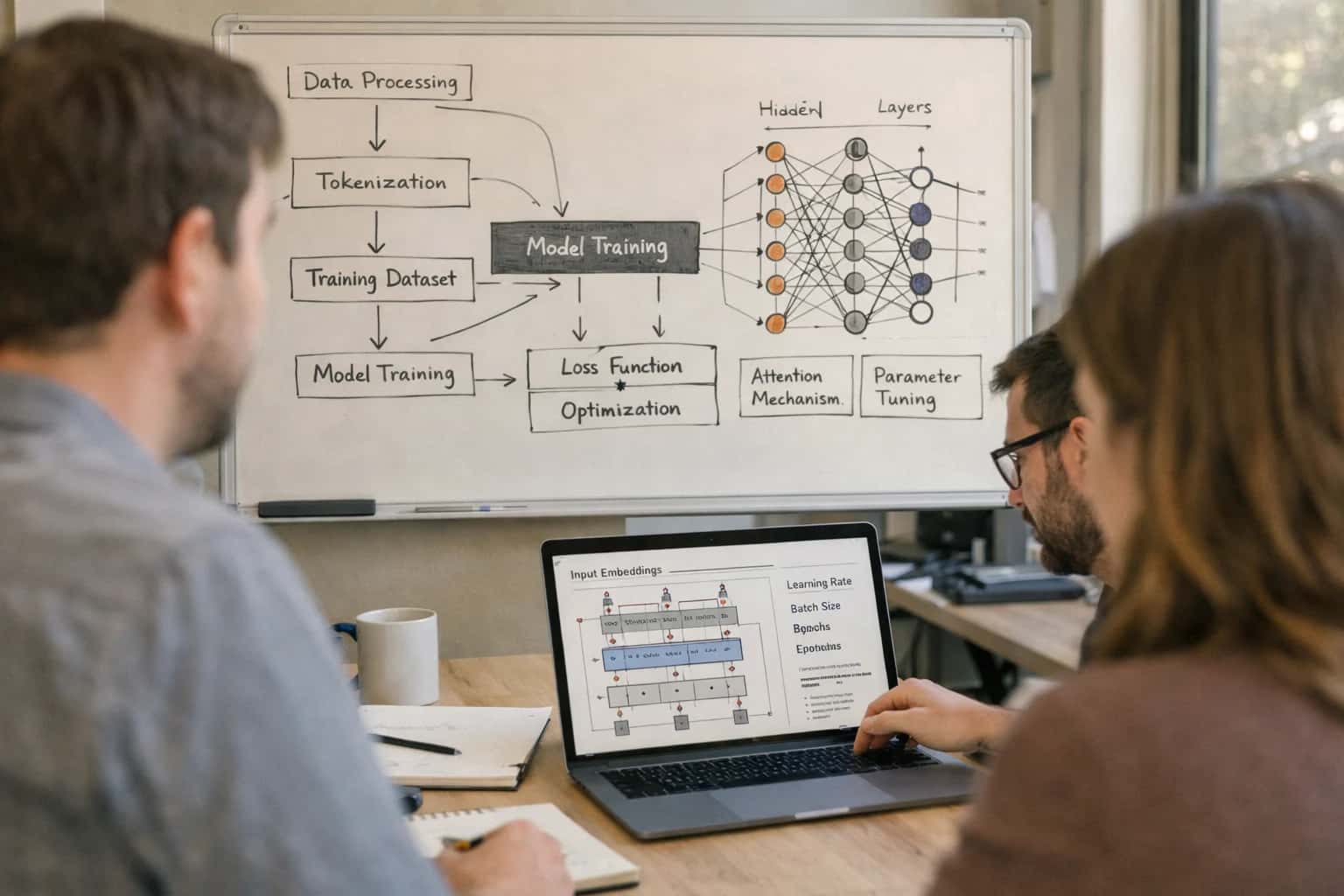
DEVELOPER-FOCUSED ARCHITECTURE
Building Custom AI Applications on NetDocuments
A technical blueprint for developers and architects extending NetDocuments with custom AI agents, workflows, and data intelligence.
A robust custom application separates the AI layer from the DMS. A common pattern uses a lightweight integration service that listens to NetDocuments webhooks, fetches document content via the API (often as a secure, temporary URL), and routes it to your AI processing pipeline. This pipeline might involve a RAG system using a vector store like Pinecone for semantic search over matter libraries, or a series of specialist agents for tasks like classification, summarization, or redaction. Processed results—extracted clauses, generated summaries, enriched metadata—are written back to NetDocuments via the API, either as document annotations, custom metadata fields, or new summary documents linked to the original. This keeps all AI-generated intelligence within the governed DMS environment.
Governance and rollout require careful planning. Start with a pilot Workspace or specific document type. Implement idempotency and retry logic in your integration service to handle API rate limits or transient failures. Audit all AI actions by logging document IDs, timestamps, and the specific AI operation performed. For user-facing features, consider embedding UI elements via NetDocuments' UI Extensibility framework, such as a custom panel showing an AI-generated summary. Roll out incrementally, measuring impact on user workflows like search time reduction or manual review hours saved. For deeper architectural patterns, see our guide on Custom AI Development for iManage Integration, which shares similar event-driven integration principles.
DEVELOPER-FOCUSED SURFACES
NetDocuments Integration Surfaces for AI
Core API Endpoints for AI Workflows
The NetDocuments REST API provides the primary surface for custom AI development. Key endpoints for AI integration include:
- Document & Folder Operations: Retrieve document content, metadata, and folder structures for processing. Use
GET /api/v1/documents/{id}/contentto fetch text for summarization or analysis. - Search & Query: Execute structured searches (
POST /api/v1/search) to find relevant precedents or matters for RAG context. This is critical for building semantic search over your document corpus. - Event Subscription (Webhooks): Configure real-time triggers for AI processing. Subscribe to events like
document.checkin,document.version.created, orfolder.createdto initiate workflows like automatic classification or summarization upon ingestion.
Implementation Note: Always use service accounts with principle of least privilege. For webhooks, implement idempotent handlers and secure callback endpoints to process AI tasks asynchronously.
DEVELOPER-FOCUSED INTEGRATION PATTERNS
High-Value Custom AI Use Cases for NetDocuments
For architects and developers building custom AI applications on the NetDocuments platform. These patterns leverage the ND REST API, webhooks, and secure data handling to inject intelligence into core document workflows.
01
Automated Document Classification on Ingestion
Trigger an AI model via a NetDocuments webhook when a document is checked in. Classify the document by type (e.g., Contract, Pleading, Memo), matter, and sensitivity. Use the API to automatically populate custom metadata fields, apply security profiles, and route to correct workspace folders. Eliminates manual tagging backlog.
Batch -> Real-time
Classification latency
02
RAG-Powered Clause Retrieval Agent
Build a custom search interface or chatbot that uses Retrieval-Augmented Generation (RAG) over a firm's precedent library in NetDocuments. The agent connects via the Search API, retrieves relevant clauses based on natural language queries, and cites source documents. Integrates with document assembly workflows for first-draft acceleration.
Hours -> Minutes
Precedent search
03
AI-Triggered Compliance Workflow
Implement a background service that polls for new documents in designated 'Compliance Review' workspaces. Use AI to analyze content against regulatory checklists or internal policies. If issues are detected, the service uses the NetDocuments API to create a task, assign it to a compliance officer, and move the document to a review queue. Proactive risk mitigation.
Next day -> Same day
Review initiation
04
Document Summarization & Matter Briefing
Create a scheduled job or user-triggered action that sends selected document IDs to an AI summarization service. Fetch document content via the API (with proper security context), generate a concise summary or a timeline of key events, and post the result as a note on the document or matter. Provides immediate context for case teams.
1 sprint
Typical build time
05
Intelligent Matter Intake & Conflict Check
Extend a custom matter intake form. When a new matter request is submitted, use AI to analyze the description and uploaded intake documents. The system calls the NetDocuments Search API to find similar past matters, potential conflicting parties, and relevant precedents, surfacing results to the conflicts team within the intake app. Reduces manual pre-clearance research.
06
Secure AI Copilot for Drafting
Build a secure, context-aware drafting assistant embedded in a firm portal. The assistant uses the logged-in user's ND permissions to fetch relevant matter documents via the API as context. It helps draft emails, memos, and document sections, citing source materials, while all data remains within the firm's controlled environment. Increases productivity without data exfiltration.
CUSTOM AI DEVELOPMENT PATTERNS
Example AI Workflows: Trigger, Process, Update
These concrete workflows illustrate how custom AI applications interact with NetDocuments via its API and webhooks to automate document intelligence, enhance search, and streamline legal operations.
Trigger: A new document is uploaded or saved to a NetDocuments cabinet.
Context/Data Pulled: The integration listens for the document.created or document.version.created webhook. The AI service fetches the document binary and its existing metadata via the NetDocuments REST API (GET /api/v1/documents/{id}/content).
Model/Agent Action: A custom classification model processes the document text. It predicts:
- Document Type (e.g.,
Pleading,Contract,Correspondence,Memo). - Matter Association based on content analysis and folder path context.
- Sensitivity Level (e.g.,
Confidential,Privileged,Public).
System Update: The AI service calls the NetDocuments API (PATCH /api/v1/documents/{id}) to write the predicted values to custom metadata profile fields (e.g., ai_doc_type, ai_predicted_matter, ai_sensitivity_score).
Human Review Point: Optionally, for low-confidence predictions, the system can create a task in NetDocuments or post to a Slack channel for a legal operations specialist to review and correct.
A DEVELOPER-FIRST BLUEPRINT
Implementation Architecture & Data Flow
A technical guide to architecting secure, scalable AI applications that connect to NetDocuments via its REST API and event-driven webhooks.
A production-ready integration is built on three core components: the NetDocuments REST API for data access and CRUD operations, a secure middleware layer (often a cloud function or containerized service) to host your AI logic, and a vector database for semantic search and RAG. The API provides OAuth 2.0 authentication and granular access to cabinets, documents, profiles, and folders. Your middleware acts as the orchestration engine, calling the API to fetch document content (text, metadata), passing it to LLMs for processing (summarization, extraction), and writing results back as attributes or new document versions. For real-time workflows, configure NetDocuments webhooks on events like Document.CheckIn or Folder.Create to trigger your AI service via a secure endpoint, enabling immediate processing upon ingestion.
Data flow is governed by a clear sequence: 1) Authentication & Context: Your service authenticates with ND using a service account scoped to specific cabinets. 2) Data Retrieval: Fetch target documents and their profile metadata via the API. For large-scale analysis, use the search endpoint with filters. 3) AI Processing: Securely send extracted text to your chosen model (e.g., via Azure OpenAI, with prompts tuned for legal language). For RAG, chunk and embed document content into a vector store like Pinecone, keyed by the NetDocuments document ID. 4) Result Persistence: Write AI outputs—such as a generated summary, extracted clauses, or classification tags—back to the document's custom attributes or to a dedicated 'AI Insights' folder within the same matter. All API calls and data movements should be logged for audit trails.
Rollout should follow a phased approach: start with a single pilot cabinet and a non-critical use case like automated document summarization. Implement human-in-the-loop approvals for any AI-generated content before it's written back to the DMS. Use NetDocuments' native security profiles and your middleware's RBAC to ensure AI access respects existing matter confidentiality. Performance and cost are managed by processing documents asynchronously via a queue (e.g., RabbitMQ, AWS SQS) and implementing caching for frequently accessed matter data. For ongoing governance, instrument your middleware to track processing accuracy, latency, and API usage, integrating with your firm's existing monitoring stack.
DEVELOPER BLUEPRINT
Code Patterns & API Examples
Real-Time Processing with ND Events
NetDocuments exposes a webhook system for real-time document events. Configure a listener for Document.CheckedIn, Document.VersionCreated, or Document.MetadataUpdated to trigger AI workflows.
A secure webhook endpoint should validate the JWT signature, extract the document ID and cabinet/workspace context, then fetch the binary via the REST API for processing. This pattern is ideal for automated classification, summarization, or metadata enrichment as documents enter the system.
Key Implementation Steps:
- Register your webhook endpoint in the NetDocuments admin console.
- Implement JWT validation using your client credentials.
- On event receipt, call
GET /api/v1/documents/{id}/contentto retrieve the file. - Process with your AI service (extraction, summarization).
- Update document metadata or create an annotation using
PATCH /api/v1/documents/{id}or the Annotations API.
CUSTOM AI DEVELOPMENT FOR NETDOCUMENTS
Realistic Time Savings & Operational Impact
This table illustrates the tangible operational improvements achievable by building custom AI applications on the NetDocuments platform, focusing on developer-led workflows and secure data handling patterns.
| Workflow / Task | Before AI (Manual/Standard) | After AI (Custom Integration) | Implementation Notes |
|---|---|---|---|
Document Classification on Ingestion | Manual tagging by paralegal or admin | Automated classification via custom model | Leverages ND API webhooks; human review for low-confidence predictions |
Clause Retrieval Across Matters | Keyword search across folders, manual review | Semantic search via custom RAG pipeline | Builds on ND search API; returns ranked results with source citations |
Draft Document Assembly | Copy-paste from precedents, manual reformatting | AI-assisted assembly pulling clauses from matter library | Uses ND API to fetch precedents; outputs draft in native ND editor |
Matter Health & Risk Analysis | Periodic manual audits by practice group lead | Automated dashboard with AI-generated risk scores | Custom app queries ND metadata & content; flags stale matters or budget overruns |
Billing Narrative Generation | Paralegal compiles time entries from emails/docs | AI extracts activities and drafts narratives | Processes documents in designated client/matter folders via scheduled job |
Security & Access Anomaly Detection | Quarterly access review reports | Real-time alerts on anomalous download patterns | Monitors ND audit logs via API; integrates with SIEM for alerting |
Migration Data Cleanup & Tagging | Contractors manually review and tag documents pre-migration | AI pre-processes documents for auto-tagging and deduplication | Runs in isolated staging environment; outputs mapping for ND import tool |
ARCHITECTING FOR PRODUCTION
Governance, Security & Phased Rollout
A secure, governed rollout for custom AI applications built on NetDocuments.
Production AI integrations require a security-first architecture. For NetDocuments, this means leveraging its native OAuth 2.0 flow for secure, token-based authentication, ensuring AI agents operate under the principle of least privilege. All data access should be scoped to specific cabinets and workspaces, with API calls logged to NetDocuments' native audit trail. Sensitive prompts and model outputs should be processed through a secure middleware layer, never directly from client-side code, to maintain control over data egress and enforce firm-wide AI usage policies.
A phased rollout is critical for adoption and risk management. Start with a pilot in a single practice group or for a specific, high-value workflow like automated matter intake classification or precedent clause retrieval. Deploy the AI agent as a background service that listens for webhook events from NetDocuments (e.g., document.created) and processes documents in a dedicated queue. This allows for human-in-the-loop review of initial outputs before any automated metadata updates are written back via the ND REST API. Use this phase to refine prompts, tune retrieval from your vector store, and establish performance baselines.
Governance is maintained through technical controls and clear operational procedures. Implement a centralized prompt registry to version and audit all prompts used against firm documents. Configure role-based access in your AI middleware to control which users or groups can trigger different AI workflows. For any AI-generated content that updates NetDocuments records—like auto-populating a Document Type or adding extracted key terms to a custom profile—require an approval step or maintain a change log for the first several months. This controlled approach ensures the integration enhances productivity without compromising the integrity of your document management system.
Enabling Efficiency, Speed & Accuracy
Intelligent Analysis, Decision & Execution
We build AI systems for teams that need search across company data, workflow automation across tools, or AI features inside products and internal software.
Talk to Us
Search across company data
Give teams answers from docs, tickets, runbooks, and product data with sources and permissions.
Useful when people spend too long searching or get different answers from different systems.
Enterprise searchRAGPermissions
Read more
Automate internal workflows
Use AI to route work, draft outputs, trigger actions, and keep approvals and logs in place.
Useful when repetitive work moves across multiple tools and teams.
AI agentsWorkflow automationGovernance
Read more
Add AI to products and internal tools
Build assistants, guided actions, or decision support into the software your team or customers already use.
Useful when AI needs to be part of the product, not a separate tool.
AI integrationDecision supportModel routing
Read moreIMPLEMENTATION BLUEPRINT
FAQ for NetDocuments AI Developers
Technical answers for developers and architects building custom AI applications on the NetDocuments platform. This guide covers secure data handling, API patterns, and workflow orchestration for production deployments.
Never send raw documents directly from the browser. Use a server-side integration pattern:
- Authentication & Authorization: Your middleware service must authenticate using OAuth 2.0 (Client Credentials flow for service-to-service) and respect NetDocuments' folder/cabinet-level permissions via the
Authorizationheader. - Content Retrieval: Use the
GET /api/v1/documents/{documentId}/contentendpoint to fetch the document stream. For large documents, consider using therangeheader to retrieve specific pages or sections. - Secure Processing: Decrypt and process the document content within your secure, VPC-isolated environment. Strip any existing redactions or metadata if not required for the AI task.
- Payload to AI: Send only the necessary text chunks to your AI service (e.g., OpenAI, Anthropic, a private model). Include a unique
correlationIdfrom NetDocuments (likedocumentIdormatterId) for auditability. - Zero Retention: Do not persist the raw document content in your AI service's logs or training data. Implement a data processing agreement that aligns with your firm's compliance requirements.
Example Secure Payload to LLM:
json{ "model": "gpt-4-turbo", "messages": [ { "role": "user", "content": "Summarize the following legal document section for an executive briefing:\n\n[Document Chunk Text Here]" } ], "metadata": { "sourceSystem": "NetDocuments", "documentId": "ndDoc-abc123", "matterId": "MAT-2024-001" } }

About the author
Prasad Kumkar
CEO & MD, Inference Systems
Prasad Kumkar is the CEO & MD of Inference Systems and writes about AI systems architecture, LLM infrastructure, model serving, evaluation, and production deployment. Over 5+ years, he has worked across computer vision models, L5 autonomous vehicle systems, and LLM research, with a focus on taking complex AI ideas into real-world engineering systems.
His work and writing cover AI systems, large language models, AI agents, multimodal systems, autonomous systems, inference optimization, RAG, evaluation, and production AI engineering.
LinkedIn
Limited slotsGet a Free AI Consultation
Partnered with leading AI, data, and software stack.





How We Work
Custom AI workflows for your Business
One-fit-all AI don't work for modern businesses. At Inferensys, we aim to understand your business & custom requirements; which we use to define most efficient agentic workflows, the data, and the tools for your business.
01
Review the use case
We understand the task, the users, and where AI can actually help.
Read more02
Pick the right approach
We define what needs search, automation, or product integration.
Read more03
Build the first useful version
We implement the part that proves the value first.
Read more04
Improve from there
We add the checks and visibility needed to keep it useful.
Read moreThe first call is a practical review of your use case and the right next step.
Talk to Us