AI integration for public sector billing targets specific functional surfaces within platforms like Tyler Munis, SAP Public Sector, or Infor CloudSuite. The primary integration points are the customer account/constituent record, the transaction/billing line item, and the dispute/case management module. AI agents connect via APIs or middleware to read account histories, payment patterns, and service usage, and to write back generated communications, proposed payment plans, or flagged anomalies. This enables use cases like automated payment discrepancy resolution, where an AI reviews a disputed utility bill against meter reads and rate schedules, drafts a plain-language explanation, and suggests a resolution path—all logged against the citizen's account for audit.

Integration
AI Integration with Public Sector Billing Systems
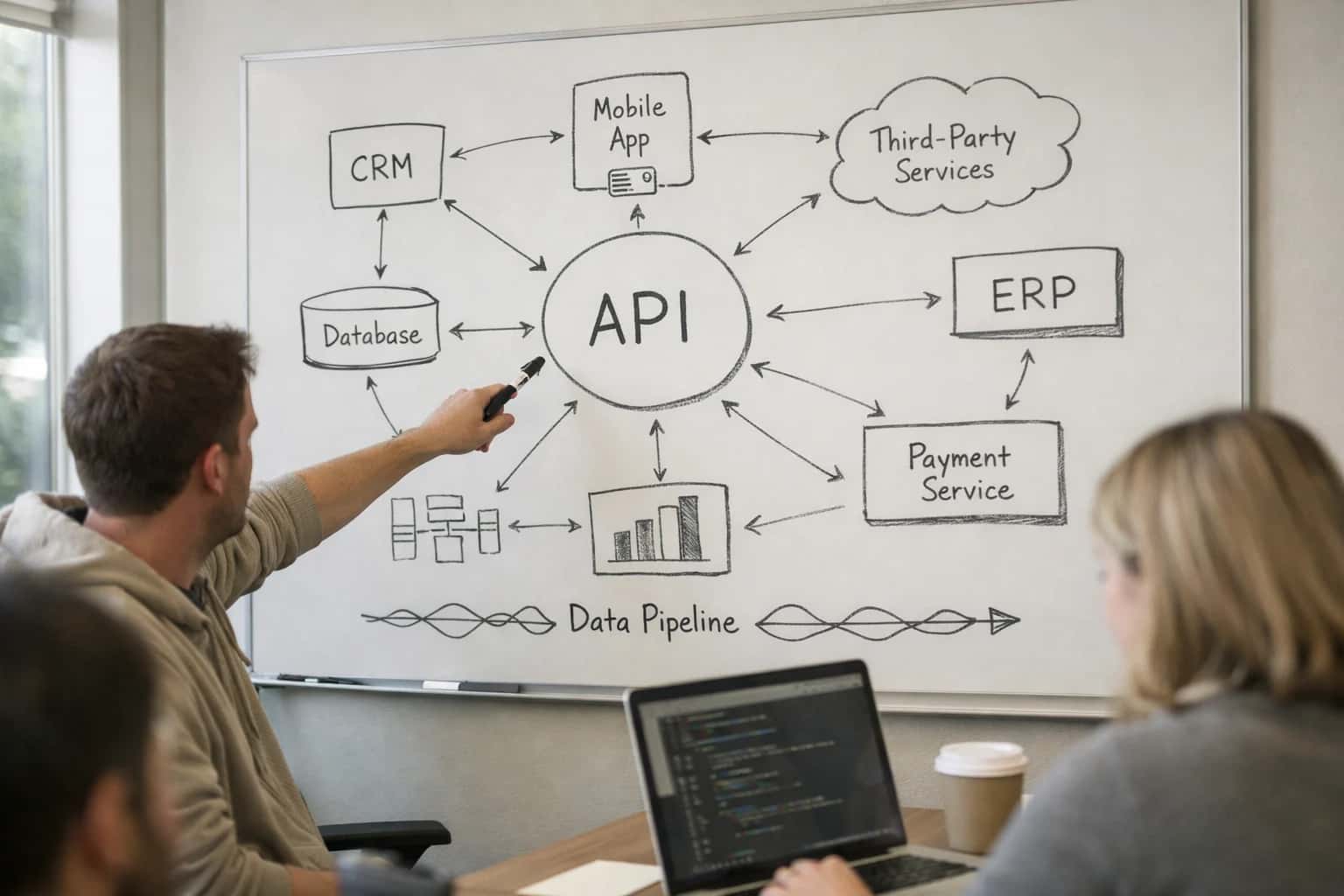
Where AI Fits into Government Billing Workflows
A practical guide to embedding AI into public sector billing platforms for utility, permit, and fee management, focusing on integration points and operational governance.
Implementation typically involves a middleware layer (like Infor OS or SAP BTP) that orchestrates between the core billing ERP and AI services. A standard pattern: a nightly batch job extracts new disputes or past-due accounts; an AI pipeline classifies the issue, retrieves relevant documents (e.g., permit applications, inspection reports), and generates a personalized outreach. The output—a draft email, a suggested payment arrangement, or an anomaly alert—is queued for a human reviewer in the billing office's workflow dashboard before being approved and sent via the platform's native communication engine. This keeps the system of record intact while adding intelligence at the edges.
Rollout requires a phased, workflow-specific approach. Start with high-volume, low-risk processes like answering balance inquiry FAQs via a chatbot integrated with the billing portal. Then move to automated payment plan generation for delinquent accounts, using AI to analyze income data (where permissible) and historical payment behavior to propose feasible terms. Finally, target complex dispute triage for permits or fees, where AI pre-fills a case summary for an officer. Governance is critical: all AI-generated outputs must be clearly labeled, have a human-in-the-loop approval step for financial adjustments, and maintain a complete audit trail linking the AI's reasoning to the source data in the billing platform.
Key Integration Surfaces in Major Government Billing Systems
Core Billing and Account Data
AI integration begins with the master data objects that define the billing relationship. This includes the Customer/Account record, which holds contact info, service addresses, and billing preferences, and the Service Point/Utility Account, which links to meters and specific tariffs.
Key integration surfaces:
- Account Inquiry APIs: Enable AI chatbots to pull real-time balance, last payment, and service status to answer citizen questions.
- Account Update Webhooks: Trigger AI workflows when accounts are created, put on hold, or flagged for delinquency.
- Contact & Communication Logs: Allow AI agents to log interactions and reference past communications, providing continuity across channels.
By grounding AI in this core data layer, you enable accurate, context-aware support and proactive communication, reducing call volume to live agents.
High-Value AI Use Cases for Public Sector Billing
Integrating AI with platforms like Tyler Munis, SAP Public Sector, or Infor CloudSuite transforms utility, permit, and fee management from reactive processing to proactive service. These patterns connect to core billing modules, payment engines, and citizen portals to automate high-volume tasks and improve constituent experience.
Intelligent Dispute & Inquiry Resolution
Deploy an AI agent integrated with the billing system's inquiry module and payment history API. The agent uses RAG over rate ordinances, past resolutions, and account data to answer citizen questions via chat or voice, draft adjustment requests for agent review, and explain complex charges in plain language.
Automated Delinquency & Payment Plan Management
Connect AI models to customer account records and payment transaction feeds. The system predicts delinquency risk scores, automatically generates and issues personalized payment plan offers via integrated communication channels (portal, SMS, email), and updates the billing system with approved terms.
Proactive Meter & Usage Anomaly Detection
Integrate AI analytics with AMI (Advanced Metering Infrastructure) data streams and the billing engine. Models detect abnormal consumption patterns (e.g., leaks, theft), trigger automated customer notifications with suggested actions, and create work orders in the associated asset management system for field verification.
Permit & Fee Calculation Assistant
Build a copilot for permit technicians integrated with the billing system's fee schedule and parcel database. Using natural language, staff describe a project scope; the AI cross-references zoning, calculates all applicable fees, generates a preliminary invoice, and drafts the fee explanation for the applicant.
Batch Payment & Cashiering Reconciliation
Automate the daily reconciliation of lockbox payments, credit card batches, and in-person cashiering. AI agents connected to the general ledger and cash receipts subledger match payments to accounts, flag discrepancies for human review, and post transactions, generating an exception report for auditors.
Multi-Service Account Consolidation & Reporting
For citizens with water, sewer, trash, and permit fees, implement an AI-powered portal view. It aggregates charges from disparate billing silos within the ERP, provides a unified statement, answers cross-service questions, and allows a single payment—updating all relevant ledgers through secured API calls.
Example AI-Powered Billing Workflows
These concrete workflows demonstrate how AI agents can be integrated into public sector billing systems to automate high-volume, manual tasks, reduce citizen wait times, and improve revenue collection accuracy.
Trigger: A citizen submits a high-usage dispute via the online portal, call center IVR, or a scanned paper form.
Context/Data Pulled: The AI agent retrieves the citizen's account history, meter read data for the disputed period, weather data for correlation, and previous dispute patterns.
Model/Agent Action: An NLP model analyzes the dispute description (e.g., "my bill doubled, no one was home"). The agent cross-references usage against historical patterns and weather. It generates a preliminary assessment: likely leak, meter error, or estimated read.
System Update/Next Step: The agent automatically:
- Creates a service case in the CRM/CMS with the assessment and priority score.
- Schedules a field service work order for a meter check if a leak is suspected.
- Sends a personalized, plain-language acknowledgment to the citizen via SMS/email, explaining the next steps and timeline.
Human Review Point: The agent's assessment and routing are logged for audit. Complex disputes involving legal precedent or multi-account issues are flagged for a human billing specialist's review before any work order is issued.
Implementation Architecture: Connecting AI to Billing Systems
A technical blueprint for integrating AI into public sector billing platforms to automate dispute resolution, enhance customer communication, and improve revenue cycle efficiency.
Integrating AI into platforms like Tyler Munis, Infor CloudSuite Public Sector, or SAP Public Sector requires connecting to core billing objects—such as customer accounts, service charges, payment transactions, and delinquency records—via their native APIs or middleware layers. The AI layer typically acts as an orchestration service that listens for events (e.g., a new dispute ticket via a citizen portal, a failed payment webhook) and uses Retrieval-Augmented Generation (RAG) against policy documents and historical cases to generate context-aware responses. For utility billing, this means the AI can cross-reference meter read histories, rate ordinances, and past payment plans to instantly answer common citizen inquiries or draft resolution summaries for staff review.
A production implementation involves deploying secure AI agents that interface with the billing system's workflow engine and document management modules. For example, an agent can be triggered by a high-volume dispute code (e.g., 'estimated read complaint') to automatically pull the account's last three actual reads, check for seasonality patterns, and generate a plain-language explanation for the citizen, while simultaneously creating a service order in the asset management system if a meter inspection is warranted. This is managed through a central orchestration platform (like Infor OS or SAP BTP) that handles authentication, audit logging, and fallback to human agents when confidence scores are low, ensuring governance and control over automated decisions.
Rollout should prioritize high-volume, low-risk workflows first, such as answering balance inquiries or generating payment plan options, before moving to more complex tasks like analyzing payment trends for delinquency prediction. A phased approach allows for tuning the AI's prompts against your specific fee schedules and compliance rules, and integrating feedback loops where staff can correct or approve the AI's outputs, continuously improving accuracy. The end goal is not to replace the billing system but to augment it, turning manual, reactive processes into proactive, intelligent operations that reduce call center volume and accelerate revenue collection.
Code and Payload Examples
Automated Dispute Classification & Routing
Integrate an AI agent with the billing system's API to intercept new dispute tickets. The agent analyzes the customer's message and recent account activity (meter reads, payments, adjustments) to classify the issue and draft a preliminary response.
Example Workflow:
- Webhook from the billing system sends a new
Disputerecord. - AI service fetches related
Account,MeterRead, andPaymentobjects. - LLM classifies intent (e.g.,
high_bill_inquiry,meter_accuracy,payment_applied). - System drafts a response with relevant data points and routes the case to the appropriate queue (e.g.,
Field_Investigation,Customer_Service).
python# Pseudo-code for dispute intake webhook handler def handle_new_dispute(webhook_payload): dispute_id = webhook_payload['id'] # Fetch related records from billing API account_data = billing_api.get_account(dispute_id) meter_data = billing_api.get_meter_reads(account_data['premise_id']) # Construct context for LLM prompt_context = f"""Dispute reason: {webhook_payload['description']} Last meter read: {meter_data[-1]['value']} on {meter_data[-1]['date']} Previous bill amount: ${account_data['last_bill_amount']}""" # Call classification agent classification = llm_client.classify_intent(prompt_context) # Update dispute record with classification and route billing_api.update_dispute(dispute_id, { 'ai_classification': classification, 'assigned_queue': routing_map[classification] })
Realistic Time Savings and Operational Impact
This table illustrates the tangible efficiency gains and workflow improvements achievable by integrating AI agents with public sector billing systems like Tyler Munis, Infor CloudSuite, or SAP Public Sector. Metrics are based on typical workflows for utility billing, permit fee management, and citizen dispute resolution.
| Process / Metric | Before AI Integration | After AI Integration | Implementation Notes |
|---|---|---|---|
Citizen billing inquiry resolution | Manual lookup across multiple systems; 15-30 min per case | AI agent retrieves account & transaction history; 2-5 min initial resolution | Agent provides source-linked answers; complex cases escalated with full context |
Dispute intake and document classification | Staff review uploads, manually tag document type and relevant account | AI auto-classifies uploads (e.g., meter photo, proof of payment), extracts key data | Reduces manual data entry; ensures documents are routed to correct workflow queue |
High-volume payment discrepancy review | Batch review of exceptions by finance staff; next-day resolution | AI flags anomalies against rules, prioritizes queue; same-day review for top items | Focuses human effort on complex exceptions; audit trail of AI-suggested actions |
Permit fee calculation and invoice generation | Manual rate table lookup and calculation for complex permits | AI calculates fees based on application data, generates draft invoice for approval | Integrated with permitting system (e.g., EnerGov); ensures consistency and reduces errors |
Delinquency communication and payment plan setup | Manual list generation, template-based mail/email blasts | AI segments accounts by risk/amount, personalizes communication, drafts payment plan options | Triggers via billing system events; plans submitted back to system for approval |
Monthly billing cycle exception reporting | Finance analyst runs queries, manually investigates outliers post-cycle | AI monitors cycle in near-real-time, generates pre-close exception report with root-cause analysis | Proactive issue identification prevents downstream reconciliation delays |
Regulatory rate change impact analysis | Manual modeling in spreadsheets; days to assess citizen impact | AI simulates impact on sample accounts using new rate structures; hours to generate report | Provides data-driven narrative for public communications and council briefings |
Governance, Security, and Phased Rollout
Integrating AI into public sector billing demands a security-first, phased approach aligned with government IT governance.
Implementation begins by mapping the AI's interaction points within the billing platform's data model—typically the Customer, Account, Invoice, Payment, and Dispute objects. AI agents are deployed as microservices that interact via secure APIs or webhooks, never storing raw citizen PII. All AI-generated actions, such as a proposed payment plan or a dispute resolution summary, are written as draft records requiring human approval within the native system's workflow engine, creating a full audit trail.
A phased rollout is critical. Phase 1 targets low-risk, high-volume workflows like answering common billing inquiries via a chatbot integrated with the citizen portal, using a tightly scoped knowledge base. Phase 2 introduces AI-assisted dispute triage, where the agent analyzes incoming dispute forms and attached documents, suggests a classification (e.g., 'meter reading error', 'payment misapplication'), and routes it to the correct queue with a summary. Phase 3 enables proactive communication, using AI to analyze payment history and identify accounts likely to become delinquent, triggering pre-approved outreach templates.
Governance is enforced through a centralized orchestration layer (often built on the agency's existing integration platform or BTP). This layer manages authentication, logs all AI system prompts and completions for compliance reviews, enforces rate limits on API calls to LLM providers, and applies data masking rules before any data leaves the environment. A human-in-the-loop checkpoint is mandated for any AI-suggested write-back that alters financial data or citizen account status.
Enabling Efficiency, Speed & Accuracy
Intelligent Analysis, Decision & Execution
We build AI systems for teams that need search across company data, workflow automation across tools, or AI features inside products and internal software.
Talk to Us
Search across company data
Give teams answers from docs, tickets, runbooks, and product data with sources and permissions.
Useful when people spend too long searching or get different answers from different systems.

Automate internal workflows
Use AI to route work, draft outputs, trigger actions, and keep approvals and logs in place.
Useful when repetitive work moves across multiple tools and teams.

Add AI to products and internal tools
Build assistants, guided actions, or decision support into the software your team or customers already use.
Useful when AI needs to be part of the product, not a separate tool.
Frequently Asked Questions
Practical questions and answers for integrating AI with government billing systems for utilities, permits, and fees.
Secure integration typically follows a layered API architecture:
- Authentication Layer: The AI agent uses a service account with strict, role-based access control (RBAC) scoped to read-only or specific write permissions (e.g.,
billing.read,dispute.update). OAuth 2.0 or API keys managed in a secrets vault are standard. - API Gateway: Calls are routed through a dedicated gateway (like Kong or Azure API Management) that enforces rate limiting, logging, and provides an abstraction layer from the core billing platform (e.g., Tyler Munis, SAP Public Sector).
- Data Context Retrieval: For a citizen inquiry, the agent first calls a customer API endpoint with the account number, retrieving the context needed for a grounded response:
json{ "endpoint": "GET /api/v1/accounts/{id}/billing-summary", "purpose": "Retrieve balance, last payment, and recent transactions for an LLM context window." }
- Audit Trail: All agent-initiated data accesses and actions are logged with a session ID to the billing system's audit log or a dedicated SIEM for compliance reviews.

About the author
Prasad Kumkar
CEO & MD, Inference Systems
Prasad Kumkar is the CEO & MD of Inference Systems and writes about AI systems architecture, LLM infrastructure, model serving, evaluation, and production deployment. Over 5+ years, he has worked across computer vision models, L5 autonomous vehicle systems, and LLM research, with a focus on taking complex AI ideas into real-world engineering systems.
His work and writing cover AI systems, large language models, AI agents, multimodal systems, autonomous systems, inference optimization, RAG, evaluation, and production AI engineering.
Partnered with leading AI, data, and software stack.





How We Work
Custom AI workflows for your Business
One-fit-all AI don't work for modern businesses. At Inferensys, we aim to understand your business & custom requirements; which we use to define most efficient agentic workflows, the data, and the tools for your business.
01
Review the use case
We understand the task, the users, and where AI can actually help.
Read more02
Pick the right approach
We define what needs search, automation, or product integration.
Read more03
Build the first useful version
We implement the part that proves the value first.
Read more04
Improve from there
We add the checks and visibility needed to keep it useful.
Read moreThe first call is a practical review of your use case and the right next step.
Talk to Us