AI integration targets the core data objects and workflows within your Enterprise Asset Management (EAM) platform. The primary surfaces are the asset register, work order management module, preventive maintenance (PM) schedules, and inventory/purchasing systems. AI agents connect via APIs or middleware to read asset condition data (from IoT sensors or manual inspections), historical work orders, and cost records. This enables use cases like predicting failure for critical infrastructure (water pumps, HVAC systems, fleet vehicles), automatically generating prioritized work orders, and recommending optimal spare parts stock levels based on predicted demand.

Integration
AI Integration with Public Sector Asset Management
A technical blueprint for integrating AI agents and predictive models with government Enterprise Asset Management (EAM) systems to automate maintenance planning, optimize capital budgets, and extend infrastructure lifespans.
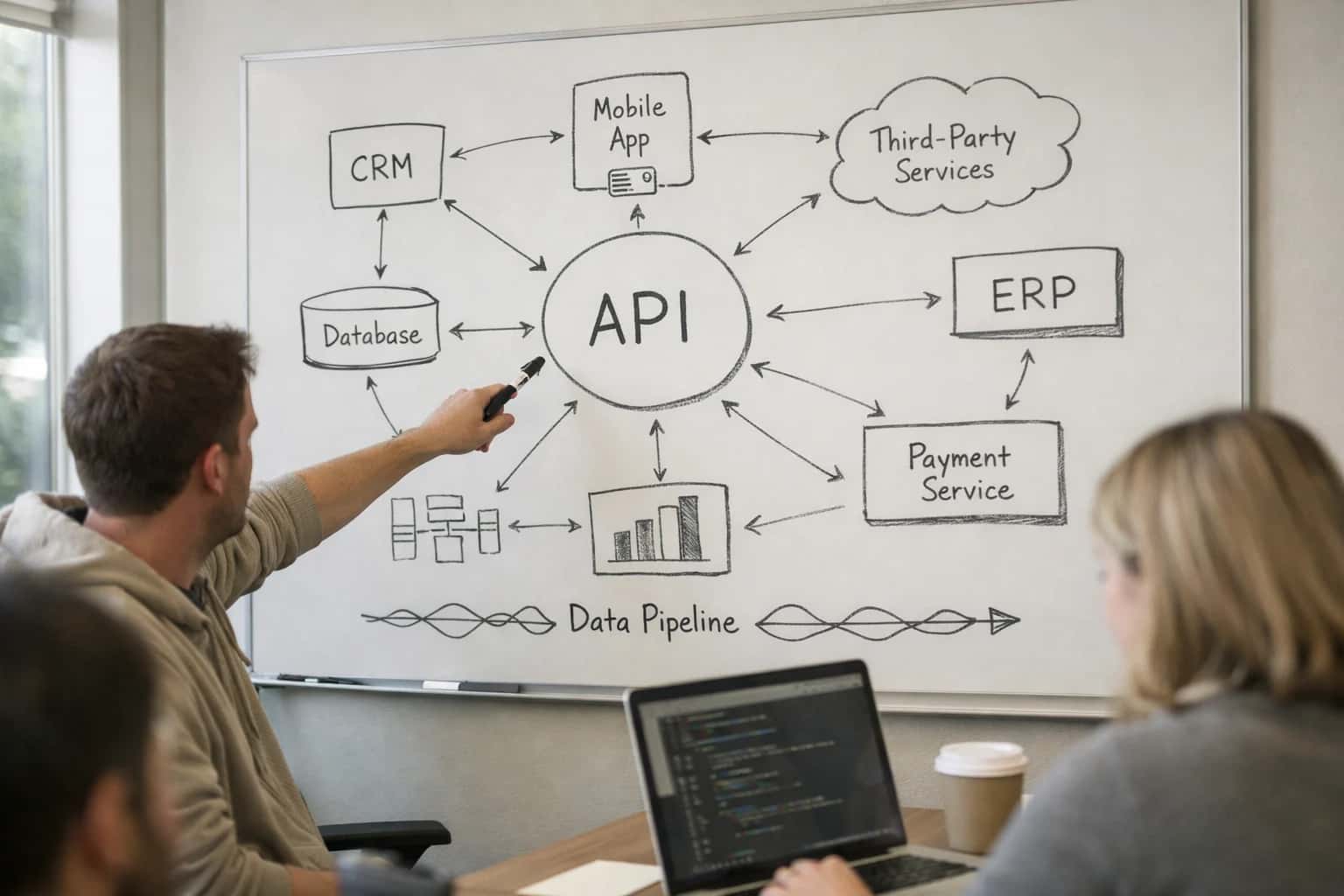
ARCHITECTURE AND ROLLOUT
Where AI Fits in Public Sector Asset Management
A practical blueprint for integrating AI with systems like Infor EAM and IBM Maximo to automate maintenance, optimize capital planning, and extend asset life.
Implementation typically involves a middleware layer (like Infor OS or a custom integration platform) that sits between your EAM and AI services. This layer handles secure data synchronization, orchestrates multi-step workflows (e.g., detect anomaly → create work order → check parts availability → assign technician), and manages approvals. For example, a predictive model can flag a high-risk asset, triggering an automated workflow that drafts a work order, routes it for supervisor approval based on cost thresholds, and reserves the necessary parts from inventory—all before a failure occurs. The impact is operational: shifting from calendar-based to condition-based maintenance reduces unplanned downtime and can lower lifecycle costs by 10-20% for targeted asset classes.
Rollout requires a phased, asset-priority approach. Start with a pilot on a single, high-value asset class (e.g., emergency generators or wastewater treatment components) where sensor data is available. Governance is critical: establish clear rules for AI-generated work order auto-approval versus human review, and maintain a full audit trail linking AI predictions to system actions. This controlled integration ensures reliability and builds trust, allowing you to scale AI across your portfolio—from buildings and fleet to linear infrastructure like roads and utilities—without disrupting core EAM operations. For a deeper look at connecting AI to specific financial workflows, see our guide on AI Integration for Fund Accounting Software.
AI FOR PUBLIC SECTOR ASSET MANAGEMENT
Key Integration Surfaces in EAM Platforms
Connecting AI to Asset Condition Data
Integrate AI models directly with the Asset Master and Condition Monitoring modules within your EAM (e.g., Infor EAM, IBM Maximo). The goal is to predict failures before they occur, moving from calendar-based to condition-based maintenance.
Key Integration Points:
- Sensor Data Ingest: Connect IoT telemetry streams (vibration, temperature, pressure) from SCADA or BMS systems to the EAM's work order generation engine via APIs or message queues.
- Historical Work Order Analysis: Use AI to analyze years of maintenance records, correlating failure modes with asset attributes, location, and environmental data to identify risk patterns.
- Automated Work Order Creation: Configure the AI system to automatically generate Corrective or Preventive work orders with recommended tasks and parts lists when a predicted failure probability exceeds a defined threshold.
Example Workflow: An AI model monitoring water pump vibration data detects an anomaly pattern indicative of bearing wear. It calls the EAM's REST API to create a high-priority work order, assigns it to the appropriate crew, and reserves the necessary spare part from inventory—all before catastrophic failure.
INTEGRATION PATTERNS FOR INFOR EAM & IBM MAXIMO
High-Value AI Use Cases for Government Assets
Integrating AI with public sector asset management systems transforms reactive maintenance into predictive, data-driven operations. These patterns connect AI agents to Infor EAM, IBM Maximo, and similar platforms to optimize lifecycle costs, improve reliability, and support capital planning decisions.
01
Predictive Maintenance Scheduling
AI models analyze historical work orders, sensor data (IoT), and environmental factors from the EAM to predict asset failures. The system automatically generates and prioritizes preventive work orders in the CMMS, shifting from calendar-based to condition-based maintenance. This reduces unplanned downtime for critical infrastructure like water pumps, HVAC systems, and fleet vehicles.
Weeks -> Days
Advanced warning
02
Automated Work Order Triage & Enrichment
An AI agent integrated via the EAM's API or service bus ingests incoming maintenance requests (from citizen portals, staff emails, IoT alerts). It uses NLP to classify urgency, predict required parts and labor hours, and auto-populate the work order with relevant historical data and procedures. This cuts administrative time and improves first-time fix rates for field technicians.
Hours -> Minutes
Request processing
03
Lifecycle Cost & Replacement Forecasting
AI aggregates total cost of ownership data—acquisition, maintenance, energy consumption, downtime—from the EAM, financials, and utility systems. It models future degradation and replacement scenarios, generating capital planning recommendations directly within the asset register. This provides data-driven justification for budget requests on bridges, fleet rotations, or facility upgrades.
Manual -> Automated
Capital planning input
04
Spare Parts & Inventory Optimization
AI analyzes parts usage patterns, lead times, and criticality scores from the EAM's inventory module. It dynamically adjusts reorder points and safety stock levels, predicts parts demand for upcoming scheduled maintenance, and flags obsolete inventory. This integration reduces carrying costs while ensuring high-availability parts for critical assets, managed within the existing procurement workflow.
10-20%
Inventory cost reduction
05
Inspection Report Intelligence
AI agents process unstructured data from field inspections—technician notes, photos, drone footage—uploaded to the EAM. They extract defects, measure deterioration against past reports, and automatically update asset condition scores. This creates a searchable, auditable history that feeds into the predictive maintenance and replacement forecasting models, closing the data loop.
Batch -> Real-time
Condition scoring
06
Regulatory Compliance & Audit Automation
AI monitors asset data, maintenance logs, and inspection records within the EAM against a library of regulatory requirements (e.g., EPA, OSHA, state DOT). It automatically generates compliance dashboards, flags gaps for corrective actions, and drafts sections of mandatory audit reports. This reduces the manual burden of proving stewardship over public infrastructure assets.
1 sprint
Audit prep time
FOR INFOR EAM AND IBM MAXIMO
Example AI-Powered Asset Management Workflows
These concrete workflows illustrate how AI agents and predictive models integrate with public sector EAM systems to automate maintenance planning, optimize capital budgets, and extend the life of critical infrastructure.
Trigger: Anomaly detection in real-time telemetry from a water pump's vibration, temperature, and pressure sensors exceeds defined thresholds.
Context Pulled: The AI agent queries the EAM (Infor EAM/IBM Maximo) via API to retrieve:
- Asset master record (make, model, serial number, location)
- Maintenance history (past work orders, failure codes, repair costs)
- Associated parts inventory (bearing, seal kit availability)
- Technician skill and certification requirements
Agent Action: A predictive model, trained on historical failure data, calculates the remaining useful life (RUL) and recommends a specific maintenance action (e.g., "Replace bearing within 14 days"). The agent drafts a complete, prioritized work order.
System Update: The drafted work order, with all pre-populated fields (asset, task, parts list, estimated hours), is created in the EAM's work order module and assigned to the appropriate maintenance planner for final review and scheduling.
Human Review Point: The planner reviews the AI-generated recommendation, adjusts the schedule based on crew availability and criticality, and approves the work order for dispatch.
A BLUEPRINT FOR PREDICTIVE PUBLIC INFRASTRUCTURE
Implementation Architecture: Connecting AI to Your EAM
A practical guide to wiring AI agents into Infor EAM or IBM Maximo for predictive maintenance, lifecycle analysis, and capital planning.
A production-ready AI integration for public sector EAM connects at three key layers: the asset data model, the work order management engine, and the capital planning module. In platforms like Infor EAM, this means creating secure API agents that listen to the ASSET_MASTER and WORK_ORDER tables, ingest sensor data from IoT platforms, and write predictions back as condition alerts or recommended maintenance tasks. For IBM Maximo, integration often leverages the Maximo Integration Framework (MIF) or REST APIs to push AI-generated failure probabilities into custom attributes, triggering inspection workflows or updating the long-range forecast for budget planning.
The core workflow orchestrates data from SCADA systems, historical maintenance logs, and weather feeds into a vector store for similarity search. An AI agent then analyzes patterns to predict failures for asset classes like water mains, traffic signals, or fleet vehicles. High-priority predictions automatically generate draft work orders in the EAM's queue, pre-populated with likely required parts from the ITEM_MASTER and recommended crew skills. For capital planning, a separate analysis agent runs quarterly, consuming predicted asset remaining useful life (RUL) and condition scores to generate a ranked list of capital renewal projects, complete with cost estimates and impact narratives, ready for import into the capital planning module.
Rollout requires a phased, asset-class-first approach, starting with a pilot on a single, well-instrumented asset type. Governance is critical: all AI recommendations should be logged with confidence scores and require supervisor approval before auto-creating work orders or impacting budget forecasts. This creates an audit trail and allows for human-in-the-loop validation, ensuring public funds are allocated based on credible, explainable predictions. The final architecture uses the EAM as the system of record, with AI acting as an intelligent layer that suggests actions—never autonomously executing them—to maintain accountability and align with public sector procurement and operational rules.
AI FOR PUBLIC SECTOR ASSET MANAGEMENT
Code & Integration Patterns
Automating Maintenance Intelligence
Integrate AI agents with the work order management module to transform reactive tasks into predictive workflows. Use the platform's REST API (e.g., /api/workorders) to fetch open orders and associated asset history. An AI model analyzes failure patterns, sensor telemetry from IoT integrations, and maintenance logs to predict the root cause and recommend corrective actions.
Example Workflow:
- A new corrective work order is created in Infor EAM or IBM Maximo.
- A webhook triggers your AI service, passing the asset ID and symptom description.
- The AI retrieves the asset's complete service history and recent sensor readings.
- Using a fine-tuned model, it suggests the most probable failed component and links to the relevant repair manual or SOP.
- The AI agent posts this analysis back as a note on the work order, enabling the technician to arrive prepared.
This pattern reduces mean time to repair (MTTR) by providing contextual intelligence directly within the technician's workflow.
AI INTEGRATION WITH INFOR EAM & IBM MAXIMO
Realistic Time Savings & Operational Impact
How AI integration transforms public sector asset management workflows, moving from reactive to predictive operations.
| Workflow / Metric | Before AI | After AI | Implementation Notes |
|---|---|---|---|
Work Order Prioritization | Manual review of backlog | AI-driven risk & criticality scoring | Uses asset health, failure history, and service impact data |
Preventive Maintenance Scheduling | Calendar-based intervals | Condition & usage-based predictions | Integrates IoT sensor data and historical maintenance logs |
Capital Planning Analysis | Manual lifecycle cost modeling | AI-assisted scenario modeling & forecasting | Automates data aggregation from CMMS, financials, and inspection reports |
Spare Parts Inventory Review | Monthly manual stock checks | Automated demand forecasting & reorder alerts | Links failure predictions to parts usage and lead times |
Inspection Report Generation | Technician handwritten notes → admin data entry | AI draft from voice notes/photos → technician review | Reduces administrative backlog; final approval remains with inspector |
Asset Failure Root Cause Analysis | Post-failure manual investigation | Proactive anomaly detection & pattern recognition | Flags deviations in performance data weeks before failure |
Regulatory Compliance Documentation | Manual compilation for audits | Automated report generation from work logs | Pulls data from closed work orders and inspection histories |
ARCHITECTING FOR PUBLIC SECTOR COMPLIANCE
Governance, Security & Phased Rollout
A practical blueprint for deploying AI in public sector asset management with the required controls, auditability, and incremental value delivery.
Integrating AI with platforms like Infor EAM or IBM Maximo requires a security-first architecture that respects the sensitivity of public infrastructure data. This means implementing AI agents as a governed service layer that interacts with the EAM via secure APIs, never storing raw asset data. Key controls include: role-based access (RBAC) synced with your IAM system to ensure technicians, planners, and analysts only see AI insights relevant to their role; a full audit trail logging every AI-generated recommendation, data query, and user override; and data anonymization for model training to protect personally identifiable information (PII) and critical infrastructure details.
A phased rollout is critical for adoption and risk management. Start with a read-only pilot focused on predictive maintenance insights. Connect the AI to work order history, sensor feeds, and maintenance logs to generate failure probability scores for assets like pumps, HVAC systems, or fleet vehicles. These scores can surface in the EAM as a custom field or dashboard, allowing maintenance planners to validate recommendations against their expertise. This low-risk phase builds trust and generates the labeled data needed to refine models. Phase two introduces automated work order suggestions, where the AI system can draft prioritized work packages with recommended parts lists, pulling from historical repair data, which then route through existing approval workflows in the EAM.
The final governance layer involves human-in-the-loop (HITL) approvals and continuous model monitoring. For capital planning recommendations—such as AI-suggested asset replacement schedules based on lifecycle cost analysis—the system should require a budget manager's sign-off before any data is written back to the capital planning module. Similarly, integrate with your existing change management and SOX or GASB compliance processes to ensure AI-driven changes to maintenance strategies or financial forecasts are documented and reviewable. This controlled, incremental approach allows public works and facilities departments to capture the efficiency gains of AI—reducing reactive repairs, extending asset life, and optimizing capital budgets—without compromising on the accountability and transparency required in the public sector.
Enabling Efficiency, Speed & Accuracy
Intelligent Analysis, Decision & Execution
We build AI systems for teams that need search across company data, workflow automation across tools, or AI features inside products and internal software.
Talk to Us
Search across company data
Give teams answers from docs, tickets, runbooks, and product data with sources and permissions.
Useful when people spend too long searching or get different answers from different systems.
Enterprise searchRAGPermissions
Read more
Automate internal workflows
Use AI to route work, draft outputs, trigger actions, and keep approvals and logs in place.
Useful when repetitive work moves across multiple tools and teams.
AI agentsWorkflow automationGovernance
Read more
Add AI to products and internal tools
Build assistants, guided actions, or decision support into the software your team or customers already use.
Useful when AI needs to be part of the product, not a separate tool.
AI integrationDecision supportModel routing
Read moreIMPLEMENTATION AND WORKFLOW DETAILS
Frequently Asked Questions
Practical questions for public sector asset managers and IT leaders planning AI integration with systems like Infor EAM or IBM Maximo.
Start with a focused, high-impact asset class where failure is costly and data exists. A common first workflow is Condition-Based Maintenance Alerting.
- Trigger: Scheduled job polls sensor data (vibration, temperature, pressure) from your CMMS/EAM's asset history or an integrated IoT platform.
- Context Pulled: The agent retrieves the asset's maintenance history, manufacturer specs, and recent work orders from the EAM API.
- AI Action: A time-series forecasting model (or a pre-trained model from the platform vendor) analyzes the sensor stream against baselines. It predicts a potential failure window (e.g., "Pump P-101 bearing likely to exceed threshold in 14-21 days").
- System Update: The agent creates a preventive work order in the EAM with priority "High," attaches the prediction report, and recommends specific parts from inventory.
- Human Review: The maintenance planner receives an alert. The workflow includes an approval step before the work order is assigned, ensuring planner oversight.
This creates a closed loop from data to actionable work order without manual analysis.

About the author
Prasad Kumkar
CEO & MD, Inference Systems
Prasad Kumkar is the CEO & MD of Inference Systems and writes about AI systems architecture, LLM infrastructure, model serving, evaluation, and production deployment. Over 5+ years, he has worked across computer vision models, L5 autonomous vehicle systems, and LLM research, with a focus on taking complex AI ideas into real-world engineering systems.
His work and writing cover AI systems, large language models, AI agents, multimodal systems, autonomous systems, inference optimization, RAG, evaluation, and production AI engineering.
LinkedIn
Limited slotsGet a Free AI Consultation
Partnered with leading AI, data, and software stack.





How We Work
Custom AI workflows for your Business
One-fit-all AI don't work for modern businesses. At Inferensys, we aim to understand your business & custom requirements; which we use to define most efficient agentic workflows, the data, and the tools for your business.
01
Review the use case
We understand the task, the users, and where AI can actually help.
Read more02
Pick the right approach
We define what needs search, automation, or product integration.
Read more03
Build the first useful version
We implement the part that proves the value first.
Read more04
Improve from there
We add the checks and visibility needed to keep it useful.
Read moreThe first call is a practical review of your use case and the right next step.
Talk to Us