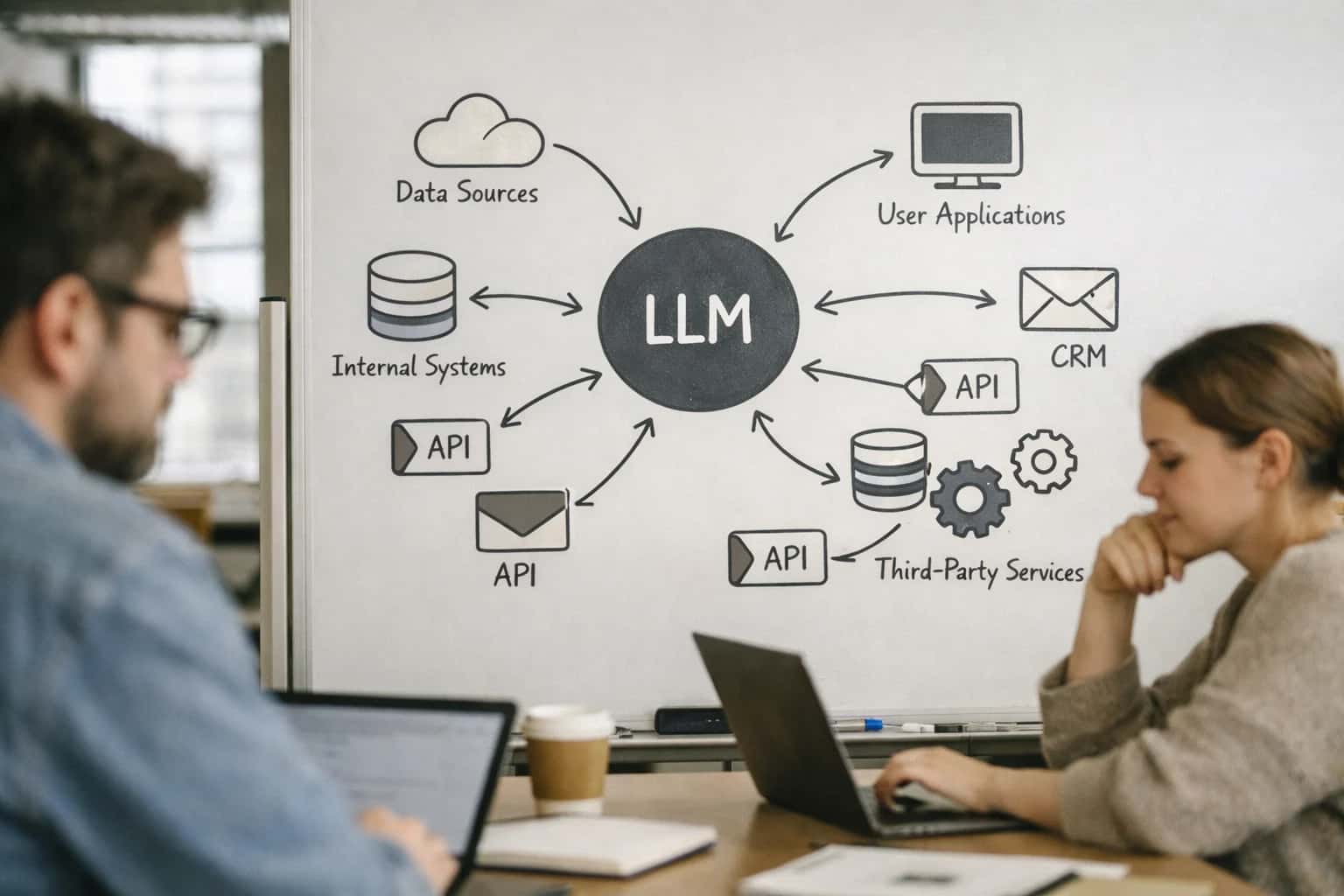
AI connects to budgeting workflows at three key integration points: the budget formulation system (like Workday Adaptive Planning or a custom module in Tyler Munis/SAP), the core financial system of record for actuals, and external data pipelines (economic indicators, tax receipts, census data). The goal is to create a closed-loop system where AI models consume historical fund performance, current economic forecasts, and departmental requests to generate probabilistic revenue and expenditure scenarios. This isn't about replacing budget analysts, but augmenting their work by automating data aggregation, running thousands of 'what-if' simulations in minutes, and drafting narrative justifications for variance explanations or capital project requests.

Integration
AI Integration for Government Budget Forecasting
Where AI Fits into Public Sector Budgeting
Integrating predictive AI into government budgeting transforms a reactive, spreadsheet-heavy process into a dynamic, data-driven planning function.
Implementation typically involves a middleware layer (often on a platform like SAP BTP or Infor OS) that orchestrates data flow. This layer securely pulls historical GL data, encumbrance records, and grant balances from the ERP via APIs, ingests external datasets, and calls hosted forecasting models. The AI's outputs—such as a predicted 5% shortfall in sales tax revenue or a high-probability cost overrun for a public works project—are written back as annotated records or alerts within the budgeting software. This allows analysts to review, adjust assumptions, and approve the AI's recommendations within their familiar workflow, maintaining crucial human oversight and audit trails. Key governance features include model versioning, explainability reports for each forecast, and RBAC to control who can trigger or approve AI-generated budget lines.
Rollout is phased, starting with a single, high-impact fund type (e.g., General Fund revenue forecasting) before expanding. The first win is often reducing the time spent on manual data collection and consolidation from weeks to hours, freeing analysts for higher-value policy analysis. A successful integration doesn't just produce a number; it creates a living forecast that can be updated monthly as new actuals arrive, allowing for mid-year corrections and more resilient financial planning. For a deeper look at connecting AI to specific financial modules, see our guide on AI Integration for Fund Accounting Software.
Integration Points Across Major Government Budgeting Platforms
Connecting AI to Budget Preparation Workflows
AI integration surfaces within the budget formulation layer, where departments build their annual or multi-year budget requests. Key integration points include:
- Revenue Forecasting Engines: Connect AI models to ingest internal historical data (tax receipts, fees) and external economic indicators (employment, inflation) via APIs. The AI generates probabilistic revenue forecasts that populate baseline figures in the planning module, replacing manual spreadsheet models.
- Expenditure Modeling Assistants: Integrate AI copilots directly into the budget preparation UI. These agents analyze past spending patterns, current service-level agreements, and projected inflation to suggest line-item adjustments, flag outliers, and draft narrative justifications for significant changes.
- Scenario Planning Workspaces: Use AI to power dynamic "what-if" analysis within the platform's scenario tools. Agents can model the multi-year impact of policy changes, grant awards, or capital project delays, updating linked financial projections across funds and departments automatically.
Implementation typically involves creating a middleware service that pulls data from the budgeting platform's APIs, runs forecasts using hosted models, and pushes structured results back into dedicated custom fields or supporting documents.
High-Value AI Use Cases for Government Budget Forecasting
Integrating predictive AI with government budgeting systems like Tyler Munis, SAP Public Sector, and Workday Adaptive Planning transforms static spreadsheets into dynamic, data-driven forecasts. These patterns connect internal ERP data with external economic indicators to improve accuracy and free up analysts for strategic work.
Multi-Source Revenue Forecasting
Integrate AI models with your ERP General Ledger and external data APIs (e.g., BLS, local economic indices) to predict sales tax, property tax, and fee revenue. Models automatically ingest historical trends, seasonal patterns, and leading indicators, generating probabilistic forecasts that update as new data arrives.
Expenditure Variance Explanation
Connect an AI agent to your budget-to-actual reporting module. When a department exceeds its line-item budget, the agent analyzes purchase orders, contract registers, and payroll data to draft a narrative explaining the variance—citing specific contracts, personnel changes, or price fluctuations—saving budget managers hours of manual investigation.
Grant-Funded Position Modeling
For budgets reliant on federal or state grants, integrate AI with Workday Grants Management or SAP GM modules. The system models the impact of grant award timing, personnel cost escalation, and FTE allocations on the general fund, automatically flagging potential funding cliffs and recommending soft vs. hard funding strategies for positions.
Capital Project Cost & Timeline Prediction
Feed historical capital project data from your PPM or capital planning module into an AI model. For new projects in the budget, the system predicts total lifecycle costs and potential timeline overruns based on project type, size, and vendor history, providing more accurate multi-year budget projections for CIP planning.
Scenario Modeling for Policy Decisions
Build an AI copilot integrated with Workday Adaptive Planning or similar tools. Budget officers use natural language to ask "what-if" questions (e.g., impact of a 3% COLA increase or a new recreation center). The AI queries the integrated financial model, runs simulations, and generates a summary report of fiscal impacts across funds.
Automated Budget Narrative & Council Packet Drafting
Integrate an AI workflow with your document management system (e.g., Tyler Content Manager). The agent pulls approved budget numbers, variance explanations, and strategic goals from the ERP to auto-generate first drafts of budget narratives, executive summaries, and council presentation materials, ensuring consistency and saving weeks of manual compilation.
Example AI-Augmented Budgeting Workflows
These workflows illustrate how predictive AI models connect to core budgeting modules within platforms like Tyler Munis, SAP S/4HANA Public Sector, and Workday Adaptive Planning. Each pattern shows a specific trigger, the data pulled, the AI action, and the resulting system update.
Trigger: Monthly close process initiates in the ERP's general ledger module.
Context/Data Pulled: The workflow agent calls the ERP's GL API to retrieve actual revenue collections for the past 36 months, segmented by fund and revenue source (e.g., property tax, sales tax, fees). It simultaneously queries the budget module for the current fiscal year's forecasted revenues and pulls external economic indicators (local unemployment rate, building permit volume) from a configured data lake.
Model or Agent Action: A time-series forecasting model (like Prophet or an LSTM) analyzes the historical actuals against the forecast and external factors. The AI agent generates a variance report, identifying sources of significant deviation (>5%). It then uses an LLM to draft a plain-language narrative explaining the variance, e.g., "Sales tax collections are 7% below forecast, correlated with a 2% dip in local retail employment; recommend a Q3 forecast adjustment of -$120,000."
System Update or Next Step: The variance report and narrative are posted as a comment in the budget module's workflow for the responsible Budget Analyst. The agent can also create a draft journal entry in the ERP for a forecast adjustment, pending manager approval.
Human Review Point: The Budget Analyst reviews the AI-generated analysis and narrative, approves or edits the journal entry draft, and submits it through the standard approval chain.
Implementation Architecture: Data Flow & Integration Patterns
A technical blueprint for connecting predictive AI models to government budgeting systems to automate data ingestion, scenario modeling, and narrative generation.
A production AI budget forecasting system integrates at three key layers: the data ingestion and enrichment layer, the predictive modeling and orchestration layer, and the budget system action layer. The ingestion layer connects to internal ERP data (historical expenditures from fund accounting modules, revenue streams from tax and billing systems) and external data sources (economic indicators, weather data, census updates) via APIs and secure data pipelines. This raw data is cleaned, transformed, and stored in a feature store or data lake accessible to the AI models. The core AI orchestration layer, often deployed on a platform like SAP BTP, Infor OS, or a custom cloud environment, runs time-series forecasting models for revenues and machine learning models for expenditure drivers. These models generate multiple 'what-if' scenarios based on policy variables.
The outputs—projected figures, variance explanations, and confidence intervals—are then formatted into payloads compatible with the target budgeting software, such as Workday Adaptive Planning, Tyler Munis Budgeting, or SAP Analytics Cloud Planning. Integration occurs via the system's native REST APIs or through middleware. For example, a forecast for property tax revenue can be written directly to a scenario worksheet in Adaptive Planning, while a detected anomaly in public safety overtime spending can trigger an alert within the SAP S/4HANA Public Sector cost center module. Crucially, a human-in-the-loop approval step is architected before final budget numbers are committed, ensuring financial officer oversight. All data flows, model inferences, and user approvals are logged to an immutable audit trail for transparency and compliance with public sector auditing standards.
Rollout follows a phased approach, starting with a single, high-impact revenue stream or departmental budget. Governance is enforced through role-based access control (RBAC) on the AI platform, ensuring only authorized budget analysts and directors can adjust model parameters or approve forecasts. Model performance is continuously monitored for drift against actuals, with retraining pipelines automated within the architecture. This pattern moves forecasting from a quarterly, manual spreadsheet exercise to a continuous, data-informed process, enabling finance teams to shift from data compilation to strategic analysis. For a deeper look at connecting AI to the core financial system, see our guide on AI Integration for Fund Accounting Software.
Code & Payload Examples for Key Integration Tasks
Orchestrating Multi-Model Forecasts
Budget forecasts often require blending outputs from internal statistical models with external economic indicators via LLMs. A central orchestrator service calls your existing forecasting APIs, retrieves external data, and uses an LLM to synthesize a narrative and final recommendation.
Key Integration Points:
- ERP Budget Module API: Pulls historical expenditure and revenue data.
- Internal Model Service: Calls proprietary forecasting algorithms.
- LLM Gateway: For narrative generation and scenario weighting.
python# Example orchestrator service (pseudocode) import requests # 1. Retrieve internal data from ERP (e.g., Tyler Munis, SAP) erp_data = requests.get( f"{ERP_API_URL}/budget/line-items", params={"fiscal_year": target_year, "fund": fund_code}, headers={"Authorization": f"Bearer {erp_token}"} ).json() # 2. Call internal forecasting model service internal_forecast = requests.post( INTERNAL_MODEL_URL, json={"historical_data": erp_data["trends"], "confidence_interval": 0.95} ).json() # 3. Enrich with external economic data (e.g., Fed rates, local CPI) external_context = get_economic_indicators(county_fips, target_year_quarter) # 4. Use LLM to synthesize final forecast with rationale llm_payload = { "model": "gpt-4", "messages": [ {"role": "system", "content": "You are a budget analyst. Synthesize a forecast."}, {"role": "user", "content": f"Internal model predicts: {internal_forecast}. External context: {external_context}. Provide a final revenue forecast and 3-line narrative."} ], "tools": [{"type": "function", "function": {"name": "submit_forecast", "description": "Submit final forecast to budget system", "parameters": {...}}}] } # LLM call returns structured JSON for system submission
This pattern keeps your core models intact while adding AI-driven synthesis and external data contextualization, writing results back to the budget module for review.
Realistic Time Savings & Operational Impact
How integrating predictive AI models with government budgeting software transforms key planning workflows from reactive data aggregation to proactive, data-driven forecasting.
| Forecasting Workflow | Before AI Integration | After AI Integration | Implementation Notes |
|---|---|---|---|
Revenue Projection Cycle | 2-3 weeks manual aggregation | Same-day preliminary forecast | AI synthesizes internal historical data, economic indicators, and demographic trends |
Expenditure Variance Analysis | Monthly manual review | Continuous anomaly detection | AI monitors GL feeds, flags outliers against budget for analyst review |
Grant Fund Monitoring | Quarterly compliance checks | Real-time spend pacing alerts | AI tracks obligations & expenditures against grant terms, predicts shortfalls |
Budget Narrative Drafting | Days of manual compilation | Hours with AI-assisted drafting | AI generates initial narrative from forecast data, analyst refines |
Scenario Modeling for Council | Limited to 2-3 static scenarios | Dynamic multi-variable modeling | AI enables rapid 'what-if' analysis on revenue, policy changes, and economic shifts |
External Data Integration | Manual spreadsheet imports | Automated API ingestion & synthesis | AI pipelines pull and normalize data from census, BLS, weather, and local economic sources |
Audit Preparation for Forecasts | Manual documentation gathering | Automated audit trail generation | AI logs data sources, model assumptions, and revision history for transparency |
Governance, Security, and Phased Rollout
A secure, governed approach to integrating predictive AI with government budgeting systems.
Integrating AI with government budget forecasting requires a zero-trust data architecture. This means AI models and agents should never directly access raw, sensitive financial data from systems like SAP Public Sector, Tyler Munis, or Workday Adaptive Planning. Instead, implement a secure data pipeline where anonymized, aggregated, or feature-engineered data is pushed to a dedicated AI inference environment. Use APIs and webhooks to trigger forecasts, returning results—such as predicted revenue shortfalls or expenditure variances—back to the budgeting system as structured data objects or alerts. All data movement must be logged, and AI-generated recommendations should be stored as auditable records linked to the source budget scenario.
Governance is managed through a human-in-the-loop approval layer. Before an AI-generated forecast adjusts a live budget model, the system should route the recommendation through a defined workflow in your ERP or PPM tool for review by a budget analyst or finance director. This ensures accountability and aligns with public sector procurement and decision-making protocols. Furthermore, all AI prompts and model outputs should be version-controlled and traceable, enabling post-hoc analysis to explain why a specific forecast was generated, which is critical for auditability and public transparency requirements.
A phased rollout mitigates risk and builds institutional trust. Start with a low-risk, high-impact pilot, such as using AI to forecast a single, volatile revenue stream (e.g., sales tax or permit fees) where external economic data can improve accuracy. In Phase 1, run the AI model in parallel with existing processes, comparing outputs to manual forecasts without making system changes. Phase 2 integrates the AI output as a recommended field within the budgeting software's interface. The final phase automates the ingestion of the AI forecast into baseline scenarios, but only after establishing clear thresholds and override protocols for financial officers. This crawl-walk-run approach allows for tuning models with agency-specific data and securing stakeholder buy-in across finance, IT, and departmental leadership.
Enabling Efficiency, Speed & Accuracy
Intelligent Analysis, Decision & Execution
We build AI systems for teams that need search across company data, workflow automation across tools, or AI features inside products and internal software.
Talk to Us
Search across company data
Give teams answers from docs, tickets, runbooks, and product data with sources and permissions.
Useful when people spend too long searching or get different answers from different systems.

Automate internal workflows
Use AI to route work, draft outputs, trigger actions, and keep approvals and logs in place.
Useful when repetitive work moves across multiple tools and teams.

Add AI to products and internal tools
Build assistants, guided actions, or decision support into the software your team or customers already use.
Useful when AI needs to be part of the product, not a separate tool.
FAQ: AI for Government Budget Forecasting
Practical questions for public sector finance and IT leaders planning to integrate predictive AI with existing budgeting and ERP systems like Tyler Munis, SAP Public Sector, or Workday Adaptive Planning.
Secure integration typically follows a pattern of controlled data extraction, model execution in a governed environment, and write-back of insights. A common architecture involves:
- API-Based Data Pulls: Use the ERP's secure APIs (e.g., Tyler Data & Insights API, SAP OData, Workday Report-as-a-Service) to extract anonymized or aggregated historical budget, revenue, and expenditure data. Avoid direct database connections.
- Orchestration Layer: A middleware service (often on a platform like SAP BTP, Infor OS, or a custom secure container) manages the workflow: it calls the ERP API, prepares the data, calls the AI model (hosted on Azure OpenAI, AWS Bedrock, or a private instance), and processes the response.
- Zero Data Retention Policy: Configure the AI service to not persist the government data after inference. All training, if any, should use fully synthetic or anonymized datasets.
- Write-Back via Secure Channels: Forecasts, variance explanations, or narrative text are written back to a dedicated staging table or a document management system (like Tyler Content Manager) via API, triggering a workflow for budget officer review before any official system update.
Key is implementing role-based access controls (RBAC) at every layer and maintaining a full audit trail of data accessed and predictions generated.

About the author
Prasad Kumkar
CEO & MD, Inference Systems
Prasad Kumkar is the CEO & MD of Inference Systems and writes about AI systems architecture, LLM infrastructure, model serving, evaluation, and production deployment. Over 5+ years, he has worked across computer vision models, L5 autonomous vehicle systems, and LLM research, with a focus on taking complex AI ideas into real-world engineering systems.
His work and writing cover AI systems, large language models, AI agents, multimodal systems, autonomous systems, inference optimization, RAG, evaluation, and production AI engineering.
Partnered with leading AI, data, and software stack.





How We Work
Custom AI workflows for your Business
One-fit-all AI don't work for modern businesses. At Inferensys, we aim to understand your business & custom requirements; which we use to define most efficient agentic workflows, the data, and the tools for your business.
01
Review the use case
We understand the task, the users, and where AI can actually help.
Read more02
Pick the right approach
We define what needs search, automation, or product integration.
Read more03
Build the first useful version
We implement the part that proves the value first.
Read more04
Improve from there
We add the checks and visibility needed to keep it useful.
Read moreThe first call is a practical review of your use case and the right next step.
Talk to Us