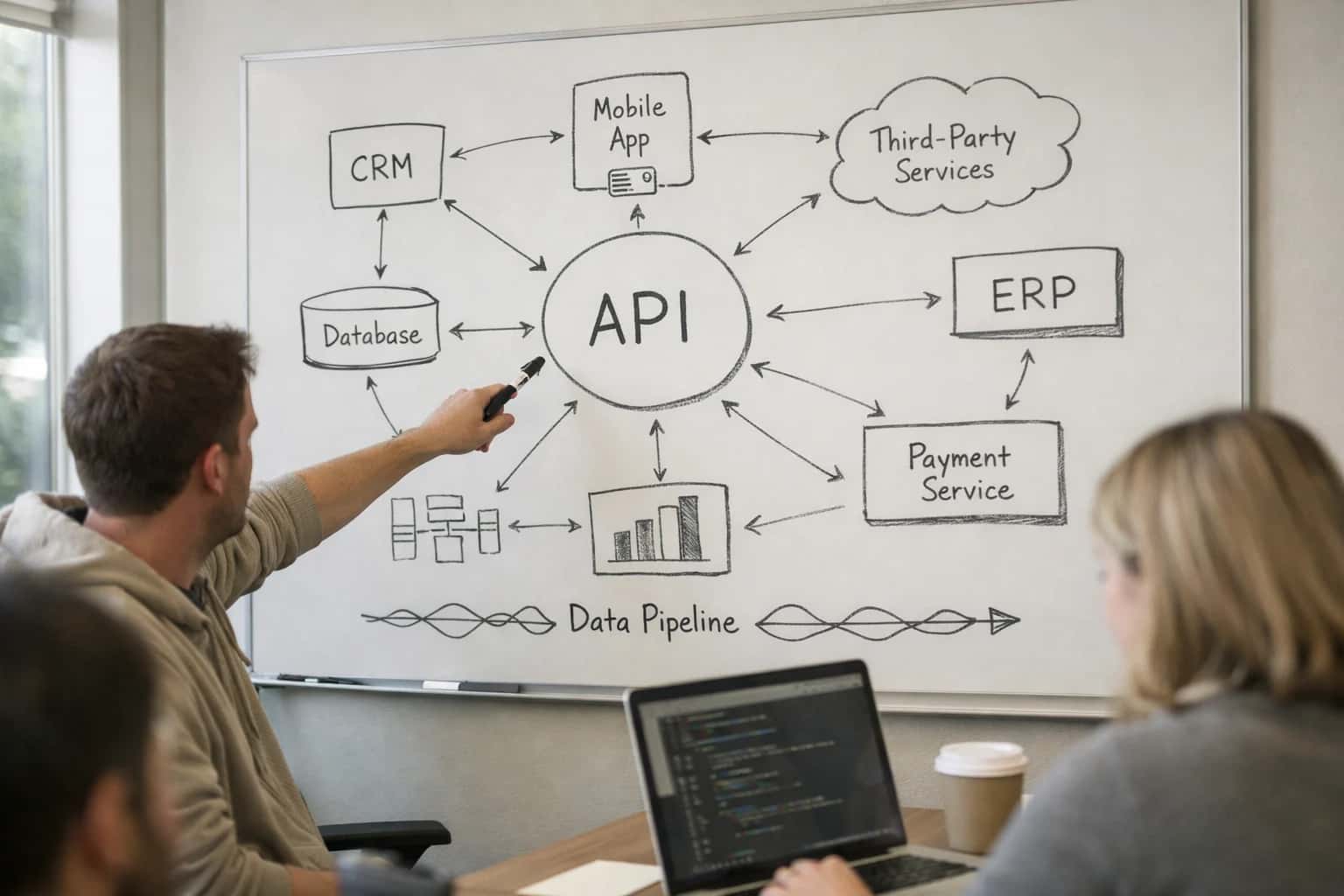
The integration architecture typically connects to core RCM objects via the EHR's APIs (FHIR R4, proprietary financial APIs) or database views. Key surfaces include the charge router, claim scrubber, denial management work queue, patient statements engine, and payment posting interface. AI agents act on these surfaces by reading Claim, Charge, Payment, and Patient Account records, then writing back suggestions, automated actions, or enriched data for human review. For example, an AI coding assistant might read an Encounter and its associated Diagnosis and Procedure records from the clinical side, then generate and post suggested CPT/ICD codes to the billing side's Charge object before submission.

Integration
AI Integration for EHR Revenue Cycle Management
A cross-platform technical blueprint for applying AI to the revenue cycle stack in Epic, athenahealth, Oracle Health, and eClinicalWorks, from charge capture to denial appeals.
ARCHITECTURE AND ROLLOUT
Where AI Fits in the EHR Revenue Cycle
AI integration for RCM is not a single feature; it's a layer of intelligence that connects to specific data objects and workflows across your EHR's financial modules.
High-impact workflows follow the money: Pre-submission (charge capture and coding accuracy), Mid-cycle (claim status monitoring and denial prediction), and Post-payment (patient responsibility estimation and collections outreach). A practical rollout starts with a single, high-volume workflow like automated claim scrubbing for missing modifiers or demographic errors, using an AI agent to review each claim against payer rules and your historical data. This is implemented as a service that polls the Claim queue, processes records, and returns an Alert or Correction payload to the RCM work queue or directly into the claim edit module. Impact is directional: reducing manual review time from hours to minutes per batch and cutting down on avoidable front-end denials.
Governance is critical. Any AI action that changes a code or writes to a financial record should flow through an approval queue or audit trail within the EHR, maintaining existing RBAC. For instance, suggested coding changes should be presented to a certified coder in the Charge Review work queue for one-click acceptance. Rollout requires parallel runs, where AI suggestions are logged but not acted upon, to measure accuracy (e.g., AI-suggested code vs. final human-coded code) and build trust. This controlled approach ensures compliance and allows you to scale from assisted workflows (AI suggests, human decides) to automated workflows (AI executes on pre-defined, high-confidence rules) over time.
WHERE AI CONNECTS TO THE REVENUE CYCLE
RCM Module Touchpoints by EHR Platform
AI for Automated Charge Entry and Code Validation
This layer focuses on the initial capture of billable services and accurate CPT/ICD-10 coding. AI integrates by reading clinical documentation from notes, orders, and flowsheets to suggest appropriate charges and validate codes against payer-specific rules and clinical evidence.
Key Integration Points:
- Epic: Charge Router rules, Charge Capture mobile workflows, and the Resolute Hospital Billing charge interface.
- athenahealth: athenaCollector's charge entry API and the Clinical Documentation Improvement (CDI) engine.
- Oracle Health: The Charge Services module in Millennium and the Charge Description Master (CDM).
- eClinicalWorks: The Charge Capture module and PRISMA engine for coding intelligence.
AI agents can monitor incomplete charts, auto-fill charge tickets based on documented procedures, and flag potential undercoding or overcoding by comparing documentation to billed services, reducing manual work for coders and minimizing lost revenue.
CROSS-PLATFORM AUTOMATION
High-Value AI Use Cases for RCM
Revenue Cycle Management is a prime candidate for AI integration, where automation can directly impact cash flow and operational costs. These use cases apply across Epic, athenahealth, Oracle Health, and eClinicalWorks, targeting specific modules and workflows.
01
Automated Charge Capture & CPT/ICD Code Suggestion
AI reviews clinical documentation from Epic Hyperspace notes, athenaClinicals, or Oracle Health Millennium to suggest accurate CPT and ICD-10 codes. It flags missing documentation for higher-level Evaluation & Management (E/M) codes and auto-populates charge tickets in modules like Epic Resolute, athenaCollector, or Soarian Financials. This reduces manual coding time and minimizes under-coding.
Hours -> Minutes
Coding review
02
AI-Prioritized Denial Management Workflow
Instead of a first-in, first-out queue, AI analyzes incoming denials from payer ERAs to predict appeal success likelihood and financial impact. It routes high-value, winnable denials (e.g., missing clinical documentation) to specialist teams first and suggests appeal letter content by pulling data from the clinical record. Integrates with Epic Cogito, athenahealth Collector analytics, or eClinicalWorks PRISMA.
Same day
High-value triage
03
Real-Time Patient Payment Estimation & Engagement
At the point of scheduling or check-in (via Epic MyChart, healow, or athenaCommunicator), AI generates a patient-specific out-of-pocket estimate. It considers the planned procedure, the patient's insurance benefits on file, and historical payer behavior. It then triggers personalized payment plan options or pre-payment prompts, reducing post-service collections workload.
Batch -> Real-time
Estimate delivery
04
Proactive Claim Scrubbing & Edits Before Submission
An AI agent acts as a final check within the billing queue, reviewing claims against payer-specific rules and historical denial patterns. It flags missing authorizations, incorrect place-of-service codes, or mismatched diagnosis codes before submission to clearinghouses. This integrates directly into the claim edit workflow in any RCM module, preventing rework.
>95%
Clean claim rate target
05
Automated Prior Authorization Clinical Summary
AI extracts key clinical indicators (diagnoses, prior treatments, lab values) from the EHR to draft the clinical summary portion of prior auth requests. It structures the data to match common payer criteria forms, saving clinicians and staff time. The draft is routed for review in the provider's inbox or authorization module before submission.
1 sprint
Implementation timeline
06
Intelligent Work Queue for Follow-up & A/R
AI continuously analyzes the accounts receivable aging report. It prioritizes follow-up actions not just by age, but by payer responsiveness trends, claim complexity, and staff capacity. It assigns tasks (e.g., call payer, send secondary claim) to specific RCM team members via integrated task systems or directly within the RCM workspace, optimizing collector productivity.
Hours -> Minutes
Daily queue planning
CROSS-PLATFORM IMPLEMENTATION PATTERNS
Example AI-Augmented RCM Workflows
These workflows illustrate how AI agents and automations can be embedded into the core revenue cycle stack of Epic, athenahealth, Oracle Health, and eClinicalWorks. Each pattern connects to specific EHR modules, APIs, and data objects to drive efficiency from charge capture to patient collections.
Trigger: A clinical note is signed or an encounter is closed in the EHR (e.g., Epic Hyperspace, athenaClinicals).
Context Pulled: The AI agent retrieves the finalized note text, patient demographics, visit type, and any documented procedures or diagnoses via the EHR's API (FHIR Encounter, Condition, Procedure resources).
Agent Action: A specialized LLM, grounded on CPT/ICD guidelines and the practice's historical coding patterns, analyzes the note. It suggests:
- Primary and secondary diagnosis codes (ICD-10).
- Evaluation and Management (E/M) level with rationale.
- Procedure codes (CPT/HCPCS) with appropriate modifiers.
- It flags any documentation gaps that could lead to downcoding.
System Update: The suggested codes, confidence scores, and supporting excerpts are written back to a dedicated field in the encounter record or posted to a work queue (e.g., Epic's Charge Router workqueue, athenahealth's Charge Entry).
Human Review Point: A certified coder reviews the AI's suggestions within the native coding module, accepting, editing, or rejecting them. The system logs all interactions for audit and model retraining. This reduces initial coding time by 50-70% and improves accuracy by surfacing compliant code combinations.
PRODUCTION-READY INTEGRATION PATTERNS
Implementation Architecture: Data Flow & Guardrails
A secure, auditable architecture for connecting AI to your EHR's revenue cycle without disrupting clinical workflows.
A production integration for EHR Revenue Cycle Management (RCM) connects to three primary data surfaces: the charge capture/charge router, the claims management/scrubbing engine, and the patient accounting/collections module. In Epic, this typically involves APIs and data queues from Resolute Hospital Billing and Resolute Professional Billing. For athenahealth, it's the athenaCollector APIs and batch files. The AI layer acts as a middleware service that subscribes to events (e.g., a new charge posted, a claim denied, a patient statement sent) via webhooks or polls designated tables. It processes the associated clinical documentation, payer rules, and patient data, then returns structured outputs—like a validated CPT/ICD-10 code set, a denial appeal letter draft, or a personalized payment plan suggestion—back into the RCM workflow through a secure API call or by updating a work queue.
Critical guardrails are implemented at each step. Before any AI model is called, a pre-flight data filter strips full patient identifiers, passing only de-identified clinical text, codes, and claim metadata to the AI service. All prompts are templated and logged with the exact context sent. The AI's output is never written directly to a patient record; instead, it's placed into a human-in-the-loop review queue within the RCM module (e.g., a worklist in Epic's Charge Review or athenahealth's Claim Status). An authorized biller or coder must review and approve the suggestion, creating a mandatory audit trail. The system also enforces role-based access control (RBAC), ensuring only users with the correct security class (like RESOLUTE_BILLING) can see and act on AI-generated suggestions.
Rollout follows a phased, service-line-specific approach. We start with a single, high-volume service line (e.g., Orthopedic surgeries or Cardiology consults) in a pilot facility. The AI is configured to only process charges from that department, allowing for controlled validation of coding accuracy and workflow impact. Performance is measured by tracking reduction in coding review time, first-pass claim acceptance rate, and time-to-appeal for denials. Governance is maintained through a weekly review of the audit logs and a sample of AI-suggested vs. human-coded records. This architecture ensures the AI augments your existing team and systems, providing scalable efficiency while maintaining compliance and control.
RCM WORKFLOW INTEGRATION
Code & Payload Examples
Automating CPT/ICD Code Assignment
This integration listens for finalized encounter notes via EHR webhooks, extracts clinical details, and calls an LLM service to suggest accurate billing codes. The response is formatted for direct insertion into the EHR's charge capture module (e.g., Epic's Charge Router, athenahealth's Charge Entry).
Example Python Webhook Handler:
python# Pseudo-webhook endpoint for finalized encounter @app.route('/ehr/encounter-finalized', methods=['POST']) def handle_encounter(): data = request.json encounter_id = data['encounterId'] note_text = data['clinicalNote'] # Call AI service for code suggestion ai_payload = { "clinical_text": note_text, "task": "suggest_cpt_icd_codes", "model": "gpt-4" } ai_response = requests.post(AI_SERVICE_URL, json=ai_payload) # Format for EHR charge entry API charge_entry = { "encounter": encounter_id, "procedures": ai_response.json().get('suggested_cpt_codes', []), "diagnoses": ai_response.json().get('suggested_icd_codes', []), "confidence_scores": ai_response.json().get('confidence_scores') } # Post to EHR's charge API ehr_response = post_to_ehr_charge_api(charge_entry) return jsonify({"status": "processed", "charge_id": ehr_response.id})
The AI service uses a RAG pipeline over CPT/ICD codebooks and payer-specific guidelines to ground its suggestions, returning codes with confidence scores for clinician review.
AI-ENHANCED RCM WORKFLOWS
Realistic Time Savings & Operational Impact
This table illustrates the operational impact of integrating AI into core EHR revenue cycle workflows, based on cross-platform implementations for Epic, athenahealth, Oracle Health, and eClinicalWorks. Metrics show realistic shifts in effort, speed, and manual intervention.
| RCM Workflow | Before AI | After AI | Implementation Notes |
|---|---|---|---|
Charge Capture & Code Assignment | Manual review of charts for missed charges; coder assigns CPT/ICD-10 | AI suggests charges and codes from clinical notes; coder reviews/edits | Focus on high-risk specialties first; human coder remains final approver |
Claim Scrubbing & Submission | Batch edits and manual checks for errors pre-submission | Real-time AI validation against payer rules; flags errors for correction | Integrates with clearinghouse or native EHR claim editor; reduces front-end denials |
Denial Triage & Root Cause Analysis | Manual sorting and investigation of denial reason codes | AI categorizes denials, predicts appeal success, drafts appeal letters | Links to EHR denial management module; prioritizes high-value, winnable appeals |
Patient Payment Estimation | Staff manually calculate using fee schedules and patient benefits | AI generates real-time estimates for patient responsibility at time of service | Pulls data from EHR scheduling and insurance eligibility modules; integrates with patient portal |
AR Follow-up & Payment Posting | Staff manually call payers, check statuses, and post explanations of benefits | AI automates status checks, identifies underpayments, suggests posting actions | Works with ERA feeds and payer portals; exceptions routed to staff for review |
Prior Authorization Clinical Summary | Clinician or staff manually compile records to meet payer criteria | AI drafts clinical summary from relevant chart data for clinician sign-off | Extracts from progress notes, labs, and imaging reports; reduces clinician prep time |
Patient Statement & Collections Outreach | Standardized statement cycles and manual call lists for overdue accounts | AI segments accounts by propensity-to-pay, triggers personalized messaging | Orchestrates via EHR patient communications module; maintains compliance with regulations |
ARCHITECTING FOR PRODUCTION
Governance, Security, and Phased Rollout
A practical framework for deploying AI in the RCM stack with control, compliance, and measurable impact.
Integrating AI into your EHR's revenue cycle requires a policy-aware architecture from day one. This means designing workflows where AI acts as a governed assistant, not an autonomous agent. For example, an AI-suggested CPT code in Epic's Charge Capture or an automated denial appeal draft in athenahealth's Collector module should be routed through a human-in-the-loop review queue before submission. All AI interactions must be logged against the specific patient account, claim ID, and user for a complete audit trail, satisfying both internal compliance and external payer scrutiny.
A phased rollout mitigates risk and builds organizational trust. Start with a non-clinical, high-volume workflow such as patient payment estimation or claim status inquiry automation via the patient portal (e.g., Epic MyChart, eClinicalWorks healow). This allows you to validate the AI's accuracy and user experience with lower regulatory stakes. The next phase typically targets back-office efficiency, like using AI to pre-scrub claims by checking for common errors against payer rules before they leave your practice management system. The final, most complex phase involves clinical-financial intersections, such as AI-assisted charge capture that reviews clinical documentation in the EHR to suggest optimal coding, which requires tight integration with modules like Epic's Hyperspace or Oracle Health's Millennium and rigorous clinical validation.
Security is paramount when AI systems access PHI and financial data. Implementations should use service accounts with strict RBAC, ensuring the AI only accesses the minimum necessary data objects (e.g., encounters, charges, statements) via the EHR's API. Data sent to external LLMs should be de-identified or processed through a private endpoint. A robust rollout plan includes creating a cross-functional governance committee (IT, Compliance, RCM, Clinical) to approve use cases, monitor performance metrics like reduction in days in A/R or first-pass claim acceptance rate, and establish protocols for handling AI errors or drift. This controlled, iterative approach turns AI integration from a speculative project into a reliable component of your revenue engine.
Enabling Efficiency, Speed & Accuracy
Intelligent Analysis, Decision & Execution
We build AI systems for teams that need search across company data, workflow automation across tools, or AI features inside products and internal software.
Talk to Us
Search across company data
Give teams answers from docs, tickets, runbooks, and product data with sources and permissions.
Useful when people spend too long searching or get different answers from different systems.
Enterprise searchRAGPermissions
Read more
Automate internal workflows
Use AI to route work, draft outputs, trigger actions, and keep approvals and logs in place.
Useful when repetitive work moves across multiple tools and teams.
AI agentsWorkflow automationGovernance
Read more
Add AI to products and internal tools
Build assistants, guided actions, or decision support into the software your team or customers already use.
Useful when AI needs to be part of the product, not a separate tool.
AI integrationDecision supportModel routing
Read moreIMPLEMENTATION AND WORKFLOW DETAILS
Frequently Asked Questions
Practical questions for technical and operational leaders planning AI integration into their EHR's revenue cycle. Focused on architecture, workflow changes, and measurable outcomes.
This integration typically connects to the EHR's clinical documentation, encounter, and charge modules via API. The workflow is triggered post-visit closure.
- Trigger: A completed encounter is flagged in the EHR (e.g., status changes to 'Ready for Billing' in Epic's Resolute or athenahealth's Collector).
- Context Pulled: The AI agent retrieves the clinical note, problem list, procedures performed, and provider details via FHIR or proprietary APIs.
- Agent Action: A specialized LLM, grounded in CPT/ICD-10 guidelines and your organization's historical billing patterns, analyzes the documentation.
- Suggests primary and secondary diagnosis codes (ICD-10).
- Recommends procedure codes (CPT/HCPCS) with appropriate modifiers.
- Flags documentation deficiencies that could lead to downcoding or denials.
- System Update: The suggested codes and a confidence score are posted back to a staging table or a dedicated UI within the RCM module (e.g., a sidebar in the coding queue).
- Human Review Point: A certified coder reviews, adjusts, and approves the AI's suggestions before final submission, creating an audit trail. This can reduce manual code lookup time by 30-50% per chart.

About the author
Prasad Kumkar
CEO & MD, Inference Systems
Prasad Kumkar is the CEO & MD of Inference Systems and writes about AI systems architecture, LLM infrastructure, model serving, evaluation, and production deployment. Over 5+ years, he has worked across computer vision models, L5 autonomous vehicle systems, and LLM research, with a focus on taking complex AI ideas into real-world engineering systems.
His work and writing cover AI systems, large language models, AI agents, multimodal systems, autonomous systems, inference optimization, RAG, evaluation, and production AI engineering.
LinkedIn
Limited slotsGet a Free AI Consultation
Partnered with leading AI, data, and software stack.





How We Work
Custom AI workflows for your Business
One-fit-all AI don't work for modern businesses. At Inferensys, we aim to understand your business & custom requirements; which we use to define most efficient agentic workflows, the data, and the tools for your business.
01
Review the use case
We understand the task, the users, and where AI can actually help.
Read more02
Pick the right approach
We define what needs search, automation, or product integration.
Read more03
Build the first useful version
We implement the part that proves the value first.
Read more04
Improve from there
We add the checks and visibility needed to keep it useful.
Read moreThe first call is a practical review of your use case and the right next step.
Talk to Us