AI integration connects directly to the metadata and stewardship surfaces within Talend Data Fabric. The primary touchpoints are the Data Inventory for automated classification and tagging, the Lineage & Impact Analysis module for intelligent mapping and documentation, and the Data Stewardship Console where AI can suggest policies, flag anomalies, and route tasks. This allows governance teams to move from manual, reactive rule definition to a proactive, model-driven approach that scales with data volume.

Integration
AI Integration for Talend Data Governance
A technical blueprint for embedding AI agents into Talend's governance workflows to automate classification, lineage, and compliance reporting, reducing manual effort from weeks to days.
ARCHITECTURE AND ROLLOUT
Where AI Fits into Talend Data Governance
Integrating AI with Talend's governance modules automates classification, enriches lineage, and powers compliance workflows.
Implementation typically involves deploying lightweight AI agents that monitor Talend's metadata API and job execution logs. These agents use LLMs to analyze data samples and job specifications, then push enriched metadata—such as inferred PII classifications, suggested business terms, or data quality scores—back into Talend's catalog. For example, an agent can parse a newly discovered database column named cust_dob and automatically apply the PII - Date of Birth tag and a relevant GDPR retention policy, triggering a workflow for steward review in the console.
Rollout should be phased, starting with a pilot on a single data domain or compliance regime (e.g., CCPA customer data). Governance remains central; all AI-generated tags and policies are suggestions that require human approval within Talend's stewardship workflows before enforcement. This creates an audit trail and ensures control. A successful integration reduces the time to classify new data assets from days to minutes and turns static lineage diagrams into interactive maps that can answer questions like, "Which downstream reports are impacted if this source field changes?"
For teams managing this integration, connecting to related guides on [/integrations/data-integration-and-etl-platforms/ai-integration-for-talend-data-lineage](AI-powered lineage) and [/integrations/data-governance-and-privacy-platforms](cross-platform governance patterns) can provide deeper architectural context.
AI FOR DATA GOVERNANCE
Key Integration Surfaces in Talend
Automating Metadata Enrichment and Discovery
Integrate AI with Talend's Enterprise Data Catalog (EDC) to automate the classification, tagging, and description of data assets. Use LLMs to analyze column names, sample data, and job metadata to infer business terms, identify PII/PHI, and suggest data quality rules. This transforms manual stewardship into an automated workflow, where AI agents scan newly discovered sources, propose glossary mappings, and flag compliance risks for review.
A typical implementation uses Talend's REST API or webhooks to trigger an AI service when new assets are profiled. The AI returns enriched metadata—such as sensitivity: high, domain: customer, description: "Customer's primary email address for service communications"—which is then written back to the catalog via API. This creates a continuously improving, AI-augmented inventory critical for GDPR and CCPA readiness.
AUTOMATE CLASSIFICATION, LINEAGE, AND COMPLIANCE
High-Value AI Use Cases for Talend Governance
Integrate AI directly with Talend's metadata and governance workflows to automate manual stewardship tasks, accelerate compliance reporting, and create intelligent, self-documenting data pipelines.
01
Automated Data Classification & PII Tagging
Use LLMs to scan column names, sample data, and business glossary terms from Talend's metadata to automatically classify data sensitivity (e.g., PII, PCI, PHI). Apply tags directly to Talend Data Fabric assets, triggering downstream privacy workflows in platforms like OneTrust or BigID.
Hours -> Minutes
Classification time
02
Intelligent Data Lineage Enrichment
Augment Talend's technical lineage with business-context summaries. An AI agent parses job names, transformation logic (tMap components), and column mappings to generate plain-English descriptions of data flow impact for auditors and business users, stored within Talend or a connected catalog.
1 sprint
Audit prep time
03
Compliance Rule Generation & Monitoring
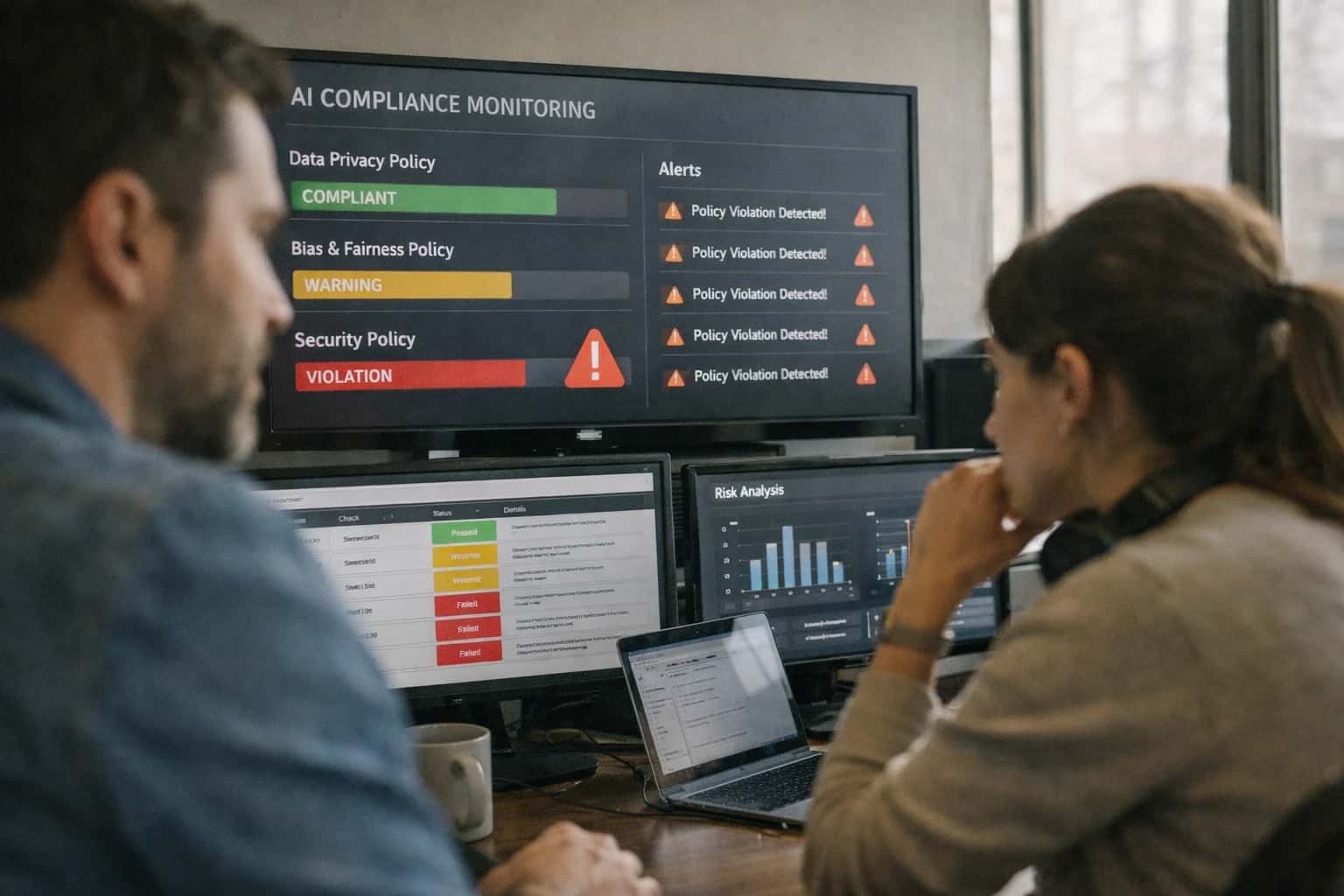
Translate regulatory requirements (GDPR 'right to be forgotten', CCPA data sale opt-out) into automated data quality and retention rules within Talend. AI suggests and configures monitoring jobs that scan for policy violations, generating alerts and remediation tickets in connected ITSM tools.
Batch -> Real-time
Violation detection
04
Stewardship Workflow Automation
Build AI agents that act as the first responder in Talend-driven stewardship queues. Agents triage data quality issues, suggest fixes based on historical resolutions, and route complex exceptions to the appropriate data owner, all within Talend's operational framework.
Same day
Issue resolution SLA
05
Unstructured Document Governance
Extend Talend's governance to contracts, reports, and emails. Use AI to extract entities, clauses, and commitments from documents ingested via Talend, creating structured metadata records linked to master data. Enables compliance tracking for obligations buried in unstructured sources.
06
Anomaly Detection in Governance Metrics
Monitor the health of the governance program itself. Apply AI to Talend job logs, catalog usage metrics, and policy violation rates to detect drift in data quality, lineage breaks, or access pattern anomalies. Proactively surfaces risks before they impact reporting or analytics.
TALEND DATA FABRIC
Example AI-Augmented Governance Workflows
These workflows demonstrate how to embed AI agents into Talend's governance surfaces to automate classification, lineage documentation, and compliance reporting, reducing manual effort from days to hours.
Trigger: A new data source connection is configured in Talend Data Inventory or a new job publishes a dataset to the data lake.
Context Pulled: The agent retrieves the schema metadata (column names, sample data, data types) from Talend's metadata repository via its API.
AI Agent Action:
- The agent sends the metadata to an LLM (e.g., GPT-4, Claude 3) with a prompt to classify each field against a taxonomy (e.g.,
PII,Financial,Operational,Public). - The LLM returns classifications with confidence scores.
- For high-confidence PII matches (e.g.,
email,ssn), the agent can suggest specific data masking or encryption rules from Talend's built-in library.
System Update: The agent uses Talend's API to write the classifications and suggested policies back to the metadata repository, tagging the assets.
Human Review Point: Low-confidence classifications or policy suggestions are routed to a data steward's queue in Talend Data Stewardship for manual review and approval.
FROM METADATA TO AUTOMATED POLICY
Implementation Architecture and Data Flow
A practical blueprint for integrating AI agents directly into Talend's data governance workflows to automate classification, lineage, and compliance.
The integration connects to Talend's metadata APIs and Data Inventory to process technical metadata—column names, data types, sample values, and job execution logs. An AI agent, typically deployed as a containerized service, ingests this metadata to perform core governance tasks: automated data classification (tagging PII, PHI, financial data), lineage gap analysis (inferring missing transformations between jobs), and policy suggestion (mapping data assets to regulations like GDPR Article 17 or CCPA). This agent acts as a co-pilot for data stewards, writing enriched metadata and suggested policies back to Talend's Data Stewardship Console via API for review and approval.
A production implementation uses an event-driven pattern. A webhook from Talend triggers the AI service when new assets are profiled or pipelines change. The service queries Talend's Data Catalog for context, uses an LLM for reasoning, and posts results to a governance queue in a system like RabbitMQ or Amazon SQS. Approved classifications automatically update Talend's Business Glossary and trigger downstream actions—like applying masking policies in Talend Data Fabric jobs or notifying Collibra via its API for enterprise-wide policy enforcement. This keeps the human-in-the-loop for critical decisions while automating the manual taxonomy work.
Rollout focuses on a phased, domain-specific approach. Start with a single data domain (e.g., Customer) and a high-value use case like consent preference tracking. The AI agent scans Talend jobs ingesting customer data, classifies fields against a consent schema, and suggests retention rules. After validation, the logic is codified into reusable Joblets within Talend Studio for broader deployment. Governance is maintained through an audit log of all AI-suggested tags and a feedback loop where steward approvals continuously fine-tune the agent's classification model, ensuring accuracy improves over time without losing regulatory compliance.
TALEND DATA GOVERNANCE
Code and Payload Examples
Classifying Sensitive Data with AI
Integrate an AI service with Talend's metadata APIs to automatically scan and tag data assets for PII, PHI, and financial data. This workflow typically involves extracting column names, sample data, and data profiles from Talend's catalog, sending them to an LLM for classification, and writing the results back as custom tags or business terms.
Example Python Payload for Classification API Call:
pythonimport requests import json # Payload to send column metadata to an LLM classification endpoint classification_payload = { "columns": [ { "name": "customer_email", "sample_values": ["[email protected]", "[email protected]"], "data_type": "varchar", "null_percentage": 0.1 }, { "name": "transaction_amount", "sample_values": ["150.75", "89.99"], "data_type": "decimal", "null_percentage": 0.05 } ], "regulatory_context": ["GDPR", "CCPA"] } # Call AI service for classification response = requests.post( "https://api.your-ai-service.com/v1/classify", json=classification_payload, headers={"Authorization": "Bearer YOUR_API_KEY"} ) # Expected response structure # { # "classifications": [ # {"column_name": "customer_email", "tags": ["PII", "Contact Information"], "confidence": 0.98}, # {"column_name": "transaction_amount", "tags": ["Financial Data"], "confidence": 0.95} # ] # }
This structured output can then be used to update Talend's governance model via its REST API, applying the generated tags to the appropriate assets.
AI-AUGMENTED DATA GOVERNANCE
Realistic Time Savings and Operational Impact
This table illustrates the operational impact of integrating AI with Talend's data governance workflows, focusing on automating manual classification, lineage tracking, and compliance reporting tasks.
| Governance Task | Before AI Integration | After AI Integration | Implementation Notes |
|---|---|---|---|
Data Classification & PII Tagging | Manual column review and rule configuration | Automated scanning with LLM-assisted tag suggestion | Human steward reviews and approves AI suggestions; integrates with Talend Data Fabric |
Business Glossary Population | Manual term definition and stakeholder interviews | AI-generated term suggestions from metadata and data samples | Stewards refine definitions; links to Talend Enterprise Data Catalog |
Impact Analysis for Schema Changes | Manual tracing through jobs and SQL to assess downstream effects | AI-generated lineage impact report with risk scoring | Leverages Talend metadata; provides change advisory for GDPR/CCPA reports |
Compliance Report Drafting (GDPR/CCPA) | Manual data inventory compilation and narrative writing | AI-assisted report generation from classified assets and policies | Generates draft for legal review; audit trail maintained in Talend |
Data Quality Rule Discovery | Manual data profiling and anomaly investigation | AI suggests potential rules based on statistical patterns and outliers | Rules are implemented in Talend Data Quality; reduces initial profiling time |
Stewardship Ticket Triage | Manual review and routing of data issue tickets | AI-assisted categorization and priority scoring based on content | Routes to appropriate steward; integrates with ServiceNow or Jira via Talend |
Lineage Gap Detection | Manual reconciliation of technical vs. business lineage | AI compares job metadata with user queries to identify missing links | Flags gaps for steward attention; improves trust in Talend lineage views |
ARCHITECTING FOR POLICY, PRIVACY, AND PRODUCTION
Governance, Security, and Phased Rollout
A practical framework for deploying AI in Talend Data Governance with controlled risk and measurable impact.
Integrating AI with Talend Data Governance requires a policy-first architecture. This means designing AI agents and workflows to operate within the existing governance framework, using Talend's metadata APIs to read and write classifications, business terms, and lineage. For example, an AI agent that scans new data assets for PII should log its classification decisions back to Talend's Data Stewardship Console via API, creating a full audit trail. Security is enforced at the integration layer: AI service calls must authenticate via Talend's OAuth 2.0 or API keys, and sensitive data should be processed in-memory or via secure, ephemeral sandboxes rather than persisting in external AI training datasets.
A phased rollout is critical for managing change and proving value. Start with a read-only pilot, such as using an LLM to analyze Talend's existing Data Catalog metadata and suggest new business glossary terms or potential data quality rules. This builds trust without altering production data. Phase two introduces assisted stewardship, where AI agents draft data classification tags or lineage mappings for a human steward to review and approve within Talend's workflow engine. The final phase enables controlled automation for high-confidence, repetitive tasks, like auto-tagging standard address columns or generating basic column-level lineage for common ETL patterns, all governed by pre-defined approval thresholds and rollback procedures.
Governance extends to the AI models themselves. Implement a feedback loop where data stewards can correct AI-generated metadata (e.g., an incorrect classification) within Talend. These corrections should be used to fine-tune the underlying models, improving accuracy over time. Rollout should be scoped by data domain (e.g., Customer, Finance) and tied to specific compliance drivers like GDPR Article 30 record-keeping or CCPA data mapping requirements. This domain-by-domain approach limits risk, delivers quick wins, and creates a repeatable blueprint for scaling AI-assisted governance across the enterprise. For related architectural patterns, see our guide on AI Integration for Data Governance and Privacy Platforms.
Enabling Efficiency, Speed & Accuracy
Intelligent Analysis, Decision & Execution
We build AI systems for teams that need search across company data, workflow automation across tools, or AI features inside products and internal software.
Talk to Us
Search across company data
Give teams answers from docs, tickets, runbooks, and product data with sources and permissions.
Useful when people spend too long searching or get different answers from different systems.
Enterprise searchRAGPermissions
Read more
Automate internal workflows
Use AI to route work, draft outputs, trigger actions, and keep approvals and logs in place.
Useful when repetitive work moves across multiple tools and teams.
AI agentsWorkflow automationGovernance
Read more
Add AI to products and internal tools
Build assistants, guided actions, or decision support into the software your team or customers already use.
Useful when AI needs to be part of the product, not a separate tool.
AI integrationDecision supportModel routing
Read moreIMPLEMENTATION GUIDE
Frequently Asked Questions
Practical questions for data governance and compliance teams evaluating AI integration with Talend Data Fabric to automate classification, lineage, and reporting.
AI integrates with Talend's governance layer through its APIs and metadata repositories. The typical architecture involves:
- Metadata Extraction: Using Talend's API or querying its repository to pull data asset metadata (tables, columns, jobs, lineage).
- AI Processing: Sending this metadata to an LLM service (like Azure OpenAI or Anthropic) via secure API calls for analysis and enrichment.
- System Update: Writing the AI-generated insights (e.g., classification tags, PII flags, business term suggestions) back into Talend's governance objects via API.
Key integration points are the Talend Metadata Service for asset discovery and the Talend Data Stewardship Console API for updating data quality rules and stewardship tasks. This allows AI to act as an automated steward, enriching the catalog and triggering compliance workflows.

About the author
Prasad Kumkar
CEO & MD, Inference Systems
Prasad Kumkar is the CEO & MD of Inference Systems and writes about AI systems architecture, LLM infrastructure, model serving, evaluation, and production deployment. Over 5+ years, he has worked across computer vision models, L5 autonomous vehicle systems, and LLM research, with a focus on taking complex AI ideas into real-world engineering systems.
His work and writing cover AI systems, large language models, AI agents, multimodal systems, autonomous systems, inference optimization, RAG, evaluation, and production AI engineering.
LinkedIn
Limited slotsGet a Free AI Consultation
Partnered with leading AI, data, and software stack.





How We Work
Custom AI workflows for your Business
One-fit-all AI don't work for modern businesses. At Inferensys, we aim to understand your business & custom requirements; which we use to define most efficient agentic workflows, the data, and the tools for your business.
01
Review the use case
We understand the task, the users, and where AI can actually help.
Read more02
Pick the right approach
We define what needs search, automation, or product integration.
Read more03
Build the first useful version
We implement the part that proves the value first.
Read more04
Improve from there
We add the checks and visibility needed to keep it useful.
Read moreThe first call is a practical review of your use case and the right next step.
Talk to Us