AI integration for contract workflow optimization connects directly to your CLM platform's workflow engine, audit logs, and task objects (e.g., Ironclad Workflow Designer, Icertis AI Studio workflows, Agiloft's configurable queues). By analyzing historical data—cycle times, review stages, approver response rates, and exception patterns—AI models can identify systemic bottlenecks, such as repetitive legal reviews for low-risk NDAs or procurement delays on standard vendor terms. This analysis allows you to reconfigure workflows to auto-route contracts based on AI-scored risk, value, and complexity, moving from sequential, manual handoffs to parallel, intelligent orchestration.

Integration
AI Integration for Contract Workflow Optimization
Use AI to analyze historical contract workflow data in CLM platforms to identify bottlenecks, recommend process improvements, and dynamically route contracts for faster execution.
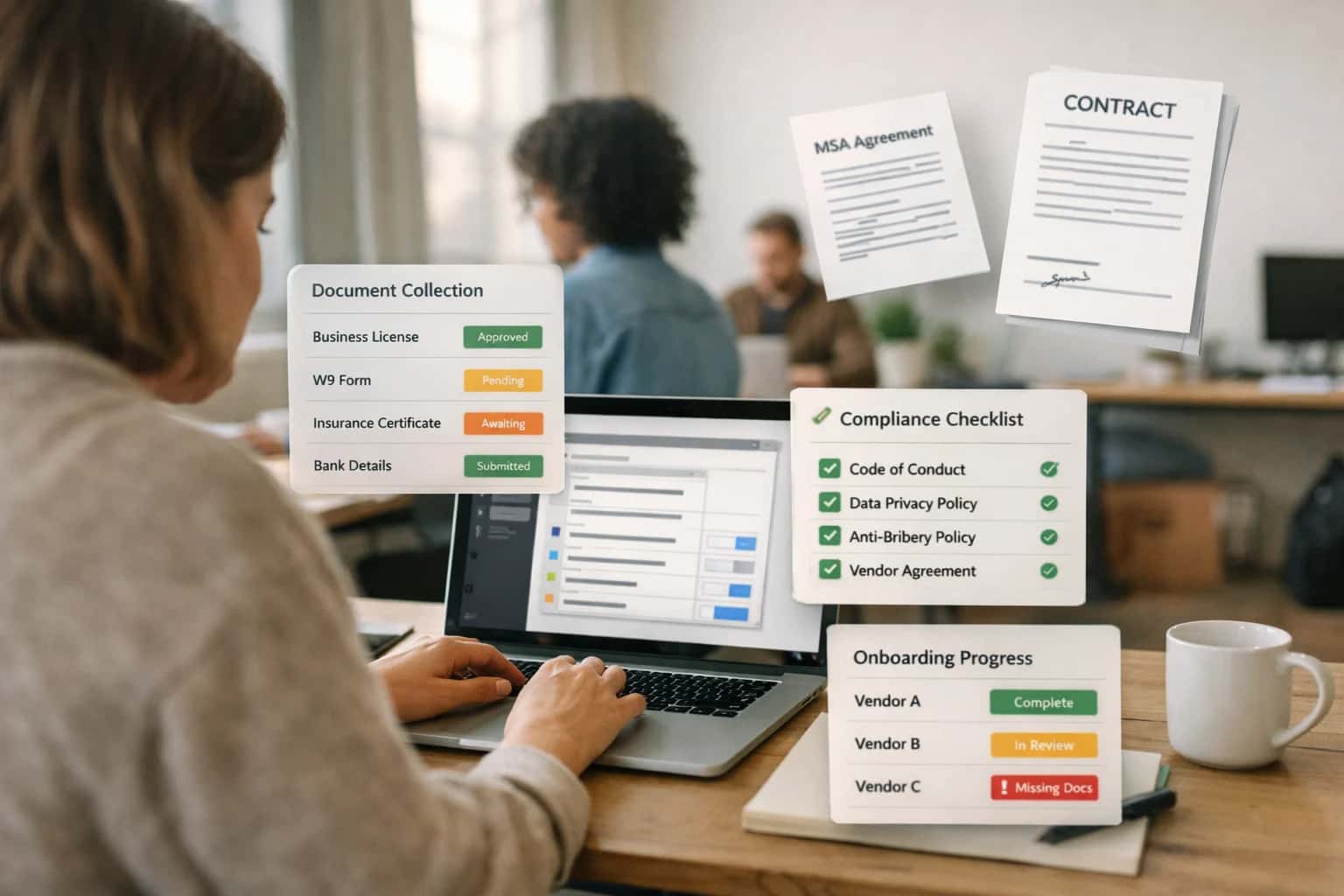
CLM PLATFORM INTEGRATION
Optimize Contract Workflows with AI-Powered Intelligence
Deploy AI to analyze historical workflow data in your CLM platform, identify bottlenecks, and dynamically route contracts for faster execution.
Implementation involves deploying an AI service that ingests workflow event data via the CLM's REST API or webhook streams. This service uses predictive analytics to recommend process improvements, such as adjusting approval thresholds or suggesting fallback approvers. For dynamic routing, the AI agent acts as a decision layer, evaluating new contract submissions (via metadata, extracted clauses, or a preliminary AI scan) and assigning them to the optimal review path—for example, sending a high-value, non-standard MSA through a full legal, finance, and security review while auto-approving a renewal with no changes against a master agreement. This reduces average cycle times from weeks to days and shifts legal and business teams from process management to exception handling and strategic negotiation.
Rollout requires a phased approach, starting with a pilot on a single contract type (e.g., NDAs) to calibrate AI routing logic against human outcomes. Governance is critical; all AI-driven routing decisions should be logged to a dedicated audit trail within the CLM, with clear override mechanisms for users. Integrating this AI layer also prepares your CLM for advanced use cases like predictive renewal workflows or obligation-triggered automations in connected systems like ERP or CRM. For a deeper dive on connecting these intelligent workflows to core business systems, see our guide on CLM and ERP Integration.
CONTRACT WORKFLOW OPTIMIZATION
Where AI Integrates into CLM Workflow Engines
Automating Contract Intake and Initial Routing
AI integrates at the earliest stage of the CLM workflow to classify incoming contract requests and assign them to the correct review path. By analyzing the request form, attached documents, and historical data, an AI agent can:
- Classify contract type (e.g., NDA, MSA, SOW, Amendment) and determine the required playbook.
- Extract key metadata like counterparty, value, and region to auto-populate the CLM record.
- Score complexity and risk to route simple, low-risk agreements (like NDAs) for automated approval while flagging complex deals for legal review.
- Trigger the correct workflow in the CLM (Ironclad, Icertis, Agiloft) based on AI-derived criteria, moving contracts from a generic intake queue to a specialized, parallelized review lane in minutes instead of days.
CONTRACT LIFECYCLE MANAGEMENT PLATFORMS
High-Value AI Use Cases for Contract Workflow Optimization
Integrating AI into CLM platforms like Ironclad, Icertis, Agiloft, and DocuSign CLM automates manual bottlenecks, injects intelligence into review cycles, and transforms static repositories into proactive operational assets. These are the highest-impact patterns we implement.
01
Automated Clause Extraction & Metadata Tagging
AI models parse uploaded contracts to identify and extract key clauses (termination, liability, governing law) and populate structured metadata fields in the CLM. This replaces manual data entry, enabling instant reporting, search, and playbook enforcement.
Hours -> Minutes
Data entry time
02
AI-Powered First-Pass Review & Redlining
An AI copilot integrated into the review interface compares draft language against approved playbooks, highlights deviations, and suggests specific redlines with rationale. This accelerates initial legal review and ensures negotiators start from a stronger, more consistent position.
Batch -> Real-time
Review support
03
Intelligent Obligation Extraction & Tracking
AI scans executed contracts to identify obligations, milestones, and reporting requirements, then automatically creates tracked tasks in the CLM or connected project tools. It monitors fulfillment and triggers alerts for upcoming deadlines, moving from passive filing to active management.
Manual → Automated
Obligation management
04
Dynamic Workflow Routing & Risk-Based Triage
AI analyzes contract content at intake to score risk, complexity, and value, then dynamically routes the agreement through the appropriate approval workflow in Ironclad or Agiloft. High-risk deals go to senior counsel; standard NDAs are auto-approved, slashing cycle times.
Same day
For low-risk contracts
05
RAG-Powered Contract Intelligence Assistant
A chatbot or Q&A interface uses Retrieval-Augmented Generation (RAG) over the entire CLM repository. Users ask natural language questions like "show all auto-renewal clauses with Vendor X" or "summarize the indemnification terms in this MSA" for instant, grounded answers.
1 sprint
Typical PoC timeline
06
Renewal Forecasting & Negotiation Window Analysis
AI correlates contract terms in the CLM with usage data from CRM or billing systems to predict renewal likelihood, optimal timing, and potential risk. It alerts account and legal teams to upcoming negotiations with data-driven insights on historical concessions and counterparty behavior.
IMPLEMENTATION PATTERNS
Example AI-Optimized Contract Workflows
These workflows illustrate how AI agents can be integrated into a CLM platform's existing automation layer to analyze historical workflow data, predict bottlenecks, and dynamically route contracts. Each pattern connects to the platform's APIs, data model, and user interfaces.
Trigger: A new contract request is submitted via a webform, email, or system integration (e.g., from Salesforce).
Context/Data Pulled: The AI agent retrieves the draft document and associated metadata (requestor, department, value, counterparty). It queries the CLM's historical data for similar past contracts and their workflow outcomes.
Model/Agent Action:
- Classifies the contract type (NDA, MSA, SOW, Amendment) and extracts key terms (governing law, liability caps, auto-renewal).
- Scores complexity and risk based on deviations from standard playbooks and historical negotiation cycles.
- Predicts the likely review bottleneck (e.g., Legal, Finance, Security) and estimated cycle time.
System Update/Next Step: The agent automatically:
- Populates CLM metadata fields with extracted terms.
- Assigns the contract to a pre-configured, dynamic workflow. High-risk, complex contracts are routed to a specialized legal review queue with extended SLAs. Low-risk, standard agreements are fast-tracked for auto-approval or sent directly to the business owner.
- Notifies the requestor with the predicted timeline and next steps.
Human Review Point: The risk score and routing recommendation are presented to a Legal Operations manager for a one-click override before the workflow is finalized, ensuring governance.
FROM HISTORICAL DATA TO INTELLIGENT WORKFLOWS
Implementation Architecture: Data Flow & System Design
A technical blueprint for connecting AI to your CLM platform's workflow engine and data lake to analyze performance and automate routing.
The integration architecture connects to your CLM platform's historical workflow data—stored in audit logs, custom report objects, or a data warehouse—and its live workflow engine API. An AI service ingests anonymized metadata on contract types, review stages, assignees, cycle times, and bottlenecks. Using this data, a machine learning model identifies patterns, such as which legal teams resolve redlines fastest for SaaS MSAs or which procurement clauses consistently cause delays in vendor agreements. This analysis feeds into a rules engine that dynamically modifies active workflow paths in platforms like Ironclad or Agiloft, for example, auto-routing high-value NDAs to specialists or escalating contracts nearing a deadline.
In practice, the system operates on a closed-loop: 1) Data Extraction: A scheduled job pulls daily workflow metrics via the CLM's REST API or from a Snowflake view. 2) Analysis & Recommendation: An AI model processes this data, scoring each active contract's predicted cycle time and risk. 3) Orchestration Action: Via webhooks or direct API calls, the integration updates the contract's workflow in the CLM—changing assignees, adding parallel review steps, or triggering alerts in Slack or Microsoft Teams. This turns static, sequential approval chains into adaptive processes that learn from past performance, reducing average handling time by prioritizing resources and eliminating predictable delays.
Rollout requires a phased approach, starting with a single contract type (e.g., Sales Order Forms) in a sandbox environment. Governance is critical: all AI-driven routing suggestions should be logged in the CLM's audit trail, with a human-in-the-loop override available for any automated assignment. The integration must respect existing Role-Based Access Control (RBAC) and data segregation, ensuring AI recommendations only use data the user is permitted to see. This architecture, grounded in your actual workflow data, provides a measurable path to faster contract execution without replacing your core CLM investment.
CONTRACT WORKFLOW OPTIMIZATION
Code & Payload Examples for Key Integration Points
Triggering AI Analysis on Contract Upload
When a new contract draft is uploaded to the CLM, a webhook payload is sent to your AI orchestration layer. This payload contains the document ID, metadata, and a pre-signed URL for secure document retrieval. The AI service fetches the document, processes it through an extraction pipeline, and returns structured data to update the CLM record and trigger the next workflow step.
Example Webhook Payload (CLM → AI Service):
json{ "event": "contract.draft.created", "timestamp": "2024-05-15T10:30:00Z", "data": { "contract_id": "CNTR-2024-78910", "document_url": "https://clm-instance.s3.amazonaws.com/secure/doc.pdf?signature=abc123", "metadata": { "contract_type": "MSA", "initiating_dept": "sales", "counterparty": "Acme Corp", "expected_value": 250000 } } }
This pattern decouples the CLM from the AI runtime, allowing for scalable, asynchronous processing of complex documents.
AI-POWERED CONTRACT WORKFLOW OPTIMIZATION
Realistic Time Savings & Operational Impact
How AI integration into CLM platforms like Ironclad, Icertis, Agiloft, and DocuSign CLM accelerates contract cycles and improves operational control.
| Workflow Stage | Before AI | After AI | Implementation Notes |
|---|---|---|---|
Initial Contract Intake & Triage | Manual routing based on form fields | AI auto-classifies by type, risk, and urgency | Routes to correct legal/procurement queue; reduces misrouting by ~70% |
Clause Extraction & Metadata Tagging | Paralegal manual review (30-60 min/doc) | AI extracts key clauses in <2 minutes | Human validates output; populates CLM fields for reporting and search |
First-Pass Review & Risk Flagging | Attorney reads entire document | AI summarizes, scores risk, highlights deviations | Reviewer focuses on flagged sections; cuts initial review time by 50-60% |
Redlining & Playbook Compliance | Negotiator manually compares to templates | AI suggests edits aligned with approved playbooks | Copilot explains rationale; ensures consistency and reduces oversights |
Obligation Extraction & Tracking Setup | Manual creation of tasks and calendar entries | AI identifies obligations, auto-creates tracked tasks | Tasks sync to project tools; owners get automated reminders pre-deadline |
Approval Routing & Exception Handling | Static rules or manual assignment | Dynamic routing based on AI-scored contract value & risk | Expedites low-risk deals; ensures high-risk contracts get senior review |
Post-Signature Query & Discovery | Keyword search across unstructured repository | RAG-powered Q&A answers natural language questions | Users ask 'show all auto-renewal clauses in vendor contracts' in seconds |
Portfolio Analysis & Renewal Forecasting | Quarterly manual report compilation | Continuous AI analytics on cycle times, risk exposure, renewal windows | Dashboard provides real-time insights for legal ops and sales leadership |
ARCHITECTING CONTROLLED AI ADOPTION
Governance, Security & Phased Rollout
A practical framework for deploying AI in contract workflows with appropriate controls, security, and a risk-managed rollout.
Integrating AI into a CLM platform like Ironclad or Icertis requires a governance model that respects the sensitivity of contract data and the final accountability of legal teams. A secure architecture typically involves a dedicated API layer between the CLM and the AI service, ensuring all data exchanges are logged, encrypted, and compliant with data residency requirements. PII and PHI redaction should occur before any document is sent for AI analysis, and all AI-generated outputs (like suggested redlines or extracted obligations) should be tagged with a confidence score and presented for human review before being committed to the system's master data. This creates a clear, auditable chain of custody for every AI-assisted decision.
A phased rollout is critical for adoption and risk management. Start with a proof of concept on a single, high-volume, low-risk workflow—such as automating the initial review and data extraction from inbound NDAs. This phase validates the technical integration, establishes baseline accuracy metrics, and builds stakeholder confidence. The next phase expands to pilot a broader use case, like AI-powered redlining support for sales contracts, with a controlled group of legal and sales operations users. This stage focuses on refining prompts, integrating feedback loops, and defining the escalation paths for low-confidence AI suggestions. Finally, a full production rollout scales the AI across prioritized contract types, with continuous monitoring of key performance indicators like review cycle time reduction, user acceptance rates of AI suggestions, and the volume of manual overrides.
Long-term governance requires establishing an AI oversight committee with members from Legal, IT Security, Data Privacy, and the business units using the CLM. This group is responsible for approving new AI use cases, reviewing model performance and drift, and updating the human-in-the-loop review protocols. All AI actions within the CLM should generate immutable audit logs, linking the source contract, the AI model version, the prompt used, the generated output, and the final human action (accept, modify, reject). This traceability is essential for regulatory compliance, internal audits, and for continuously training and improving the AI models on your organization's unique contract language and playbooks.
Enabling Efficiency, Speed & Accuracy
Intelligent Analysis, Decision & Execution
We build AI systems for teams that need search across company data, workflow automation across tools, or AI features inside products and internal software.
Talk to Us
Search across company data
Give teams answers from docs, tickets, runbooks, and product data with sources and permissions.
Useful when people spend too long searching or get different answers from different systems.
Enterprise searchRAGPermissions
Read more
Automate internal workflows
Use AI to route work, draft outputs, trigger actions, and keep approvals and logs in place.
Useful when repetitive work moves across multiple tools and teams.
AI agentsWorkflow automationGovernance
Read more
Add AI to products and internal tools
Build assistants, guided actions, or decision support into the software your team or customers already use.
Useful when AI needs to be part of the product, not a separate tool.
AI integrationDecision supportModel routing
Read moreIMPLEMENTATION QUESTIONS
FAQ: AI for Contract Workflow Optimization
Practical questions for teams planning to use AI to analyze workflow data and optimize contract execution within Ironclad, Icertis, Agiloft, or DocuSign CLM.
The connection is typically built via the CLM platform's REST APIs and webhooks, using a middleware layer for security and orchestration.
Standard Architecture:
- API Gateway & Authentication: Use OAuth 2.0 or API keys (stored in a vault) to authenticate AI service calls to the CLM (e.g., Ironclad's External Actions API, Icertis' GraphQL API).
- Event-Driven Triggers: Configure CLM webhooks to fire on key events (e.g.,
contract.created,workflow.stage.entered) and push payloads to a secure queue (AWS SQS, Azure Service Bus). - Data Processing Layer: An orchestration service (like n8n or a custom service) pulls from the queue, redacts any PII/PHI if required, and formats the data (contract text, metadata, workflow history) for the AI model.
- Secure Model Inference: Call your AI model (hosted on Azure OpenAI, AWS Bedrock, or a private endpoint) via a private API, passing only the necessary context. Logs should exclude full contract text.
- Write-Back via API: The AI's output (e.g., a bottleneck score, routing recommendation) is posted back to the CLM via API to update a custom field, create a task, or modify the workflow path.
Key Security Controls:
- Data never leaves your designated cloud region/tenant.
- Implement strict network ACLs and private endpoints.
- All prompts and responses should be logged to a secure audit trail for compliance.

About the author
Prasad Kumkar
CEO & MD, Inference Systems
Prasad Kumkar is the CEO & MD of Inference Systems and writes about AI systems architecture, LLM infrastructure, model serving, evaluation, and production deployment. Over 5+ years, he has worked across computer vision models, L5 autonomous vehicle systems, and LLM research, with a focus on taking complex AI ideas into real-world engineering systems.
His work and writing cover AI systems, large language models, AI agents, multimodal systems, autonomous systems, inference optimization, RAG, evaluation, and production AI engineering.
LinkedIn
Limited slotsGet a Free AI Consultation
Partnered with leading AI, data, and software stack.





How We Work
Custom AI workflows for your Business
One-fit-all AI don't work for modern businesses. At Inferensys, we aim to understand your business & custom requirements; which we use to define most efficient agentic workflows, the data, and the tools for your business.
01
Review the use case
We understand the task, the users, and where AI can actually help.
Read more02
Pick the right approach
We define what needs search, automation, or product integration.
Read more03
Build the first useful version
We implement the part that proves the value first.
Read more04
Improve from there
We add the checks and visibility needed to keep it useful.
Read moreThe first call is a practical review of your use case and the right next step.
Talk to Us