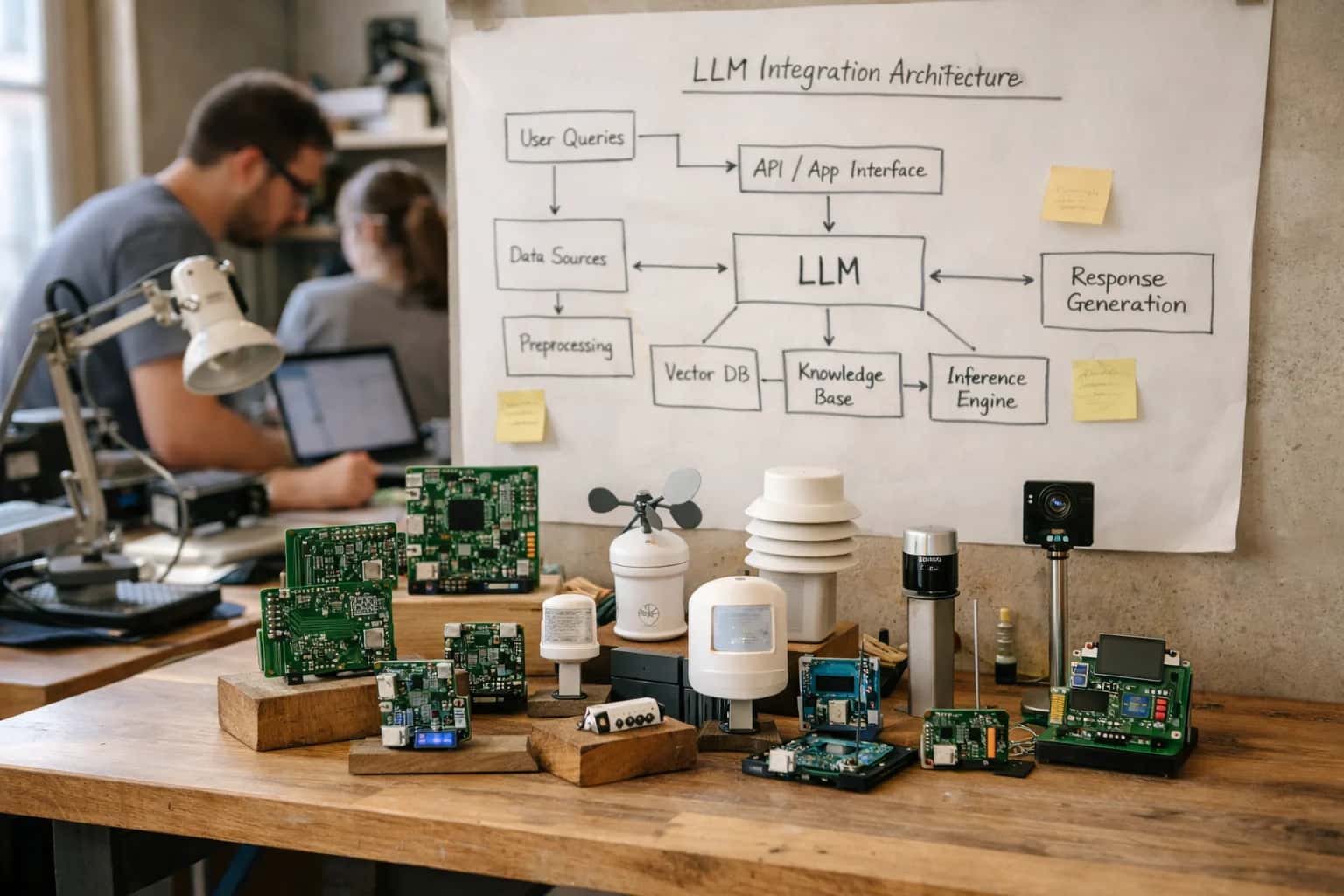
Large language models (LLMs) like GPT-4 and Claude act as a reasoning layer atop your CLM's structured data and document repository. They connect at three key integration points: the document ingestion API for parsing and extracting data from incoming contracts, the workflow engine to provide intelligent routing and decision support, and the user interface (often via a chatbot or copilot) for natural language Q&A and drafting assistance. This transforms static PDFs and metadata fields into an interactive, intelligent system.

Integration
AI Integration for Contract AI with LLMs
A technical blueprint for securely connecting large language models (GPT-4, Claude, etc.) to Contract Lifecycle Management platforms via APIs to automate drafting, summarization, Q&A, and intelligent extraction.
ARCHITECTURE
Where LLMs Fit into the Contract Lifecycle
A practical guide to integrating large language models into the core workflows of your Contract Lifecycle Management (CLM) platform.
For a production implementation, you typically deploy a secure middleware service (an 'AI gateway') that sits between your CLM platform (e.g., Ironclad, Icertis) and the LLM provider. This service handles:
- Secure API calls to the CLM to fetch contract text and metadata.
- Orchestration of a RAG (Retrieval-Augmented Generation) pipeline that grounds the LLM's responses in your specific clause library and playbooks to reduce hallucinations.
- Prompt management and governance, ensuring consistent, auditable instructions for tasks like summarization or redlining.
- Human-in-the-loop review queues for high-stakes outputs before they commit changes back to the CLM via its REST API.
Rollout should start with a contained, high-volume use case—like automating the initial review and data extraction for NDAs or simple order forms. This delivers quick wins (reducing review from hours to minutes) and builds trust. Governance is critical: establish clear audit trails logging all AI-suggested edits, maintain version control for your prompts and fine-tuned models, and design approval workflows that keep legal and procurement teams in control of final decisions. For a deeper dive on implementing this RAG architecture, see our guide on AI Integration for Contract AI with RAG.
ARCHITECTURE PATTERNS
Key Integration Surfaces in CLM Platforms
Automating Review and Routing
The workflow engine is the primary surface for AI integration, governing the contract's path from draft to signature. AI can be injected at key decision points to automate routing and pre-screen submissions.
Key Integration Points:
- Intake Triggers: Use webhooks or platform APIs to send new contract drafts to an AI service for initial classification and risk scoring. The score can auto-populate a custom field, dictating the approval path (e.g., low-risk NDAs route directly to business, high-value MSAs route to legal).
- Conditional Logic: Embed AI outputs as variables in workflow rules. For example, a rule can state:
IF AI_Extracted_Value['LiabilityClause'] == 'Unlimited' THEN assign to Senior Counsel. - Task Generation: Use AI to parse executed contracts and automatically create tracked obligations or renewal tasks in the CLM's task management module, assigning them to business owners with deadlines.
This turns static workflows into intelligent, content-aware processes that adapt to the contract's specific terms.
INTEGRATION PATTERNS
High-Value AI Use Cases for Contract Management
Integrating LLMs directly into your CLM platform (Ironclad, Icertis, Agiloft, DocuSign CLM) automates high-volume, high-friction workflows. These are the most impactful patterns we implement for legal ops, procurement, and sales teams.
01
Automated Clause Extraction & Metadata Tagging
AI parses uploaded contracts to identify and extract key clauses (termination, liability, governing law) and structured data (parties, dates, values). Results populate custom metadata fields in the CLM, turning unstructured documents into searchable, reportable assets. Workflow: Upload -> AI Extraction -> CLM Field Population -> QA/Approval.
Batch -> Real-time
Data entry shift
02
Playbook-Driven Redlining Assistant
An AI copilot integrated into the CLM's redlining interface. It compares draft language against approved playbooks, suggests specific edits to align with standard positions, and explains the rationale. Workflow: Open draft -> AI suggests edits -> Negotiator reviews/accepts -> Track concessions.
1 sprint
Negotiation cycle reduction
03
Intelligent Obligation & Milestone Manager
Post-signature, AI scans executed contracts to identify obligations, deliverables, and key dates. It automatically creates tracked tasks within the CLM or syncs them to project management tools, with automated reminders for owners. Workflow: Contract executed -> AI extraction -> Task creation in CLM -> Alerting.
Same day
Obligation activation
04
RAG-Powered Contract Q&A & Discovery
A retrieval-augmented generation (RAG) layer over the entire contract repository. Users ask natural language questions ("Show all auto-renewal clauses with 60-day notice") and get accurate, sourced answers. Grounds LLMs in your specific contract library to reduce hallucinations.
Hours -> Minutes
Research time
05
Risk Detection & Triage for Legal Review
AI pre-screens all incoming contracts against a risk rulebook (unlimited liability, unusual indemnity, non-standard terms). It scores risk, flags exceptions, and can auto-route or auto-approve low-risk agreements (e.g., standard NDAs). Workflow: Intake -> AI Scoring -> Routing/Approval.
80%+
Low-risk auto-routing
06
Dynamic Template & Clause Assembly
AI-driven template generation within the CLM. Based on deal attributes (product, region, counterparty type), the system assembles a first draft from the approved clause library, ensuring consistency and compliance from the start. Integrates with CRM/CPQ for deal context.
First draft in <5 min
Drafting acceleration
IMPLEMENTATION PATTERNS
Example AI-Augmented Contract Workflows
These workflows illustrate how LLMs can be integrated into CLM platforms to automate high-volume tasks, reduce cycle times, and surface critical insights. Each pattern is triggered by a platform event, uses AI for analysis or generation, and updates the system of record.
Trigger: A new Non-Disclosure Agreement is uploaded via a web portal or email ingestion into the CLM (e.g., Ironclad's Webforms).
Workflow:
- Context Pull: The CLM workflow engine extracts the document and its metadata (submitting party, counterparty name).
- AI Action: The document is sent via a secure API call to an LLM service (e.g., GPT-4, Claude) configured for NDA analysis. A prompt instructs the model to:
- Identify the agreement type (Mutual vs. Unilateral).
- Extract key terms: term length, governing law, indemnification clauses.
- Score overall risk based on a pre-defined playbook (e.g., flags unlimited liability, unusual confidentiality scope).
- System Update: The AI's JSON output populates custom metadata fields in the CLM record. A risk score (High/Medium/Low) triggers an automated approval path:
- Low Risk: Routes to a business owner for signature via integrated e-signature.
- Medium/High Risk: Routes to the legal team's review queue with the AI-generated risk summary pre-attached.
- Human Review Point: Legal reviewers see the AI's extracted terms and risk rationale, allowing them to focus negotiation on flagged issues only.
SECURE, GROUNDED, AND GOVERNED
Core Implementation Architecture: APIs, RAG & Orchestration
A production-ready AI integration for Contract Lifecycle Management (CLM) requires a secure, multi-layered architecture that grounds LLMs in your specific contract data and embeds intelligence directly into user workflows.
The integration connects at three key layers: the CLM platform's API (e.g., Ironclad Workflow API, Icertis AI Studio, Agiloft REST API, DocuSign CLM APIs), a centralized RAG (Retrieval-Augmented Generation) pipeline, and an orchestration service. When a user initiates an action—like requesting a contract summary or uploading a new draft—the orchestration service calls the CLM API to fetch the relevant document and metadata. This content is then sent through the RAG pipeline, where it is chunked, embedded, and used to retrieve the most relevant passages from your vector store (containing your clause library, playbooks, and historical contracts) before being sent as grounded context to the LLM (GPT-4, Claude, etc.). The LLM's response is formatted and returned via the orchestration service, which can also trigger follow-up actions in the CLM, like updating a custom metadata field, creating a review task, or posting a comment.
For high-value use cases like obligation extraction or redlining support, the architecture must handle stateful, multi-step workflows. An AI agent orchestrator manages these sequences: first extracting key dates and deliverables, then cross-referencing them against a master data service for party information, and finally creating tracked milestones in the CLM or a connected project tool like Asana. All LLM calls are routed through a governance layer that enforces prompt templates, logs inputs/outputs for audit trails, applies PII redaction filters, and can enforce a human-in-the-loop review for high-risk clauses before any system-of-record updates are committed.
Rollout follows a phased pilot, typically starting with a single, high-volume contract type (e.g., NDAs) within a sandbox environment. Success is measured by reduction in manual review time, increase in metadata field auto-population accuracy, and user satisfaction scores. The final architecture ensures AI is a secure, governed, and useful copilot within the existing CLM workflow, not a standalone black box. For a deeper dive on implementing the RAG pipeline specifically for contract intelligence, see our guide on AI Integration for Contract AI with RAG.
CONTRACT AI INTEGRATION PATTERNS
Code & Payload Examples for Key Interactions
Extracting Key Terms into CLM Metadata
Use an AI service to parse uploaded contracts and populate structured fields in your CLM platform. This typically involves a webhook from the CLM (e.g., Ironclad, Icertis) to trigger analysis upon document ingestion.
The AI service returns a structured JSON payload mapping to custom objects or metadata fields. This automates data entry and ensures searchability for critical terms like governing law, termination clauses, and liability caps.
python# Example: Python service processing a webhook from a CLM import requests from openai import OpenAI def extract_clauses(document_text, clm_record_id): client = OpenAI() # System prompt defines the extraction schema response = client.chat.completions.create( model="gpt-4-turbo", messages=[ {"role": "system", "content": "Extract the following clauses from the contract. Return JSON with keys: 'parties', 'effective_date', 'termination_date', 'governing_law', 'liability_cap', 'auto_renewal'."}, {"role": "user", "content": document_text[:15000]} ], response_format={ "type": "json_object" } ) extracted_data = json.loads(response.choices[0].message.content) # Push enriched data back to CLM via its REST API clm_api_response = requests.patch( f"https://api.your-clm.com/contracts/{clm_record_id}", json={"metadata": extracted_data}, headers={"Authorization": "Bearer YOUR_CLM_API_KEY"} ) return clm_api_response.status_code
AI-ENHANCED CONTRACT LIFECYCLE
Realistic Time Savings & Operational Impact
How integrating LLMs with CLM platforms like Ironclad, Icertis, Agiloft, and DocuSign CLM changes core contract workflows.
| Workflow | Before AI | After AI | Notes |
|---|---|---|---|
Initial Contract Review | 2-4 hours per agreement | 30-45 minutes with AI summary | AI flags high-risk clauses; legal reviews exceptions |
Clause & Obligation Extraction | Manual search & highlight | Automated extraction to metadata fields | Structured data feeds reporting, dashboards, and obligation tracking |
Contract Drafting from Template | Manual assembly from clause library | AI-assisted assembly with playbook guidance | Ensures consistency, reduces missing terms |
Redlining & Negotiation Support | Side-by-side manual comparison | AI suggests edits against playbook | Highlights deviations, explains rationale to negotiator |
Contract Query & Discovery | Keyword search across repository | Natural language Q&A with RAG | Answers complex questions across entire corpus |
Obligation Tracking Setup | Manual entry of dates & deliverables | AI extracts and creates calendar tasks | Automated reminders reduce compliance risk |
High-Volume NDA Processing | Legal team reviews every document | AI triage: auto-approve standard, flag exceptions | Legal focuses on 10-20% of non-standard agreements |
Contract Summarization for Executives | Manual creation of term sheets | AI generates executive summary in minutes | Provides consistent format for leadership review |
ARCHITECTING CONTROLLED, PRODUCTION-READY AI
Governance, Security & Phased Rollout
A practical framework for deploying AI in your CLM with appropriate controls and a low-risk adoption path.
Integrating LLMs like GPT-4 or Claude into a CLM platform such as Ironclad, Icertis, Agiloft, or DocuSign CLM introduces new vectors for data handling and decision influence. A secure architecture treats the LLM as a stateless API service, with all sensitive contract data remaining within your cloud environment. A typical pattern uses a secure middleware layer (e.g., an Azure Function or AWS Lambda) that acts as a gatekeeper: it retrieves contract text and metadata via the CLM's API (e.g., Ironclad's Workflow Engine API, Icertis's AI Studio), redacts PII/PHI if required, and sends only contextually necessary text to the external LLM. Responses are logged with the source contract ID, user, and timestamp before any suggested edits or summaries are written back to the CLM record, creating a full audit trail.
Governance is built into the workflow design. For high-stakes tasks like redlining support or obligation extraction, implement a human-in-the-loop (HITL) approval step within the CLM's native review workflow. AI suggestions should be presented as clearly marked recommendations in a side panel or comment, requiring a user action to accept. For lower-risk, high-volume tasks like metadata enrichment or initial summarization, you can configure rules-based auto-approval for contracts below a certain value or within a standard template family. Use the CLM's role-based access controls (RBAC) to restrict which user groups can trigger AI actions or view AI-generated content, aligning with legal and procurement team structures.
A phased rollout de-risks adoption. Start with a proof-of-concept on a single, high-impact use case, such as AI-powered extraction of key dates (Effective Date, Termination) from NDAs into Ironclad custom fields, or generating executive summaries for sales contracts in Icertis. Pilot with a controlled group of power users in Legal Ops or Procurement. Measure accuracy (e.g., % of extractions requiring manual correction), time savings, and user satisfaction. Upon validation, expand to adjacent workflows—like clause identification against playbooks or risk flagging for auto-renewal terms—before enabling broader, cross-functional AI features. This iterative approach allows for continuous model tuning on your specific contract corpus and ensures the integration delivers tangible ROI before scaling.
Enabling Efficiency, Speed & Accuracy
Intelligent Analysis, Decision & Execution
We build AI systems for teams that need search across company data, workflow automation across tools, or AI features inside products and internal software.
Talk to Us
Search across company data
Give teams answers from docs, tickets, runbooks, and product data with sources and permissions.
Useful when people spend too long searching or get different answers from different systems.
Enterprise searchRAGPermissions
Read more
Automate internal workflows
Use AI to route work, draft outputs, trigger actions, and keep approvals and logs in place.
Useful when repetitive work moves across multiple tools and teams.
AI agentsWorkflow automationGovernance
Read more
Add AI to products and internal tools
Build assistants, guided actions, or decision support into the software your team or customers already use.
Useful when AI needs to be part of the product, not a separate tool.
AI integrationDecision supportModel routing
Read moreIMPLEMENTATION AND ARCHITECTURE
Frequently Asked Questions (FAQ)
Common technical and operational questions about integrating large language models (LLMs) like GPT-4 or Claude with Contract Lifecycle Management (CLM) platforms such as Ironclad, Icertis, Agiloft, and DocuSign CLM.
Secure integration follows a zero-trust, API-first pattern. The core architecture involves:
- API Gateway & Authentication: All calls to the LLM (e.g., OpenAI, Anthropic, Azure OpenAI) are routed through a secure API gateway (like Kong or Apigee) hosted in your cloud. This gateway enforces authentication (using OAuth 2.0 or API keys from your CLM) and strict rate limiting.
- Data Contextualization with RAG: Instead of sending full contracts to the LLM, you implement a Retrieval-Augmented Generation (RAG) pipeline. When a user asks a question (e.g., "What are the termination terms in this MSA?"), the system:
- Queries the CLM's search API or a synced vector database (like Pinecone or Weaviate) to find the most relevant contract chunks.
- Sends only those specific, relevant text snippets as context to the LLM, along with the user's question.
- Data Residency & PII: For highly sensitive contracts, you can deploy the LLM inference within your own VPC (using Azure OpenAI or AWS Bedrock) and implement a pre-processing step to redact specific PII/PHI patterns before any data leaves your CLM's staging area.
- Audit Logging: Every LLM call is logged with the user ID, source contract ID, prompt sent, and response received, creating a complete audit trail within your security information and event management (SIEM) platform.

About the author
Prasad Kumkar
CEO & MD, Inference Systems
Prasad Kumkar is the CEO & MD of Inference Systems and writes about AI systems architecture, LLM infrastructure, model serving, evaluation, and production deployment. Over 5+ years, he has worked across computer vision models, L5 autonomous vehicle systems, and LLM research, with a focus on taking complex AI ideas into real-world engineering systems.
His work and writing cover AI systems, large language models, AI agents, multimodal systems, autonomous systems, inference optimization, RAG, evaluation, and production AI engineering.
LinkedIn
Limited slotsGet a Free AI Consultation
Partnered with leading AI, data, and software stack.





How We Work
Custom AI workflows for your Business
One-fit-all AI don't work for modern businesses. At Inferensys, we aim to understand your business & custom requirements; which we use to define most efficient agentic workflows, the data, and the tools for your business.
01
Review the use case
We understand the task, the users, and where AI can actually help.
Read more02
Pick the right approach
We define what needs search, automation, or product integration.
Read more03
Build the first useful version
We implement the part that proves the value first.
Read more04
Improve from there
We add the checks and visibility needed to keep it useful.
Read moreThe first call is a practical review of your use case and the right next step.
Talk to Us