AI integration connects directly to Agiloft's workflow engine via its REST API and webhook system, acting as an intelligent participant in the Contract Review or Approval Process business rules. The integration typically injects AI at three key workflow stages: Intake & Classification, where AI scans uploaded documents to auto-populate the Contract table's metadata fields (e.g., contract type, governing law, parties); Review & Analysis, where an AI agent is triggered as a parallel task to generate a risk summary and suggest redlines against a configured playbook; and Routing & Assignment, where AI scores the contract based on extracted terms to dynamically assign it to the correct legal or business reviewer queue, bypassing manual triage.

Integration
AI Integration for Agiloft Review Workflows
A practical guide to embedding AI agents into Agiloft's configurable review workflows to automate risk analysis, suggest redlines, and route contracts based on AI-scored criteria, reducing manual review from hours to minutes.
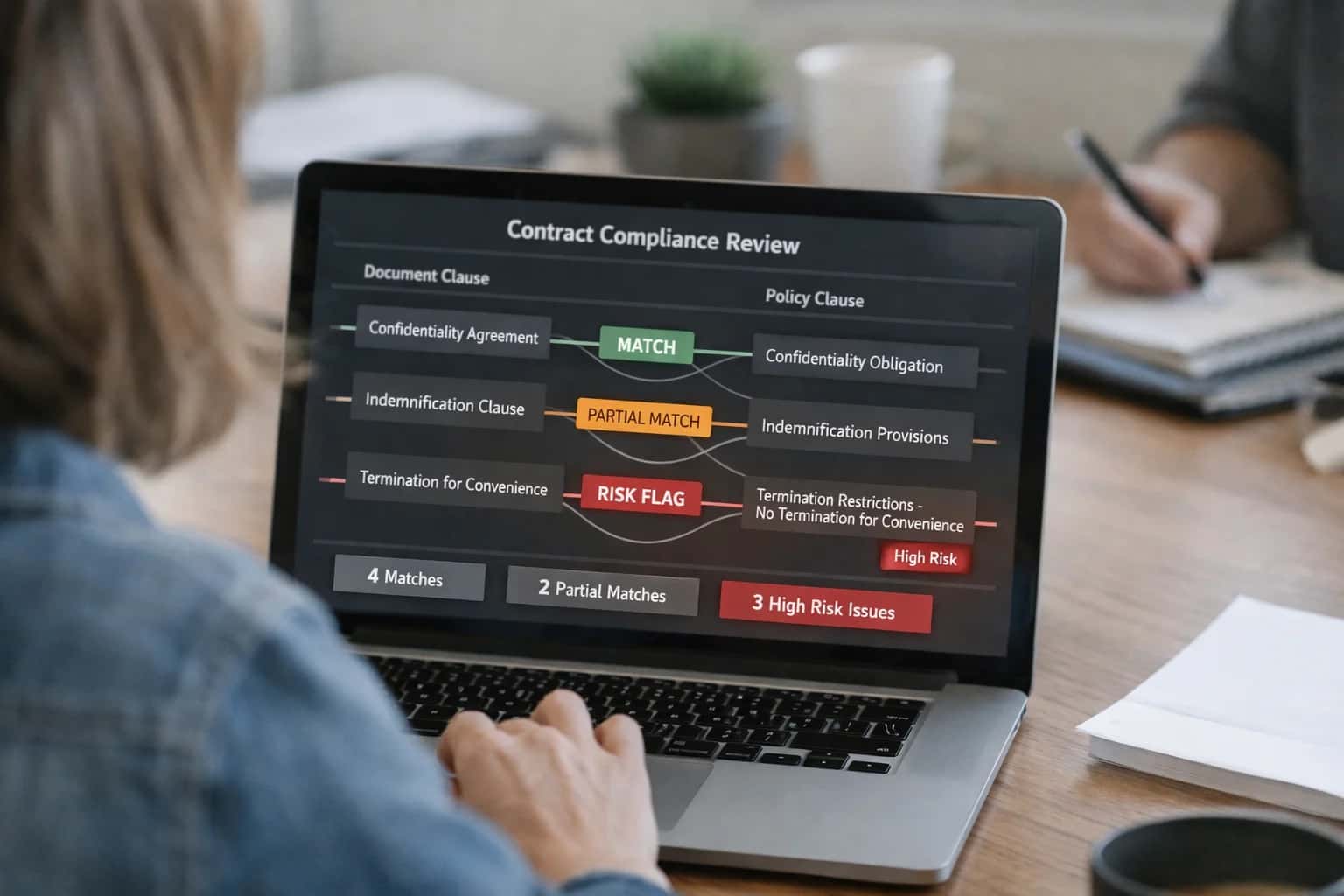
ARCHITECTURE FOR INTELLIGENT AUTOMATION
Where AI Fits into Agiloft's Review Workflow Engine
A technical blueprint for embedding AI agents into Agiloft's configurable review and approval workflows to automate risk assessment, redline suggestions, and intelligent routing.
For a production implementation, the AI service—hosted securely—listens for Agiloft webhooks on new contract record creation or status change. It fetches the document from Agiloft's file storage, processes it through a RAG pipeline grounded in your clause library and historical agreements, and posts results back to custom fields like AI Risk Score, Suggested Edits, and Priority Routing. This creates an audit trail within Agiloft's native activity logs. Governance is managed through Agiloft's role-based permissions, ensuring only authorized users can view AI suggestions and override them, maintaining a human-in-the-loop for high-stakes decisions.
Rollout should start with a pilot on a high-volume, lower-risk contract type like NDAs or Order Forms. Configure a dedicated AI Review step in your Agiloft workflow that, upon completion, automatically updates the record and progresses the contract. This measured approach allows teams to validate AI accuracy, calibrate risk thresholds, and build trust in the automated workflow before expanding to complex MSAs or sales agreements. For a deeper technical dive on configuring these automations, see our guide on AI Integration for Agiloft Workflow Automation.
WHERE TO CONNECT AI AGENTS FOR REVIEW WORKFLOWS
Key Agiloft Surfaces for AI Integration
Automating the Front Door
The Contract Request and Intake Form modules are the primary entry points for new agreements. AI can be integrated here to:
- Auto-classify incoming documents (e.g., NDA vs. MSA vs. SOW) using a pre-trained model, routing them to the correct workflow template.
- Extract key metadata (parties, effective dates, contract value) from uploaded files to pre-populate Agiloft records, eliminating manual data entry.
- Perform initial risk triage by scanning for high-risk clause patterns (e.g., unlimited liability, unusual indemnity) and flagging contracts for priority legal review.
This surface connects via Agiloft's REST API or webhooks triggered upon record creation. The AI service processes the document, returns structured JSON, and updates the Agiloft record, setting the stage for the automated review workflow.
CONTRACT LIFECYCLE MANAGEMENT
High-Value AI Use Cases for Agiloft Review
Integrate AI directly into Agiloft's configurable workflows and AI-powered search to automate manual review tasks, accelerate negotiation cycles, and surface hidden risks across your contract portfolio.
01
Automated Contract Intake & Triage
Deploy an AI agent on Agiloft's intake webforms or email ingestion points to classify incoming contracts, extract key metadata, and route them to the correct workflow. The agent populates custom objects, flags high-risk agreement types, and assigns tasks based on content, reducing manual sorting from hours to minutes.
Hours -> Minutes
Intake processing
02
AI-Powered Risk Summary & Redlining
Embed an AI copilot within the Agiloft review interface. As a contract loads, the agent generates a one-page risk summary, highlights deviations from approved playbooks, and suggests specific redlines. It explains the rationale for each suggestion, accelerating legal and procurement reviews without leaving the platform.
Batch -> Real-time
Review support
03
Intelligent Obligation Extraction & Tracking
Connect AI to Agiloft's data model to parse executed contracts, identify obligations, deliverables, and milestone dates, and automatically create tracked tasks. The system syncs with project management tools, sets reminders for business owners, and updates status based on external system feeds, turning static documents into live operational plans.
Manual -> Automated
Obligation management
04
Enhanced Semantic Search with RAG
Augment Agiloft's native AI-powered search with a Retrieval-Augmented Generation (RAG) layer. This allows users to ask complex, natural language questions (e.g., "Show all contracts with automatic renewal clauses in EMEA") across the entire repository and linked documents. Responses are grounded in your specific contract library, providing accurate, cited answers.
Keyword -> Conversational
Discovery method
05
Dynamic Workflow Routing & Approval
Use AI to analyze contract content and context to dynamically route agreements through Agiloft's configurable workflows. The system can auto-approve low-risk, standard NDAs, escalate high-value deals to senior legal, and trigger parallel finance reviews based on extracted payment terms—optimizing cycle times and ensuring compliance.
Same day
Standard NDA turnaround
06
Portfolio Analytics & Renewal Forecasting
Build a custom analytics layer on top of Agiloft's API. AI models analyze contract terms, usage data, and relationship history to predict renewal likelihood, identify consolidation opportunities, and forecast financial exposure. Insights are fed back into Agiloft as custom fields or pushed to BI dashboards for leadership visibility.
1 sprint
Insight deployment
INTEGRATION PATTERNS
Example AI-Augmented Workflows in Agiloft
These workflows illustrate how AI agents can be embedded into Agiloft's configurable tables, business rules, and web services to automate review, enhance decision-making, and trigger downstream actions. Each pattern connects to Agiloft's core data model and leverages its API for system updates.
Trigger: A new contract record is created via Agiloft webform, email parser, or API.
AI Agent Action:
- The agent retrieves the attached document from the Agiloft
documentstable via the/downloadendpoint. - It runs a multi-step analysis:
- Classification: Identifies contract type (NDA, MSA, SOW, Lease).
- Extraction: Pulls key metadata (Parties, Effective Date, Term, Termination Notice, Liability Cap, Governing Law).
- Risk Scoring: Evaluates clauses against a configured playbook, flagging non-standard terms (e.g., unlimited liability, auto-renewal > 1 year).
- The agent generates a summary and risk assessment.
System Update:
- The agent uses Agiloft's REST API to update the contract record, populating custom fields (
Contract Type,Counterparty,AI Risk Score,Flagged Clauses). - Based on the risk score, a business rule automatically routes the contract:
- Low Risk: To a procurement manager for fast-track approval.
- High Risk: To the legal team's review queue with the AI summary pre-attached.
Human Review Point: All AI-populated data is presented as suggestions. The assigned reviewer can accept, modify, or override the AI's classification and scoring before proceeding.
AGILOFT INTEGRATION BLUEPRINT
Implementation Architecture: Data Flow & System Design
A technical blueprint for embedding AI agents into Agiloft's configurable workflow engine to automate review, risk assessment, and routing.
The integration architecture connects Agiloft's core data model—Contracts, Companies, Custom Tables, and Workflow Steps—to an external AI orchestration layer. When a contract enters a designated review queue, Agiloft's API or a webhook triggers an AI agent service. This service extracts the document text and relevant metadata (e.g., contract type, originating department, monetary value) and passes it through a RAG pipeline grounded in your clause library and legal playbooks. The AI analyzes the document against these sources to generate a risk summary, suggested redlines, and a routing score.
The AI's outputs are structured as a JSON payload and posted back to Agiloft via API, populating custom fields for AI_Risk_Score, AI_Summary, and Suggested_Edits. Based on configurable thresholds, Agiloft's workflow engine can then automatically route the contract: high-risk agreements go to a senior legal reviewer, medium-risk go to a business unit approver with AI suggestions attached, and low-risk, standard documents can be auto-approved. This data flow keeps Agiloft as the system of record while injecting intelligence at key decision points, turning a manual triage process into a conditional, AI-driven workflow.
For governance, all AI interactions are logged with trace IDs in a separate audit system, linking the Agiloft record ID to the specific model version, prompt, and retrieved context used. A human-in-the-loop review step is recommended for the initial pilot, where legal staff can validate or override AI suggestions directly within Agiloft's interface, creating a feedback loop to fine-tune the models. This architecture ensures the integration is secure, auditable, and enhances—rather than disrupts—existing Agiloft governance and role-based access controls.
AI-ENHANCED WORKFLOW INTEGRATION
Code & Payload Examples
Ingesting Agiloft Workflow Events
When a contract enters a review queue, Agiloft can trigger a webhook. This Python Flask endpoint receives the payload, extracts the document ID, and initiates an AI analysis job. The key is to handle the contract_id, queue_name, and current_user from Agiloft's event data to maintain context for the AI agent and subsequent task assignment.
pythonfrom flask import Flask, request, jsonify import requests import os app = Flask(__name__) AGILOFT_API_KEY = os.getenv('AGILOFT_API_KEY') AI_ORCHESTRATOR_URL = os.getenv('AI_ORCHESTRATOR_URL') @app.route('/webhook/agiloft/review-trigger', methods=['POST']) def handle_review_trigger(): data = request.json # Extract core context from Agiloft webhook contract_id = data.get('record_id') queue_name = data.get('queue_name') reviewer = data.get('assigned_to') # Fetch contract text from Agiloft API contract_text = fetch_contract_text(contract_id) # Payload to AI Orchestrator ai_payload = { "contract_id": contract_id, "text": contract_text, "analysis_type": "risk_summary_and_redline", "metadata": { "source_queue": queue_name, "assigned_reviewer": reviewer } } # Call AI service ai_response = requests.post(AI_ORCHESTRATOR_URL, json=ai_payload) # Store AI results back to Agiloft custom table store_ai_results(contract_id, ai_response.json()) return jsonify({"status": "AI analysis initiated"}), 202 def fetch_contract_text(record_id): # Call Agiloft API to get contract document text headers = {'Authorization': f'Bearer {AGILOFT_API_KEY}'} response = requests.get(f'https://your-instance.agiloft.com/rest/{record_id}/document', headers=headers) return response.json().get('text_content')
AI-ASSISTED REVIEW WORKFLOWS
Realistic Time Savings & Operational Impact
How AI integration accelerates Agiloft review cycles, reduces manual effort, and maintains legal oversight.
| Workflow Stage | Before AI | After AI | Implementation Notes |
|---|---|---|---|
Initial Contract Triage & Routing | Manual review by legal ops (15-30 min per doc) | AI auto-classifies & routes in <2 min | AI scores risk, suggests assignee; human confirms routing |
Risk & Obligation Summary | Associate manually reads, highlights (45-60 min) | AI generates executive summary in 30 sec | Summary includes flagged clauses, key dates, obligations; attorney reviews |
Playbook Deviation Detection | Side-by-side manual comparison (30+ min) | AI highlights non-standard clauses in 1 min | Compares draft against approved clause library; flags for legal review |
Redline Suggestion Generation | Attorney drafts edits from scratch (20-40 min) | AI suggests specific redlines in 2 min | Suggests fallback language based on playbook; attorney approves/modifies |
Metadata & Data Extraction | Manual data entry into Agiloft fields (10-15 min) | AI auto-populates 80-90% of fields in <1 min | Extracts parties, dates, values, governing law; admin validates |
Approval Workflow Trigger | Manual status updates and task assignment | AI-triggered workflows based on content | Routes high-risk clauses for legal sign-off, standard terms for business approval |
Post-Signature Obligation Creation | Manual reading to create tracked tasks | AI identifies obligations, creates tasks in 2 min | Generates tasks in Agiloft or linked PM tool; owner assignment required |
IMPLEMENTING AI IN A REGULATED WORKFLOW
Governance, Security & Phased Rollout
A controlled approach to deploying AI agents within Agiloft's configurable review and approval engine.
Integrating AI into Agiloft's review workflows requires a security-first architecture that respects the platform's role-based access control (RBAC) and audit trail. AI agents should be deployed as a middleware service that interacts with Agiloft via its REST API, never storing contract data persistently. All AI-generated outputs—such as risk summaries or redline suggestions—are written back to designated custom fields or linked as notes, creating a full audit log within the Agiloft record itself. For sensitive contracts, a pre-processing step can redact specific PII or confidential financial terms before sending data to the AI model, ensuring only de-identified text is analyzed.
A phased rollout is critical for adoption and risk management. Start with a low-risk, high-volume use case like triaging and summarizing Non-Disclosure Agreements (NDAs). Configure Agiloft to route all new NDAs to a dedicated queue where an AI agent provides a instant summary of key parties, term, and non-standard clauses. This allows legal ops to validate AI accuracy in a controlled setting. Phase two can introduce AI-suggested redlines for Sales Order Forms against a pre-approved playbook, with all suggestions requiring a human reviewer's approval within the Agiloft interface before application.
Governance is maintained through Agiloft's existing workflow engine. AI confidence scores can be used to automate routing decisions; for example, contracts scoring below a 90% confidence threshold for 'standard language' are automatically assigned to a senior reviewer. All AI interactions are logged as system activities, and a regular human-in-the-loop review of a sample of AI-processed records ensures model drift is detected. This approach allows teams to incrementally automate review stages while keeping final approval authority and auditability firmly within the Agiloft platform's governed workflow.
Enabling Efficiency, Speed & Accuracy
Intelligent Analysis, Decision & Execution
We build AI systems for teams that need search across company data, workflow automation across tools, or AI features inside products and internal software.
Talk to Us
Search across company data
Give teams answers from docs, tickets, runbooks, and product data with sources and permissions.
Useful when people spend too long searching or get different answers from different systems.
Enterprise searchRAGPermissions
Read more
Automate internal workflows
Use AI to route work, draft outputs, trigger actions, and keep approvals and logs in place.
Useful when repetitive work moves across multiple tools and teams.
AI agentsWorkflow automationGovernance
Read more
Add AI to products and internal tools
Build assistants, guided actions, or decision support into the software your team or customers already use.
Useful when AI needs to be part of the product, not a separate tool.
AI integrationDecision supportModel routing
Read moreAI INTEGRATION FOR AGILOFT
Frequently Asked Questions
Practical questions about implementing AI agents within Agiloft's configurable workflows to automate contract review, risk scoring, and routing.
AI review is typically triggered via Agiloft's Business Rules or Web Services API when a contract reaches a specific workflow status (e.g., 'Awaiting Legal Review').
Common Trigger Pattern:
- A user submits a contract for review, changing its status.
- A Business Rule fires, calling an external AI service endpoint via a REST API webhook.
- The webhook payload includes the contract record ID, document URL (from Agiloft's file storage), and relevant metadata (contract type, business unit).
- The AI service processes the document and returns a structured JSON payload.
- A subsequent Agiloft Business Rule or script updates the record with AI outputs (e.g., sets a 'Risk Score' field, populates a 'Summary' text area, or suggests a routing path).
Key Integration Points: Agiloft's REST API, Web Services (SOAP) for complex logic, and the internal scripting engine for data manipulation.

About the author
Prasad Kumkar
CEO & MD, Inference Systems
Prasad Kumkar is the CEO & MD of Inference Systems and writes about AI systems architecture, LLM infrastructure, model serving, evaluation, and production deployment. Over 5+ years, he has worked across computer vision models, L5 autonomous vehicle systems, and LLM research, with a focus on taking complex AI ideas into real-world engineering systems.
His work and writing cover AI systems, large language models, AI agents, multimodal systems, autonomous systems, inference optimization, RAG, evaluation, and production AI engineering.
LinkedIn
Limited slotsGet a Free AI Consultation
Partnered with leading AI, data, and software stack.





How We Work
Custom AI workflows for your Business
One-fit-all AI don't work for modern businesses. At Inferensys, we aim to understand your business & custom requirements; which we use to define most efficient agentic workflows, the data, and the tools for your business.
01
Review the use case
We understand the task, the users, and where AI can actually help.
Read more02
Pick the right approach
We define what needs search, automation, or product integration.
Read more03
Build the first useful version
We implement the part that proves the value first.
Read more04
Improve from there
We add the checks and visibility needed to keep it useful.
Read moreThe first call is a practical review of your use case and the right next step.
Talk to Us