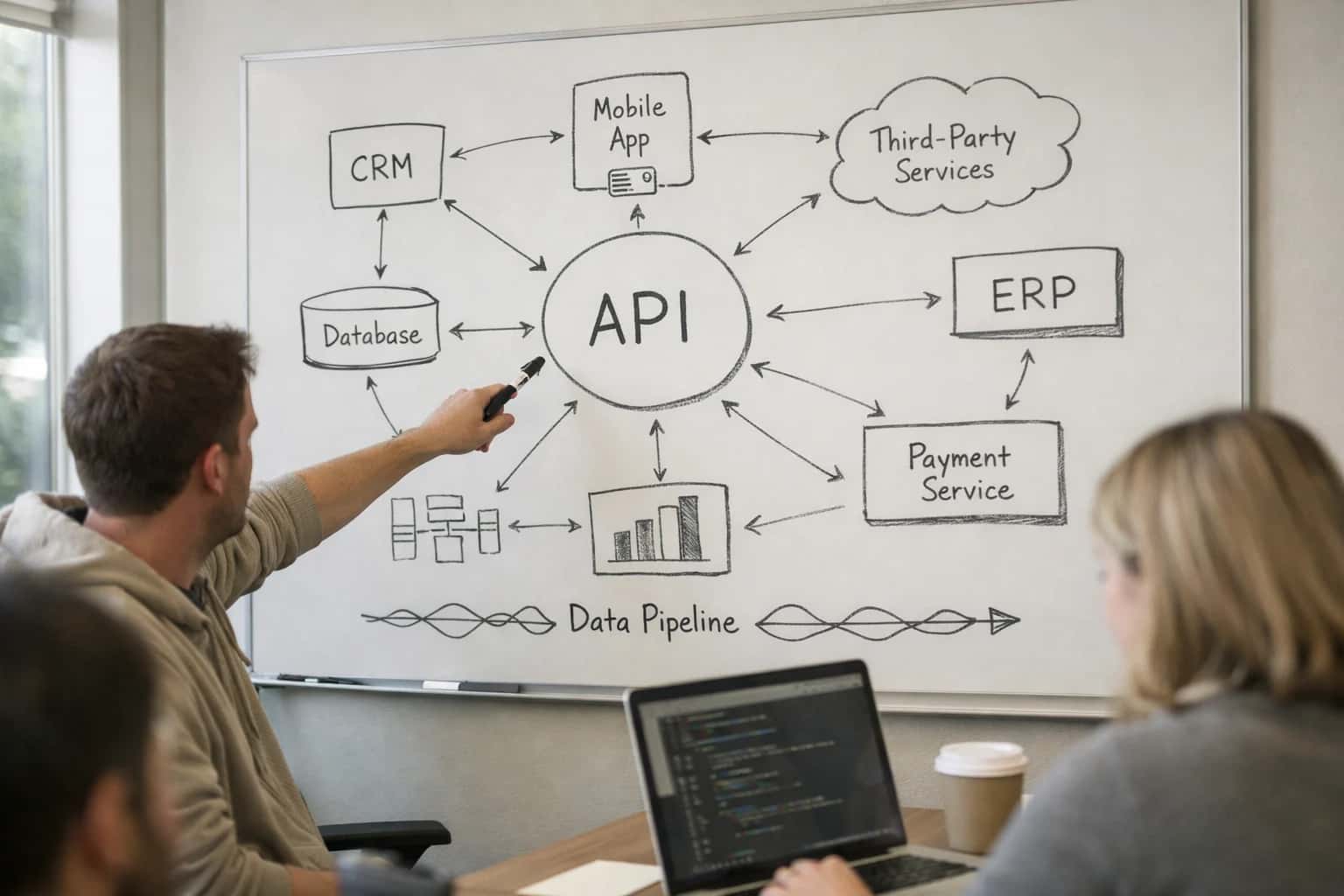
AI integration for center management software connects to the operational APIs and data models of platforms like Brightwheel, Procare, Kangarootime, and Famly to automate and augment high-volume, repetitive tasks. The primary architectural surfaces are the staff scheduling engine, inventory and supply modules, maintenance work order systems, and compliance tracking dashboards. AI agents can listen for webhook events—like a low-stock alert from an inventory API or a staff call-out from a scheduling module—and execute predefined workflows, such as reordering supplies or finding coverage, without manual intervention.

Integration
AI Integration for Center Management Software
A technical blueprint for embedding AI into core center operations—staffing, inventory, maintenance, and compliance—for enterprise childcare chains using Brightwheel, Procare, Kangarootime, and Famly.
ARCHITECTURE FOR ENTERPRISE CHAINS
Where AI Fits in Center Operations
A practical blueprint for embedding AI into the core operational workflows of multi-location childcare centers.
For enterprise chains, the implementation focuses on cross-location orchestration. An AI layer can analyze aggregated data from all centers to optimize staffing pools, predict supply consumption across the network, and prioritize facility maintenance based on usage patterns. For example, an AI model can process historical attendance, local events, and staff certifications to generate a recommended weekly schedule for each location, which a director can review and approve with one click in the management platform. This moves planning from a reactive, hours-long process to a proactive, data-driven recommendation system.
Rollout requires a phased, location-by-location approach, starting with a single high-value workflow like automated ratio compliance monitoring. Governance is critical: all AI-generated actions (e.g., sending a purchase order, assigning a task) should be logged in the platform's native audit trail and, for significant decisions, routed through an approval step in the existing workflow engine. This ensures center directors retain oversight while offloading the cognitive load of constant monitoring. The result is not a replacement of the center management platform, but an intelligent automation layer that makes its existing modules more efficient and predictive.
ARCHITECTURAL BLUEPOINTS FOR ENTERPRISE CHAINS
Key Integration Surfaces in Center Management Platforms
Core Staffing Surfaces
AI integrates with the staff profile, availability, and shift scheduling modules to automate labor-intensive workflows. Key surfaces include the staff-to-child ratio engine, real-time attendance feeds, and credential/compliance tracking databases.
High-Value Use Cases:
- Predictive Coverage: AI models forecast absenteeism and suggest on-call staff based on historical patterns and real-time health logs.
- Dynamic Ratio Compliance: Monitors live check-in/out streams to flag impending ratio violations, automatically suggesting room merges or staff re-assignments.
- Credential Alerts: Scans staff records for expiring certifications (CPR, First Aid) and triggers renewal workflows via integrated task managers.
Implementation Pattern: AI agents subscribe to attendance webhooks, query staff APIs for availability, and push optimized schedule adjustments back to the platform's scheduling engine.
ENTERPRISE CHILDCARE CHAINS
High-Value AI Use Cases for Center Operations
For multi-location operators, AI integration transforms core administrative workflows from manual, reactive tasks into automated, predictive operations. These patterns connect directly to your center management software's APIs for staffing, compliance, inventory, and maintenance.
01
Predictive Staff Scheduling & Ratio Compliance
AI models forecast daily attendance by room using historical patterns, weather, and local events. The system automatically generates optimal shift schedules in Procare or Kangarootime, flags potential ratio violations before they occur, and suggests coverage from a float pool. Integrates with the platform's scheduling APIs and real-time check-in feeds.
1-2 Hours -> 15 Minutes
Weekly planning time
02
Automated Licensing & Audit Preparedness
An AI agent continuously monitors child records, staff credentials, and inspection logs against state licensing rules. It generates pre-audit checklists, flags expired certifications in Brightwheel or Famly, and auto-compiles required documentation packets (e.g., fire drill logs, staff-to-child ratios). Reduces manual prep from days to hours.
Days -> Hours
Audit preparation
03
Intelligent Supply & Inventory Replenishment
AI analyzes consumption patterns for diapers, formula, art supplies, and snacks across locations. By connecting to Famly's operational logs or custom inventory modules, it predicts depletion dates, generates purchase orders, and routes approvals. Prevents stock-outs and optimizes bulk ordering for chains.
Reactive -> Predictive
Replenishment mode
04
Preventive Maintenance Workflow Automation
AI schedules and prioritizes facility maintenance (HVAC filters, playground equipment) based on usage data, manufacturer guidelines, and past work orders. Creates and assigns tasks in the center's management platform, sends reminders to directors, and tracks completion. Prolongs asset life and ensures safety compliance.
Batch -> Real-time
Issue detection
05
Multi-Center Financial Anomaly Detection
For chains, AI monitors billing, attendance, and payment data across all locations in Procare or Kangarootime. Flags anomalies like unusual attendance voids, consistent late payment patterns, or subsidy calculation discrepancies. Alerts regional managers with context, preventing revenue leakage and audit findings.
Monthly -> Daily
Review cycle
06
Centralized Policy RAG for Staff Support
A Retrieval-Augmented Generation (RAG) system indexes all employee handbooks, state regulations, and internal SOPs. Staff ask natural language questions (e.g., "What's the procedure for a child allergy?" via a chat interface. The AI provides grounded answers with citations, reducing director interruptions and ensuring policy consistency. Learn more about our approach to RAG for enterprise knowledge.
Minutes -> Seconds
Policy lookup
CENTER OPERATIONS
Example AI Automation Workflows
These workflows illustrate how AI can be embedded into the core operational surfaces of center management software to automate routine tasks, enhance decision-making, and maintain compliance. Each flow connects to specific APIs, data objects, and user roles within platforms like Brightwheel, Procare, Kangarootime, and Famly.
Trigger: A scheduled nightly job or a real-time event (e.g., a staff member calls in sick).
Context/Data Pulled:
- Current and projected child attendance per room from the
Attendancemodule. - Staff records with credentials, roles, availability, and wage rates from the
Staffmodule. - State-mandated staff-to-child ratios and qualification requirements.
- Upcoming scheduled activities requiring specialized staff.
Model or Agent Action:
- An AI agent analyzes the data to forecast staffing needs for the next 1-3 days.
- It generates multiple schedule permutations, optimizing for:
- Ratio compliance with a safety buffer.
- Labor cost minimization.
- Staff qualification matching (e.g., lead teacher per room).
- Fair distribution of overtime/preferred hours.
- The agent identifies coverage gaps and can automatically send shift pickup offers via SMS/email to qualified, available staff using the platform's communication APIs.
System Update or Next Step:
The proposed schedule is pushed as a draft to the Scheduling module for director review and one-click approval. Approved schedules are published, and staff receive notifications via the platform's native alerts.
Human Review Point: The director must approve the final schedule. The agent provides a rationale for its recommendations, highlighting compliance status and cost impact.
BUILDING A RESILIENT, GOVERNED AI LAYER FOR CENTER OPERATIONS
Implementation Architecture: Data Flow and Guardrails
A production-ready AI integration for childcare management software requires a secure, event-driven architecture that respects sensitive data and augments existing workflows without disruption.
The core integration pattern is an event-driven middleware layer that sits between your center management platform (Brightwheel, Procare, Kangarootime, Famly) and AI services. This layer listens for platform webhooks or polls APIs for key operational events, such as a new check-in, a submitted incident report, or a generated invoice. For each event type, a dedicated AI workflow agent is triggered. For example, a check-in event might trigger an agent that analyzes real-time attendance against staff schedules to predict ratio compliance risks within the next hour, sending an alert to a director's Slack channel if intervention is needed. These agents are built using orchestration platforms like n8n or Microsoft Copilot Studio, which manage the multi-step logic, tool calling (to the center platform's API), and secure communication with LLM APIs.
Data flow and security are paramount. The architecture must enforce role-based access control (RBAC) at the API level, ensuring AI agents only access data scoped to their function (e.g., a billing agent cannot query child health records). All Personally Identifiable Information (PII) should be pseudonymized or tokenized before being sent to external LLMs, with strict data retention policies. For retrieval-augmented generation (RAG) use cases—like a staff chatbot answering policy questions—a separate vector database (Pinecone, Weaviate) stores only approved, non-PII center documents (employee handbooks, licensing regulations). This creates a secure, grounded knowledge layer that prevents LLM hallucination and keeps sensitive data within your controlled environment.
Rollout follows a phased, human-in-the-loop approach. Start with a single, high-impact workflow in a supervised mode. For instance, deploy an AI agent that drafts personalized daily reports from teacher log entries, but require a teacher's review and approval before the report is published via Brightwheel's API. This builds trust and provides a feedback loop for prompt tuning. Governance is maintained through comprehensive audit logging of all AI agent actions, including the prompts used, data accessed, and decisions made. This traceability is critical for compliance audits and for understanding the AI's impact on operations. The final architecture is not a replacement for your center software, but a resilient, governed automation layer that makes your existing investment smarter, reducing manual load on directors and teachers while keeping child and family data secure.
AI INTEGRATION FOR CENTER MANAGEMENT SOFTWARE
Code and Payload Examples
Staff Scheduling & Coverage API Integration
AI-driven staff scheduling connects to the platform's Staff, Availability, and Room APIs to predict demand and automate shift creation. The core workflow involves fetching historical attendance, current enrollments, and staff credentials to generate an optimized schedule, then posting it back via the scheduling endpoint.
A common use case is last-minute coverage: when a teacher calls in sick, an AI agent can scan substitute lists, check credential compliance for the room's age group, and send a shift offer via SMS or in-app notification—all triggered by a webhook from the absence reporting module.
Example Payload for Shift Creation:
jsonPOST /api/v1/schedules/shifts { "center_id": "CTR-789", "date": "2024-11-15", "shifts": [ { "staff_id": "EMP-456", "room_id": "TOD-A", "role": "Lead Teacher", "start_time": "07:30", "end_time": "16:00", "notes": "AI-assigned: Certified for infant/toddler, highest availability score." } ], "source": "ai_coverage_agent_v1" }
This payload is generated after the AI evaluates compliance rules, staff preferences, and labor cost targets.
AI INTEGRATION FOR CENTER MANAGEMENT SOFTWARE
Realistic Time Savings and Operational Impact
A comparison of manual processes versus AI-augmented workflows for core center operations, showing realistic time savings and operational improvements for multi-location childcare chains.
| Metric | Before AI | After AI | Notes |
|---|---|---|---|
Staff Schedule Creation & Adjustment | 2-4 hours weekly per center | 30-60 minutes weekly per center | AI suggests optimal coverage based on ratios, certifications, and preferences; human director approves. |
Daily Attendance & Ratio Compliance Monitoring | Manual spot checks, next-day reporting | Real-time alerts for violations | AI monitors live check-in/out data and room assignments, alerting supervisors immediately. |
Supply Inventory & Reordering | Monthly manual counts, reactive ordering | Automated low-stock alerts with suggested orders | AI analyzes usage patterns and integrates with vendor catalogs; staff confirm purchase. |
Maintenance Work Order Triage & Routing | Phone calls/emails, manual assignment | AI-assisted categorization and priority routing | AI reads staff descriptions, suggests urgency and skilled technician; dispatcher finalizes. |
Compliance Document Audit Preparation | Days of manual file gathering and review | Automated checklist and document compilation | AI scans digital records for expiry dates and missing items, generating a pre-audit report. |
Multi-Center Operational Reporting | Manual data pulls, spreadsheet consolidation | Automated daily/weekly dashboards | AI aggregates data from all locations, highlights anomalies, and generates executive summaries. |
Parent Communication for Routine Inquiries | Staff handles calls/emails during business hours | AI chatbot handles 40-60% of common FAQs | Chatbot integrated with parent portal answers billing, schedule, and policy questions 24/7. |
Emergency Contact & Notification Workflow | Manual call trees, contact list lookups | AI-prioritized, multi-channel broadcast | AI selects best contact method, routes by relationship, and confirms receipt during drills/incidents. |
ENTERPRISE ARCHITECTURE
Governance and Phased Rollout for Chains
A practical guide to implementing AI across multiple childcare centers with control, consistency, and measurable impact.
For multi-location chains, AI integration must be deployed as a centralized platform capability, not a collection of point solutions. This means establishing a unified AI layer that connects to your primary center management software (e.g., Procare, Brightwheel) via its APIs to orchestrate workflows across locations. Key architectural components include a central AI orchestration engine that processes events from all centers, a vector database for chain-wide policy and knowledge retrieval, and a governance dashboard for directors to monitor AI activity, override decisions, and review audit logs. This ensures every location benefits from the same intelligence while maintaining a single source of truth for data and model governance.
Rollout should follow a phased, use-case-driven approach. Phase 1 typically targets high-volume, low-risk automation: start with AI-driven parent communication (personalizing daily reports and payment reminders) and attendance exception reporting (flagging late pick-ups or ratio violations). This builds trust and delivers quick operational relief. Phase 2 introduces more complex workflows like staff scheduling optimization and enrollment waitlist prioritization, which require tighter integration with center-specific rules and staff availability data. Phase 3 expands to predictive and prescriptive analytics, such as family churn risk scoring and cross-center resource forecasting, leveraging aggregated historical data from the entire chain.
Governance is critical for regulated childcare environments. Implement role-based access controls (RBAC) so center directors can configure AI rules (e.g., late fee logic) for their location, while regional managers oversee clusters. All AI-generated communications, decisions, and data modifications must write to an immutable audit trail within your management platform or a linked system. Establish a human-in-the-loop review process for sensitive actions, like subsidy claim generation or incident report triage, where AI suggests an action but a staff member must approve it. Regularly evaluate model performance against business KPIs—like reduction in manual data entry hours or improvement in on-time payment rates—and retrain models using chain-wide data to avoid location-specific bias.
Successful chain-wide AI adoption depends on treating it as a center operations platform upgrade. Partner with a provider like Inference Systems who understands both the technical APIs of platforms like Kangarootime and Famly and the operational realities of running a childcare business. We architect integrations that scale, provide clear ROI per workflow, and include the guardrails needed for safe, compliant rollout across your portfolio. Explore our specific integration blueprints for Procare and cross-platform billing automation to see detailed implementation patterns.
Enabling Efficiency, Speed & Accuracy
Intelligent Analysis, Decision & Execution
We build AI systems for teams that need search across company data, workflow automation across tools, or AI features inside products and internal software.
Talk to Us
Search across company data
Give teams answers from docs, tickets, runbooks, and product data with sources and permissions.
Useful when people spend too long searching or get different answers from different systems.
Enterprise searchRAGPermissions
Read more
Automate internal workflows
Use AI to route work, draft outputs, trigger actions, and keep approvals and logs in place.
Useful when repetitive work moves across multiple tools and teams.
AI agentsWorkflow automationGovernance
Read more
Add AI to products and internal tools
Build assistants, guided actions, or decision support into the software your team or customers already use.
Useful when AI needs to be part of the product, not a separate tool.
AI integrationDecision supportModel routing
Read moreIMPLEMENTATION AND ARCHITECTURE
Frequently Asked Questions
Practical questions for technical leaders planning AI integration into center management platforms like Brightwheel, Procare, Kangarootime, and Famly.
Secure integration typically follows a layered API-first approach:
- Authentication & RBAC: Use the platform's OAuth 2.0 or API keys, scoped to the minimal necessary permissions (e.g., read-only for child records, write for messaging). AI services should never store primary credentials.
- Data Flow: Implement a middleware layer (often a secure cloud function or container) that:
- Listens to relevant webhook events (e.g.,
check_in_created,message_received). - Makes authenticated API calls to pull context (child profile, room assignment, staff schedule).
- Calls the AI model (e.g., OpenAI, Anthropic) via a secure, private endpoint.
- Posts results back via the platform's API (e.g., creating a personalized report).
- Listens to relevant webhook events (e.g.,
- Data Governance: All PII should be masked or pseudonymized before being sent to external AI models. For highly sensitive workflows, consider on-premise or VPC-deployed open-source models.
Example payload for a check-in event webhook:
json{ "event": "check_in.created", "data": { "child_id": "CH_789", "room_id": "RM_123", "checked_in_by": "ST_456", "timestamp": "2024-05-15T08:30:00Z" } }

About the author
Prasad Kumkar
CEO & MD, Inference Systems
Prasad Kumkar is the CEO & MD of Inference Systems and writes about AI systems architecture, LLM infrastructure, model serving, evaluation, and production deployment. Over 5+ years, he has worked across computer vision models, L5 autonomous vehicle systems, and LLM research, with a focus on taking complex AI ideas into real-world engineering systems.
His work and writing cover AI systems, large language models, AI agents, multimodal systems, autonomous systems, inference optimization, RAG, evaluation, and production AI engineering.
LinkedIn
Limited slotsGet a Free AI Consultation
Partnered with leading AI, data, and software stack.





How We Work
Custom AI workflows for your Business
One-fit-all AI don't work for modern businesses. At Inferensys, we aim to understand your business & custom requirements; which we use to define most efficient agentic workflows, the data, and the tools for your business.
01
Review the use case
We understand the task, the users, and where AI can actually help.
Read more02
Pick the right approach
We define what needs search, automation, or product integration.
Read more03
Build the first useful version
We implement the part that proves the value first.
Read more04
Improve from there
We add the checks and visibility needed to keep it useful.
Read moreThe first call is a practical review of your use case and the right next step.
Talk to Us