In high-volume hiring, AI connects to iCIMS at three critical pressure points: the application queue, the candidate communication layer, and the analytics engine. For the queue, AI agents can be triggered via iCIMS webhooks on new application submissions to perform initial triage—parsing resumes, scoring against requisition requirements, and populating custom fields like AI_Match_Score or Flagged_Skills. This processing should be queued and asynchronous to handle spikes of thousands of applications without impacting iCIMS UI performance. The communication layer integrates with iCIMS Connect (or the REST API) to automate bulk, personalized outreach for screening, interview scheduling, and status updates, using candidate and job data from the iCIMS Candidate and Requisition objects to drive dynamic messaging.

Integration
AI Integration for iCIMS High-Volume Hiring
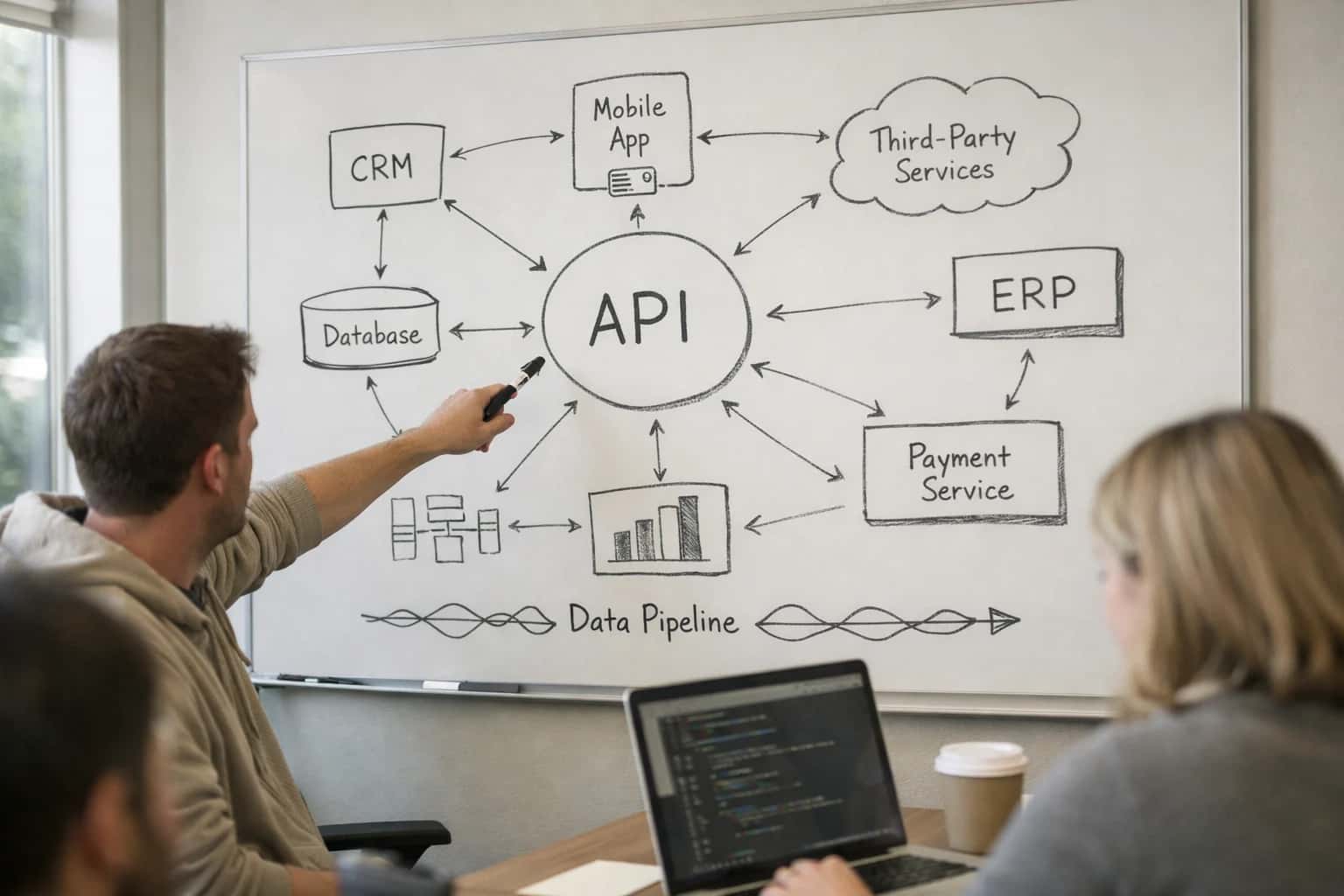
Where AI Fits in iCIMS for High-Volume Hiring
A practical blueprint for embedding AI into iCIMS to automate the high-volume hiring funnel, from application triage to offer management.
The implementation centers on a middleware service that listens to iCIMS events, orchestrates AI tasks (screening, messaging, analytics), and writes results back. A key pattern is using iCIMS' custom objects and fields to store AI-generated data—like a candidate's summarized qualifications or communication sentiment—enabling recruiters to filter and sort within the native platform. For example, after an AI screens an application, it can update a Screening_Status field to "AI-Recommended" or "Needs Review," and add notes to the candidate profile. High-volume workflows also benefit from batch processing: an end-of-day job that re-scores the entire active candidate pool for a requisition based on new AI models, updating rankings visible to the recruiting team the next morning.
Rollout should be phased, starting with a single high-volume requisition type (e.g., retail associate, call center agent) to validate accuracy and recruiter adoption. Governance is critical: all AI decisions should be logged in an external audit trail, and a human-in-the-loop rule should be configured in iCIMS workflows for certain thresholds (e.g., any candidate scoring below 40% is auto-rejected, but scores between 40-70% require recruiter review). This ensures compliance and allows for continuous model tuning based on real hiring outcomes. For scaling, the architecture must respect iCIMS API rate limits, implement retry logic for failed writes, and separate PII handling for privacy. A successful integration turns iCIMS from a system of record into an intelligent hiring engine, reducing time-to-screen from hours to minutes and ensuring no viable candidate slips through the cracks during volume surges.
Key iCIMS Surfaces for AI Integration
The Core Data Layer for AI
The Candidate & Application Hub is the primary data surface for AI integration in iCIMS. This includes the candidate profile, application records, resumes, and associated custom fields. AI workflows typically ingest this data for analysis and write back scores or tags.
Key integration points:
- Candidate API: Pull candidate profiles, resumes, and application history for batch scoring or real-time enrichment.
- Custom Fields: Write AI-generated outputs like
match_score,skills_summary, orred_flagsback to candidate or application records for recruiter visibility and reporting. - Resume Parsing: Use AI to extract structured skills, experience, and education from uploaded resumes, supplementing or validating iCIMS's native parser.
This hub enables use cases like automated application triage, skills gap analysis, and candidate rediscovery by making AI insights a native part of the recruiter's workflow.
High-Value AI Use Cases for iCIMS
For high-volume hiring teams, AI integration with iCIMS transforms manual, repetitive processes into automated, intelligent workflows. These patterns focus on the iCIMS Talent Cloud API, webhooks, and data model to accelerate hiring velocity while maintaining compliance and candidate experience.
Automated Application Triage & Scoring
AI agents process incoming applications via iCIMS webhooks, parsing resumes and profiles against requisition requirements. The system assigns a match score, populates custom fields (e.g., AI_Score, Top_Skills), and can auto-advance top candidates to the next stage or flag for review. This replaces manual first-pass screening.
Bulk Candidate Communication Orchestration
An AI workflow engine listens to iCIMS candidate stage changes (e.g., Phone Screen Scheduled, Offer Extended) and triggers personalized, bulk communications. It drafts and sends status updates, interview confirmations, and follow-ups using iCIMS communication APIs, maintaining a unified audit trail and reducing recruiter administrative load.
Intelligent Talent Pool Rediscovery
For new requisitions, an AI agent semantically searches the entire iCIMS candidate database—including past applicants and silver medalists—to find matches. It tags and segments the talent pool, then can automate re-engagement sequences via iCIMS, turning historical data into an active pipeline asset.
Compliance-Aware Offer Management
AI assists in generating offer letters by pulling structured data from the iCIMS requisition and candidate records. It runs compliance checks against internal equity bands and geo-specific regulations, routes for approvals via iCIMS workflows, and manages versioning—all while keeping the offer synchronized in the candidate's profile.
High-Volume Interview Scheduling
An AI scheduler integrates with iCIMS candidate events and external calendar APIs (Google, Outlook) to coordinate panel interviews for dozens of candidates simultaneously. It proposes optimal times, sends invites, updates iCIMS event records, and handles rescheduling requests, eliminating manual coordination for volume roles like retail or call centers.
Funnel Analytics & Predictive Insights
AI models analyze iCIMS pipeline data—application sources, stage durations, drop-off points—to generate predictive insights on time-to-fill, source quality, and candidate conversion likelihood. These insights are surfaced via automated reports or injected back into iCIMS dashboards, enabling data-driven hiring strategy adjustments.
Example AI-Agent Workflows for iCIMS
For enterprise teams managing thousands of applications, these workflows illustrate how AI agents can be embedded into iCIMS to automate repetitive tasks, accelerate screening, and improve candidate experience while maintaining recruiter oversight.
Trigger: A new application is submitted via the iCIMS Career Portal and lands in the Applications object.
Context Pulled: The agent retrieves the candidate's resume (attached file or parsed text), the job requisition ID, and the associated job description fields (skills, qualifications, location).
Agent Action:
- Parses the resume for skills, years of experience, and education.
- Compares the candidate's profile against the job requisition using a configurable matching algorithm.
- Generates a match score (e.g., 0-100) and extracts key matching/diverging points.
- Applies predefined business rules (e.g., "requires active security clearance").
System Update: The agent writes back to the iCIMS candidate record via API:
- Updates a custom field:
AI_Match_Score - Adds tags:
High Match,Needs Review,Missing Certification - Logs the analysis rationale in a notes field with a
[System]prefix for auditability.
Human Review Point: Applications tagged High Match are automatically moved to a "AI-Recommended" view for recruiter review. Those tagged Needs Review remain in the main queue but are prioritized.
Implementation Architecture: Data Flow & System Design
A production-ready architecture for embedding AI into iCIMS to automate high-volume hiring workflows without disrupting core operations.
A robust integration for iCIMS high-volume hiring is built on a decoupled, event-driven architecture that listens to iCIMS webhooks (e.g., application.created, candidate.stage_change) and processes candidate data asynchronously. The core flow begins when a new application lands in iCIMS for a high-volume requisition. A webhook payload containing the candidate ID, job ID, and resume file URL is sent to a secure ingestion endpoint. This triggers an AI processing pipeline that: 1) fetches the candidate record and resume via iCIMS REST API, 2) parses and extracts structured data (skills, experience, education), 3) runs a match score against the job requisition's requirements using a configured LLM, and 4) writes the results back to iCIMS as custom field data (e.g., AI_Match_Score, AI_Skills_Summary). This keeps the intelligence inside iCIMS where recruiters already work.
For bulk communication, the system leverages iCIMS' Communication Center or API-driven email endpoints. An AI agent monitors the candidate pipeline for trigger events—like moving to a "Phone Screen" stage—and generates personalized, templated outreach. To manage scale, these communications are queued and batched, with send times optimized to avoid email throttling. The agent can also handle simple inbound replies, using intent classification to triage questions to a FAQ knowledge base or escalate to a human recruiter. All interactions are logged as activities on the candidate profile in iCIMS, maintaining a complete audit trail.
Rollout follows a phased, requisition-first approach. Begin with a single, high-volume job family (e.g., "Customer Support Representative") to calibrate the AI scoring model and communication templates. Use iCIMS' user permissions and custom field security to control visibility, initially exposing AI insights only to a pilot team of recruiters. Governance is critical: implement a human-in-the-loop review for low-confidence scores or automated decisions, and establish a regular feedback cycle where recruiter overrides are used to retrain and improve the models. This controlled launch mitigates risk while demonstrating clear ROI through metrics like reduction in manual screen time per application and improved time-to-communication.
The final architecture is a resilient microservice layer that sits alongside iCIMS, not inside it. It uses iCIMS as the system of record, ensuring data consistency and leveraging its native security model. This approach allows enterprises to scale AI from hundreds to hundreds of thousands of applications without overloading the core ATS, while keeping all candidate intelligence and workflow automation directly actionable within the iCIMS interface recruiters already trust. For related architectural patterns, see our guides on AI Integration for Greenhouse and AI Integration for High-Volume Hiring.
Code & Payload Examples
Trigger AI Screening on New Applications
When a candidate submits an application in iCIMS, a webhook can be configured to send the application payload to an AI service for immediate triage. This pattern allows for real-time scoring and prioritization in high-volume scenarios.
Example Webhook Payload (Simplified):
json{ "event": "application.submitted", "timestamp": "2024-05-15T10:30:00Z", "data": { "application_id": "APP-789012", "job_id": "REQ-456789", "candidate_id": "CAN-123456", "resume_url": "https://icims-instance.com/files/resume_789.pdf", "answers": [ { "question_id": "Q1", "response": "5 years of Python experience" } ] } }
Python Handler for AI Processing:
pythonimport requests from inference_llm import score_application def handle_icims_webhook(payload): """Process incoming iCIMS webhook for AI screening.""" app_data = payload['data'] # Fetch resume text from iCIMS file URL (using iCIMS API token) resume_text = fetch_resume(app_data['resume_url']) # Call AI service for scoring ai_score, match_reasons, red_flags = score_application( resume_text=resume_text, job_req_id=app_data['job_id'], application_answers=app_data['answers'] ) # Update iCIMS custom field via PATCH update_payload = { "fields": { "customfield_ai_score": ai_score, "customfield_ai_summary": match_reasons } } requests.patch( f"https://api.icims.com/v1/applications/{app_data['application_id']}", json=update_payload, headers={"Authorization": "Bearer <ICIMS_TOKEN>"} )
Realistic Time Savings & Operational Impact
This table illustrates the operational impact of integrating AI into core iCIMS workflows for high-volume hiring, focusing on time savings, process changes, and the role of human oversight.
| Workflow / Metric | Before AI Integration | After AI Integration | Implementation Notes |
|---|---|---|---|
Initial Application Triage | Manual screening of 100% of applications | AI pre-screens 80-90%, flags top 20% and bottom 30% | Human recruiters review AI-ranked shortlist; reduces first-pass review time by ~70% |
Candidate Communication (Bulk) | Manual, templated emails sent in batches | AI generates & sends personalized status updates triggered by stage changes | Maintains brand voice, includes human-in-the-loop for exceptions and sensitive communications |
Resume-to-Requisition Matching | Recruiter manually compares skills and experience | AI scores all applicants against job requirements using semantic search | Scores populate custom iCIMS fields; recruiters use score to prioritize, not replace judgment |
Interview Scheduling Coordination | Recruiter manages 5-10 email threads to align panel availability | AI scheduler proposes times based on integrated calendar feeds, sends invites | Recruiter approves final time; reduces scheduling back-and-forth from hours to minutes |
Candidate Rediscovery from Talent Pool | Manual search and review of past applicants for new roles | AI agent automatically surfaces and ranks relevant past candidates | Triggers a recruiter task in iCIMS for outreach; turns a weekly project into a daily automated alert |
Offer Package Generation | Manual assembly from templates, HR review for compliance | AI drafts offer letter using approved clauses and requisition data | HR and hiring manager review and approve; cuts draft creation from 30+ minutes to <5 minutes |
High-Volume Reporting & Funnel Health | Weekly manual report compilation from iCIMS analytics | AI generates daily digest of key metrics (apply-to-interview rate, source quality) with anomaly alerts | Delivered via Slack/email; enables same-day intervention instead of next-week analysis |
Governance, Security, and Phased Rollout
For high-volume hiring, AI integration must be secure, auditable, and rolled out with surgical precision to avoid disrupting active requisitions.
Governance starts with data access. Your AI agents and workflows will interact with iCIMS objects like Candidates, Requisitions, Applications, and Communications. We implement role-based access control (RBAC) at the API layer, ensuring AI processes only see data scoped to their function—for example, a screening agent only accesses applications for its assigned job family. All AI actions, such as score updates or status changes, are logged to a dedicated audit trail linked to the system service account, creating a clear lineage for compliance reviews and model validation.
Security is non-negotiable with candidate PII. We architect integrations to keep sensitive data within your cloud boundary. Common patterns include:
- Webhook-triggered processing: iCIMS fires an event (e.g.,
application.submitted), which queues a job in your secure environment. The AI service processes the data internally and posts back results via iCIMS API, never exposing raw resumes to external endpoints. - Zero-data retention policies: Configure AI models for stateless processing, where candidate data is not stored post-analysis.
- Encrypted custom fields: AI-generated scores or tags are written back to iCIMS as encrypted custom field values, maintaining data integrity within the platform's own security model.
A phased rollout mitigates risk and builds trust. We recommend a three-stage approach:
- Pilot a single, high-volume requisition: Activate AI screening for one role (e.g.,
Customer Support Representative). Run AI scoring in parallel with human review, comparing outcomes and calibrating the model. Use iCIMS' reporting to track discrepancy rates. - Expand to a job family: Once validated, extend the integration to all requisitions in a defined job family. Implement human-in-the-loop gates for low-confidence AI decisions, requiring recruiter review before status changes.
- Enterprise enablement: Roll out to all targeted high-volume roles. By this stage, operational playbooks, monitoring dashboards for AI performance (e.g., score drift), and a defined escalation path for the recruiting operations team are fully established. This controlled progression ensures the integration enhances—never hinders—your hiring velocity.
Enabling Efficiency, Speed & Accuracy
Intelligent Analysis, Decision & Execution
We build AI systems for teams that need search across company data, workflow automation across tools, or AI features inside products and internal software.
Talk to Us
Search across company data
Give teams answers from docs, tickets, runbooks, and product data with sources and permissions.
Useful when people spend too long searching or get different answers from different systems.

Automate internal workflows
Use AI to route work, draft outputs, trigger actions, and keep approvals and logs in place.
Useful when repetitive work moves across multiple tools and teams.

Add AI to products and internal tools
Build assistants, guided actions, or decision support into the software your team or customers already use.
Useful when AI needs to be part of the product, not a separate tool.
FAQs: AI Integration for iCIMS High-Volume Hiring
Common technical and operational questions for enterprise teams planning to integrate AI into iCIMS for high-volume hiring scenarios.
A phased, requisition-based rollout is critical for high-volume hiring in iCIMS.
- Pilot with a Controlled Cohort: Start with a single job family (e.g., Customer Support) or a specific location. Use iCIMS' requisition tags or custom fields to flag which reqs are "AI-enabled."
- Leverage iCIMS Webhooks for Gradual Activation: Configure your AI service to listen only for webhooks (e.g.,
application.created) from the pilot requisitions. This isolates the AI's scope. - Parallel Processing with Human Review: Initially, run AI scoring or triage in parallel with existing processes. Display AI-generated scores or tags in a custom field (e.g.,
AI_Screening_Score) without automating any stage changes. Recruiters can compare AI output with their own judgment. - Gradual Automation: After validating accuracy (e.g., 2-3 hiring cycles), introduce light automation, such as auto-tagging candidates with
AI_Recommended_for_Reviewor moving clearly unqualified candidates to a "AI-Screened Out" stage, with an audit log. - Scale by Business Unit: Use iCIMS' user permissions and job distribution rules to roll out the integrated workflow to additional teams, ensuring each group receives training and has a clear opt-out path during transition.
This approach minimizes risk, builds trust with recruiting teams, and allows for continuous tuning of AI models based on real iCIMS data.

About the author
Prasad Kumkar
CEO & MD, Inference Systems
Prasad Kumkar is the CEO & MD of Inference Systems and writes about AI systems architecture, LLM infrastructure, model serving, evaluation, and production deployment. Over 5+ years, he has worked across computer vision models, L5 autonomous vehicle systems, and LLM research, with a focus on taking complex AI ideas into real-world engineering systems.
His work and writing cover AI systems, large language models, AI agents, multimodal systems, autonomous systems, inference optimization, RAG, evaluation, and production AI engineering.
Partnered with leading AI, data, and software stack.





How We Work
Custom AI workflows for your Business
One-fit-all AI don't work for modern businesses. At Inferensys, we aim to understand your business & custom requirements; which we use to define most efficient agentic workflows, the data, and the tools for your business.
01
Review the use case
We understand the task, the users, and where AI can actually help.
Read more02
Pick the right approach
We define what needs search, automation, or product integration.
Read more03
Build the first useful version
We implement the part that proves the value first.
Read more04
Improve from there
We add the checks and visibility needed to keep it useful.
Read moreThe first call is a practical review of your use case and the right next step.
Talk to Us