The iCIMS Talent Cloud is built for scale, but high-volume hiring creates manual bottlenecks in candidate screening, personalized communication, and data enrichment. AI integration targets these surfaces by connecting to iCIMS's REST API and webhooks to inject intelligence at key workflow points: when a new application is submitted (POST /applications), when a candidate stage changes, or when a recruiter action is logged. This allows for event-driven processing of candidate profiles, resumes, and requisition data without disrupting the core user experience.

Integration
AI Integration for iCIMS
Enterprise architecture for embedding AI agents and workflows into the iCIMS Talent Cloud to automate high-volume hiring, improve candidate experience, and ensure compliance-aware data processing.
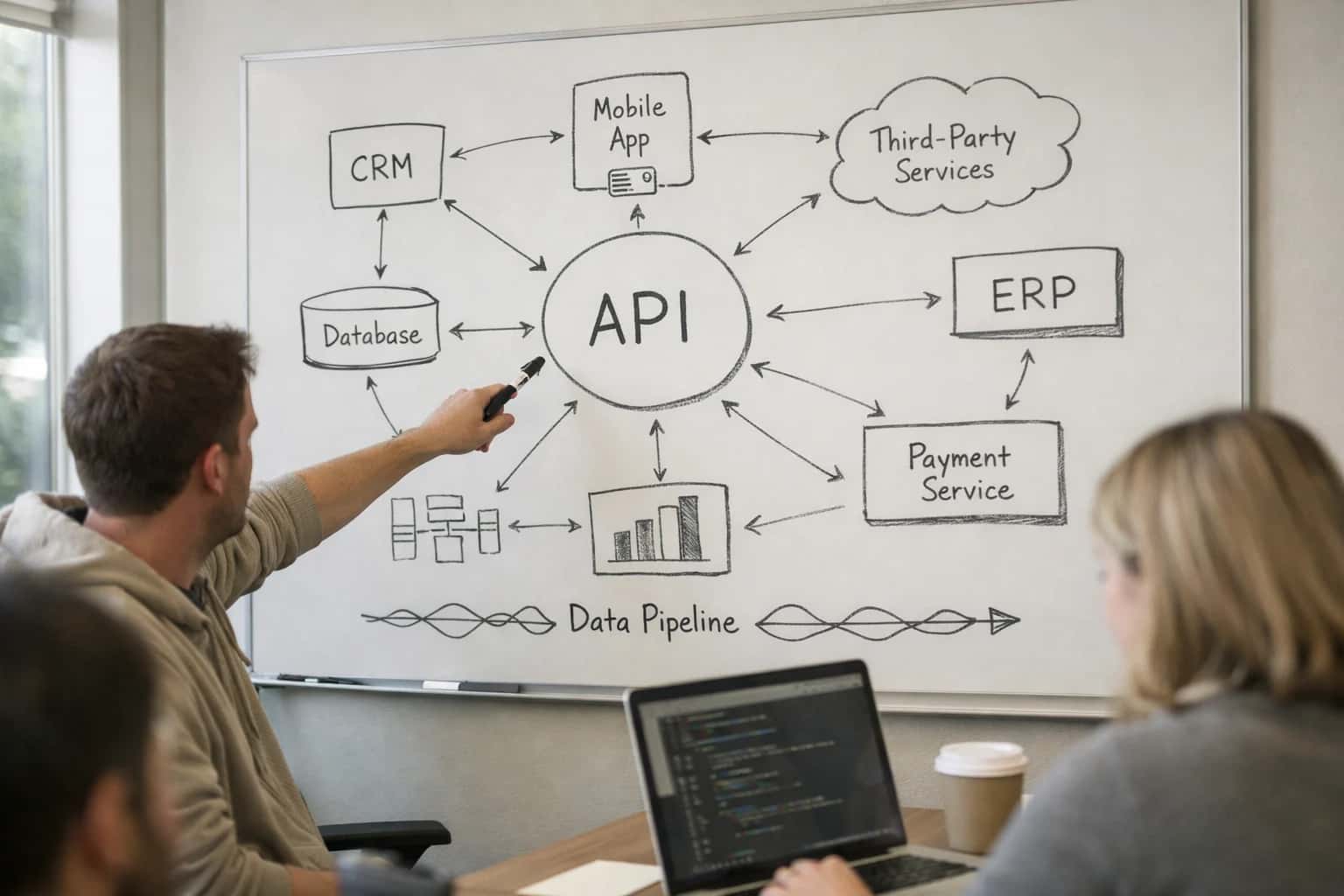
ENTERPRISE ARCHITECTURE FOR HIGH-VOLUME WORKFLOWS
Where AI Fits in the iCIMS Talent Cloud
A technical blueprint for embedding AI agents and workflows into the iCIMS platform to automate candidate screening, communication, and compliance-aware data processing.
Implementation focuses on stateless, queue-based services that process payloads from iCIMS webhooks. For example, an AI screening service can listen for new applications, parse the attached resume PDF, extract skills and experience, and score the candidate against the job requisition's requirements using a configured LLM. The resulting match score and extracted attributes are then written back to iCIMS via the API, populating custom fields like AI_Match_Score or AI_Skills_JSON. This creates an auditable, automated layer of intelligence that recruiters can use to prioritize their pipeline. Similarly, communication workflows can be triggered by stage changes (e.g., moving to "Phone Screen") to automatically generate and send personalized email or SMS templates via iCIMS Communications, with AI drafting context-aware content.
Rollout and governance are critical for enterprise ATS integrations. A phased approach typically starts with a single high-volume requisition to validate the AI's output quality and system performance before scaling. All AI interactions must be logged in a separate audit trail, linking iCIMS candidate IDs to model inputs, outputs, and any human-override decisions. Given iCIMS often handles sensitive PII, AI services should be deployed in a compliant cloud environment, with data processing agreements in place for any third-party LLMs. The goal is not full automation, but a human-in-the-loop system where AI handles the tedious first pass—reducing manual resume review from hours to minutes—allowing recruiters to focus on high-touch candidate engagement and strategic decision-making.
ENTERPRISE ARCHITECTURE
iCIMS Modules and Surfaces for AI Integration
Core Data Objects for AI Enrichment
The iCIMS Talent Cloud structures hiring data around key objects that serve as the primary surfaces for AI integration. Intelligent workflows typically start by retrieving and enriching these records via the iCIMS REST API.
Candidate Profiles contain resumes, applications, and custom fields. AI can parse resumes to extract skills, years of experience, and education, then populate structured custom fields automatically. This transforms unstructured text into queryable data for better matching and reporting.
Job Requisitions define open roles with requirements, descriptions, and hiring team details. AI agents can use this data to generate screening questions, tailor communication, and power semantic matching against candidate profiles. Updates to requisition status can also trigger downstream AI workflows, like notifying a sourcing agent to refresh a talent pool.
Applications link candidates to requisitions. This is the critical junction for AI-driven scoring and ranking. By analyzing the application, attached resume, and requisition data together, an AI model can generate a match score, flag top candidates, and suggest interview focus areas, all while logging its reasoning for audit compliance.
ENTERPRISE TALENT CLOUD INTEGRATIONS
High-Value AI Use Cases for iCIMS
For enterprise talent teams managing high-volume hiring, AI integration with iCIMS automates manual screening, personalizes candidate engagement, and injects intelligence into compliance-heavy workflows. These are production-ready patterns that connect to iCIMS's REST API, webhooks, and data model.
01
High-Volume Application Triage
Automate first-pass screening for high-volume requisitions (e.g., retail, call center). An AI agent ingests new applications via iCIMS webhooks, parses resumes against job requisition data, and scores candidates based on skills, experience, and location match. Top candidates are flagged in iCIMS with a custom score field, while non-matches receive an automated, templated disposition.
Hours -> Minutes
Screening time
02
Intelligent Candidate Rediscovery
Activate dormant talent pools by using AI to continuously match past applicants in iCIMS against new open requisitions. The integration runs semantic search across historical candidate profiles and job descriptions, identifies strong fits, and can trigger personalized re-engagement campaigns or alert recruiters to high-potential rediscoveries, improving time-to-fill and reducing sourcing costs.
Batch -> Real-time
Pool matching
03
Compliance-Aware Offer Management
Streamline offer generation and approval workflows. An AI workflow pulls data from the iCIMS candidate record and approved requisition to draft compliant offer letters, checking for jurisdictional requirements. It routes drafts through configured approval chains in iCIMS, manages e-signature collection, and updates candidate stages—all while maintaining a full audit trail within the platform.
Same day
Offer turnaround
04
Candidate Experience Chatbot
Deploy an AI-powered chatbot on career sites or within the application portal that syncs with iCIMS. It answers FAQs about application status, benefits, or interview logistics by querying the iCIMS API (with appropriate privacy gates). It can also schedule interviews by checking recruiter calendar availability and creating events in iCIMS, reducing recruiter admin work and improving response times.
24/7
Candidate support
05
Automated Background Check Review
Integrate with background check vendors to automate a critical compliance workflow. When a report is delivered, an AI agent parses the document, flags potential discrepancies against the candidate's iCIMS profile, and summarizes findings for the recruiter. It can then update the candidate's iCIMS status or trigger a review workflow based on configurable rules, speeding up pre-boarding.
Manual -> Automated
Report triage
06
Global Hiring & Localization Support
For multinational enterprises, use AI to manage localization complexities within iCIMS. Agents can translate and localize job descriptions, candidate communications, and offer documents based on requisition location. They can also run compliance checks for regional hiring regulations and populate location-specific custom fields in iCIMS, ensuring consistent yet locally compliant processes.
1 sprint
Implementation cycle
ENTERPRISE-SCALE IMPLEMENTATION PATTERNS
Example AI Automation Workflows for iCIMS
These workflows illustrate how AI agents and automations connect to iCIMS's core objects—Requisitions, Candidates, and Communications—to handle high-volume, repetitive tasks while maintaining compliance and audit trails. Each pattern is designed to be triggered via iCIMS webhooks or API events.
Trigger: A new application is submitted to a high-volume requisition (e.g., Retail Associate, Call Center Agent).
Context Pulled: The AI agent receives the webhook payload from iCIMS, then fetches:
- The full candidate application and resume.
- The job requisition details, including must-have skills, location, and shift requirements.
- Historical hiring data for similar roles to establish scoring baselines.
Agent Action: A configured LLM (e.g., GPT-4, Claude 3) performs a multi-step analysis:
- Parses & Extracts: Pulls skills, certifications, and experience from the unstructured resume.
- Scores & Matches: Compares extracted data against requisition criteria, generating a match score (0-100).
- Flags & Tags: Identifies potential red flags (e.g., large employment gaps) or green flags (e.g., relevant certification).
- Generates Summary: Creates a concise, 3-bullet point summary for the recruiter.
System Update: The agent makes a secure API call back to iCIMS to:
- Update the candidate's custom field
AI_Match_Score. - Add relevant tags (e.g.,
High_Match,Needs_Review). - Post the analysis summary to the candidate's private notes.
Human Review Point: Candidates scoring below a pre-defined threshold (e.g., < 40) are automatically moved to a "Talent Pool" stage. Scores between 40-80 trigger a notification for recruiter review. Scores above 80 can be configured to automatically schedule a screening call.
ENTERPRISE-SCALE INTEGRATION PATTERN
Implementation Architecture: Data Flow and Guardrails
A production-ready architecture for embedding AI into the iCIMS Talent Cloud, designed for security, scalability, and compliance.
A robust integration connects to iCIMS via its REST API and webhooks, treating the platform as the system of record. The core data flow is event-driven: webhooks for application.created, candidate.stage_change, or job.updated trigger serverless functions that fetch the full candidate profile, job requisition, and related notes. This payload is enriched and normalized before being sent to an orchestration layer. For high-volume hiring, we implement a queue-based system (e.g., Amazon SQS or RabbitMQ) to handle bursts of thousands of applications, ensuring the iCIMS API isn't overwhelmed and processing is resilient.
The AI layer operates on specific iCIMS objects and surfaces. Key integration points include:
- Candidate Profiles & Resumes: For parsing, skills extraction, and match scoring against job requisitions, updating custom fields like
AI_Match_Score. - Job Requisitions: For generating job descriptions, inclusive language checks, and defining the ideal candidate profile for matching logic.
- Candidate Stages & Activities: To automate stage transitions (e.g., moving from "Screen" to "Interview" based on score), log AI-generated notes, and trigger communications.
- iCIMS Talent Pools: For segmenting and tagging passive candidates using AI-driven clustering, enabling proactive pipelining. All AI outputs are written back to iCIMS via API as audit-logged activities or updates to configurable custom fields, keeping all data synchronized.
Governance is non-negotiable. The architecture includes:
- PII Scrubbers & Tokenization: Candidate resumes and profiles are stripped of direct identifiers before processing in LLMs, using hashed references.
- Human-in-the-Loop Gates: Critical actions, like moving a candidate to "Reject" or sending an offer, require approval or are presented as suggestions within the iCIMS UI.
- Bias Auditing & Explainability: All scoring models output confidence scores and key rationale (e.g., "matched on 5 of 7 required skills"), stored in a
AI_Reasoningfield for recruiter review and compliance reporting. - Rollout Strategy: We typically start with a single, high-volume requisition in a sandbox iCIMS environment, measuring AI suggestions against human recruiter outcomes, before expanding to global hiring programs.
ENTERPRISE IMPLEMENTATION PATTERNS
Code and Payload Examples for iCIMS API Integration
Automating Resume-to-Job Matching
This pattern uses iCIMS webhooks to trigger AI analysis when a new application is submitted. The AI agent parses the resume, extracts skills and experience, and scores the candidate against the job requisition's requirements. The score is written back to a custom field in the candidate profile via the iCIMS REST API for recruiter visibility and automated filtering.
Example Python Payload for Score Update:
pythonimport requests # Payload to update a candidate's custom field with an AI-generated match score score_update_payload = { "fields": [ { "id": "custom_field_ai_match_score", # Your custom field ID "value": 87 # AI-generated score (0-100) } ] } # iCIMS API call to update candidate record response = requests.patch( 'https://yourtenant.icims.com/api/v1/candidates/{candidate_id}', json=score_update_payload, headers={'Authorization': 'Bearer YOUR_API_KEY', 'Content-Type': 'application/json'} )
This enables automated ranking within iCIMS candidate lists and triggers workflows for high-scoring applicants.
ICIMS TALENT CLOUD
Realistic Time Savings and Operational Impact
Expected efficiency gains and workflow changes from integrating AI into core iCIMS modules for high-volume hiring.
| Workflow / Module | Before AI Integration | After AI Integration | Implementation Notes |
|---|---|---|---|
Initial Resume Screening | Manual review of 100+ resumes per req (4-6 hours) | AI-assisted scoring & ranking (30-45 minutes) | Human recruiter reviews top 10-15 ranked candidates; AI updates custom iCIMS score field |
Candidate Communication & Status Updates | Manual email/SMS templates, prone to delays | Automated, personalized outreach triggered by iCIMS stage changes | Uses iCIMS webhooks & email templates; human-in-the-loop for exceptions |
Interview Scheduling Coordination | Back-and-forth emails to align panel (2-3 days lead time) | AI scheduler integrates with Outlook/Google via iCIMS API (same-day scheduling) | Respects interviewer preferences from iCIMS user profiles; updates iCIMS candidate events |
Offer Letter Generation | Manual drafting from templates, legal review cycle | AI drafts from iCIMS requisition & candidate data, routes for approval | Pulls data from iCIMS job, compensation, and candidate records; uses iCIMS workflow for approvals |
High-Volume Application Triage (Seasonal Hiring) | Overwhelming volume leads to application lag or generic declines | AI performs initial skills/match check, routes qualified candidates | Processes iCIMS application queue; can tag candidates or update disposition reasons |
Interview Feedback Synthesis | Manual compilation of notes from multiple interviewers | AI summarizes feedback, highlights key themes & red flags | Ingests notes from iCIMS feedback forms or email; appends summary to candidate record |
Talent Pool Nurturing | Infrequent, batch email blasts to past applicants | Segmented, triggered communications based on new roles & profile updates | AI segments iCIMS talent pool using tags & skills; campaigns managed via iCIMS communications module |
Background Check Review | Manual review of lengthy third-party reports | AI parses reports, flags discrepancies for reviewer attention | Triggers on iCIMS background check completion; updates candidate status based on review outcome |
ENTERPRISE-READY AI INTEGRATION
Governance, Security, and Phased Rollout
A controlled, secure approach to embedding AI within the iCIMS Talent Cloud for high-volume, compliance-sensitive hiring.
Production AI integrations with iCIMS must be architected with strict data governance from day one. This means implementing role-based access controls (RBAC) that mirror iCIMS permissions, ensuring AI agents and workflows only interact with candidate and job data for which the requesting user or system has explicit access. All AI-generated content—such as candidate summaries, outreach drafts, or screening scores—should be logged as custom notes or activities within the iCIMS audit trail, tagged with the model version and prompt used. For processing sensitive Personally Identifiable Information (PII), data should be pseudonymized before being sent to external LLM APIs, and all vector embeddings stored for semantic search must reside in a secure, company-controlled environment like Pinecone or Weaviate, not in public model provider systems.
A phased rollout is critical for adoption and risk management. Start with a pilot on a single, high-volume requisition stream—such as entry-level customer service roles—where the use case is clear: automated resume screening and initial match scoring. In this phase, the AI acts as a copilot, suggesting scores and summaries to recruiters who retain final approval before any data is written back to iCIMS via its REST API. Key technical checkpoints include monitoring API latency, verifying the accuracy of parsed resume data against iCIMS candidate profiles, and establishing a human-in-the-loop review queue for low-confidence AI judgments. Success metrics should focus on time-to-screen reduction and recruiter satisfaction, not just automation rate.
Upon validating the pilot, expand to adjacent workflows like automated candidate communications for status updates and interview scheduling, and interview question generation based on job requisition data. Each new phase introduces its own governance layer: communications require template approval and opt-out management, while question generation needs compliance reviews for role-relevance and bias mitigation. The final phase involves integrating predictive analytics, such as time-to-fill forecasting or candidate drop-off risk scoring, which requires historical iCIMS data pipelines and clear disclaimers on model limitations for stakeholders. Throughout, maintain a centralized prompt registry and conduct regular audits to ensure AI outputs remain aligned with evolving hiring policies and legal requirements.
This structured approach ensures the AI integration enhances iCIMS without introducing unmanaged risk. It transforms the platform from a system of record into an intelligent system of engagement, where automation handles volume and consistency, allowing recruiters and coordinators to focus on high-touch candidate relationships and strategic hiring decisions. For a deeper dive on architecting these data flows, see our guide on AI Integration for Applicant Tracking Platforms.
Enabling Efficiency, Speed & Accuracy
Intelligent Analysis, Decision & Execution
We build AI systems for teams that need search across company data, workflow automation across tools, or AI features inside products and internal software.
Talk to Us
Search across company data
Give teams answers from docs, tickets, runbooks, and product data with sources and permissions.
Useful when people spend too long searching or get different answers from different systems.
Enterprise searchRAGPermissions
Read more
Automate internal workflows
Use AI to route work, draft outputs, trigger actions, and keep approvals and logs in place.
Useful when repetitive work moves across multiple tools and teams.
AI agentsWorkflow automationGovernance
Read more
Add AI to products and internal tools
Build assistants, guided actions, or decision support into the software your team or customers already use.
Useful when AI needs to be part of the product, not a separate tool.
AI integrationDecision supportModel routing
Read moreENTERPRISE IMPLEMENTATION QUESTIONS
FAQs: AI Integration for iCIMS
Answers to the most common technical and strategic questions from enterprise teams planning AI integrations with the iCIMS Talent Cloud.
Secure integration requires a layered approach, as iCIMS contains sensitive PII. The standard pattern is:
- API Gateway & Authentication: Use iCIMS's OAuth 2.0 for secure API access. Deploy a dedicated integration service (e.g., in your VPC) that acts as a gateway, managing tokens and rate limits.
- Data Minimization: Configure the integration to pull only the necessary fields for a given workflow (e.g.,
candidate.name,resume_text,job_requisition.title) rather than full records. - Secure Processing: Transmit data to your AI model endpoint (e.g., Azure OpenAI, Anthropic, or a fine-tuned model) over TLS. For maximum control, process data within your own cloud environment before sending to a managed LLM API.
- Audit Logging: Log all API calls to iCIMS, including the trigger, data fields accessed, and the AI-generated output, for compliance and debugging.
- Zero Data Retention: Configure the AI service to not persist iCIMS data beyond the immediate session, unless explicitly required for a workflow (like storing a generated score).
Example secure payload structure sent from your integration service:
json{ "workflow": "resume_screening", "candidate_id": "ICIMS-12345", "data": { "job_title": "Senior Software Engineer", "job_description": "...", "resume_text": "..." } }

About the author
Prasad Kumkar
CEO & MD, Inference Systems
Prasad Kumkar is the CEO & MD of Inference Systems and writes about AI systems architecture, LLM infrastructure, model serving, evaluation, and production deployment. Over 5+ years, he has worked across computer vision models, L5 autonomous vehicle systems, and LLM research, with a focus on taking complex AI ideas into real-world engineering systems.
His work and writing cover AI systems, large language models, AI agents, multimodal systems, autonomous systems, inference optimization, RAG, evaluation, and production AI engineering.
LinkedIn
Limited slotsGet a Free AI Consultation
Partnered with leading AI, data, and software stack.





How We Work
Custom AI workflows for your Business
One-fit-all AI don't work for modern businesses. At Inferensys, we aim to understand your business & custom requirements; which we use to define most efficient agentic workflows, the data, and the tools for your business.
01
Review the use case
We understand the task, the users, and where AI can actually help.
Read more02
Pick the right approach
We define what needs search, automation, or product integration.
Read more03
Build the first useful version
We implement the part that proves the value first.
Read more04
Improve from there
We add the checks and visibility needed to keep it useful.
Read moreThe first call is a practical review of your use case and the right next step.
Talk to Us