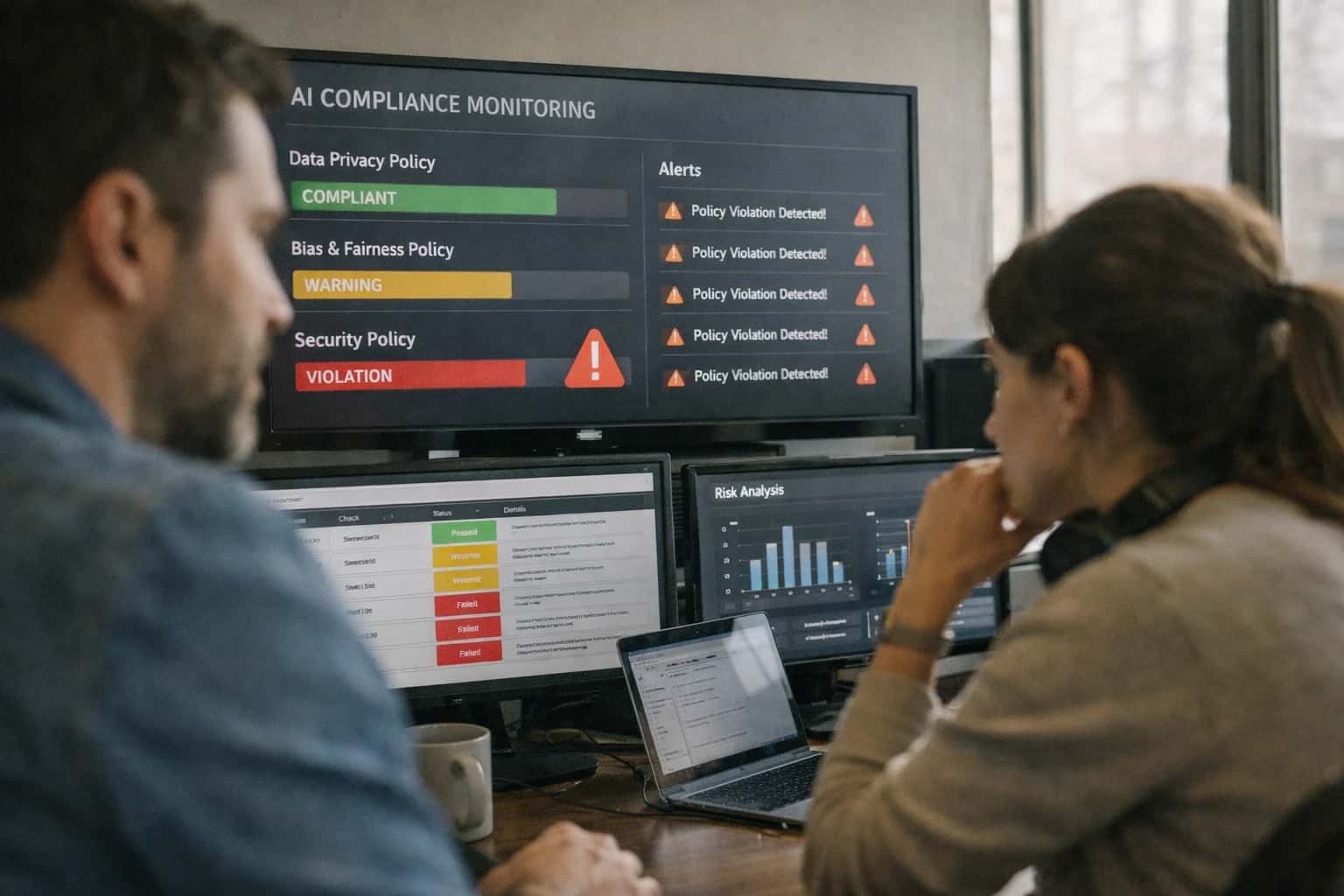
AI for safety compliance connects at three key layers within the warehouse tech stack: the WMS transaction engine, the IoT data stream (from wearables, cameras, and environmental sensors), and the compliance reporting dashboard. The integration acts as a real-time monitoring layer that ingests events from systems like Manhattan Active or SAP EWM—such as a task assignment to a high-reach truck zone—and correlates them with live IoT feeds to check for corresponding PPE usage or safe proximity alerts. This creates a closed-loop where safety is validated per transaction, not just during periodic audits.

Integration
AI for Safety Compliance Monitoring
A technical blueprint for integrating AI with Warehouse Management Systems (WMS) and IoT devices to automate safety compliance monitoring, generate real-time alerts, and produce audit-ready reports.
ARCHITECTURE FOR REAL-TIME MONITORING AND AUTOMATED WORKFLOWS
Where AI Fits into Warehouse Safety Compliance
Integrating AI with WMS and IoT systems transforms reactive safety logging into proactive, automated compliance operations.
Implementation typically involves deploying an AI agent that subscribes to WMS event queues (e.g., task creation, login/logout) and IoT platforms via APIs. For example, when the WMS dispatches a replenishment task to a narrow aisle, the agent can immediately check the assigned operator's wearable tag for a hard_hat_detected signal and the zone camera feed for proper_high-vis_vest. If a violation is detected, the agent can trigger multiple workflows: an immediate alert to the operator's RF device, a supervisor notification in the WMS mobile dashboard, and the automatic creation of a non-conformance record in the WMS's compliance module or a connected EHS platform like Cority.
Governance and rollout require careful planning. Start with a pilot zone and high-risk violations (e.g., forklift pedestrian proximity). The AI model's confidence thresholds should be configurable, routing low-confidence alerts to a human review queue within the WMS interface before creating official incidents. All AI-driven actions must write to the WMS audit trail with a clear source tag (e.g., safety_agent_v1.2) to maintain an immutable record for compliance audits. This approach moves safety from a manual, checklist-driven process to an automated, data-enforced layer embedded directly into core warehouse operations.
AI FOR SAFETY COMPLIANCE MONITORING
Integration Surfaces: WMS Modules and IoT Data Streams
Core WMS Integration Points
AI for safety compliance primarily integrates with the task management and labor management modules of your WMS (e.g., Manhattan Active's Task Management, SAP EWM's Warehouse Activity Monitor). The goal is to correlate safety events with operational workflows.
Key integration surfaces include:
- Task Assignment APIs: Inject safety risk scores (e.g., proximity to high-traffic areas) into the task dispatch logic to influence routing.
- Labor Performance Data: Enrich standard productivity metrics (units per hour) with safety compliance scores derived from IoT feeds, creating a holistic view of associate performance.
- Exception Management Workflows: When an AI model detects a repeated PPE violation or unsafe proximity, it can trigger a standard WMS exception (e.g., a
SAFETY_HOLDflag) that pauses task assignment for that associate, routing them to a supervisor for review.
This integration ensures safety governance is embedded directly into the core operational system of record, not managed in a separate silo.
WAREHOUSE MANAGEMENT INTEGRATION
High-Value AI Safety Compliance Use Cases
Integrate AI with your WMS and IoT systems to move from reactive incident logging to proactive safety monitoring. These patterns use real-time data to enforce protocols, reduce risk, and automate compliance workflows.
01
PPE Detection & Access Control
Integrate AI-powered computer vision from gate/door cameras with WMS user profiles. The system validates required PPE (hard hats, vests, safety glasses) before granting access to high-risk zones (e.g., receiving docks, mezzanines), logging compliance events directly to the user's record in the WMS.
Manual -> Automated
Enforcement
02
Proximity Alerting for MHE
Connect IoT wearables or UWB tags to the WMS task engine. AI models analyze real-time location of personnel and Material Handling Equipment (MHE) like forklifts. The system triggers audible/visual alerts on devices and can dynamically reassign WMS pick paths to maintain safe distances, logging near-misses for review.
Reactive -> Preventive
Incident model
03
Ergonomics & Fatigue Monitoring
Use AI to analyze WMS task completion times combined with wearable sensor data (posture, lift frequency). The system identifies associates at risk of strain, suggesting micro-breaks or task rotation within the WMS labor management module, and flags trends for supervisor coaching.
Batch -> Real-time
Risk scoring
04
Automated Safety Audit & Reporting
Deploy AI agents to continuously scan WMS transaction logs, IoT feeds (door sensors, conveyor stops), and incident reports. The system auto-generates daily safety briefings, identifies recurring violation patterns linked to specific zones or processes, and populates compliance dashboards for management.
Hours -> Minutes
Report generation
05
Spill & Obstruction Detection
Integrate overhead camera feeds with the WMS exception management workflow. AI vision models detect spills, fallen pallets, or blocked aisles in real-time. The system automatically creates a high-priority cleanup task in the WMS, alerts nearby associates via their RF devices, and updates digital twin maps.
Same day
Response time
06
Permit-to-Work & Lockout/Tagout
Build an AI workflow engine that interfaces with WMS maintenance modules and IoT locks. For tasks like conveyor maintenance, the AI verifies technician certifications, ensures energy isolation via sensor checks, and only releases the relevant WMS task (e.g., 'zone out of service') after all safety protocols are digitally confirmed.
Paper -> Digital
Workflow
IMPLEMENTATION PATTERNS
Example AI Safety Compliance Monitoring Workflows
These workflows illustrate how to connect AI models with WMS transaction data and IoT feeds (wearables, cameras) to monitor safety compliance in real-time, generating alerts and reports directly within warehouse management dashboards.
Trigger: An associate scans into a restricted zone (e.g., high-volume picking area, loading dock) using an RFID badge or mobile device.
Context Pulled:
- WMS user/role data for zone permissions.
- Real-time video feed from zone entry cameras.
AI Agent Action:
- A computer vision model analyzes the video frame for required PPE (hard hat, safety vest, steel-toe boots).
- The model returns a confidence score and itemized list of detected/missing PPE.
System Update:
- If compliant: The WMS task queue is updated, and the associate's mobile device receives the next picking or putaway task.
- If non-compliant:
- An alert is pushed to the supervisor's dashboard with the associate's ID, zone, and missing PPE.
- The WMS temporarily blocks task assignment to that user for the zone.
- The associate's device displays a message: "Safety vest not detected. Access denied. Please don required PPE."
Human Review Point: Supervisors can override the block via the dashboard after a visual confirmation, with the action logged for audit.
BUILDING A REAL-TIME SAFETY COMPLIANCE LAYER
Implementation Architecture: Data Flow and System Design
A practical blueprint for integrating AI with WMS and IoT systems to monitor safety compliance, generate alerts, and embed insights into warehouse dashboards.
The architecture centers on an AI Safety Orchestrator—a middleware service that ingests real-time data from two primary sources: the Warehouse Management System (WMS) transaction logs (e.g., task assignments, user logins from Manhattan Active or SAP EWM) and IoT sensor streams (e.g., body-worn cameras, proximity sensors on Material Handling Equipment (MHE), and gate/zone geofences). This orchestrator uses lightweight computer vision and rule-based models to detect compliance events such as missing PPE (hard hats, safety vests), unsafe proximity to forklifts, or entry into restricted zones. Detected events are immediately correlated with the WMS user and task context (e.g., 'PICK-10045 for user JDoe in zone A-12') to provide actionable alerts.
For implementation, the orchestrator integrates via the WMS's REST APIs or event bus (like SAP EWM's Queue-based RFC or Manhattan's ActiveMQ streams) to subscribe to user-location and task-start events. IoT data is ingested through a dedicated MQTT or Kafka pipeline. When a violation is detected, the system creates an incident record via the WMS's custom object API (or a sidecar database) and triggers a multi-channel alert: a real-time notification to the associate's RF device or wearable, a supervisor alert in the WMS dashboard, and an entry into a compliance audit log. For persistent issues, the system can automatically generate a corrective action task within the WMS's labor management or quality module.
Rollout should be phased, starting with a single high-risk zone (e.g., the receiving dock) and a single violation type (e.g., PPE detection). Governance is critical: all AI-generated alerts should route through a human-in-the-loop review queue in a connected system like ServiceNow or a custom dashboard before escalating to disciplinary action. This ensures model accuracy improves over time and maintains operator trust. The final architecture provides a closed-loop system where compliance data feeds back into the WMS for predictive analytics, such as identifying high-risk shifts or zones, enabling proactive safety interventions.
SAFETY COMPLIANCE MONITORING
Code and Payload Examples
Ingesting and Structuring IoT Safety Events
Safety events from wearables, cameras, and sensors must be normalized into a structured format for AI analysis before being sent to the WMS for alerting. This Python example consumes a webhook from a typical IoT platform, enriches it with warehouse context (zone, associate ID), and publishes it to a message queue for processing.
pythonimport json from datetime import datetime from your_message_queue import publish_event def handle_iot_safety_webhook(request_payload): """ Processes a raw IoT safety event (e.g., from Samsara, Procore, or custom hardware). """ raw_event = request_payload.get('data', {}) # Enrich with WMS context using a lookup service enriched_event = { "event_id": raw_event.get('id'), "timestamp": datetime.utcnow().isoformat(), "event_type": raw_event.get('type'), # e.g., 'PPE_VIOLATION', 'PROXIMITY_ALERT' "device_id": raw_event.get('deviceId'), "associate_id": lookup_associate_by_device(raw_event.get('deviceId')), # Custom service "warehouse_zone": raw_event.get('metadata', {}).get('zone'), "sensor_data": { "confidence": raw_event.get('confidenceScore', 0.0), "image_url": raw_event.get('imageUrl'), # For visual violations "distance_ft": raw_event.get('distanceToMhe') # For proximity alerts }, "raw_payload": raw_event # Keep original for audit } # Publish to queue for AI scoring and WMS integration publish_event(topic='safety-events-raw', message=enriched_event) return {"status": "ingested"}
SAFETY COMPLIANCE MONITORING
Realistic Operational Impact and Time Savings
How AI integration with WMS and IoT sensors transforms manual safety monitoring into a proactive, data-driven program.
| Safety Process | Traditional Manual Process | With AI + WMS Integration | Implementation Notes |
|---|---|---|---|
PPE (Hard Hat/Vest) Verification | Spot checks by supervisors; ~10% of shifts audited | Continuous monitoring via cameras; 100% of high-risk zones covered | AI flags non-compliance in real-time to WMS dashboard; alerts sent to supervisor radios |
Proximity to MHE (Forklifts) Incident Detection | Reactive investigation after near-miss report or accident | Real-time geofence alerts via wearables/IoT; prevention before incident | Integrates RTLS/WMS location data; triggers audible warning to both pedestrian and operator |
Safety Audit & Inspection Reporting | Weekly manual audits; 4-6 hours to compile findings & reports | Automated daily reports generated from AI findings; ready in <30 mins | AI correlates violations with WMS task/location data; reports auto-pushed to EHS platform |
Incident Documentation & Root Cause | Manual witness interviews, photo collection; 2-3 hours per incident | Automated timeline & visual evidence package assembled in <15 mins | AI pulls relevant video clips, WMS task logs, and sensor data into a single case file |
Corrective Action Workflow Initiation | Email/paper-based; 24-48 hour delay from incident to assigned action | Automated work order creation in WMS/CMMS within 1 hour of violation | AI classifies severity, suggests corrective action (e.g., retraining), creates ticket with evidence link |
Compliance Training Assignment | Quarterly blanket training for all staff; low relevance | Targeted, just-in-time training based on individual/zone violation trends | AI identifies risk patterns; WMS labor module schedules 15-min micro-training sessions pre-shift |
Regulatory Record Keeping for Audits | Manual compilation of paper logs & spreadsheets; days of prep for audit | Continuous, searchable digital audit trail; report generation in hours, not days | All AI alerts, overrides, and resolutions logged in WMS with immutable timestamps for regulators |
SAFETY FIRST, DATA ALWAYS
Governance, Privacy, and Phased Rollout
Implementing AI for safety compliance requires a deliberate approach to data governance, privacy, and controlled rollout to ensure trust and operational integrity.
A production AI safety system integrates with two primary data sources: your Warehouse Management System (WMS) for task and location context, and IoT sensor streams from wearables, cameras, and proximity sensors. Governance starts with defining the data flow: WMS APIs provide real-time associate IDs, task locations, and equipment assignments, while IoT gateways stream anonymized video frames or proximity events. The AI layer processes this fused data to detect compliance events—like missing PPE or unsafe proximity to Material Handling Equipment (MHE)—but must be architected to never persist raw video or personally identifiable telemetry without explicit consent and policy. All alerts and audit logs are written back to the WMS as non-repudiable events, tagged with the relevant transaction (e.g., PICK-10025) for traceability.
Rollout follows a phased, risk-based model. Phase 1 is a passive monitoring pilot in a single zone, where AI generates alerts visible only to a safety supervisor within the WMS dashboard or a dedicated safety console, with no automated enforcement. This builds a baseline of accuracy and allows for tuning detection thresholds (e.g., "how close is 'too close' to a forklift?"). Phase 2 introduces real-time, in-the-moment feedback via connected devices—a gentle vibration on a smartwatch or a visual cue on a vision-picking device—to coach associates proactively. Phase 3 escalates to automated workflow triggers, such as pausing an RF task until a safety vest is confirmed or generating a mandatory safety briefing in the learning management system.
Critical to success is maintaining a human-in-the-loop for serious incidents and establishing clear protocols for data retention and access. AI-generated safety reports should be aggregated and anonymized for trend analysis, while individual event data is governed by the same privacy policies as other HR systems. This approach ensures the integration enhances safety culture without creating a surveillance environment, turning real-time data into proactive prevention.
Enabling Efficiency, Speed & Accuracy
Intelligent Analysis, Decision & Execution
We build AI systems for teams that need search across company data, workflow automation across tools, or AI features inside products and internal software.
Talk to Us
Search across company data
Give teams answers from docs, tickets, runbooks, and product data with sources and permissions.
Useful when people spend too long searching or get different answers from different systems.
Enterprise searchRAGPermissions
Read more
Automate internal workflows
Use AI to route work, draft outputs, trigger actions, and keep approvals and logs in place.
Useful when repetitive work moves across multiple tools and teams.
AI agentsWorkflow automationGovernance
Read more
Add AI to products and internal tools
Build assistants, guided actions, or decision support into the software your team or customers already use.
Useful when AI needs to be part of the product, not a separate tool.
AI integrationDecision supportModel routing
Read moreAI FOR SAFETY COMPLIANCE MONITORING
Frequently Asked Questions (FAQ)
Practical questions for technical leaders evaluating AI integration with WMS and IoT to automate safety monitoring, alerting, and reporting.
The integration is event-driven and typically follows this architecture:
- Data Ingestion: IoT devices (wearables, cameras, proximity sensors) stream data to a central ingestion layer (e.g., via MQTT, REST APIs). Your WMS (Manhattan, SAP EWM, etc.) provides contextual data like user IDs, task assignments, and zone permissions via its APIs or database feeds.
- AI Processing Layer: An inference service receives the fused data stream. Computer Vision models analyze video feeds for PPE detection (hard hats, safety vests). Time-series models analyze sensor data for proximity violations (e.g., personnel too close to moving MHE).
- Orchestration & Action: When a potential violation is detected with high confidence:
- An alert is generated with details (user, location, rule, timestamp, evidence snippet).
- Via WMS APIs, the system can log the event against the user's record or the task in progress.
- Real-time alerts are pushed to supervisor dashboards (via webhook) or mobile devices.
- For critical violations (e.g., entry into a restricted zone), the system can trigger an automated action through integrated controls, like sounding a local alarm or slowing nearby equipment.
The AI layer acts as an intelligent sensor, augmenting your existing safety infrastructure without replacing core WMS logic.

About the author
Prasad Kumkar
CEO & MD, Inference Systems
Prasad Kumkar is the CEO & MD of Inference Systems and writes about AI systems architecture, LLM infrastructure, model serving, evaluation, and production deployment. Over 5+ years, he has worked across computer vision models, L5 autonomous vehicle systems, and LLM research, with a focus on taking complex AI ideas into real-world engineering systems.
His work and writing cover AI systems, large language models, AI agents, multimodal systems, autonomous systems, inference optimization, RAG, evaluation, and production AI engineering.
LinkedIn
Limited slotsGet a Free AI Consultation
Partnered with leading AI, data, and software stack.





How We Work
Custom AI workflows for your Business
One-fit-all AI don't work for modern businesses. At Inferensys, we aim to understand your business & custom requirements; which we use to define most efficient agentic workflows, the data, and the tools for your business.
01
Review the use case
We understand the task, the users, and where AI can actually help.
Read more02
Pick the right approach
We define what needs search, automation, or product integration.
Read more03
Build the first useful version
We implement the part that proves the value first.
Read more04
Improve from there
We add the checks and visibility needed to keep it useful.
Read moreThe first call is a practical review of your use case and the right next step.
Talk to Us