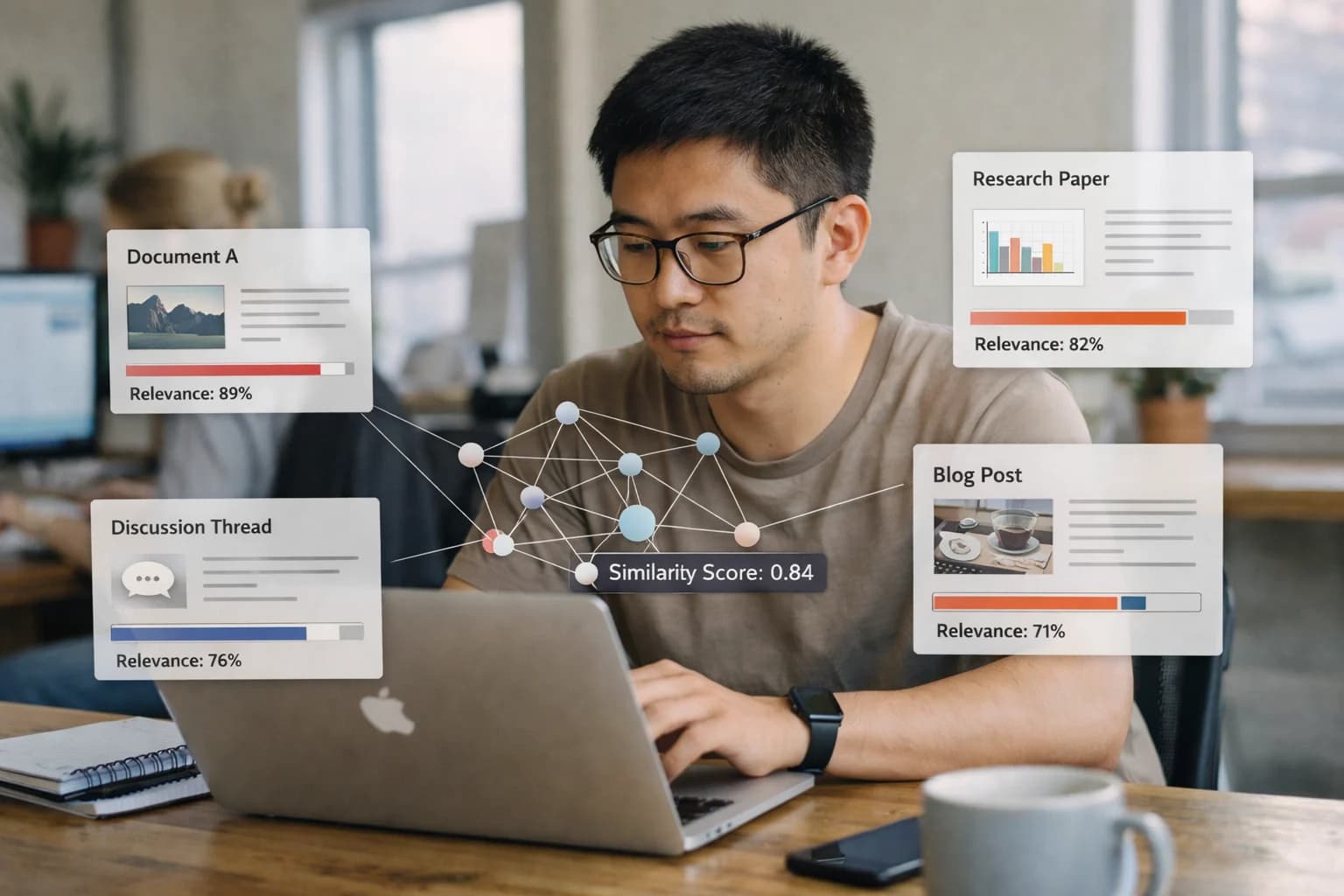
HIPAA-aware architecture for using Weaviate to enable semantic search across de-identified patient cohorts, clinical notes, and research literature within EHR-adjacent analytics and research platforms.
ARCHITECTURE FOR HIPAA-AWARE PATIENT COHORT RETRIEVAL
Where Semantic Search Fits in Healthcare Data Workflows
A practical blueprint for integrating Weaviate to enable semantic search across de-identified patient data, clinical notes, and research literature within EHR-adjacent analytics and research platforms.
Semantic search with Weaviate connects downstream from primary EHR systems like Epic or athenahealth, acting as a secondary, purpose-built retrieval layer for research and analytics. The integration typically ingests de-identified data from Clinical Data Warehouses (CDWs), research registries, or FHIR APIs, focusing on specific objects: Patient cohorts (de-identified), ClinicalNote text, LabResult narratives, and ResearchArticle abstracts. This creates a unified, queryable index without touching live production EHR databases, preserving system-of-record integrity and minimizing clinical workflow disruption.
Implementation involves a secure ETL pipeline that chunks and embeds documents, using Weaviate's modules for vectorization and its GraphQL API for queries. A common high-value workflow is patient cohort discovery for clinical trials: a researcher can ask, "Find patients over 50 with heart failure and a history of medication X," and Weaviate retrieves similar patient profiles and relevant note snippets based on meaning, not just keyword matches. This can reduce manual chart review from hours to minutes for each query. Governance is critical; the architecture must enforce role-based access control (RBAC) at the application layer, maintain a full audit log of queries, and ensure all data is properly de-identified before indexing, often using a dedicated HIPAA-compliant tenant within Weaviate Cloud.
Rollout is phased, starting with a single data source—like historical, de-identified clinical notes from a specific department. Success is measured by query precision/recall and researcher adoption, not just technical uptime. A key caveat: this is a retrieval and augmentation system, not a diagnostic tool. Results should always route to a human-in-the-loop review within the analytics platform before informing any clinical decision. For teams building this, our related guide on [/integrations/vector-database-and-rag-platforms/ai-integration-for-epic-with-vector-databases](AI Integration for Epic with Vector Databases) details the upstream EHR connection patterns.
HIPAA-COMPLIANT ARCHITECTURE
Primary Data Sources and Integration Surfaces
Clinical Notes and Patient Cohorts
Weaviate integrates with the de-identified data lake adjacent to your EHR (e.g., Epic Clarity, athenahealth data warehouse). This surface includes structured patient cohorts, longitudinal clinical notes, discharge summaries, and problem lists that have been stripped of 18 HIPAA identifiers. The integration typically uses a secure ETL pipeline to chunk and embed this data, creating vector representations for semantic search.
Key Objects:
Patient cohort attributes (age range, diagnosis codes, lab value ranges)
Clinical note text (history of present illness, assessment & plan)
Medication and allergy lists
Procedure and encounter summaries
This enables researchers and clinicians to find similar patient populations for study design or to retrieve past clinical reasoning patterns without exposing PHI.
HIPAA-AWARE ARCHITECTURE
High-Value Use Cases for Semantic Patient Retrieval
Weaviate enables secure, semantic search across de-identified patient data, clinical notes, and research literature. These patterns connect to EHR-adjacent analytics and research platforms, grounding AI in accurate, compliant context.
01
Clinical Trial Cohort Matching
Match de-identified patient profiles to trial inclusion/exclusion criteria by semantically searching EHR data for similar medical histories, lab results, and medication lists. Workflow: Ingest flattened, de-identified patient vectors from a research data warehouse. Use Weaviate's hybrid search with filters for age, diagnosis codes, and dates to find potential candidates, reducing manual chart review from days to hours.
Days -> Hours
Screening time
02
Longitudinal Patient Record Search
Enable clinicians and researchers to find patients with similar longitudinal journeys—like post-operative recovery patterns or chronic disease progression—across years of encounter notes and vitals. Workflow: Index time-windowed embeddings of clinical notes and structured data. Use Weaviate's multi-vector and cross-reference capabilities to query by narrative similarity (e.g., 'patients whose notes mention fatigue and weight loss after chemotherapy').
03
Differential Diagnosis Support
Retrieve similar past cases and relevant literature by semantically matching a patient's presenting symptoms and history against a vector index of de-identified case summaries and medical textbooks. Workflow: Ingest embeddings from an internal case repository and PubMed abstracts. A clinician-facing copilot queries Weaviate with a symptom list, returning the most semantically similar cases and studies to inform diagnostic reasoning.
Batch -> Real-time
Literature review
04
Operational Analytics Query Layer
Power natural language queries for hospital operations teams over de-identified patient flow data. Ask 'show me patients with long ED wait times and respiratory complaints last winter' without pre-defined reports. Workflow: Connect Weaviate to a de-identified operational data mart. Embed encounter summaries, chief complaints, and timing data. Provide a secure query interface for analysts, bypassing complex SQL for exploratory analysis.
05
Patient Education Material Retrieval
Dynamically match the most relevant, understandable educational content to a patient's specific condition, treatment plan, and recorded health literacy cues from past interactions. Workflow: Index embeddings of patient education documents, videos, and discharge instructions tagged by reading level and language. Use the patient's latest clinical note embedding to retrieve and recommend the top 3 most semantically appropriate resources via a patient portal integration.
Same day
Personalized outreach
06
Research Literature Synthesis
Accelerate systematic reviews and grant writing by finding semantically related research across internal institutional repositories and licensed journal databases. Workflow: Create a unified Weaviate index of local research outputs (PDFs) and metadata from PubMed/MEDLINE. Researchers query with a draft abstract or specific hypothesis to find gaps, conflicting studies, and supporting evidence, cutting literature review time significantly.
1 sprint
Review acceleration
HIPAA-COMPLIANT ARCHITECTURE
Example Workflows: From Query to Actionable Insight
These workflows demonstrate how Weaviate, deployed within a secure enclave, can power semantic search across de-identified patient data. Each flow connects to EHR-adjacent analytics and research platforms, enabling faster insights while maintaining strict data governance.
Trigger: A clinical researcher submits a natural language query (e.g., "Find female patients over 50 with a history of Type 2 Diabetes and LDL > 130, not on statins, seen in the last 18 months") via a research portal integrated with the EHR data warehouse.
Context/Data Pulled:
The query is converted into a vector embedding using a clinical BERT model.
Weaviate performs a hybrid search (vector + keyword filters) against its index of de-identified patient cohort profiles. These profiles are pre-computed aggregates from the EHR, containing vectors for:
Diagnosis codes (ICD-10) and their temporal sequences.
Lab result trends (e.g., HbA1c, LDL).
Medication lists (RxNorm codes).
Key demographic bands.
Model/Agent Action:
Weaviate returns the top-k most semantically similar patient cohorts, along with aggregate counts and confidence scores.
A secondary agent validates the results against the original eligibility criteria using deterministic logic on the filtered, anonymized source data.
System Update/Next Step:
The research portal displays a cohort size estimate and high-level characteristics.
The researcher can request a formal, IRB-approved data pull for the full de-identified dataset via an integrated workflow to the data governance platform.
Human Review Point: The final cohort list and the request for full data extraction require manual approval by the data governance officer within the portal before any identifiable data handling begins.
SECURE VECTOR SEARCH FOR DE-IDENTIFIED DATA
HIPAA-Aware Implementation Architecture
A production-ready blueprint for deploying Weaviate as a semantic search layer for patient data, designed to meet healthcare compliance and security requirements.
A HIPAA-compliant Weaviate deployment for patient data retrieval requires a clear separation between Protected Health Information (PHI) and the de-identified clinical concepts used for search. The architecture typically involves a two-path data pipeline: 1) a secure ETL process that extracts and tokenizes data from source systems like Epic or athenahealth, strips PHI using a dedicated de-identification service, and creates vector embeddings from the remaining clinical text (e.g., progress notes, lab result interpretations, discharge summaries); and 2) a separate, encrypted PHI lookup table, stored in a compliant database like AWS RDS or Azure SQL with strict access controls. Weaviate itself is configured with object-level security and only stores the de-identified embeddings and a secure token (e.g., a UUID) that can be used to re-join with the PHI lookup table only after user authentication and authorization are verified at the application layer.
In practice, this means search queries from a research portal or clinician copilot are first converted to an embedding. Weaviate performs a nearest-neighbor search to find the top-k semantically similar de-identified patient records or note chunks. The application backend then uses the returned secure tokens to fetch the corresponding, authorized PHI from the lookup table, applying role-based access control (RBAC) rules—ensuring a researcher only sees cohorts, while a treating physician can see full identified records. All data ingress/egress, embedding API calls (to models like text-embedding-ada-002), and query logs must be audited. Using Weaviate's modules, you can enable hybrid search combining vector similarity with metadata filters (e.g., patient_age_group: '50-59', diagnosis_code_category: 'I10') to refine cohort retrieval without exposing identities.
Rollout requires phased validation: start with a non-production dataset, conduct a formal HIPAA risk assessment with your security team, and implement strict network isolation (VPC, private endpoints) for the Weaviate cluster. All data must be encrypted at rest and in transit. For a detailed pattern on integrating vector search with a specific EHR, see our guide on AI Integration for Epic with Vector Databases. Governance is continuous; establish procedures for prompt auditing to ensure AI-generated summaries or insights do not inadvertently re-identify patients, and implement automated monitoring for data drift in the embedding models that could affect retrieval quality over time.
HIPAA-AWARE ARCHITECTURE PATTERNS
Code and Payload Examples
Ingesting and Preparing Clinical Notes
Before indexing, patient data must be de-identified and chunked for semantic retrieval. This Python example uses a synthetic data generator and the Weaviate Python client to create a schema and batch import records. The ClinicalNote class defines properties for de-identified content, note type, and a unique encounter ID, ensuring no PHI is stored in the vector database.
How a HIPAA-secure Weaviate integration accelerates data retrieval and decision support for clinical research, quality improvement, and patient care workflows.
Workflow / Task
Before AI (Keyword/Manual)
After AI (Semantic Search)
Implementation Notes
Finding similar patient cohorts for a study
Manual chart review: 4-8 hours per query
Semantic cohort retrieval: 2-5 minutes
Requires de-identified embeddings of notes, labs, and codes; human validation of final cohort.
Clinical literature review for a treatment plan
Database keyword searches, manual synthesis: 1-2 days
Retrieval of top 5-10 relevant papers/guidelines: <10 minutes
Grounds AI in latest research; final clinical decision remains with provider.
Identifying past cases with similar post-op complications
Scrolling through EHR notes or basic filters: 1-3 hours
Semantic search across de-identified notes & reports: <5 minutes
Enables faster root cause analysis; integrates with M&M conference workflows.
Answering clinical questions from internal guidelines
Searching PDFs/intranet; may not find relevant section: 15-30 mins
RAG-powered Q&A from indexed policy documents: <2 minutes
Reduces time for nurses, residents; citations provided for verification.
Preparing for a tumor board (gathering similar cases)
Coordinator manually pulls charts from last 6-12 months: 3-5 hours
Automated retrieval of similar histology/staging cases: 20-30 minutes
Provides longitudinal context; presentation prep time cut by ~70%.
Coding support & clinical documentation improvement
Coder manually references code books and past notes: 10-15 mins per chart
Assisted code suggestion based on similar documented cases: 2-3 mins per chart
Suggests potential codes; certified coder makes final determination for compliance.
Research participant pre-screening
Manual review of eligibility criteria against charts: 20-30 mins per patient
Automated initial match against de-identified criteria: 2-3 mins per patient
Produces a shortlist for coordinator deep review; dramatically increases screening throughput.
HIPAA-AWARE ARCHITECTURE FOR CLINICAL DATA
Governance, Compliance, and Phased Rollout
Deploying Weaviate for patient data retrieval requires a security-first architecture, granular access controls, and a phased rollout to manage risk and build trust.
A production Weaviate deployment for clinical data operates within a HIPAA-compliant enclave, where data ingestion, embedding, and retrieval are treated as separate, auditable workflows. De-identified patient cohorts and clinical notes are indexed via a secure ETL pipeline from source systems (e.g., Epic Clarity, athenahealth data warehouses, or research platforms like REDCap). The vectorization service, whether using a local model like all-MiniLM-L6-v2 or a secured API endpoint, must run within the same trust boundary, ensuring Protected Health Information (PHI) is never exposed to external AI services during embedding creation. Weaviate's multi-tenancy features can be configured to isolate data by research study, institution, or user role, with access governed by the application layer's existing identity provider (e.g., Okta, Azure AD).
Rollout typically follows a three-phase approach: 1) Internal Research Pilot, indexing a limited, fully de-identified dataset (e.g., public research literature or synthetic notes) to validate recall and relevance for specific queries like 'patients over 65 with similar lab trends'. 2) Controlled Cohort Expansion, adding real, de-identified data for a single IRB-approved study, with all queries and results logged to an audit trail for human review. 3) Broad Production Access, where the system is integrated into analytics dashboards or clinician-facing tools, with mandatory query logging, result justification (showing retrieved source snippets), and a human-in-the-loop review step for any action-driving insights. This phased approach allows tuning of chunking strategies, hybrid search weights, and prompt templates while demonstrating compliance controls.
Ongoing governance requires monitoring for concept drift—ensuring the embedded knowledge remains clinically relevant as guidelines evolve—and maintaining a clear data lineage from source record to vector index. All retrieval operations should be scoped by user role and purpose, using Weaviate's where filters to enforce data access policies. For a deeper dive on implementing these access patterns, see our guide on Identity and Access Management for AI Integrations. Furthermore, integrating this retrieval layer into a full RAG agent for clinical support requires careful orchestration; our blueprint for Agent Context Orchestration with Weaviate details the surrounding workflow architecture.
Enabling Efficiency, Speed & Accuracy
Intelligent Analysis, Decision & Execution
We build AI systems for teams that need search across company data, workflow automation across tools, or AI features inside products and internal software.
HIPAA-AWARE IMPLEMENTATION
Frequently Asked Questions
Common technical and operational questions about implementing Weaviate for secure, semantic patient data retrieval in healthcare analytics and research environments.
De-identification is a critical pre-processing step before any PHI enters the vectorization pipeline. A typical production workflow involves:
Source System Trigger: A new clinical note, lab result, or imaging report is finalized in the EHR or adjacent research database.
Secure Extraction & Pre-Processing: Data is pulled via secure API or from a dedicated, limited dataset. A dedicated de-identification service (e.g., AWS Comprehend Medical, Microsoft Presidio, or a custom NLP model) processes the text to:
Remove or hash direct identifiers (names, addresses, MRNs, account numbers).
Replace dates with offsets (e.g., "2023-10-26" becomes "Admission Date + 7 days").
Generalize locations (e.g., "Massachusetts General Hospital" becomes "Large Academic Hospital").
Metadata Tagging: The de-identified text is chunked, and each chunk is tagged with safe metadata for filtering:
Embedding & Indexing: Only the de-identified text chunks are sent to the embedding model (hosted in your VPC). The resulting vectors, along with the safe metadata, are written to Weaviate.
Key Governance Point: The mapping between de-identified vectors and original patient records is maintained outside of Weaviate, in a separate, highly secure mapping service with strict access controls.
About the author
Prasad Kumkar
CEO & MD, Inference Systems
Prasad Kumkar is the CEO & MD of Inference Systems and writes about AI systems architecture, LLM infrastructure, model serving, evaluation, and production deployment. Over 5+ years, he has worked across computer vision models, L5 autonomous vehicle systems, and LLM research, with a focus on taking complex AI ideas into real-world engineering systems.
His work and writing cover AI systems, large language models, AI agents, multimodal systems, autonomous systems, inference optimization, RAG, evaluation, and production AI engineering.
Partnered with leading AI, data, and software stack.
How We Work
Custom AI workflows for your Business
One-fit-all AI don't work for modern businesses. At Inferensys, we aim to understand your business & custom requirements; which we use to define most efficient agentic workflows, the data, and the tools for your business.
The first call is a practical review of your use case and the right next step.