In a modern educational technology stack, a RAG platform acts as a contextual bridge between AI models and institutional knowledge. It connects to core systems like the Student Information System (SIS) (e.g., PowerSchool, Ellucian Banner), the Learning Management System (LMS) (e.g., Canvas, Brightspace), and internal document repositories (e.g., SharePoint, Google Drive). The RAG pipeline ingests, chunks, and embeds key resources: curriculum standards (Common Core, NGSS), district-approved lesson plans, pedagogical research, past assessment data, and school policy documents. This creates a vector-indexed knowledge base that grounds AI responses in verified, relevant content, preventing hallucinations and ensuring alignment with educational goals.

Integration
RAG Platform for Educational Resources
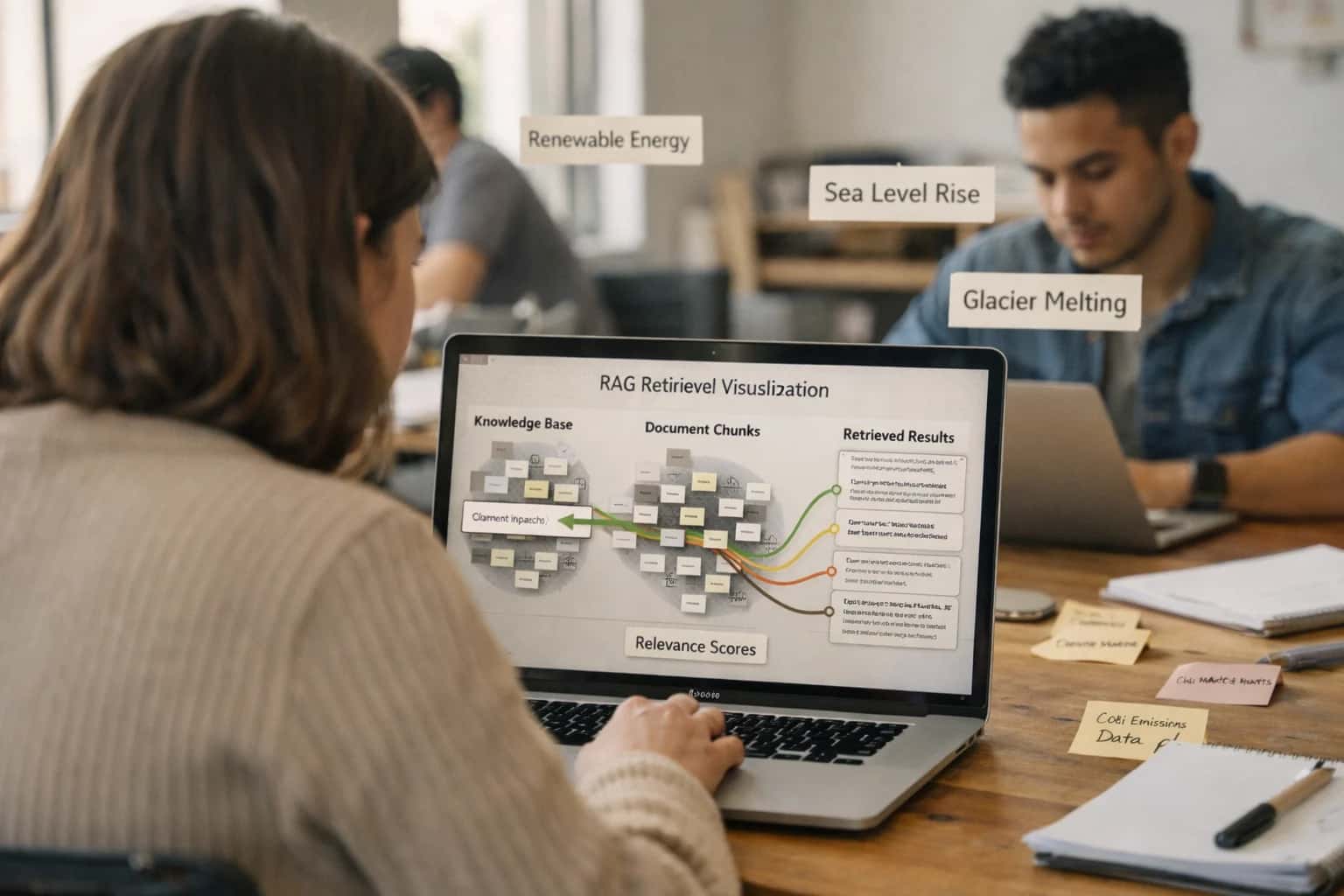
Where RAG Fits in the Educational Technology Stack
A practical guide to implementing Retrieval-Augmented Generation (RAG) as a central intelligence layer for K-12 and higher education systems.
Implementation focuses on specific workflows and surfaces. For teachers, a RAG-powered copilot can be embedded within the LMS gradebook or assignment builder, retrieving similar successful lesson plans or differentiation strategies based on the current unit and student performance data. For administrators, an agent integrated with the SIS can answer complex queries about enrollment trends or compliance by pulling from historical reports and state guidelines. Key technical touchpoints include:
- LMS LTI integrations or REST API hooks to inject AI assistants into course modules.
- Scheduled ingestion jobs from SIS data warehouses and document management systems.
- Role-based access controls (RBAC) to ensure teachers only retrieve materials for their grade/subject, and administrators access appropriate district-level data.
- Audit logs tracking all queries and retrieved documents for compliance and continuous improvement of the retrieval system.
Rollout should be phased, starting with a low-risk, high-impact use case like a district knowledge base Q&A bot for professional development resources. This validates the retrieval quality and governance model before expanding to student-facing applications. A production architecture typically involves a dedicated vector database (like Pinecone or Weaviate) deployed in the institution's cloud environment, with strict data governance to ensure FERPA compliance. The system should be designed for continuous feedback, allowing educators to flag unhelpful or inaccurate retrievals to fine-tune embedding models and chunking strategies, ensuring the RAG platform becomes a trusted, evolving partner in the educational mission.
Key Integration Surfaces in Educational Systems
Core Content and Activity Layers
Integrating a RAG platform with an LMS like Canvas, Moodle, or Blackboard focuses on grounding AI in structured course materials and unstructured student interactions. Key surfaces include:
- Course Content Repositories: Indexing syllabi, lecture slides, PDF readings, and assignment prompts to power AI teaching assistants that can answer student questions with direct citations.
- Discussion Forums & Announcements: Chunking and embedding years of Q&A threads to help instructors quickly find similar past student questions and recommended responses.
- Assignment Submissions & Rubrics: Creating embeddings of high-scoring past submissions and rubric criteria to enable semantic search for grading consistency and to provide students with relevant examples.
Implementation typically involves using the LMS's REST API or LTI 1.3 to sync content into a vector store like Pinecone or Weaviate. An AI layer then retrieves this context to augment responses in chatbots, grading copilots, or course design tools. See our guide for AI Integration for Canvas with Vector Databases.
High-Value Use Cases for Educational RAG
Practical integration patterns for grounding AI in institutional knowledge, curriculum standards, and pedagogical content to support teachers, administrators, and students.
Personalized Learning Path Generation
AI agents query a vector store of curriculum standards, lesson plans, and student performance data to generate individualized learning sequences. The system retrieves prerequisite concepts, suggests remedial content, and aligns activities with district pacing guides, all within the LMS workflow.
Instructional Material & Resource Finder
Replace keyword search in district resource libraries (e.g., SharePoint, Google Drive) with semantic search. Teachers describe a lesson goal (teach fractions with real-world examples), and the RAG system retrieves relevant worksheets, videos, and interactive simulations from indexed repositories, tagged by standard and grade level.
Administrative Policy & Compliance Q&A
Ground an AI assistant in vectorized policy manuals, state education codes, and union contracts. Administrators and staff can ask natural language questions (What's the process for a field trip?) and get accurate, cited answers pulled directly from the governing documents, reducing miscommunication and manual lookup.
Pedagogical Research Synthesis for PLCs
Professional Learning Communities (PLCs) use a RAG-powered copilot to query a corpus of academic journals, district action research, and best practice guides. The system summarizes findings on specific strategies (e.g., scaffolding for ELL students), providing evidence-based recommendations directly within collaboration tools like Microsoft Teams.
Differentiated Assignment & Assessment Builder
Integrate with the SIS and LMS gradebook to retrieve student skill gaps. The system then queries a vector database of assessment items and activity banks, returning a set of differentiated questions or projects tailored to varied readiness levels, all aligned to the same learning objective.
Student Support & Tutoring Agent
Deploy a secure, context-aware chatbot for students within the LMS. Grounded in the course's specific textbooks, lecture notes, and approved external resources, it provides step-by-step guidance on homework problems, avoiding hallucinations by retrieving and citing relevant passages from the indexed materials.
Example RAG-Powered Workflows in Education
Concrete examples of how Retrieval-Augmented Generation (RAG) can be integrated into educational platforms to ground AI responses in institutional knowledge, curriculum standards, and pedagogical research.
Trigger: A teacher in a Canvas or Brightspace course shell clicks "Generate Lesson Plan Draft" for an upcoming unit on cellular biology.
Context/Data Pulled: The RAG system queries the vector database (e.g., Pinecone) with the teacher's prompt, embedding key concepts like "cellular biology," "high school," and "NGSS HS-LS1." It retrieves:
- The most relevant state or national curriculum standards (NGSS, Common Core).
- Similar high-quality lesson plans from the district's internal repository.
- Excerpts from adopted textbook chapters and supplemental digital resources.
- Recent pedagogical research on effective strategies for teaching complex systems.
Model/Agent Action: An LLM (like GPT-4) receives the retrieved context and the teacher's original request. It synthesizes a draft lesson plan that includes:
- Learning objectives explicitly mapped to the retrieved standards.
- A suggested sequence of activities, referencing the retrieved exemplars.
- Discussion prompts and differentiation ideas drawn from the pedagogical research.
System Update/Next Step: The generated draft is presented to the teacher within the LMS interface as an editable document. The teacher can modify, accept, or reject sections. The system logs the generation event for professional development tracking.
Human Review Point: The teacher is the final reviewer and editor. The AI-generated content is always a draft assistant, ensuring pedagogical expertise and contextual sensitivity remain with the educator.
Implementation Architecture: Connecting RAG to Your EdTech Stack
A technical blueprint for grounding AI in your institution's knowledge using a Retrieval-Augmented Generation (RAG) platform, turning disparate educational resources into a unified, queryable intelligence layer.
A production RAG integration for education connects to three primary data sources in your stack: your Learning Management System (LMS) like Canvas or Moodle for course content and syllabi; your Student Information System (SIS) such as PowerSchool or Banner for institutional policies and anonymized enrollment patterns; and your content management platforms (SharePoint, Google Drive) housing lesson plans, curriculum standards (e.g., Common Core, NGSS), and pedagogical research. The architecture involves an automated ingestion pipeline that chunks, embeds, and indexes this content into a vector database (like Pinecone or Weaviate), creating a semantic search layer over your entire knowledge base.
For instructors, this powers AI teaching assistants that can answer questions like "Show me 10th-grade biology lesson plans on cellular respiration" or "What are evidence-based strategies for teaching fractions to students with dyscalculia?" by retrieving and synthesizing relevant documents. For administrators, it enables policy-aware copilots that ground answers in the latest faculty handbook or accreditation requirements. The key is implementing role-based access controls (RBAC) at the retrieval layer to ensure data privacy—for instance, preventing a teacher from retrieving another teacher's unpublished lesson drafts or a student's personal information from the SIS.
Rollout should be phased, starting with a pilot group and a single, high-value data source—often the district's public-facing curriculum guide or a well-structured internal knowledge base. Governance is critical: establish a review workflow where AI-generated lesson suggestions or policy summaries are flagged for human verification by a department chair or instructional coach before being shared, creating a feedback loop to improve retrieval accuracy. This architecture doesn't replace your core EdTech systems; it sits alongside them, making their collective knowledge instantly accessible and actionable for every educator and administrator.
Code and Payload Examples
Ingesting and Indexing Lesson Plan Documents
This example shows how to chunk and embed lesson plan PDFs or DOCX files from a shared drive, preparing them for semantic search. The script uses PyPDF2 for parsing, langchain for text splitting, and the OpenAI embeddings API to create vectors for storage in a vector database like Pinecone.
pythonimport os from PyPDF2 import PdfReader from langchain.text_splitter import RecursiveCharacterTextSplitter from langchain.embeddings import OpenAIEmbeddings import pinecone # Initialize components embeddings = OpenAIEmbeddings(openai_api_key=os.getenv('OPENAI_API_KEY')) pinecone.init(api_key=os.getenv('PINECONE_API_KEY'), environment='us-west1-gcp') index = pinecone.Index('lesson-plans') text_splitter = RecursiveCharacterTextSplitter(chunk_size=1000, chunk_overlap=200) # Process a lesson plan PDF def process_lesson_plan(file_path, metadata): reader = PdfReader(file_path) text = '' for page in reader.pages: text += page.extract_text() chunks = text_splitter.split_text(text) # Create embeddings and upsert vectors = [] for i, chunk in enumerate(chunks): embedding = embeddings.embed_query(chunk) vector_id = f"{metadata['plan_id']}_{i}" vectors.append((vector_id, embedding, metadata)) index.upsert(vectors=vectors) print(f"Indexed {len(vectors)} chunks from {file_path}")
Realistic Time Savings and Operational Impact
How a RAG-powered knowledge layer changes daily workflows for educators and administrators by reducing search time and improving content relevance.
| Workflow / Task | Before RAG | After RAG | Implementation Notes |
|---|---|---|---|
Finding curriculum-aligned resources | Manual keyword search across shared drives, 15-30 minutes | Semantic search returns ranked, relevant materials in <2 minutes | Requires initial ingestion and chunking of PDFs, lesson plans, and standards docs |
Answering student questions with institutional knowledge | Scouring old emails, forums, or asking colleagues, 10-20 minutes | AI assistant provides grounded answer with source citations in <1 minute | Needs integration with LMS Q&A forums or a dedicated copilot interface |
Creating differentiated lesson plans | Manual review of past plans and student performance data, 2-3 hours | RAG retrieves similar successful plans and student group strategies, cutting prep to 1 hour | Depends on quality of historical plan documentation and tagging |
Staff onboarding & policy lookup | New hires search intranet or handbook, often missing nuances, 30+ minutes | Conversational agent answers specific policy questions instantly with relevant excerpts | Governance required to ensure answers align with latest approved policies |
Academic research for grant proposals | Broad literature review across disparate databases, 4-8 hours | Semantic search surfaces internal past proposals and relevant external research faster, saving 2-3 hours | Must include secure, licensed research repository access |
Parent communication drafting | Manual composition for common scenarios (e.g., attendance, progress) | AI suggests templated responses grounded in district communication guidelines, cutting draft time by 50% | Requires human review loop before sending to maintain tone and compliance |
Professional development content discovery | Browsing generic external catalogs, poorly matched to district needs | System recommends internal micro-learning videos and docs based on teacher's goals and past feedback | Leverages existing PD library; effectiveness grows with usage data |
Governance, Security, and Phased Rollout
A secure, governed rollout ensures your RAG platform for educational resources delivers trusted, actionable insights without disrupting core operations.
A production RAG system for education must be built on a secure data ingestion and access control foundation. This starts with connecting to source systems like your Student Information System (SIS) (e.g., PowerSchool, Skyward), Learning Management System (LMS) (e.g., Canvas, Brightspace), and internal document repositories (SharePoint, Google Drive). Ingestion pipelines should use service accounts with role-based access control (RBAC) to pull only authorized curriculum documents, lesson plans, and pedagogical research. All text chunks are converted to embeddings via a secure API call to models like OpenAI or open-source alternatives, with metadata tagging for source, grade level, subject, and access permissions before indexing in your vector database (Pinecone, Weaviate).
Governance is critical for maintaining accuracy and trust. Implement a human-in-the-loop review workflow where AI-generated answers—such as lesson plan suggestions or standards alignment—are logged and can be flagged by teachers or curriculum specialists for review. An audit trail should track the retrieved source chunks for every query, enabling transparency. For sensitive student data, ensure all embeddings are derived from de-identified or anonymized records, and consider a private, air-gapped deployment for highly confidential research or assessment materials. Regularly evaluate retrieval quality with a set of known query-answer pairs to monitor for model drift or degradation in source data freshness.
Adopt a phased rollout to manage change and prove value. Start with a pilot cohort of administrators or instructional coaches querying a limited corpus—such as district curriculum frameworks or state standards—to refine prompts and retrieval parameters. Phase two expands to a department or grade-level team, integrating the RAG copilot into their existing planning workflows within the LMS or a dedicated portal. Finally, roll out to all educators with clear use cases: reducing time spent searching for relevant teaching resources, aligning activities to standards, or personalizing learning materials. Continuous feedback loops and clear opt-in/opt-out controls ensure the tool adapts to real pedagogical needs while maintaining institutional oversight.
Enabling Efficiency, Speed & Accuracy
Intelligent Analysis, Decision & Execution
We build AI systems for teams that need search across company data, workflow automation across tools, or AI features inside products and internal software.
Talk to Us
Search across company data
Give teams answers from docs, tickets, runbooks, and product data with sources and permissions.
Useful when people spend too long searching or get different answers from different systems.

Automate internal workflows
Use AI to route work, draft outputs, trigger actions, and keep approvals and logs in place.
Useful when repetitive work moves across multiple tools and teams.

Add AI to products and internal tools
Build assistants, guided actions, or decision support into the software your team or customers already use.
Useful when AI needs to be part of the product, not a separate tool.
Frequently Asked Questions (FAQ)
Practical questions for education technology leaders, IT administrators, and curriculum directors planning to ground AI tools in institutional knowledge using a Retrieval-Augmented Generation (RAG) platform.
The ingestion pipeline is a critical first step. A typical secure workflow involves:
-
Source Connection: Using secure APIs, SFTP, or direct database connectors to pull content from your existing systems:
- Learning Management Systems (LMS): Canvas, Moodle, Blackboard for course modules, syllabi, and assignment descriptions.
- Curriculum Repositories: Shared drives (Box, SharePoint), Google Workspace, or dedicated platforms housing state/district standards, scope & sequence documents, and lesson plans.
- Pedagogical Research: Internal wikis (Confluence), subscribed journal databases, or professional development libraries.
-
Chunking & Embedding: Documents are split into logical segments (e.g., by standard, lesson objective, or research finding). Each chunk is converted into a vector embedding using a model like
text-embedding-3-small. Metadata (e.g.,grade_level,subject,source_system,last_review_date) is attached to each vector. -
Secure Indexing: Vectors and metadata are uploaded to your chosen vector database (e.g., Pinecone, Weaviate) running in your compliant cloud environment (AWS, GCP, Azure). All data remains within your defined network perimeter; no educational content is sent to external AI model providers during indexing.
Key Governance Point: Implement a CI/CD-like pipeline for updates, so when a curriculum director updates a lesson plan in the source system, the RAG index is refreshed on a scheduled or triggered basis.

About the author
Prasad Kumkar
CEO & MD, Inference Systems
Prasad Kumkar is the CEO & MD of Inference Systems and writes about AI systems architecture, LLM infrastructure, model serving, evaluation, and production deployment. Over 5+ years, he has worked across computer vision models, L5 autonomous vehicle systems, and LLM research, with a focus on taking complex AI ideas into real-world engineering systems.
His work and writing cover AI systems, large language models, AI agents, multimodal systems, autonomous systems, inference optimization, RAG, evaluation, and production AI engineering.
Partnered with leading AI, data, and software stack.





How We Work
Custom AI workflows for your Business
One-fit-all AI don't work for modern businesses. At Inferensys, we aim to understand your business & custom requirements; which we use to define most efficient agentic workflows, the data, and the tools for your business.
01
Review the use case
We understand the task, the users, and where AI can actually help.
Read more02
Pick the right approach
We define what needs search, automation, or product integration.
Read more03
Build the first useful version
We implement the part that proves the value first.
Read more04
Improve from there
We add the checks and visibility needed to keep it useful.
Read moreThe first call is a practical review of your use case and the right next step.
Talk to Us