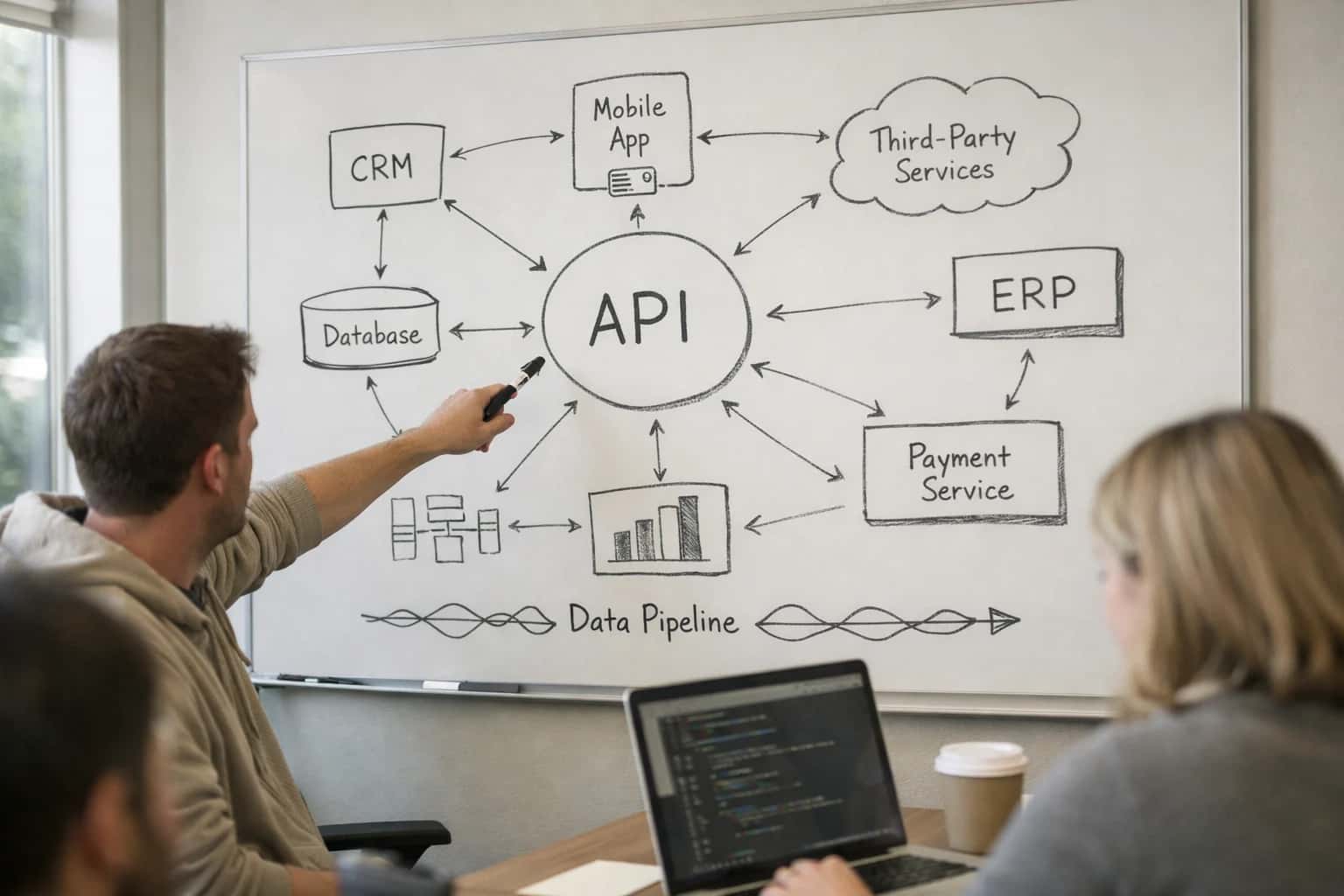
An AI virtual receptionist for Zoom Phone is not a separate app; it's a service layer that connects to the Zoom Phone Cloud PBX via its Call Queue and Auto Receptionist APIs. The AI agent acts as a virtual extension, intercepting calls routed to a designated Call Queue or Auto Receptionist menu. When a call arrives, the Zoom Phone API sends a webhook event to your AI service, which streams the audio in real-time, processes the conversation, and returns routing instructions (e.g., transfer to extension 123, send to voicemail, play message) back to the Zoom platform. This keeps the core telephony control within Zoom's secure, compliant infrastructure while offloading the conversational intelligence to your AI models.

Integration
AI-Powered Virtual Receptionist for Zoom Phone
Build an AI virtual receptionist for Zoom Phone that answers calls, routes to extensions, takes messages, and schedules appointments by integrating with calendar systems.
ARCHITECTURE AND ROLLOUT
Where AI Fits into Your Zoom Phone System
A practical blueprint for integrating an AI virtual receptionist into your Zoom Phone deployment.
Implementation centers on three key workflows: call answering & intent recognition, dynamic call routing, and post-call action orchestration. For a basic receptionist, the AI uses speech-to-text and an LLM to understand a caller's request ("I need billing," "Schedule a consultation") and matches it to a configured routing rule. For advanced use, it can authenticate callers via DTMF or voice, pull calendar availability from Microsoft 365 or Google Workspace APIs to schedule appointments, or log a message directly into a ServiceNow or Zendesk ticket. The state of each interaction—caller ID, intent, disposition—should be logged to a secure database, creating an audit trail for compliance and continuous improvement of the AI's routing accuracy.
Rollout is best done in phases, starting with a pilot on a non-critical inbound line, like general information or after-hours support. Use Zoom Phone's Call Routing Policies to direct a subset of calls to the AI queue. Implement a human-in-the-loop fallback, where the AI can seamlessly transfer to a live operator if confidence is low or the request is complex. Governance is critical: regularly review conversation logs and routing outcomes to tune prompts and routing logic, and ensure your AI service is deployed in a HIPAA or SOC 2 compliant environment if required, as it will be processing potentially sensitive audio and caller data.
ARCHITECTURE BLUEPRINT
Zoom Phone Surfaces for AI Integration
Core Call Control APIs
Integrate AI at the point of inbound call reception using Zoom's Call Queue and Auto Receptionist APIs. These surfaces allow an AI agent to answer, greet, and perform initial intent recognition before executing a routing decision.
Key Integration Points:
/phone/auto_receptionistsAPI: Configure an AI-powered virtual receptionist to replace or augment the standard IVR. The AI can handle natural language queries like "I need to speak with someone in billing" or "Schedule an appointment with Dr. Smith."/phone/call_queuesAPI: Inject AI into queue management to provide estimated wait times, collect callback information, or attempt to resolve simple issues before transferring to a live agent.- Webhooks (
call_started,call_answered): Trigger your AI agent the moment a call hits the Zoom Phone system. The agent can process the caller's initial speech and decide on the next action—transfer, voicemail, or continued conversation.
Example Workflow: An inbound call triggers a call_started webhook to your AI service. The agent answers, listens for intent, queries a directory API to find the correct extension or department, and uses the transfer API endpoint to complete the handoff.
ZOOM PHONE INTEGRATION PATTERNS
High-Value Use Cases for an AI Receptionist
An AI virtual receptionist for Zoom Phone automates call handling, reduces front-desk workload, and connects voice interactions to business workflows. These are the most impactful patterns for production deployment.
01
Automated Call Routing & Directory Lookup
The AI answers inbound calls, asks for the caller's intent or the person/department they need, and performs a real-time lookup against the Zoom Phone directory or an integrated HR system (like Workday) to connect the call. Operational value: Eliminates manual transfers and misrouted calls, especially during peak hours or after-hours.
Seconds
Average connection time
02
Intelligent After-Hours Message Taking
When a call comes in outside business hours, the AI greets the caller, identifies the urgency via conversation, and takes a detailed message. It can then create a ticket in a service desk (e.g., ServiceNow) or send a formatted Slack/Teams message to the on-call roster. Operational value: Ensures no critical after-hours inquiry is missed or poorly documented.
24/7 Coverage
Without staffing overhead
03
Appointment Scheduling via Calendar Integration
For calls requesting meetings or appointments, the AI agent checks real-time availability in integrated calendars (Google Workspace, Microsoft 365) and offers available slots to the caller. Upon confirmation, it creates the calendar event and sends invites. Operational value: Closes the loop on scheduling during the initial call, reducing email back-and-forth and missed bookings.
1 Call
To book vs. 3+ emails
04
Frequently Asked Questions & Tier-0 Support
The AI is trained on internal FAQs (e.g., office hours, Wi-Fi password, package delivery status) and can answer common questions instantly. For IT or HR support, it can run simple diagnostics or fetch information from a knowledge base via RAG. Operational value: Deflects routine inquiries, freeing up human staff for complex issues.
40-60% Deflection
For common inquiries
05
Visitor & Delivery Pre-Check-in
For calls from visitors in the lobby or delivery personnel, the AI verifies their identity and purpose, then notifies the internal host via SMS or chat (e.g., Slack) with visitor details. It can also trigger automated door access systems via webhook. Operational value: Streamlines physical front-desk operations and enhances security logging.
Batch -> Real-time
Visitor notification
06
Call Context & CRM Logging
The AI transcribes the call, extracts key entities (caller name, company, reason), and automatically creates or updates a record in Salesforce, HubSpot, or a custom CRM. This includes logging the call outcome and attaching the summary. Operational value: Ensures 100% call activity capture for sales, support, and compliance, eliminating manual data entry.
Zero-Click Logging
CRM activity capture
IMPLEMENTATION PATTERNS
Example AI Receptionist Workflows
These workflows illustrate how an AI virtual receptionist integrates with Zoom Phone's APIs, calendar systems, and downstream business tools to handle common inbound call scenarios.
Trigger: An inbound call to the main company Zoom Phone number.
- Context Retrieval: The AI agent answers, greets the caller, and asks for the person or department they're trying to reach.
- Entity Recognition & Lookup: Using NLP, the agent extracts the target name or department. It queries:
- The company directory (via SCIM or a custom API) to find the user's Zoom extension.
- The Zoom
/usersAPI to check the target's real-time presence (Available, Busy, Do Not Disturb).
- Agent Action:
- If available: "I'll connect you now." The agent uses the Zoom
callsAPI to transfer the call to the target's extension. - If busy/unavailable: "[Name] is currently unavailable. Would you like to be transferred to their voicemail, or may I take a message?"
- If available: "I'll connect you now." The agent uses the Zoom
- System Update: Call disposition (transferred, sent to voicemail) is logged to a webhook endpoint for analytics in tools like Salesforce or a data warehouse.
Human Review Point: Low-confidence name matches (e.g., "I need to speak with Mike" in a company with 5 Mikes) can trigger the agent to ask for a last name or department for clarification.
CONNECTING AI TO ZOOM PHONE'S CALL CONTROL
Implementation Architecture & Data Flow
A production-ready virtual receptionist integrates with Zoom Phone's APIs, your calendar system, and a stateful AI agent to handle inbound calls.
The integration architecture connects three core systems: Zoom Phone's Call Control API, your AI agent runtime (hosted on Inference Systems infrastructure or your cloud), and a calendar provider like Google Calendar or Microsoft 365. When a call arrives at your main Zoom Phone number, a webhook from Zoom is sent to your AI agent endpoint. The agent answers the call using Zoom's POST /phone/calls/{callId}/answer endpoint, initiates real-time audio streaming via WebSocket, and begins the conversation using a speech-to-text service. The agent's logic—built with frameworks like CrewAI or AutoGen—accesses the calendar system's API to check availability and uses a vector database for company knowledge to answer basic questions.
A typical call flow involves: 1) Greeting & Intent Capture: The agent greets the caller and uses NLP to classify intent (e.g., 'schedule appointment', 'get directions', 'speak to a person'). 2) Contextual Routing: For scheduling, the agent queries the calendar API for open slots, proposes times, and—upon confirmation—creates a calendar event using the provider's API, then sends a confirmation SMS via Twilio or Zoom's SMS API. For call routing, it checks a digital directory (often a CRM or HRIS lookup) to find the correct extension and uses Zoom's POST /phone/calls/{callId}/transfer to connect the caller. 3) Message Taking & Follow-up: If the intended party is unavailable, the agent records a message, transcribes it, and posts it to a designated Microsoft Teams channel or creates a ticket in Zendesk via webhook, including the caller's phone number and urgency flag.
Rollout is phased, starting with after-hours call handling to build confidence. Governance is critical: all call transcripts and agent decisions are logged to an audit trail. A human-in-the-loop escalation path is configured via a dedicated Zoom Phone extension that rings a live operator if the agent encounters uncertainty or the caller requests it. Performance is monitored through Zoom's call detail records and custom dashboards tracking metrics like call containment rate, transfer accuracy, and scheduler conversion.
AI Virtual Receptionist for Zoom Phone
Code & Configuration Patterns
Handling Inbound Calls with Zoom's Call Control API
A virtual receptionist's core is a call flow handler that listens for inbound Zoom Phone calls via webhook. The system must capture the call event, answer, and play a greeting.
Key steps:
- Webhook Subscription: Configure your Zoom App to receive
phone.call_startandphone.call_answeredevents. - Answer & Greet: Use the Zoom Call Control API to answer the incoming call and stream a TTS greeting or play a pre-recorded audio file.
- Intent Recognition: Pipe the caller's speech to a real-time transcription service (e.g., Zoom's own or a third-party like Deepgram) and pass the text to an LLM for intent classification (e.g., "Schedule Appointment," "Route to Extension," "Leave Message").
Example Webhook Payload (Simplified):
json{ "event": "phone.call_start", "payload": { "call_id": "abc123", "phone_number": "+15551234567", "caller_number": "+15559876543" } }
AI VIRTUAL RECEPTIONIST FOR ZOOM PHONE
Realistic Time Savings & Business Impact
A practical look at how an AI virtual receptionist changes daily workflows for office managers, sales teams, and customer support, measured in time saved and operational improvements.
| Workflow | Before AI | After AI | Implementation Notes |
|---|---|---|---|
Inbound call handling | Manual answer, transfer, voicemail | AI answers, routes, or takes message | Handles 70-80% of routine calls; human for complex |
New lead qualification | Manual review of voicemail/email | AI captures details, scores, creates ticket | Data pushed to CRM; human reviews high-potential |
Appointment scheduling | Back-and-forth calls/emails | AI checks calendars, sends invites | Integrates with Google/Outlook; confirms via SMS |
After-hours coverage | Voicemail only, next-day callback | 24/7 AI answering & triage | Critical issues can be escalated via SMS alert |
Internal directory lookup | Manual search or transfer to operator | AI finds extension by name/department | Pulls from Active Directory or HRIS nightly |
Message delivery accuracy | Handwritten notes or paraphrased | AI transcribes & delivers exact message | Sent via Teams/Slack/Email with audio snippet |
New hire setup (extension/VM) | IT ticket, manual configuration | AI auto-configures from onboarding system | Triggered by Workday/BambooHR webhook |
PRODUCTION-READY ARCHITECTURE
Governance, Security & Phased Rollout
A secure, phased implementation ensures your AI receptionist enhances service without disrupting operations.
A production-ready virtual receptionist for Zoom Phone is built on a secure, event-driven architecture. Inbound calls trigger a webhook from the Zoom Phone API to your AI agent endpoint, which streams audio to a real-time speech-to-text service. The agent's intent recognition and routing logic—powered by a hosted LLM—processes the transcript to determine caller need, then executes actions via the Zoom Phone API (call transfer, voicemail) and integrated calendar APIs (Google Workspace, Microsoft 365). All call metadata, transcripts, and agent decisions are logged to a secure audit trail for compliance and performance review.
Security is layered: the agent endpoint sits behind your firewall or a private cloud, with all data encrypted in transit and at rest. The LLM call uses zero-data retention policies, and sensitive data like caller PII or calendar details is never used for model training. Role-based access controls (RBAC) in your admin console determine who can configure the agent's behavior, review logs, or access call recordings. For regulated industries, the architecture supports integration with compliance archiving solutions to meet FINRA, HIPAA, or GDPR requirements for recorded communications.
We recommend a phased rollout to manage risk and gather feedback. Phase 1 (Pilot): Deploy the agent to handle after-hours calls only, routing to a simple menu and logging all interactions. Phase 2 (Controlled Expansion): Enable the agent during business hours for a single department or location, adding calendar scheduling for that group. Phase 3 (Full Deployment): Roll out to all incoming lines, with advanced features like CRM lookups (e.g., pulling Salesforce contact info) and multi-language support. Each phase includes a review of success metrics—like call handling rate, transfer accuracy, and user satisfaction—before proceeding.
This governance-first approach ensures the AI receptionist becomes a reliable, scalable component of your communications stack, not a black-box experiment. For teams managing complex compliance needs, we can extend the architecture to include pre-call disclosure announcements, automated consent logging, and integration with e-discovery platforms like /integrations/legal-practice-management-platforms/ai-integration-for-unified-communications-in-legal-services.
Enabling Efficiency, Speed & Accuracy
Intelligent Analysis, Decision & Execution
We build AI systems for teams that need search across company data, workflow automation across tools, or AI features inside products and internal software.
Talk to Us
Search across company data
Give teams answers from docs, tickets, runbooks, and product data with sources and permissions.
Useful when people spend too long searching or get different answers from different systems.
Enterprise searchRAGPermissions
Read more
Automate internal workflows
Use AI to route work, draft outputs, trigger actions, and keep approvals and logs in place.
Useful when repetitive work moves across multiple tools and teams.
AI agentsWorkflow automationGovernance
Read more
Add AI to products and internal tools
Build assistants, guided actions, or decision support into the software your team or customers already use.
Useful when AI needs to be part of the product, not a separate tool.
AI integrationDecision supportModel routing
Read moreIMPLEMENTATION & OPERATIONS
Frequently Asked Questions
Common technical and operational questions about deploying an AI virtual receptionist on Zoom Phone.
The virtual receptionist can authenticate callers through several methods, depending on your security requirements:
- Voice PIN: The system prompts the caller to enter a numeric PIN via their keypad (DTMF tones). The PIN is validated against a secure, encrypted data store (e.g., a hashed table in your backend or a secure API call to your identity provider).
- Spoken Name Verification: For lower-security internal routing, the AI can ask "Who are you trying to reach?" and use speech recognition to match the spoken name against a directory. A confidence score determines if it proceeds or asks for clarification.
- Integration with Corporate Directories: For the most seamless experience, the system can be integrated with Microsoft Entra ID (Azure AD), Okta, or your HRIS. When a call comes from a recognized company DID (Direct Inward Dial) number, it can perform a reverse lookup and greet the caller by name ("Hello Jane, connecting you now.").
All authentication attempts and outcomes are logged with timestamps and caller IDs for audit trails.

About the author
Prasad Kumkar
CEO & MD, Inference Systems
Prasad Kumkar is the CEO & MD of Inference Systems and writes about AI systems architecture, LLM infrastructure, model serving, evaluation, and production deployment. Over 5+ years, he has worked across computer vision models, L5 autonomous vehicle systems, and LLM research, with a focus on taking complex AI ideas into real-world engineering systems.
His work and writing cover AI systems, large language models, AI agents, multimodal systems, autonomous systems, inference optimization, RAG, evaluation, and production AI engineering.
LinkedIn
Limited slotsGet a Free AI Consultation
Partnered with leading AI, data, and software stack.





How We Work
Custom AI workflows for your Business
One-fit-all AI don't work for modern businesses. At Inferensys, we aim to understand your business & custom requirements; which we use to define most efficient agentic workflows, the data, and the tools for your business.
01
Review the use case
We understand the task, the users, and where AI can actually help.
Read more02
Pick the right approach
We define what needs search, automation, or product integration.
Read more03
Build the first useful version
We implement the part that proves the value first.
Read more04
Improve from there
We add the checks and visibility needed to keep it useful.
Read moreThe first call is a practical review of your use case and the right next step.
Talk to Us