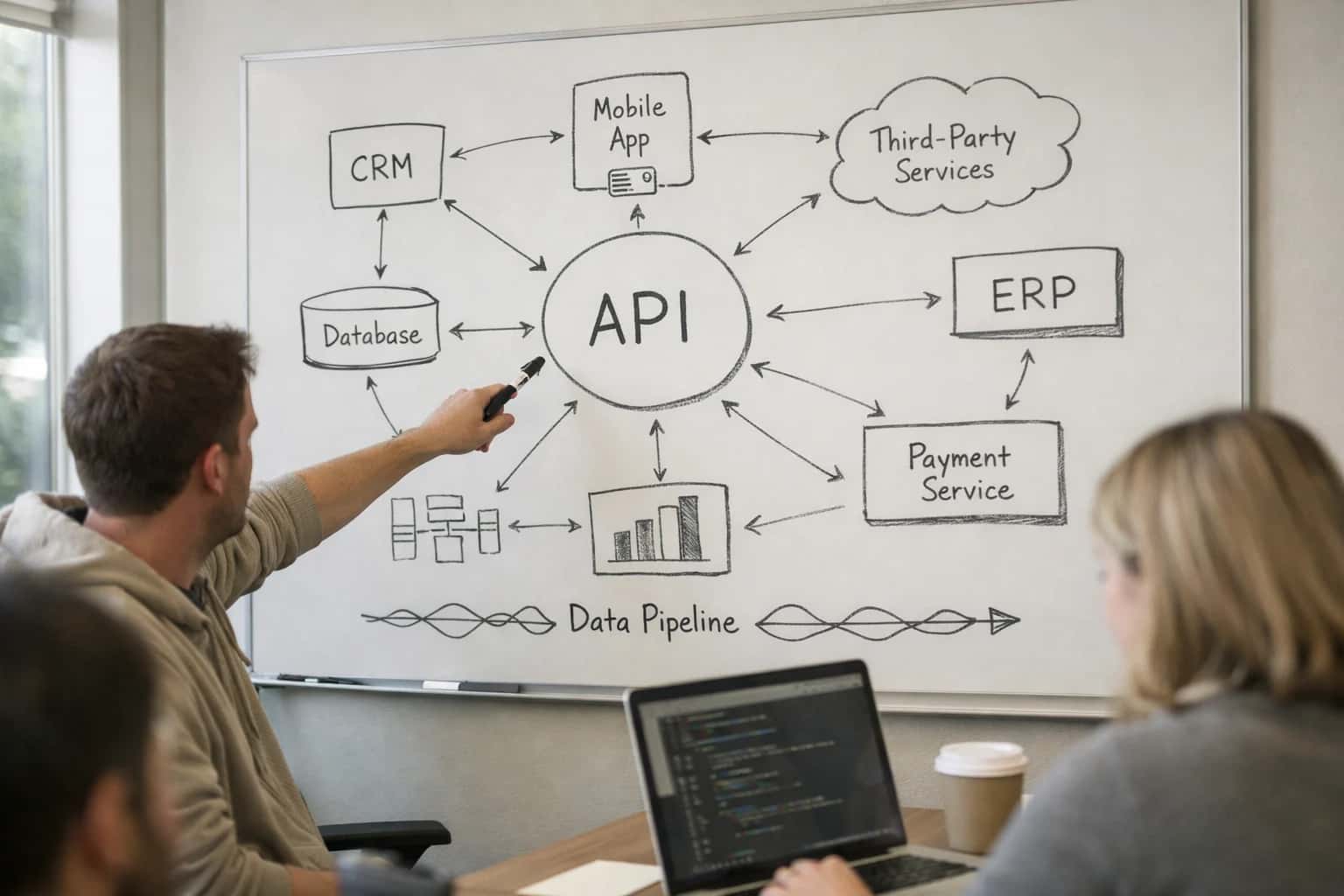
AI integration for Zoom Webinars connects at two primary API surfaces: the Polling API for structured feedback and the Q&A API for open-ended audience questions. The workflow begins by subscribing to Zoom's webhooks for polling.ended and question.answered events. When a poll ends, the system ingests all responses—especially the open-text answers from "single answer" or "multiple answer" poll types—and passes them to an LLM for thematic clustering and sentiment scoring. Simultaneously, as questions are submitted to the Q&A panel, an AI agent can categorize them (e.g., 'Technical', 'Pricing', 'Feature Request'), detect duplicates, and even surface the most urgent or popular queries to the host in real-time via a companion dashboard or direct in-webinar alert.

Integration
AI-Powered Polling and Survey for Zoom Webinars
Where AI Fits into Zoom Webinar Polling and Q&A
A practical guide to wiring AI into Zoom Webinar's polling and Q&A surfaces for real-time audience intelligence.
The implementation detail lies in the orchestration layer. A lightweight middleware service, often deployed as a serverless function, listens to Zoom's event payloads. It enriches the raw text with metadata (attendee name, registration details if permitted) before sending batches to a configured AI model endpoint. For real-time analysis, a streaming architecture using a message queue (like Amazon SQS or Google Pub/Sub) ensures low latency between question submission and host notification. The output—a sentiment heatmap, trending topic tags, or a prioritized question list—is then pushed back to the host via a secure web socket connection to a custom host control panel or injected directly into the webinar's 'Broadcast Message' feature via the API. This creates a closed-loop where the host can acknowledge trends live, e.g., "I see many questions about integration, let's address that now."
Rollout and governance require careful planning. Start with a pilot webinar series, using the AI in monitor-only mode to build confidence in its categorization accuracy before enabling real-time host alerts. Data governance is critical: ensure your integration complies with Zoom's data processing terms and your own privacy policies. Attendee consent for analysis may be required depending on jurisdiction. Log all AI interactions—original questions, AI-generated tags, and any automated actions—to an audit trail for review. This allows for continuous prompt tuning and model evaluation, ensuring the AI assistant remains a useful copilot rather than a source of distraction. For a deeper dive on architecting these event-driven workflows, see our guide on Custom AI Integration for Zoom.
Zoom Webinar APIs and Data Touchpoints for AI
Core APIs for Real-Time and Post-Event Data
To power AI-driven polling analysis, you need to connect to Zoom's webinar-specific APIs for data ingestion and real-time interaction.
Key Endpoints:
GET /webinars/{webinarId}/registrants: Retrieve attendee list for demographic context.GET /webinars/{webinarId}/polls: Fetch structured poll questions and closed-ended responses.GET /past_webinars/{webinarId}/qa: Access the full Q&A transcript, a primary source for open-ended feedback.- Webhook
webinar.ended: Trigger post-event processing pipelines to analyze all collected data.
Data Payloads: The Q&A and poll results provide structured JSON, but the rich, qualitative insights are locked in open-text attendee responses. This is where NLP models add value by extracting themes, sentiment, and urgency.
High-Value Use Cases for AI in Webinar Polling
Move beyond simple multiple-choice analytics. AI can transform open-ended poll responses and Q&A from Zoom Webinars into actionable intelligence, giving hosts real-time visibility into audience sentiment, emerging topics, and engagement drivers.
Real-Time Sentiment Heatmaps
Analyze open-ended poll responses as they are submitted during the webinar. AI classifies sentiment (positive, negative, neutral) and urgency, generating a live dashboard for the host. This allows for on-the-fly adjustments to content, pacing, or tone to address audience concerns before the session ends.
Trending Topic Identification
Use NLP to cluster similar themes from thousands of poll and Q&A text entries. The AI identifies rising topics and frequently asked questions, presenting them to the host or moderator. This enables prioritizing Q&A segments on what the audience cares about most, improving perceived value and engagement.
Automated Post-Webinar Report Generation
At the webinar's conclusion, AI automatically synthesizes all poll data, Q&A, and transcript segments into a structured report. This includes key themes, sentiment breakdowns, and direct quotes, saving marketing and product teams hours of manual analysis and accelerating follow-up campaign planning.
Lead Scoring & Segmentation Triggers
Integrate poll responses with your CRM (e.g., Salesforce, HubSpot). AI analyzes the content and intent of a participant's answers to score engagement level and infer interests. This can automatically update lead records, trigger personalized follow-up emails, or add leads to specific nurture campaigns based on their expressed needs.
Content Gap & Knowledge Base Enrichment
Analyze poll and Q&A data across a series of webinars to identify consistent knowledge gaps or confusing topics. This intelligence feeds directly into product documentation, FAQ pages, and future content strategy, ensuring your educational materials address real, recurring audience questions.
Dynamic Speaker & Moderator Prompts
Build a real-time copilot for hosts and moderators. As polls are submitted, the AI analyzes them and suggerts clarifying questions, related talking points, or resources to mention. This is delivered via a private dashboard or whisper feed, turning data into immediate conversational guidance.
Example AI Workflows for Zoom Webinar Polling
These workflows illustrate how AI can be integrated with Zoom's Polling and Q&A APIs to transform passive data collection into active intelligence, driving real-time engagement and post-event action.
Trigger: A webinar participant submits an open-ended poll response via the Zoom Webinar API.
Context Pulled: The system retrieves the poll question text, participant metadata (role, company if available via registration), and the timestamp.
AI Action: A lightweight sentiment/emotion classifier (e.g., positive, negative, confused, excited) processes the text response. For longer responses, a topic extraction model identifies key themes (e.g., "pricing," "integration," "security").
System Update: Results are pushed in near-real-time (<2s) to a host dashboard overlay within Zoom or a separate co-host view. Responses are grouped by sentiment and topic, allowing the host to address concerns or highlight positive feedback immediately.
Human Review Point: The host retains full control. The AI provides categorization, but the host decides whether and how to act on the insights during the live session.
Implementation Architecture: Data Flow and Model Layer
A production-ready architecture for analyzing open-ended poll and Q&A data from Zoom Webinars in real-time.
The integration connects to the Zoom Webinars API via a secure webhook listener. When a participant submits an open-ended poll response or a question in the Q&A panel, Zoom pushes a structured event payload containing the text, participant ID, and timestamp. This payload is immediately routed to a message queue (e.g., Apache Kafka or Amazon SQS) to ensure durability and handle spikes during live sessions. A processing service dequeues the message, enriches it with metadata (e.g., webinar topic, host name), and sends the raw text to the model layer for analysis.
The model layer employs a multi-step NLP pipeline. First, a sentiment classifier (e.g., fine-tuned transformer model) scores each response on a positive/neutral/negative scale. Concurrently, a topic clustering model (using embeddings from models like all-MiniLM-L6-v2) groups similar responses to identify trending themes. These outputs—sentiment scores and topic clusters—are streamed to a real-time dashboard via WebSockets, giving the host a live sentiment heatmap and a ranked list of emerging topics. All processed data is indexed in a time-series database (e.g., TimescaleDB) for historical trend analysis and written to the host's preferred data warehouse (e.g., Snowflake) via a batch ETL job.
For governance, all data flows are logged with participant IDs hashed for privacy. The system supports configurable data retention policies and can be deployed in a VPC for enhanced security. Rollout typically follows a pilot webinar series, with hosts receiving a lightweight training module on interpreting the AI-generated dashboards. This architecture ensures insights are actionable within seconds, allowing hosts to adjust their presentation or address concerns while the webinar is still live.
Code and Payload Examples
Handling Poll Responses in Real-Time
When a participant submits a poll response during a Zoom Webinar, Zoom sends a webinar.poll_submitted webhook event. Your integration endpoint must process this JSON payload, extract the open-ended answers, and send them to an AI model for immediate analysis.
Key fields in the payload include the webinar UUID, participant details, and the poll question/answer objects. The handler should be stateless and queue the analysis task to avoid blocking the webhook response. Below is a Python FastAPI example for the initial receipt and validation.
pythonfrom fastapi import FastAPI, Request import httpx import json from pydantic import BaseModel from typing import List, Optional app = FastAPI() class PollAnswer(BaseModel): question: str answer: str class PollSubmission(BaseModel): event: str payload: dict # ... other Zoom webhook fields @app.post("/webhooks/zoom/poll") async def handle_poll_submission(request: Request): data = await request.json() # Validate Zoom webhook signature here if data.get('event') == 'webinar.poll_submitted': poll_data = data['payload']['object'] webinar_id = poll_data['webinar_id'] participant = poll_data['participant']['user_name'] answers: List[PollAnswer] = [] for question in poll_data['questions']: if question['type'] == 'open_ended': answers.append(PollAnswer( question=question['question_name'], answer=question['answer_details'][0]['answer'] )) # Send to analysis queue if answers: await queue_ai_analysis(webinar_id, participant, answers) return {"status": "processed"}
Realistic Time Savings and Business Impact
How AI transforms the manual, post-webinar analysis of open-ended poll responses and Q&A into a real-time strategic asset for hosts and marketers.
| Workflow Stage | Before AI | After AI | Implementation Notes |
|---|---|---|---|
Poll Response Analysis | Manual review of 100+ open-ended responses takes 2-3 hours post-event. | AI categorizes and summarizes key themes in real-time during the webinar. | Hosts can pivot discussion or address concerns live based on AI-generated sentiment heatmaps. |
Q&A Triage & Prioritization | Hosts must read and mentally prioritize dozens of questions in the chat. | AI identifies trending topics, surfaces duplicate questions, and highlights urgent inquiries. | Enables hosts to answer the most pressing questions first, improving attendee satisfaction. |
Sentiment & Engagement Tracking | Subjective guesswork based on a few vocal participants or chat emojis. | AI provides a live sentiment score and tracks engagement shifts across webinar segments. | Quantifiable data helps optimize content pacing and format for future webinars. |
Post-Event Report Generation | Marketing team spends 1-2 days compiling insights from recordings and exports. | AI auto-generates a structured insights report (PDF/PPT) within 5 minutes of webinar end. | Report includes top poll themes, Q&A summary, and engagement metrics, accelerating follow-up campaigns. |
Lead Qualification Signal | Qualification relies on explicit poll answers (e.g., 'plan to buy in 6 months'). | AI infers intent and interest level from language used in open-ended responses. | Provides a nuanced scoring layer for marketing automation, supplementing explicit data. |
Content & Follow-up Personalization | Generic 'thank you' email with a recording link sent to all attendees. | Segmented follow-up emails referencing specific topics an attendee engaged with via polls/Q&A. | Personalization is driven by AI analysis, increasing the relevance and perceived value of communications. |
Host & Speaker Preparation | Briefing for next webinar is based on anecdotal feedback and gut feeling. | Data-driven briefing highlights which topics resonated, which confused, and what the audience wants next. | Enables continuous improvement of webinar content and delivery based on concrete attendee signals. |
Governance, Security, and Phased Rollout
A practical blueprint for deploying AI-powered polling analysis in Zoom Webinars with appropriate controls and a low-risk adoption path.
A production-ready integration for Zoom Webinars must respect the platform's data model and API constraints. The core architecture typically involves: listening to the report.webinar_poll_details API endpoint or webhooks for poll completion; securely processing open-ended responses through an AI service (e.g., hosted LLM API); and writing the generated insights—sentiment heatmaps, trending topics, keyword clusters—back to a Zoom Dashboard App or a dedicated analytics interface via OAuth 2.0. All data flows should be encrypted in transit, and PII in responses should be handled according to your data residency and retention policies, often requiring a data anonymization step before AI processing.
Governance is critical for responsible rollout. Implement role-based access controls (RBAC) so only authorized hosts or producers can view AI-generated analytics. Maintain a full audit trail linking each insight batch to the source webinar, poll, and processing timestamp. For regulated industries, consider an optional human-in-the-loop review step where a host can approve or modify AI-generated topic summaries before they are shared with co-hosts or exported. This builds trust and ensures the AI acts as an assistant, not an autonomous actor.
Adopt a phased rollout to manage risk and gather feedback. Phase 1 (Pilot): Enable the integration for a single team of experienced webinar hosts, focusing on post-event analysis only. Phase 2 (Expansion): Introduce near-real-time analysis (e.g., insights delivered during the Q&A segment) for a broader group, coupled with host training on interpreting the sentiment heatmaps. Phase 3 (Scale): Roll out to all enterprise webinar licenses, integrating insights directly into host dashboards and triggering automated workflows—like flagging a frustrated attendee for immediate follow-up in your CRM (/integrations/customer-relationship-management-platforms/ai-integration-for-salesforce). This measured approach allows you to tune prompts, validate business impact, and ensure the system scales with your webinar volume without degrading performance.
Enabling Efficiency, Speed & Accuracy
Intelligent Analysis, Decision & Execution
We build AI systems for teams that need search across company data, workflow automation across tools, or AI features inside products and internal software.
Talk to Us
Search across company data
Give teams answers from docs, tickets, runbooks, and product data with sources and permissions.
Useful when people spend too long searching or get different answers from different systems.

Automate internal workflows
Use AI to route work, draft outputs, trigger actions, and keep approvals and logs in place.
Useful when repetitive work moves across multiple tools and teams.

Add AI to products and internal tools
Build assistants, guided actions, or decision support into the software your team or customers already use.
Useful when AI needs to be part of the product, not a separate tool.
Frequently Asked Questions
Common technical and operational questions for integrating AI-powered polling and survey analysis into Zoom Webinars.
The integration uses a combination of Zoom's APIs and webhooks to capture and process data with low latency.
Typical Data Flow:
- Webhook Trigger: The Zoom
webinar.endedorwebinar.updatedwebhook signals the system to fetch data. - API Calls: Our service calls the Zoom API endpoints:
GET /webinars/{webinarId}/registrantsfor attendee list.GET /report/webinars/{webinarId}/pollsfor poll questions and aggregated results.GET /report/webinars/{webinarId}/qafor Q&A session text.
- Processing Pipeline: Raw JSON responses are parsed. For open-ended responses, text is sent to an LLM (e.g., GPT-4, Claude) via a secure API gateway.
- Analysis & Storage: The AI generates sentiment scores, themes, and trends. Results are stored in a database (like PostgreSQL) with the webinar ID as a key and can be pushed to a dashboard or back to Zoom via the API (e.g., as a custom webinar report).
Key Consideration: For near-real-time analysis during the webinar, you can subscribe to the webinar.poll.reported webhook, but note rate limits and the need for fast, idempotent processing.

About the author
Prasad Kumkar
CEO & MD, Inference Systems
Prasad Kumkar is the CEO & MD of Inference Systems and writes about AI systems architecture, LLM infrastructure, model serving, evaluation, and production deployment. Over 5+ years, he has worked across computer vision models, L5 autonomous vehicle systems, and LLM research, with a focus on taking complex AI ideas into real-world engineering systems.
His work and writing cover AI systems, large language models, AI agents, multimodal systems, autonomous systems, inference optimization, RAG, evaluation, and production AI engineering.
Partnered with leading AI, data, and software stack.





How We Work
Custom AI workflows for your Business
One-fit-all AI don't work for modern businesses. At Inferensys, we aim to understand your business & custom requirements; which we use to define most efficient agentic workflows, the data, and the tools for your business.
01
Review the use case
We understand the task, the users, and where AI can actually help.
Read more02
Pick the right approach
We define what needs search, automation, or product integration.
Read more03
Build the first useful version
We implement the part that proves the value first.
Read more04
Improve from there
We add the checks and visibility needed to keep it useful.
Read moreThe first call is a practical review of your use case and the right next step.
Talk to Us