AI-driven attendance and engagement analytics connect to three primary surfaces within the Zoom platform: the Zoom Meeting API for real-time participant state (join/leave, video on/off, hand raises), the Zoom Report API for post-meeting metrics (duration, attentiveness score), and the Zoom Webhook system for event-driven triggers. This allows an integration to process raw signals—like chat frequency, audio participation, and video engagement—and transform them into structured insights without disrupting the host or participant experience. The core data objects are participants, meetings, and webinar records, enriched by the audio/video transcript available via the Zoom Cloud Recording API.

Integration
AI Attendance and Engagement Analytics for Zoom
Architect AI systems that analyze Zoom participant video, audio, and chat patterns to generate engagement scores, meeting effectiveness insights, and automated reports for hosts and people managers.
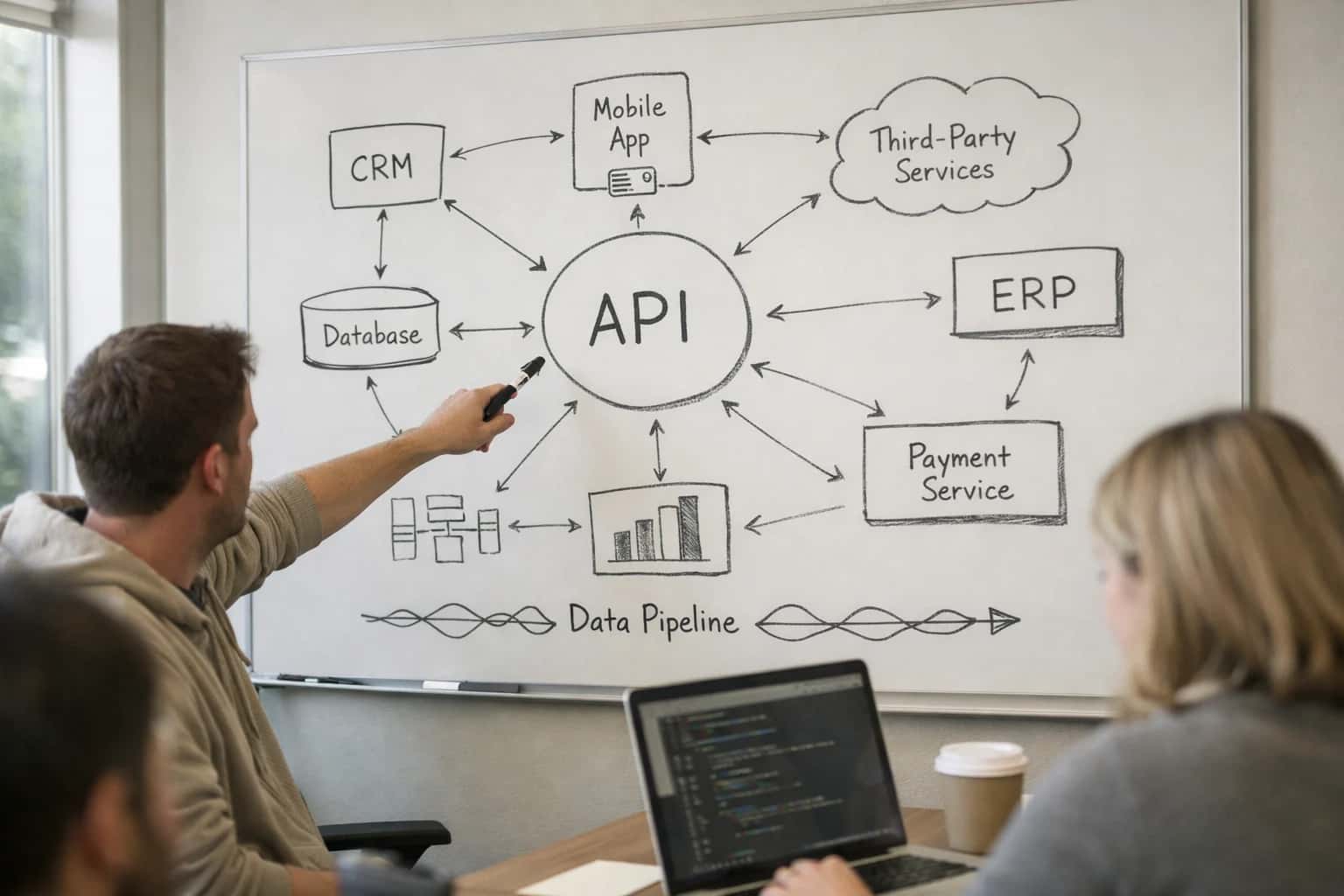
ARCHITECTURE & DATA FLOW
Where AI Fits into Zoom's Meeting Analytics Stack
A practical guide to integrating AI analytics into Zoom's native data and automation surfaces.
Implementation typically involves a middleware service that subscribes to Zoom webhooks (e.g., meeting.ended) to kick off an analytics pipeline. This service calls the Report and Cloud Recording APIs, runs AI models for sentiment, talk/listen ratios, and topic clustering on the transcript, and writes composite engagement scores back to a dedicated database. High-value workflows include auto-generating host dashboards in tools like Power BI, triggering manager alerts for low-engagement recurring meetings, and syncing participation metrics to HRIS platforms like Workday for performance and wellness insights. The architecture must handle batch processing for large meetings and real-time streams for live engagement widgets.
Rollout requires careful governance: engagement scores should be opt-in for participants, with clear data retention policies. Analytics should be surfaced first to meeting hosts and people managers via secure, role-based dashboards, not broadcast broadly. Start with pilot teams, using Zoom's OAuth scopes like report:read:admin and recording:read, and ensure all data processing adheres to corporate communication policies. For a production implementation, consider our related guide on Custom AI Integration for Zoom for bespoke pipeline design.
AI ATTENDANCE AND ENGAGEMENT ANALYTICS
Zoom APIs and Data Surfaces for AI Integration
Core APIs for Engagement Data
The Zoom API suite provides the foundational data for AI-powered attendance and engagement analytics. The Meeting API (/v2/meetings) is essential for retrieving scheduled and past meeting lists, including metadata like duration and participants. For detailed interaction data, the Meeting Participants API (/v2/past_meetings/{meetingId}/participants) returns the join/leave times for each attendee, forming the basis for attendance duration and punctuality metrics.
To analyze the content of engagement, the Cloud Recording API (/v2/meetings/{meetingId}/recordings) provides access to audio, video, and chat transcripts. These transcripts, when processed with NLP models, allow for the analysis of speaking time, question frequency, and topic contribution by participant. Webhooks from the Meeting Events API can trigger real-time analytics pipelines the moment a meeting ends, enabling same-day insights for hosts and managers.
ACTIONABLE INSIGHTS FOR HOSTS AND MANAGERS
High-Value Use Cases for AI-Powered Zoom Analytics
Move beyond simple attendance reports. AI-driven analytics on Zoom video, audio, and chat data unlock operational intelligence for people management, training, and meeting effectiveness.
01
Automated Engagement Scoring for Managers
Analyze participant video (camera on/off, attention direction), audio (talk time, interruptions), and chat activity to generate per-meeting and longitudinal engagement scores. Managers receive dashboards highlighting team members who are consistently disengaged or dominating conversations, enabling targeted one-on-ones.
Batch -> Real-time
Insight delivery
02
Meeting Effectiveness & Facilitation Feedback
Provide hosts with post-meeting reports on pacing, participant balance, and Q&A effectiveness. AI identifies segments where multiple participants spoke over each other, when engagement dropped, and if action items were clearly articulated. Integrates with tools like Lattice or Culture Amp for 360 feedback.
1 sprint
Facilitation improvement cycle
03
Sales & Customer Success Call Diagnostics
For customer-facing Zoom calls, analyze conversational patterns against best practices. Flag monologues exceeding configured thresholds, detect customer sentiment shifts, and identify missed opportunity signals (e.g., competitor mentions, pricing questions). Push insights to Salesforce or Gong for coaching workflows.
Hours -> Minutes
Coaching prep
04
Training & Onboarding Participation Compliance
Automate compliance tracking for mandatory training sessions delivered via Zoom. Verify active participation (not just log-in) through periodic engagement checks. Generate exception reports for HR systems like Workday, triggering follow-up requirements and reducing manual session monitoring.
05
Large-Scale All-Hands & Town Hall Analytics
Process hundreds of concurrent participant streams to generate aggregate sentiment and engagement heatmaps throughout a large virtual event. Identify which topics or speakers drove the highest engagement and which segments lost the audience. Inform future agenda planning and executive communications strategy.
Same day
Post-event report
06
Wellbeing & Burnout Risk Indicators
Establish baselines for vocal tone, speech pace, and camera behavior. Anonymized, aggregated trend analysis can signal team-wide stress or burnout risks by detecting deviations like increased monotone speech or consistently turned-off cameras. Provides People Ops with data to proactively offer support resources.
IMPLEMENTATION PATTERNS
Example AI Analytics Workflows for Zoom Meetings
These are production-ready workflows for analyzing participant engagement, sentiment, and behavior in Zoom meetings. Each pattern connects Zoom's APIs and webhooks to AI models, then pushes insights to downstream systems for managers, coaches, and operations teams.
Trigger: Zoom webhook for recording.completed.
Context Pulled:
- Meeting metadata (host, participants, duration) via
GET /past_meetings/{meetingId}. - Audio transcript via
GET /meetings/{meetingId}/recordings(download transcript file). - Chat log via
GET /chat/users/{userId}/messages(scoped to meeting). - Participant join/leave timestamps from the
participantevents in the meeting detail.
AI Agent Action:
- Speaker Diarization & Sentiment: Process transcript to assign sentiment (positive, neutral, negative) per speaker segment.
- Engagement Metrics: Calculate:
Speaking Time %per participant.Talk-to-Listen Ratiofor host vs. attendees.Chat Activity Scorebased on questions asked and responses in chat.Attention Scoreinferred from join/leave patterns (early leave penalizes score).
- Topic Heatmap: Use NLP to identify key discussion topics and map which participants contributed to each.
System Update:
- A JSON payload is generated and posted to a webhook endpoint for your HRIS (e.g., Workday) or manager dashboard (e.g., Power BI).
- Example payload sent to
https://internal-api.example.com/engagement:
json{ "meeting_id": "123456789", "date": "2024-05-15", "scores": [ { "participant_email": "[email protected]", "speaking_pct": 35.2, "sentiment_avg": 0.72, "chat_activity": "high", "attention_score": 0.89, "key_topics_contributed": ["Q2 Planning", "Budget Review"] } ], "summary": "Meeting showed high engagement on budget topics, moderate sentiment." }
Human Review Point: Scores are first sent to the meeting host via a Slack digest for review before being committed to permanent HR records.
FROM ZOOM DATA TO ACTIONABLE INSIGHTS
Implementation Architecture: Data Flow and Model Layer
A production-ready architecture for transforming raw Zoom meeting data into secure, governed engagement analytics.
The integration connects to the Zoom Meeting API and Zoom Report API to ingest raw telemetry: participant join/leave timestamps, video on/off states, audio mute/unmute events, chat messages, reactions (emoji, raised hand), and screen share activity. This data is streamed via webhooks or pulled in batch, then normalized into a unified event log. A key architectural decision is whether to process data in real-time (for live dashboards) or post-meeting (for comprehensive analysis), which dictates the choice of streaming platform (Apache Kafka, Amazon Kinesis) versus batch orchestration (Apache Airflow, Prefect).
The core model layer applies a series of specialized AI/ML tasks to this event log. This is not a single monolithic model, but a pipeline: 1) Feature Engineering creates temporal aggregates (e.g., talk time ratio, attention span segments). 2) Behavioral Clustering groups participants by engagement patterns (e.g., 'active contributor', 'listener', 'multi-tasker'). 3) Sentiment & Topic Analysis processes chat and, if transcribed, audio to gauge discussion tone and key themes. 4) Anomaly Detection flags unusual behavior like sudden mass drop-offs. These models are typically hosted on a scalable inference service (e.g., SageMaker, Azure ML) with results stored in a time-series database (TimescaleDB) and a vector database (Pinecone) for semantic search over meeting insights.
Governance and rollout are critical. All data flows must respect Zoom's data processing addendum and participant consent settings. The system should implement role-based access control (RBAC), ensuring managers only see aggregated, anonymized analytics for their direct reports, with individual opt-out capabilities. Insights are delivered via a secure dashboard embedded in internal portals or pushed as digestible Slack/Teams alerts. A phased rollout starts with pilot teams, focusing on non-punitive use cases like identifying meetings that could be emails or improving hybrid meeting inclusivity, before scaling to organization-wide analytics.
AI ATTENDANCE AND ENGAGEMENT ANALYTICS FOR ZOOM
Code and Configuration Examples
Setting Up the Zoom Webhook Pipeline
To analyze meeting engagement, you first need to capture meeting data. Configure Zoom webhooks for the meeting.ended and recording.completed events. The webhook payload contains the meeting UUID, participant list, and recording file details. Use a serverless function (e.g., AWS Lambda, Google Cloud Function) to receive this payload, validate the signature, and push the meeting metadata and recording file URL to a secure queue for processing.
python# Example: AWS Lambda handler for Zoom webhook import json import boto3 from zoom_webhook_validator import validate_webhook sqs = boto3.client('sqs') QUEUE_URL = os.environ['MEETING_QUEUE_URL'] def lambda_handler(event, context): # Validate Zoom webhook signature is_valid = validate_webhook( event['body'], event['headers']['x-zm-signature'], event['headers']['x-zm-request-timestamp'] ) if not is_valid: return {'statusCode': 401} payload = json.loads(event['body']) event_type = payload['event'] if event_type == 'meeting.ended': meeting_data = { 'meeting_id': payload['payload']['object']['id'], 'uuid': payload['payload']['object']['uuid'], 'participants': payload['payload']['object']['participant_count'], 'end_time': payload['payload']['object']['end_time'] } # Send to queue for analytics processing sqs.send_message( QueueUrl=QUEUE_URL, MessageBody=json.dumps(meeting_data) ) return {'statusCode': 200}
This asynchronous pattern ensures your analytics pipeline scales and remains resilient if downstream AI services are temporarily slow.
AI ATTENDANCE AND ENGAGEMENT ANALYTICS FOR ZOOM
Realistic Time Savings and Operational Impact
How AI transforms manual meeting analysis into automated, actionable insights for hosts, managers, and L&D teams.
| Metric | Before AI | After AI | Notes |
|---|---|---|---|
Meeting engagement report generation | Manual review of recordings and chat logs (1-2 hours per meeting) | Automated report delivered post-meeting (<5 minutes) | AI analyzes video presence, speaking time, chat participation, and sentiment |
Participant attention scoring | Subjective host perception or no tracking | Objective, data-driven score per participant | Based on camera-on duration, active speaking, and chat interaction patterns |
Manager one-on-one preparation | Skimming multiple meeting summaries (30-45 minutes per direct report) | AI-generated engagement trend dashboard (5 minutes) | Highlights participation changes, topic contributions, and collaboration patterns |
Training and coaching identification | Reactive, based on escalations or manager observation | Proactive alerts on low engagement or speaking time outliers | Triggers workflows in L&D platforms like Docebo or Cornerstone |
Cross-meeting participation analysis | Manual spreadsheet compilation across projects (half-day per week) | Automated roll-up of individual contributions across all meetings | Identifies quiet experts or over-extended contributors for workload balancing |
Compliance and policy monitoring | Spot-check recordings for regulatory adherence | Continuous analysis for keywords and speaking time violations | Alerts sent to compliance officers via Slack or ServiceNow |
Post-meeting follow-up targeting | Broad, untargeted follow-up emails to all attendees | Personalized follow-ups based on individual engagement and questions asked | Integrates with CRM or marketing automation for tailored communications |
Program/Initiative health tracking | Quarterly survey-based sentiment checks | Real-time engagement pulse from related meeting series | Provides leading indicator for project morale and alignment risks |
ARCHITECTING FOR TRUST AND SCALE
Governance, Privacy, and Phased Rollout
Deploying AI for attendance and engagement analytics requires a deliberate approach to data security, user consent, and incremental value delivery.
A production-ready architecture for Zoom analytics must respect the platform's data model and API constraints. Core data sources include the Zoom Meeting API for participant lists and join/leave times, the Zoom Report API for meeting metrics, and the Zoom Cloud Recording API for audio/video transcript analysis. Processing typically involves an event-driven pipeline: Zoom webhooks trigger an ingestion service that fetches data, anonymizes participant IDs for aggregate analysis, and stores raw events in a secure queue. The AI layer then processes this data—applying models for speech patterns, chat sentiment, and video engagement cues—to generate per-participant and per-session scores. All outputs should be written to a dedicated analytics database, never modifying Zoom's native data, and all API calls must adhere to Zoom's rate limits and OAuth scopes like report:read:admin and recording:read.
Governance starts with explicit consent and transparency. Before enabling analytics for a meeting, hosts should be required to activate the feature and inform participants via a custom disclaimer that AI is being used for engagement insights. All processed data must be classified and tagged according to its sensitivity (e.g., audio transcript vs. aggregate score). Access to raw transcripts and individual scores should be restricted via Role-Based Access Control (RBAC), typically limiting detailed views to people managers or L&D teams, while providing hosts with high-level summaries. An immutable audit log should track every data access event, model inference, and configuration change to support compliance reviews for regulations like GDPR or CCPA. For highly regulated industries, the pipeline can be designed to process data within a specific geographic region or VPC.
A phased rollout mitigates risk and proves value. Phase 1 (Pilot): Enable analytics for voluntary, internal team meetings only. Output simple dashboards showing aggregate meeting engagement trends, with no individual identifiers. Use this phase to calibrate AI models and gather feedback. Phase 2 (Controlled Expansion): Roll out to specific departments (e.g., Sales, Customer Success) with manager-level access to de-identified participant trends. Introduce automated weekly digest emails to hosts. Phase 3 (Enterprise Scale): Enable org-wide with full RBAC, integrate scores with HRIS platforms like Workday for manager dashboards, and trigger automated workflows—such as flagging recurring low-engagement meetings for calendar optimization. Throughout, maintain a clear off-ramp: any participant or host should be able to opt-out of analytics at any time, with data deletion workflows adhering to Zoom's data retention policies.
Enabling Efficiency, Speed & Accuracy
Intelligent Analysis, Decision & Execution
We build AI systems for teams that need search across company data, workflow automation across tools, or AI features inside products and internal software.
Talk to Us
Search across company data
Give teams answers from docs, tickets, runbooks, and product data with sources and permissions.
Useful when people spend too long searching or get different answers from different systems.
Enterprise searchRAGPermissions
Read more
Automate internal workflows
Use AI to route work, draft outputs, trigger actions, and keep approvals and logs in place.
Useful when repetitive work moves across multiple tools and teams.
AI agentsWorkflow automationGovernance
Read more
Add AI to products and internal tools
Build assistants, guided actions, or decision support into the software your team or customers already use.
Useful when AI needs to be part of the product, not a separate tool.
AI integrationDecision supportModel routing
Read moreIMPLEMENTATION AND OPERATIONS
Frequently Asked Questions
Common technical and operational questions about deploying AI-driven attendance and engagement analytics for Zoom at scale.
The integration connects to Zoom's APIs and webhooks to access data in a secure, governed manner. Here's the typical data flow:
- Authentication & Authorization: The system uses OAuth 2.0 with scoped permissions (
meeting:read:admin,recording:read,dashboard:read:list_meetings) to access data on behalf of your Zoom account. - Data Ingestion Triggers:
- Webhooks: The
meeting.endedwebhook triggers the processing pipeline for a completed meeting. - APIs: The system polls the
/metrics/meetingsand/report/meetingsendpoints for historical data and dashboard metrics.
- Webhooks: The
- Processing Pipeline:
- Audio/Video: If recordings are enabled and stored in Zoom Cloud, the system downloads the media files for processing. Audio is transcribed using a high-accuracy ASR model.
- Metadata: Participant join/leave times, chat logs, reactions (
raise hand,clap), and poll responses are pulled via the Zoom API. - Engagement Signals: The AI models analyze the combined dataset—transcript sentiment, speaker talk time, chat activity frequency, and video presence (if video-on data is available via the Dashboard API)—to generate composite engagement scores.
- Output: The resulting analytics (scores, trends, raw signals) are written to your data warehouse (e.g., Snowflake, BigQuery) or pushed back to a secure application via a REST API for visualization.

About the author
Prasad Kumkar
CEO & MD, Inference Systems
Prasad Kumkar is the CEO & MD of Inference Systems and writes about AI systems architecture, LLM infrastructure, model serving, evaluation, and production deployment. Over 5+ years, he has worked across computer vision models, L5 autonomous vehicle systems, and LLM research, with a focus on taking complex AI ideas into real-world engineering systems.
His work and writing cover AI systems, large language models, AI agents, multimodal systems, autonomous systems, inference optimization, RAG, evaluation, and production AI engineering.
LinkedIn
Limited slotsGet a Free AI Consultation
Partnered with leading AI, data, and software stack.





How We Work
Custom AI workflows for your Business
One-fit-all AI don't work for modern businesses. At Inferensys, we aim to understand your business & custom requirements; which we use to define most efficient agentic workflows, the data, and the tools for your business.
01
Review the use case
We understand the task, the users, and where AI can actually help.
Read more02
Pick the right approach
We define what needs search, automation, or product integration.
Read more03
Build the first useful version
We implement the part that proves the value first.
Read more04
Improve from there
We add the checks and visibility needed to keep it useful.
Read moreThe first call is a practical review of your use case and the right next step.
Talk to Us