In a retail TMS, AI integration surfaces are typically the planning cockpit, order management module, and carrier management workflows. The goal is to inject intelligence into three key decisions: demand-aware store replenishment routing, dynamic last-mile delivery slot management, and returns logistics optimization. This is done by connecting AI agents to the TMS's order, shipment, and carrier APIs, allowing them to read constraints (store delivery windows, trailer cube/weight, carrier contracts) and write back optimized plans or exception handling actions.

Integration
AI Integration for Transportation Management in Retail
A practical guide for retail supply chain leaders on embedding AI into Transportation Management Systems (TMS) to optimize store replenishment, last-mile delivery, and returns logistics.
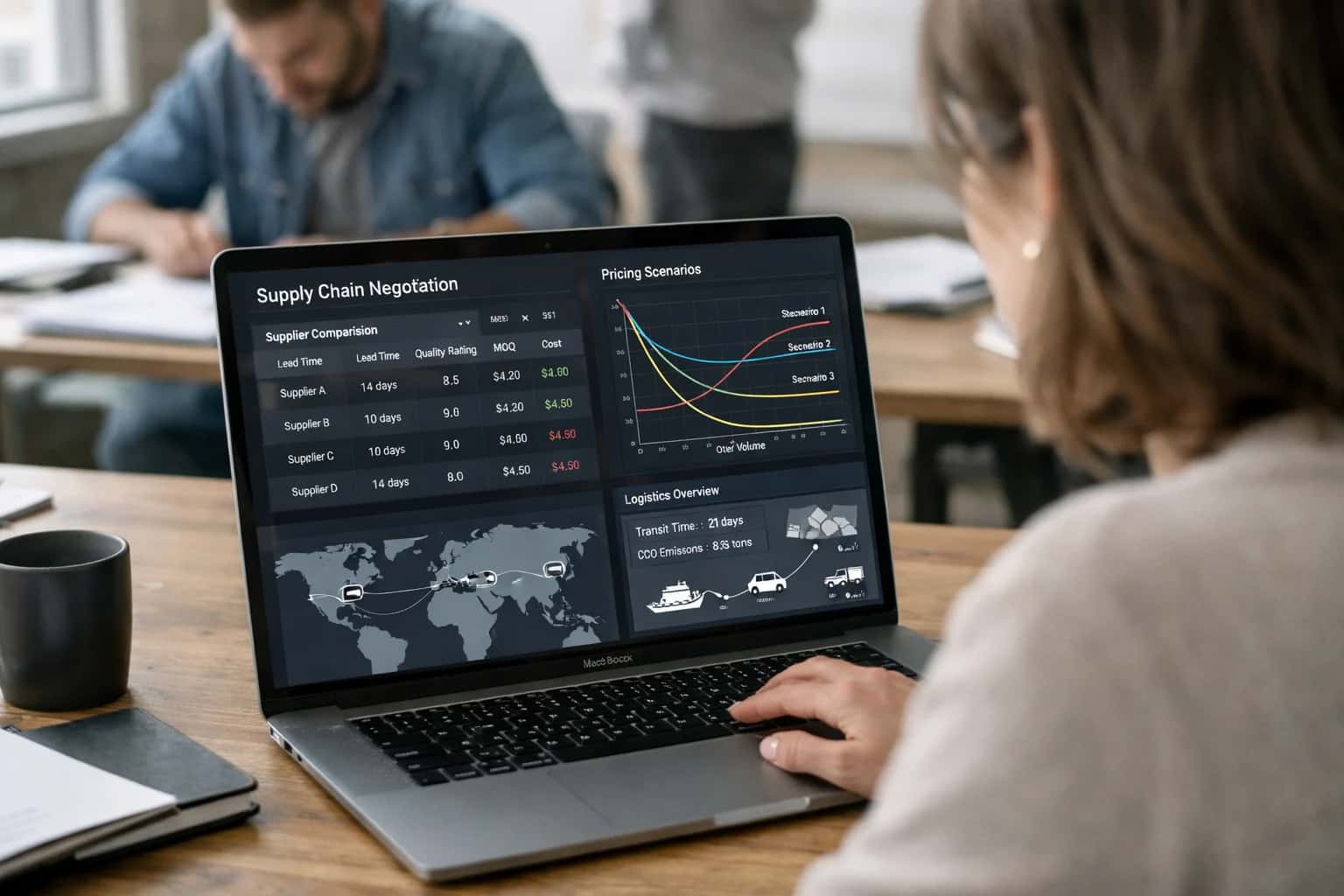
ARCHITECTURE AND ROLLOUT
Where AI Fits in Retail Transportation Management
Integrating AI into retail TMS requires a targeted approach that connects to high-impact workflows without disrupting core operations.
A practical implementation wires an AI orchestration layer—using platforms like CrewAI or n8n—between the retail ERP (for demand signals), the TMS (for execution), and carrier APIs. For example, an AI agent can continuously monitor incoming e-commerce orders and store replenishment POs, then dynamically re-optimize last-mile delivery routes and appointment slots in Oracle TMS or SAP TM, reducing failed deliveries and carrier wait times. Another agent can analyze return patterns to suggest optimal consolidation points and return-to-stock routing, cutting reverse logistics costs by 15-25%.
Rollout should be phased, starting with a single high-volume lane or a specific workflow like dynamic slot management for home delivery. Governance is critical: all AI-generated plans should be logged with a human-in-the-loop approval step initially, and integrated with the TMS's existing audit trail and RBAC systems. Performance is measured against baseline TMS metrics: on-time in-full (OTIF) rates, transportation cost per unit, and asset utilization. This approach allows retail supply chain leaders to augment their existing TMS investment with predictive and autonomous capabilities, moving from reactive exception management to proactive, cost-optimized execution.
RETAIL SUPPLY CHAIN
Key TMS Modules and Surfaces for AI Integration
Optimizing Multi-Stop Replenishment Routes
AI integration transforms static store delivery schedules into dynamic, demand-aware routes. This connects to the TMS's Order Management and Route Planning modules, using real-time data from POS systems, warehouse inventory levels, and predictive demand models.
Key integration surfaces:
- Order Pooling Engine: AI analyzes incoming replenishment orders to intelligently pool shipments destined for stores in the same geographic cluster, optimizing trailer cube and weight.
- Dynamic Stop Sequencing: Instead of fixed routes, AI continuously re-sequences stops based on real-time traffic, store receiving hours, and priority flags (e.g., promotional stock).
- Multi-Temperature Planning: For retailers with fresh/chilled goods, AI optimizes load plans for multi-compartment trailers, balancing temperature zones and delivery windows.
Impact: Reduces miles driven, improves on-shelf availability, and lowers transportation costs per case.
RETAIL LOGISTICS AUTOMATION
High-Value AI Use Cases for Retail TMS
Integrating AI into your retail TMS moves beyond basic automation to create an adaptive, predictive logistics layer. These use cases target the specific workflows, data, and pressures of retail supply chains, from store replenishment to last-mile delivery and returns.
01
Demand-Aware Store Replenishment Routing
Dynamically consolidates and sequences store delivery routes using real-time POS data, shelf-level inventory, and promotional calendars. AI analyzes daily sales velocity, upcoming ad campaigns, and warehouse pick times to build multi-stop loads that prioritize high-need stores and optimize trailer cube, reducing expedited freight costs.
Batch -> Real-time
Planning cadence
02
Dynamic Last-Mile Slot & Carrier Management
Automates the selection of final-mile carriers and time slots based on real-time constraints. AI evaluates carrier performance (on-time, damage rates), current network congestion, weather forecasts, and customer delivery preferences (e.g., porch vs. locker) to assign each parcel, maximizing first-attempt success and minimizing cost per delivery.
Same day
Slot optimization
03
Intelligent Returns Logistics & Routing
Orchestrates the reverse flow of goods from stores or customers back to DCs, liquidation hubs, or suppliers. AI determines the optimal return path (restock, refurbish, recycle) based on item value, condition (from photos/descriptions), and destination capacity, then dynamically routes consolidation trailers to minimize empty miles on backhauls.
1 sprint
Implementation scope
04
Promotional & Seasonal Capacity Forecasting
Predicts freight capacity needs and spot rate pressure weeks ahead of major sales events (Black Friday, Prime Day). AI models correlate historical shipment volumes, current carrier contract rates, and broader market indices to generate actionable procurement alerts, guiding when to lock in dedicated capacity versus using the spot market.
05
Carrier Performance & Invoice Anomaly Detection
Continuously audits carrier invoices against tender agreements and actual performance data. AI cross-references TMS tender records, ELD/GPS tracking, and accessorial charge rules to flag discrepancies like incorrect mileage, unauthorized detention, or missed pick-up windows, automating the dispute initiation process for logistics finance teams.
Hours -> Minutes
Audit review
06
Perishable & High-Value Goods Exception Triage
Prioritizes and resolves in-transit exceptions for temperature-sensitive or high-value retail shipments. AI monitors IoT sensor streams (temperature, shock) and milestone tracking, automatically escalating deviations, suggesting corrective actions (reroute to alternate DC), and triggering pre-populated customer communication templates.
RETAIL TRANSPORTATION
Example AI-Augmented Workflows
These workflows demonstrate how AI agents can be embedded into retail TMS operations to automate decisions, predict disruptions, and optimize costs. Each flow connects to specific TMS modules and data objects.
Trigger: A wave of store replenishment orders is released from the Warehouse Management System (WMS) into the TMS planning cockpit.
Context Pulled: The AI agent accesses:
- Order details (SKUs, cube, weight, store destination, priority)
- Real-time store inventory levels and sales velocity from the retail data lake
- Current network constraints (available trailer capacity, driver HOS)
- Promotional calendar data for destination stores
Agent Action: The agent runs a multi-objective optimization model to:
- Cluster orders into loads not just by geography, but by predicted stock-out risk.
- Prioritize routing for stores with high-demand items or upcoming promotions.
- Recommend mode shifts (e.g., LTL to dedicated truck) for critical replenishment.
System Update: The optimized load plans and prioritized dispatch list are pushed back into the TMS (e.g., Oracle TMS Shipment Management, SAP TM Freight Unit Builder) for execution.
Human Review Point: The transportation planner reviews the AI-proposed plan, with the agent highlighting trade-offs (e.g., "This plan increases cost by 5% but reduces potential stock-outs at 3 high-priority stores by 80%").
RETAIL LOGISTICS
Implementation Architecture: Connecting AI to Your TMS Stack
A practical blueprint for embedding AI into retail transportation workflows to optimize store replenishment, last-mile delivery, and returns logistics.
A retail-specific AI integration connects to key TMS data objects and workflows. For demand-aware store replenishment routing, AI models consume forecast data from your merchandising system and real-time inventory positions to dynamically group orders and optimize multi-stop routes from distribution centers. This impacts the Shipment and Route modules, adjusting planned sequences and carrier assignments to prioritize high-velocity stores or promotional windows. For dynamic last-mile delivery slot management, the integration taps into the Appointment Scheduling API and carrier ETA streams, using predictive models to adjust time windows in real-time based on traffic, weather, and driver proximity, then pushes updates back to the TMS and customer communication channels.
The technical implementation typically involves a middleware layer that sits between your TMS (e.g., Oracle TMS, SAP TM) and other retail systems. This layer hosts the AI agents responsible for specific workflows: a Routing Optimizer Agent that calls the TMS planning API with new constraints, a Slot Management Agent that listens to telematics webhooks and recalculates ETAs, and a Returns Orchestration Agent that analyzes return reasons and suggests the most cost-effective reverse logistics path (carrier, service level, destination). These agents write recommendations or automated decisions back to the TMS via its Freight Order or Shipment APIs, with all actions logged for audit and human-in-the-loop review.
Rollout should be phased, starting with a single high-impact workflow like dynamic slot management for a specific metro area. Governance is critical: define clear business rules for when the AI can auto-execute a route change versus flagging for planner review. Implement role-based access controls (RBAC) in the middleware to ensure only authorized agents can modify certain TMS objects. Finally, establish a feedback loop where planner overrides and shipment outcomes are used to continuously retrain the models, closing the loop between AI recommendations and real-world retail logistics performance. For a deeper dive into foundational concepts, see our guide on AI-Powered Load Planning in TMS.
RETAIL TMS INTEGRATION PATTERNS
Code and Payload Examples
Optimizing Multi-Stop Replenishment Runs
Integrate AI with your TMS's route planning engine to dynamically sequence store deliveries based on real-time sales data, shelf-life constraints, and store capacity. The AI model consumes a daily feed of predicted out-of-stock risks and store receiving schedules to output an optimized multi-stop route that minimizes miles while maximizing sales-floor availability.
Typical Integration Points:
- Order Management System (OMS) feed for priority SKUs.
- TMS Route Builder API to post the optimized stop sequence and time windows.
- Store Inventory API to confirm receiving capacity and special handling needs.
Example Payload to TMS API:
json{ "routeId": "REPL-2024-05-15-001", "driverId": "DRV-789", "vehicleId": "VAN-45", "stops": [ { "sequence": 1, "locationId": "STORE-112", "arrivalWindow": { "start": "2024-05-15T09:00:00Z", "end": "2024-05-15T09:30:00Z" }, "priorityScore": 0.92, "items": [{"sku": "SKU-5567", "qty": 24}] } // ... additional stops ], "optimizationGoal": "minimize_miles_high_priority_first" }
This payload is generated by an AI orchestration layer that scores and sequences stops, then pushes the executable plan into the TMS for dispatch.
RETAIL TRANSPORTATION MANAGEMENT
Realistic Operational Impact and Time Savings
How AI integration transforms key retail logistics workflows, focusing on time savings, process automation, and improved decision-making for store replenishment, last-mile delivery, and returns.
| Workflow / Metric | Before AI | After AI | Notes |
|---|---|---|---|
Store Replenishment Routing | Weekly static route planning based on forecasts | Daily dynamic routing adjusted for real-time sales & inventory | Reduces out-of-stocks and optimizes fleet utilization. |
Last-Mile Delivery Slot Management | Fixed time windows, high failed delivery rates | Dynamic slot optimization using customer location & traffic | Increases first-attempt delivery success, reduces driver idle time. |
Carrier Selection for Store Deliveries | Manual rate comparison and historical preference | AI-assisted scoring based on cost, on-time performance, and capacity | Maintains human approval for strategic lanes. |
Exception Handling for In-Transit Delays | Reactive calls and emails after a delay is reported | Proactive alerts with root-cause analysis and rerouting options | Shifts operations from firefighting to proactive management. |
Returns Logistics Optimization | Batched returns processing, high reverse logistics cost | Consolidated return routing and automated disposition recommendations | Turns returns from a cost center into a recovery opportunity. |
Freight Invoice Audit for Retail Shipments | Manual line-by-line checking against contracts | Automated anomaly detection and predictive GL coding | Finance team focuses on exceptions, not routine audits. |
Multi-Channel Fulfillment Coordination | Siloed planning for store, DC, and drop-ship orders | Unified load planning optimizing across all channels | Lowers total transportation spend by pooling volume. |
Sustainability Reporting for Retail Fleet | Manual fuel and mileage calculations for ESG reports | Automated carbon tracking per shipment and mode shift suggestions | Provides auditable data for sustainability disclosures. |
ARCHITECTING FOR PRODUCTION
Governance, Security, and Phased Rollout
A practical guide to implementing AI in retail TMS with control, security, and measurable impact.
Integrating AI into a retail TMS like Oracle TMS or SAP TM requires a secure, governed architecture that respects existing workflows. We typically implement a sidecar agent layer that connects to the TMS via its REST APIs or database, avoiding direct modification of core logic. This layer ingests key objects—shipments, orders, routes, carrier contracts, and appointment schedules—to power AI models. All AI-generated recommendations (e.g., a dynamic route change or a carrier switch) are written back to the TMS as actionable suggestions or automated work orders, preserving the system of record and maintaining a full audit trail of AI-influenced decisions.
Security is paramount, especially when handling sensitive shipment data, customer addresses, and carrier rates. We enforce role-based access control (RBAC) synced from the TMS, ensuring planners only see AI suggestions for their lanes or regions. All data exchanges are encrypted in transit, and we implement data anonymization and masking for model training where appropriate. For generative tasks like drafting customer delay notifications, we use prompt grounding with approved templates and a human-in-the-loop review step before any external communication is sent, preventing hallucinations in customer-facing messages.
A phased rollout de-risks the implementation. We recommend starting with a single, high-impact workflow like demand-aware store replenishment routing for a specific region or DC. This allows the operations team to validate AI suggestions against manual plans, building trust in the system's logic. Phase two typically expands to dynamic last-mile delivery slot management, integrating real-time traffic and customer preference data. The final phase focuses on returns logistics optimization, using AI to consolidate returns shipments and suggest the most cost-effective recovery paths. Each phase includes defined KPIs—such as reduction in miles driven, improvement in on-time in-full (OTIF) rates, or decrease in manual planning hours—to measure incremental value.
Enabling Efficiency, Speed & Accuracy
Intelligent Analysis, Decision & Execution
We build AI systems for teams that need search across company data, workflow automation across tools, or AI features inside products and internal software.
Talk to Us
Search across company data
Give teams answers from docs, tickets, runbooks, and product data with sources and permissions.
Useful when people spend too long searching or get different answers from different systems.
Enterprise searchRAGPermissions
Read more
Automate internal workflows
Use AI to route work, draft outputs, trigger actions, and keep approvals and logs in place.
Useful when repetitive work moves across multiple tools and teams.
AI agentsWorkflow automationGovernance
Read more
Add AI to products and internal tools
Build assistants, guided actions, or decision support into the software your team or customers already use.
Useful when AI needs to be part of the product, not a separate tool.
AI integrationDecision supportModel routing
Read moreIMPLEMENTATION AND WORKFLOW DETAILS
Frequently Asked Questions
Practical questions from retail supply chain leaders evaluating AI integration for their Transportation Management Systems (TMS).
AI connects to your TMS (e.g., Oracle TMS, SAP TM) via its APIs to enhance the routing decision engine. The typical workflow is:
- Trigger: A wave of store replenishment orders is released from your Order Management System (OMS) into the TMS.
- Context Pulled: The AI agent calls the TMS and WMS APIs to gather:
- Store demand forecasts and priority levels.
- Real-time inventory levels at the Distribution Center (DC).
- Available trailer types, weights, and cube constraints.
- Current carrier contract rates and capacity.
- AI Action: A model processes this data to optimize for multiple objectives:
- Cost: Minimize total transportation spend.
- Service: Prioritize high-demand or out-of-stock stores.
- Sustainability: Suggest multi-stop routes that reduce empty miles.
- System Update: The optimized load plan and carrier assignments are pushed back into the TMS as a suggested shipment, ready for dispatcher review or automated tender.
- Human Review Point: The final load plan is presented in the TMS UI with an AI-generated explanation (e.g., "Route A selected over B to serve high-priority Store #42 and avoid a 12% spot market premium").

About the author
Prasad Kumkar
CEO & MD, Inference Systems
Prasad Kumkar is the CEO & MD of Inference Systems and writes about AI systems architecture, LLM infrastructure, model serving, evaluation, and production deployment. Over 5+ years, he has worked across computer vision models, L5 autonomous vehicle systems, and LLM research, with a focus on taking complex AI ideas into real-world engineering systems.
His work and writing cover AI systems, large language models, AI agents, multimodal systems, autonomous systems, inference optimization, RAG, evaluation, and production AI engineering.
LinkedIn
Limited slotsGet a Free AI Consultation
Partnered with leading AI, data, and software stack.





How We Work
Custom AI workflows for your Business
One-fit-all AI don't work for modern businesses. At Inferensys, we aim to understand your business & custom requirements; which we use to define most efficient agentic workflows, the data, and the tools for your business.
01
Review the use case
We understand the task, the users, and where AI can actually help.
Read more02
Pick the right approach
We define what needs search, automation, or product integration.
Read more03
Build the first useful version
We implement the part that proves the value first.
Read more04
Improve from there
We add the checks and visibility needed to keep it useful.
Read moreThe first call is a practical review of your use case and the right next step.
Talk to Us