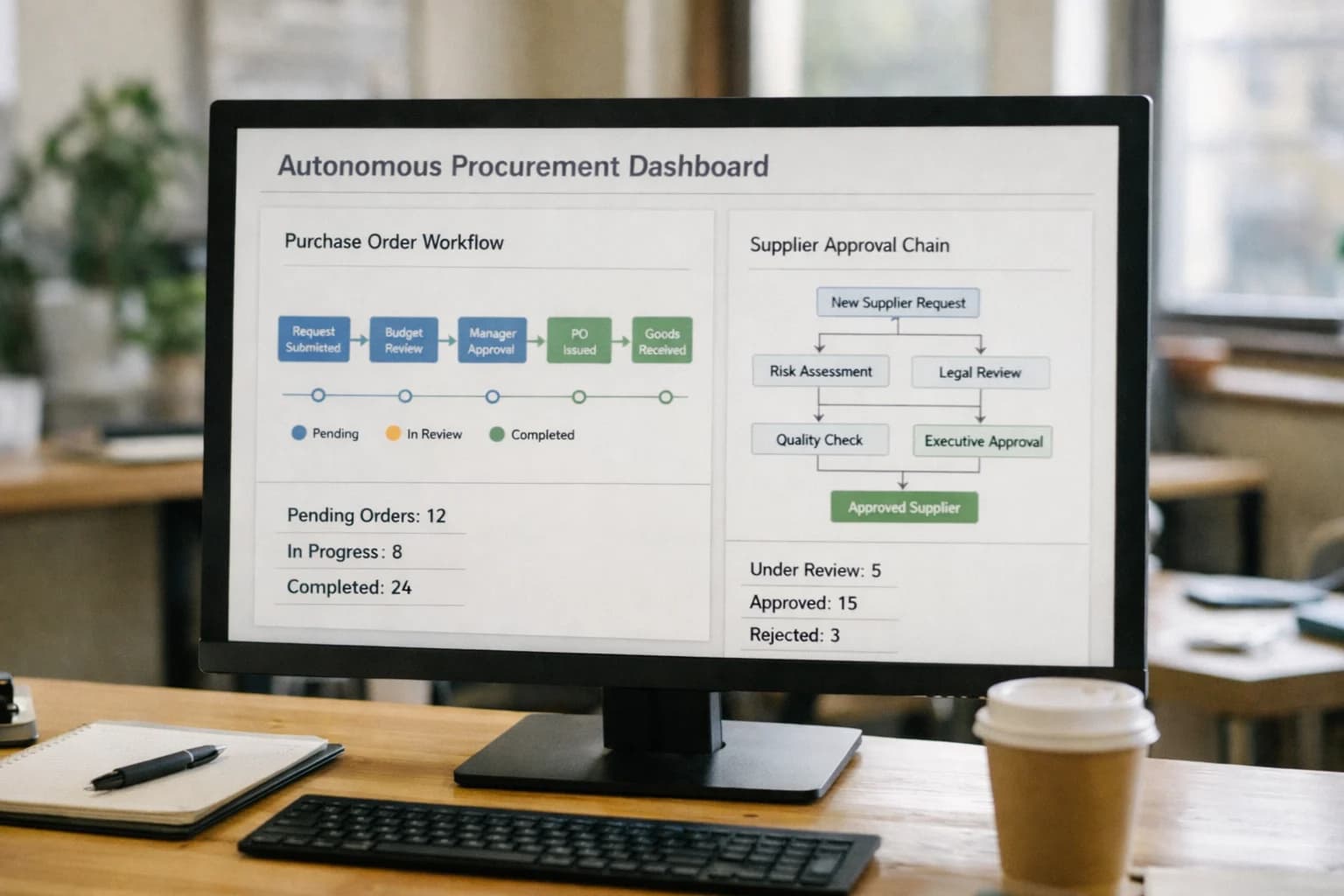
AI Integration for AI-Powered Freight Procurement in TMS
Automate the RFQ/RFP lifecycle in your Transportation Management System with AI agents for lane analysis, carrier scoring, and negotiation support, reducing procurement cycles from weeks to days.
AI integration transforms freight procurement from a reactive, manual bidding process into a proactive, data-driven negotiation engine.
The AI integration surface for freight procurement is the RFQ/RFP lifecycle within your TMS. This typically involves modules for lane package creation, bid management, carrier response collection, and award analysis. AI agents connect to these modules via APIs to automate the creation of intelligent bid packages—bundling lanes based on historical volume, seasonality, and strategic importance—and ingest structured and unstructured carrier responses (rates, terms, capacity commitments) for immediate analysis.
In practice, the integration creates a closed-loop system: An AI agent monitors your TMS for planned shipments and triggers the procurement workflow. It uses historical award data, current market benchmarks from integrated data feeds, and carrier performance scores to generate a scored shortlist and negotiation guidance. For example, the system can flag a carrier's rate as an outlier against the lane's predictive benchmark and suggest counter-offer terms, or identify a high-performing carrier whose capacity is at risk, prompting early engagement. The output isn't just a rate sheet; it's a prioritized playbook for your procurement specialists, turning days of analysis into hours.
Rollout is phased, starting with a pilot lane group. Governance is critical: all AI-generated recommendations should be logged with a clear audit trail showing the data sources and logic used. Final award decisions remain with the specialist, but the AI handles the heavy lifting of data consolidation and initial scoring. This approach de-risks implementation, builds trust, and allows for tuning of scoring models based on real procurement outcomes before scaling across the network. For a deeper look at AI-driven analysis for carrier contracts, see our guide on AI-Powered Carrier Selection in TMS.
AI-POWERED FREIGHT PROCUREMENT
Connecting AI to Your TMS Procurement Modules
Automating Lane Package Assembly
AI can transform the manual, spreadsheet-heavy process of building RFQ packages. By connecting to your TMS's historical shipment data, carrier contracts, and lane master, an AI agent can automatically generate comprehensive bid packages for upcoming procurement cycles.
Key Integration Points:
Shipment History Tables: Extract volume, service patterns, and past performance by lane.
Contract Management Module: Reference current rates, carrier commitments, and contract terms.
Lane & Network Definitions: Understand origin-destination pairs, accessorial requirements, and equipment needs.
The agent uses this data to propose which lanes to bundle, suggest optimal bid quantities, and pre-populate RFQ templates with relevant historical benchmarks. This reduces preparation from days to hours and ensures data-driven, consistent package creation.
TRANSPORTATION MANAGEMENT PLATFORMS
High-Value AI Use Cases for Freight Procurement
Integrating AI into your Transportation Management System (TMS) transforms the freight procurement process from a manual, reactive operation into a predictive, automated workflow. These use cases target the core RFQ/RFP lifecycle, delivering efficiency and intelligence for procurement specialists.
01
Automated Lane Package Creation
AI analyzes historical shipment data, current order books, and market forecasts to automatically generate RFQ packages for upcoming lanes. It identifies optimal bid timing, groups compatible lanes for volume discounts, and pre-populates tender documents with accurate specs, reducing manual data gathering from days to minutes.
Days -> Minutes
RFQ Prep Time
02
Intelligent Carrier Response Analysis
Instead of manual spreadsheet comparisons, an AI agent ingests all carrier bid responses. It extracts rates, transit times, and service terms, then scores and ranks carriers based on configurable criteria (cost, on-time performance, lane coverage). The system flags non-compliant bids and surfaces the most competitive options for review.
AI models benchmark incoming bids against historical contract rates, current spot market data, and lane-specific forecasts. The system provides procurement teams with data-driven negotiation points, suggesting target rates and identifying carriers with capacity likely to accept counter-offers, moving negotiations from gut feel to strategy.
Data-Driven
Negotiation Strategy
04
Automated Contract Generation & Load Tender
Upon award, AI drafts carrier contracts or rate confirmations by populating templates with negotiated terms. It then integrates with the TMS execution module to automatically tender the first wave of loads, sending booking instructions and documentation via the carrier's preferred channel (EDI, API, portal), closing the loop from bid to book.
1 Sprint
Implementation Timeline
05
Post-Award Performance Tracking & Insights
AI continuously monitors awarded carriers against contracted KPIs (on-time pickup/delivery, invoice accuracy). It generates predictive scorecards and alerts procurement to underperformance risks, providing actionable data for quarterly business reviews (QBRs) and informing the next RFQ cycle. Connect insights to platforms like /integrations/transportation-management-platforms/ai-integration-for-ai-powered-exception-management-in-tms for closed-loop correction.
06
Dynamic Spot Market Sourcing
For unplanned or overflow freight, an AI agent continuously scans digital freight boards and carrier networks for available capacity. It evaluates spot rates against budget and historical benchmarks, recommends the most cost-effective options, and can be configured to auto-book within pre-defined guardrails, ensuring coverage without manual firefighting.
Same Day
Coverage Assurance
FROM MANUAL RFQ TO AUTOMATED NEGOTIATION
Example AI-Powered Procurement Workflows
These workflows detail how AI agents and automations can be embedded into your Transportation Management System (TMS) to transform the freight procurement cycle from a reactive, manual process into a proactive, data-driven operation.
Trigger: A new annual bid cycle begins, or a new lane is added to the network.
Context/Data Pulled: The AI agent connects to the TMS and historical data platforms to gather:
Historical lane data (volumes, tender acceptance rates, service performance)
Current contracted rates and carrier performance scores
Forecasted shipment volumes from the ERP or demand planning system
Market benchmark data for the lane
Model/Agent Action: The agent analyzes the data to create an optimized bid package. It:
Segments lanes into strategic, tactical, and spot categories based on volume and criticality.
Recommends carrier shortlists for each lane, balancing incumbent performance with new carrier diversification.
Drafts the RFQ document, auto-populating lane details, volumes, and service requirements.
Suggests a negotiation strategy for each lane (e.g., target rate reduction, focus on capacity guarantees).
System Update/Next Step: The completed bid package is presented in the TMS procurement module for manager review and approval. Upon approval, the system automatically dispatches RFQs to the selected carriers via email or EDI.
Human Review Point: The procurement manager reviews the lane segmentation, carrier list, and suggested strategy before finalizing and sending the RFQ.
BUILDING A PRODUCTION-READY AI LAYER FOR TRANSPORTATION PROCUREMENT
Implementation Architecture: Data Flow & System Design
A practical blueprint for integrating AI agents into your TMS to automate and enhance the freight procurement lifecycle.
The integration architecture connects your TMS's procurement modules—typically the RFQ/RFP workspace, carrier management database, and rate management tables—to a dedicated AI orchestration layer. This layer ingests lane data (origin/destination, equipment, volume, service requirements) and historical carrier performance to automate the creation of intelligent bid packages. The core data flow is event-driven: a new procurement event in the TMS triggers a webhook to the AI system, which then calls internal APIs to fetch relevant lane history, incumbent carrier data, and market benchmarks before generating a structured, context-rich RFQ payload.
Within the AI layer, specialized agents handle discrete tasks: a Lane Analysis Agent enriches the package with predictive rate guidance and capacity forecasts; a Carrier Scoring Agent evaluates historical on-time performance, claims ratio, and compliance to pre-qualify and rank invitees; and a Response Analysis Agent parses incoming carrier bids, extracting key terms, exceptions, and pricing structures for side-by-side comparison. The system writes scoring summaries and negotiation talking points back to the TMS as notes attached to the procurement record, enabling procurement specialists to move from manual data aggregation to strategic decision-making in a single interface.
Rollout follows a phased, lane-specific approach, starting with a controlled pilot on a single commodity or lane group. Governance is critical: all AI-generated recommendations include confidence scores and source attribution (e.g., "based on 24 historical lanes with Carrier X"). Human-in-the-loop approval gates are maintained for final carrier selection and rate acceptance, with a full audit trail of AI-suggested actions and user overrides logged back to the TMS for compliance. This architecture, built with tools like CrewAI or n8n for orchestration and integrated with your existing data warehouse for historical analysis, ensures the AI augments—rather than replaces—the specialist's expertise, turning a multi-week process into a matter of days.
For teams looking to extend this pattern, the same orchestration layer can be adapted for related workflows like dynamic contract management or automated carrier onboarding. Explore our related guides on AI-Powered Carrier Selection in TMS and AI-Powered Freight Rate Forecasting to build a comprehensive procurement intelligence suite.
AI-POWERED FREIGHT PROCUREMENT
Code & Payload Examples
Automating RFQ Bundle Generation
This workflow uses historical shipment data and market intelligence to automatically create optimized RFQ packages for upcoming procurement cycles. The AI analyzes past lanes, volumes, seasonality, and carrier performance to group lanes strategically, balancing negotiation leverage with operational feasibility.
Example Python Payload for Lane Analysis API:
python
import requests
# Payload to request AI-generated lane packages
lane_analysis_request = {
"procurement_cycle": "Q4-2025",
"historical_data_source": "tms_shipments_table",
"filters": {
"origin_regions": ["US-MIDW", "US-SOUTH"],
"destination_regions": ["US-NE", "US-WEST"],
"equipment_type": "DRYVAN",
"min_annual_volume": 50
},
"optimization_goals": ["cost_reduction", "service_level", "carrier_diversification"],
"max_lanes_per_package": 15
}
# Call the AI service endpoint
response = requests.post(
'https://api.your-ai-service.com/v1/procurement/lane-packages',
json=lane_analysis_request,
headers={'Authorization': 'Bearer YOUR_API_KEY'}
)
# Response contains grouped lanes with rationale
packages = response.json()['lane_packages']
for pkg in packages:
print(f"Package {pkg['id']}: {len(pkg['lanes'])} lanes")
print(f"Rationale: {pkg['grouping_rationale']}")
The response includes scored lane bundles ready for RFQ distribution, with explanations for each grouping to guide procurement specialists.
AI-Powered Freight Procurement
Realistic Time Savings & Operational Impact
This table illustrates the operational impact of integrating AI into the RFQ/RFP process within a TMS, focusing on realistic time savings and workflow improvements for procurement specialists.
Procurement Workflow Step
Before AI Integration
After AI Integration
Implementation Notes
Lane Package Creation
Manual data pull, spreadsheet assembly (2-4 hours per package)
Automated data aggregation and document drafting (15-30 minutes)
AI uses historical lane data, contract rates, and volume forecasts from TMS.
Carrier Shortlisting & Invitation
Manual review of carrier history and service maps (1-2 hours)
AI-assisted scoring and automated invitation dispatch (10-15 minutes)
Model scores carriers on historical on-time performance, lane coverage, and cost.
Proposal (Rate & Capacity) Analysis
Manual spreadsheet comparison across dozens of line items (3-5 hours)
Automated extraction, normalization, and side-by-side analysis (30-45 minutes)
AI parses unstructured carrier responses, flags non-compliant rates, and highlights outliers.
Carrier Scoring & Negotiation Prep
Subjective weighting and manual scoring (1-2 hours)
Weighted, multi-factor scoring with rationale and counter-offer suggestions (20 minutes)
System provides data-backed talking points (e.g., 'Carrier X is 12% above lane average').
Award Recommendation & Documentation
Manual compilation of analysis into presentation decks (1-3 hours)
Automated generation of award summary with key metrics and visuals (15 minutes)
Final human approval required; documentation auto-synced to TMS carrier contract module.
Post-Award Carrier Onboarding
Email/phone follow-up for capacity commitments and system setup (Ongoing over days)
Automated workflow triggers for capacity confirmation and portal access (Same-day initiation)
AI monitors for carrier response delays and escalates to procurement specialist.
Spend Analysis & Contract Compliance
Quarterly manual audit against awarded rates (8-16 hours per quarter)
Continuous monitoring with anomaly alerts and quarterly summary reports (1-2 hours review)
AI compares invoiced rates in TMS to contracted rates, flagging discrepancies for review.
ARCHITECTING FOR CONTROL AND CONFIDENTIALITY
Governance, Security & Phased Rollout
Implementing AI for freight procurement requires a secure, governed approach that integrates with existing TMS workflows and approval chains.
The integration architecture connects to your TMS (e.g., Oracle TMS, SAP TM) via its Procurement or Bid Management APIs. AI agents act as a middleware layer, ingesting lane data, historical rates, and carrier performance records to generate RFQ packages. All sensitive data—including contract rates, carrier financials, and negotiation history—remains within your secure cloud environment. The AI's outputs (scored carrier responses, negotiation points) are written back to the TMS as structured notes or custom objects, creating a full audit trail within the system of record. This ensures procurement specialists review and approve all AI-generated recommendations within their familiar TMS interface before any tender is issued.
A phased rollout is critical for adoption and risk management. Phase 1 typically targets a single, high-volume lane or a specific commodity group. The AI is configured to analyze historical bids and generate the initial RFQ package, but all carrier communication and final award decisions remain manual. This builds trust in the AI's lane packaging and scoring logic. Phase 2 expands to more lanes and introduces automated carrier response analysis, flagging non-compliant bids and highlighting best-value options based on configurable cost/service weightings. Phase 3 enables the AI to suggest counter-offer strategies and draft initial negotiation communications, all subject to specialist approval.
Governance is enforced through role-based access controls (RBAC) mirroring your TMS permissions. For instance, only senior procurement managers might access the AI's rate forecasting models or adjust its scoring algorithms. Every AI-suggested action is logged with a user attribution for compliance. Furthermore, the system should include a human-in-the-loop (HITL) checkpoint for any communication with carriers or final award decisions, ensuring the specialist retains ultimate control. Regular model performance reviews against key metrics—like cost savings achieved, carrier acceptance rates, and procurement cycle time reduction—ensure the AI's recommendations remain aligned with business goals.
Security extends to the AI models themselves. Proprietary rate intelligence and negotiation strategies developed by your team are used to fine-tune foundational models, creating a competitive advantage that stays within your firewall. For highly sensitive data, consider a retrieval-augmented generation (RAG) architecture that keeps raw carrier contracts and confidential bid documents in a private vector store, allowing the AI to reference them without storing their content in its parameters. This approach, combined with robust API authentication and encrypted data-in-transit, meets the security standards required for strategic procurement data. For more on securing AI data flows, see our guide on AI Governance and LLMOps Platforms.
Enabling Efficiency, Speed & Accuracy
Intelligent Analysis, Decision & Execution
We build AI systems for teams that need search across company data, workflow automation across tools, or AI features inside products and internal software.
AI-POWERED FREIGHT PROCUREMENT
Frequently Asked Questions
Practical questions about implementing AI agents and automations for the RFQ/RFP process within your Transportation Management System.
This workflow automates the data-intensive first step of procurement.
Trigger: A procurement specialist initiates a new RFQ event in the TMS for a set of lanes, or a scheduled quarterly procurement cycle begins.
Context/Data Pulled: The AI agent queries the TMS and connected data sources for:
Historical lane data (volumes, dates, equipment types)
Past carrier performance and rates
Current contract rates and tender acceptance history
Any special requirements (temperature control, hazmat, accessorials)
Model/Agent Action: Using this context, the LLM generates a structured, comprehensive lane package. This includes:
A clear cover letter with bid instructions and timeline.
Detailed lane-specific tables with origin/destination, expected volumes, and equipment specs.
Pre-populated rate sheets in the required format (e.g., per mile, flat rate, fuel surcharge table).
System Update/Next Step: The completed package is saved as a draft in the TMS's bid management module and queued for a procurement specialist's review and approval before distribution.
About the author
Prasad Kumkar
CEO & MD, Inference Systems
Prasad Kumkar is the CEO & MD of Inference Systems and writes about AI systems architecture, LLM infrastructure, model serving, evaluation, and production deployment. Over 5+ years, he has worked across computer vision models, L5 autonomous vehicle systems, and LLM research, with a focus on taking complex AI ideas into real-world engineering systems.
His work and writing cover AI systems, large language models, AI agents, multimodal systems, autonomous systems, inference optimization, RAG, evaluation, and production AI engineering.
Partnered with leading AI, data, and software stack.
How We Work
Custom AI workflows for your Business
One-fit-all AI don't work for modern businesses. At Inferensys, we aim to understand your business & custom requirements; which we use to define most efficient agentic workflows, the data, and the tools for your business.
The first call is a practical review of your use case and the right next step.