Modern translation management platforms (TMS) like Smartling, Phrase, Lokalise, and Crowdin are built as orchestration hubs, not endpoints. AI models connect at three key integration points: 1) Pre-translation analysis, where models classify content complexity, extract terminology, and recommend routing; 2) Translation suggestion, where NMT or LLM engines plug into the translator's workflow via the TMS API to provide real-time, context-aware suggestions; and 3) Post-translation QA, where custom models run automated checks for brand voice, regulatory compliance, and consistency beyond basic string matching. The TMS acts as the system of record, managing the job lifecycle, human review queues, and final delivery, while AI models operate as stateless services called via API.

Integration
AI Integration for Translation with AI Models
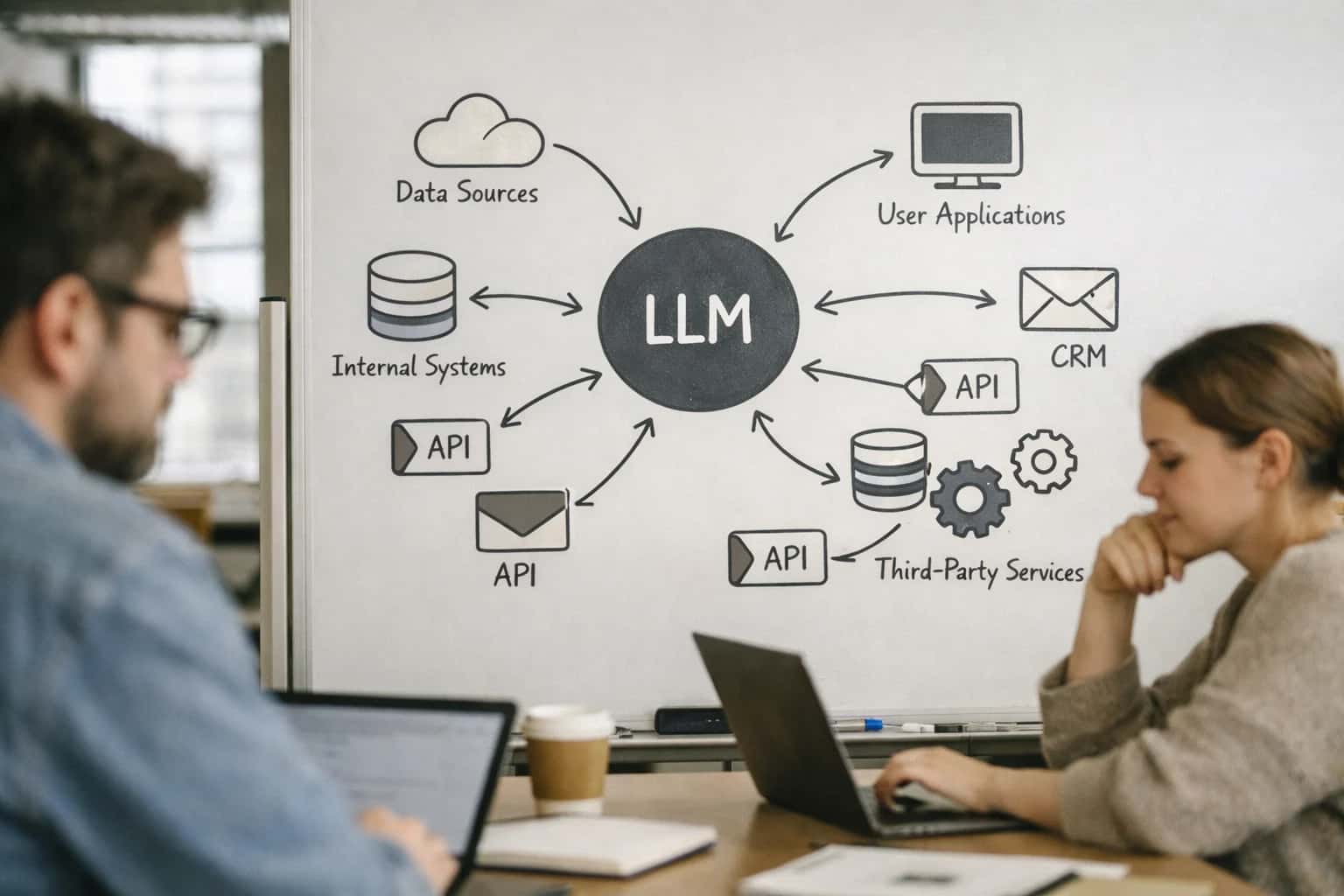
Where AI Models Fit Into Your Translation Stack
A practical guide to connecting AI translation models into your TMS, from pre-translation analysis to post-editing workflows.
For a production implementation, you'll wire AI services into the TMS via its webhook and REST API layer. A common pattern is to set up a middleware service that listens for TMS events (e.g., job.created, string.ready_for_translation), enriches the payload with context from a connected vector database or knowledge base, calls the appropriate AI model (balancing cost, speed, and domain specificity), and posts the results back. Governance is critical: implement RBAC to control which projects or content types can use AI, maintain audit logs of all AI-suggested segments, and set up human-in-the-loop approval gates for high-risk content. This architecture keeps your core translation memory and vendor relationships intact while augmenting them with AI-driven velocity.
Rollout should be phased. Start with low-risk, high-volume content like internal communications or repetitive UI strings, using AI for first-pass translation with human post-editing. Measure acceptance rates and time savings. Next, integrate AI into terminology management, using models to auto-suggest new terms from source documents and validate consistency. Finally, deploy predictive QA agents that pre-flag potential issues for reviewers. Avoid a "big bang" replacement of human translators; the goal is to use AI to handle repetitive tasks and provide context, freeing your linguists for high-value creative and strategic work. For a deeper look at orchestrating these models, see our guide on AI Integration for Translation Management RAG.
Integration Touchpoints in a TMS
Automating the Translation Pipeline
The core of a TMS is the translation job. AI integration here focuses on intelligent orchestration. Use the TMS API (e.g., Smartling's JobsApi, Phrase's JobsApi) to create jobs programmatically, but inject AI logic to decide which content gets which model.
For example, an AI agent can analyze source strings upon ingestion:
- High-Complexity/High-Risk Content: Route to a premium LLM (GPT-4, Claude 3) or flag for human translation only.
- Medium-Complexity Content: Send to a cost-optimized, fine-tuned NMT model for draft generation, then to human post-editing.
- Low-Risk/Repetitive Content: Send directly to a fast, low-cost model (like a dedicated NMT engine) for fully automated translation, with optional light QA.
This decision layer, often built as a microservice listening to TMS webhooks, uses metadata, content classification, and historical quality scores to optimize for cost, speed, and final quality.
High-Value AI Translation Use Cases
Practical AI integration patterns for Smartling, Phrase, Lokalise, and Crowdin that connect LLMs and custom models to core localization workflows, reducing manual effort and accelerating time-to-market for global content.
AI-Powered Translation Suggestion Engine
Integrate LLMs (OpenAI, Claude) or custom NMT models via the TMS API to provide real-time, in-context translation suggestions within the translator's workbench. Grounds outputs in project-specific Translation Memory and terminology to reduce cognitive load and post-editing effort by ~40%.
Automated Terminology Management & Enforcement
Use NLP models to automatically extract candidate terms from source content and connected brand assets. Integrate with the TMS glossary API to suggest, validate, and enforce approved terminology across all projects, eliminating manual glossary maintenance and ensuring brand consistency.
Context-Aware Quality Assurance (QA) Automation
Deploy custom AI models as additional QA steps via webhook or plugin architecture. Move beyond basic checks to analyze tone, brand voice, regulatory compliance, and contextual accuracy (e.g., checking UI string length against design mockups), flagging high-risk segments for human review.
Intelligent Translation Job Routing & Orchestration
Build an AI agent that analyzes incoming content (complexity, domain, urgency) and automatically routes strings to the optimal resource: internal team, preferred vendor, or cost-effective MT engine. Integrates with TMS project creation APIs and vendor management modules to optimize cost and speed.
RAG for Translator Context & Knowledge Retrieval
Implement a Retrieval-Augmented Generation (RAG) system using a vector database (Pinecone, Weaviate) indexed with product documentation, past decisions, and style guides. Connect it to the TMS via API to provide translators with semantic search and Q&A for ambiguous strings, reducing back-and-forth queries.
Predictive Localization Analytics & Planning
Integrate AI analytics on top of TMS historical data (via reporting APIs) to forecast translation volume, costs, and bottlenecks. Use these insights to proactively allocate budgets, schedule linguist capacity, and identify high-impact optimization opportunities in the localization pipeline.
Example AI-Enhanced Translation Workflows
These concrete workflows demonstrate how to integrate AI models into a Translation Management Platform (TMS) like Smartling, Phrase, Lokalise, or Crowdin. Each pattern connects specific TMS APIs and webhooks to AI services to automate tasks, improve quality, and accelerate delivery.
Trigger: A translator opens a new segment for translation in the TMS editor.
Workflow:
- A browser extension or integrated sidebar app detects the segment's unique key and project ID.
- It calls a backend service with the key, which queries the TMS API (e.g.,
GET /projects/{projectId}/keys/{keyId}) to fetch the source string and metadata (e.g., file name, context description). - The service then uses a Retrieval-Augmented Generation (RAG) system to find relevant context:
- It searches a vector database containing past translations, product documentation, and style guides using the source string as a query.
- It retrieves the top 3 most semantically similar passages.
- An LLM (like GPT-4) is prompted to synthesize a concise context note:
`Based on the product docs, this string is a button in the billing settings screen. The term 'invoice' should match our glossary ID INV-01.` - This note is displayed next to the translation field in the editor, giving the translator immediate, grounded context without manual searching.
System Update: The context note is logged for audit purposes. Translator acceptance rate of AI-suggested translations can be tracked to improve retrieval relevance.
Implementation Architecture: The AI Orchestration Layer
A practical blueprint for integrating AI translation models into your TMS as a managed, governed service layer.
Effective integration treats the TMS—be it Smartling, Phrase, Lokalise, or Crowdin—as the system of record, while AI models operate as a configurable, upstream service layer. This is typically implemented via a central AI Orchestrator that sits between your content sources and the TMS API. The orchestrator handles key decisions: it analyzes incoming content (via webhook or scheduled job), determines the optimal model—choosing between a fast, generic NMT for simple UI strings, a fine-tuned LLM for marketing copy, or a custom model for domain-specific terminology—and routes the request. It also manages context injection, pulling relevant segments from the TMS's translation memory and glossary via API to ground the AI's output in your approved terminology before the suggestion is posted back to the TMS for human review or automated acceptance.
The orchestrator's logic is driven by metadata and rules defined in the TMS. For example, a project in Smartling tagged as marketing-high-touch might trigger a different, more expensive LLM pipeline than a development-low-risk project. This model routing is coupled with cost and quality governance: the orchestrator logs every inference for audit, can enforce fallback to human translation for content exceeding a confidence threshold, and integrates with approval workflows. Implementation involves setting up secure service accounts with appropriate TMS API permissions (often project manager or admin level), establishing idempotent webhook listeners for events like job.created or string.added, and building a retry/queue mechanism for reliable processing during TMS or model API outages.
Rollout follows a phased, content-type-first approach. Start by connecting the orchestrator to a single, low-risk Smartling workflow or a specific Lokalise project for automated translation of repetitive, high-volume content like product attribute values. Use this pilot to validate the quality gates, cost tracking, and the human-in-the-loop review steps configured in your TMS. Governance is critical; establish a clear AI usage policy within the TMS—using Phrase's custom fields or Crowdin's tags to mark which strings are AI-translated and which require mandatory post-editing. This architecture turns your TMS from a passive platform into an intelligent hub, where AI augments human linguists by handling the predictable work, while the TMS maintains control, consistency, and compliance across all multilingual content operations.
Code & Payload Examples
Automating Translation Job Submission
Use the TMS API to create projects and submit strings for translation programmatically. This is the foundation for integrating AI models that pre-process or analyze source content before submission.
Example: Create a job via Smartling API
pythonimport requests # Authenticate and create a translation job api_key = 'YOUR_SMARTLING_TOKEN' project_id = 'your-project-id' url = f'https://api.smartling.com/jobs-api/v3/projects/{project_id}/jobs' headers = { 'Authorization': f'Bearer {api_key}', 'Content-Type': 'application/json' } # Payload for a new job, potentially enriched by AI analysis payload = { 'jobName': 'AI-Preprocessed Marketing Campaign - Q3', 'description': 'Campaign copy analyzed for brand tone and complexity by AI.', 'targetLocaleIds': ['fr-FR', 'de-DE', 'ja-JP'], 'dueDate': '2024-12-01T00:00:00Z', 'referenceNumber': 'CAMPAIGN-Q3-2024', 'customFields': { 'ai_confidence_score': 0.92, # Added by your AI model 'content_type': 'marketing', 'priority_tier': 'high' } } response = requests.post(url, headers=headers, json=payload) job_uid = response.json()['response']['data']['translationJobUid']
This pattern allows you to embed AI-generated metadata (ai_confidence_score, content_type) directly into the job, enabling smarter routing and workflow automation within the TMS.
Realistic Impact: Time Saved & Quality Gains
This table compares typical manual translation management tasks against an AI-integrated workflow, showing realistic efficiency gains and quality improvements achievable by connecting AI models to a TMS like Smartling, Phrase, Lokalise, or Crowdin.
| Metric | Before AI | After AI | Notes |
|---|---|---|---|
Terminology Glossary Creation | Manual extraction & entry: 4-8 hours per project | AI-assisted extraction & suggestions: 1-2 hours per project | AI scans source docs, suggests terms; human finalizes and approves. |
Initial Translation of High-Volume Content | Human translation only: Days to weeks | AI-first draft with human post-edit: Hours to 1-2 days | AI handles bulk translation; linguists focus on refinement and nuance. |
Quality Assurance (QA) Checks | Manual review for style/consistency: 30-60 min per 1k words | AI pre-flags potential issues: 5-10 min review per 1k words | AI runs automated checks for glossary adherence, tone, and basic errors. |
Translation Memory (TM) Maintenance | Quarterly manual cleanup & deduplication | AI-driven ongoing deduplication & optimization alerts | AI identifies redundant or conflicting entries, suggests merges. |
Context Provision for Translators | Manual search through docs/designs for context | AI retrieves & surfaces relevant context automatically | RAG system pulls from product specs, UI screenshots, and past translations. |
Project Setup & String Routing | Manual file parsing, job creation, and vendor assignment | AI classifies content & auto-routes based on domain/urgency | AI analyzes content type (UI, legal, marketing) to determine best workflow. |
Stakeholder Reporting | Manual data pull and spreadsheet analysis | AI-generated narrative reports with insights & anomalies | AI synthesizes TMS data into actionable summaries for product/marketing teams. |
Governance, Security, and Phased Rollout
A controlled, secure approach to integrating AI translation models into your TMS environment.
Integrating AI models into a TMS like Smartling, Phrase, Lokalise, or Crowdin requires a governance layer that sits between the platform's APIs and the AI service. This typically involves a middleware service or agent that handles secure API calls, prompt management, and response routing. Key architectural components include: a secure credential store for TMS and AI model API keys, a queuing system (e.g., Redis, RabbitMQ) to manage translation job requests and avoid timeouts, and a vector database for RAG implementations that ground LLM outputs in your approved translation memory (TM) and term bases. The integration should use the TMS's webhooks (for event-driven triggers) and REST APIs (for job creation and string management) to maintain the TMS as the system of record.
A phased rollout is critical for managing risk and building trust. Start with a pilot in a low-risk, high-volume workflow, such as auto-translating internal knowledge base articles or pre-filling first drafts for human post-editing. Implement a human-in-the-loop (HITL) review gate as a mandatory step in the TMS workflow for all AI-generated content initially. Use the TMS's built-in QA check system or custom webhooks to flag segments for review based on confidence scores or content type. For governance, ensure all AI-suggested translations are logged with metadata: model version, prompt used, source segment hash, and reviewer actions. This creates an audit trail for quality control and model retraining.
Security and compliance are paramount. All data transmitted to external AI models must be scrubbed of PII and sensitive intellectual property. For regulated industries, consider using on-premise or VPC-deployed open-source models (like Llama or Mixtral) instead of public cloud APIs. Implement strict role-based access controls (RBAC) within your integration layer to determine which projects, languages, or content types can trigger AI translation, often mirroring permissions set in the TMS itself. Finally, establish a cost governance mechanism to monitor and cap AI model usage per project or department, integrating with the TMS's reporting APIs to attribute expenses accurately.
Enabling Efficiency, Speed & Accuracy
Intelligent Analysis, Decision & Execution
We build AI systems for teams that need search across company data, workflow automation across tools, or AI features inside products and internal software.
Talk to Us
Search across company data
Give teams answers from docs, tickets, runbooks, and product data with sources and permissions.
Useful when people spend too long searching or get different answers from different systems.

Automate internal workflows
Use AI to route work, draft outputs, trigger actions, and keep approvals and logs in place.
Useful when repetitive work moves across multiple tools and teams.

Add AI to products and internal tools
Build assistants, guided actions, or decision support into the software your team or customers already use.
Useful when AI needs to be part of the product, not a separate tool.
Frequently Asked Questions
Practical questions for technical leaders evaluating how to connect AI models to platforms like Smartling, Phrase, Lokalise, and Crowdin.
A secure integration typically involves a middleware service (an AI gateway) that sits between your TMS and the LLM provider. Here’s a common pattern:
- Trigger: A translator opens a segment in the TMS editor.
- Context Fetch: Your middleware service calls the TMS API (e.g., Smartling's
context/stringAPI) to get the source string, surrounding context, and relevant translation memory (TM) matches. - Secure Call: The middleware constructs a prompt with the context and calls the LLM provider's API (e.g., OpenAI, Anthropic) using a secure, private endpoint. All calls should be logged and encrypted in transit.
- Post-Processing & Injection: The LLM's suggestion is validated (e.g., checked for placeholder integrity) and then injected back into the TMS editor via its UI extension or real-time suggestion API.
Key Security Considerations:
- Use environment-specific API keys stored in a secrets manager.
- Implement request rate limiting and cost tracking at the middleware layer.
- Ensure your data processing agreement with the LLM vendor covers your content, or use a self-hosted model.
- For highly sensitive strings, implement a policy engine in your middleware to skip AI processing entirely.

About the author
Prasad Kumkar
CEO & MD, Inference Systems
Prasad Kumkar is the CEO & MD of Inference Systems and writes about AI systems architecture, LLM infrastructure, model serving, evaluation, and production deployment. Over 5+ years, he has worked across computer vision models, L5 autonomous vehicle systems, and LLM research, with a focus on taking complex AI ideas into real-world engineering systems.
His work and writing cover AI systems, large language models, AI agents, multimodal systems, autonomous systems, inference optimization, RAG, evaluation, and production AI engineering.
Partnered with leading AI, data, and software stack.





How We Work
Custom AI workflows for your Business
One-fit-all AI don't work for modern businesses. At Inferensys, we aim to understand your business & custom requirements; which we use to define most efficient agentic workflows, the data, and the tools for your business.
01
Review the use case
We understand the task, the users, and where AI can actually help.
Read more02
Pick the right approach
We define what needs search, automation, or product integration.
Read more03
Build the first useful version
We implement the part that proves the value first.
Read more04
Improve from there
We add the checks and visibility needed to keep it useful.
Read moreThe first call is a practical review of your use case and the right next step.
Talk to Us