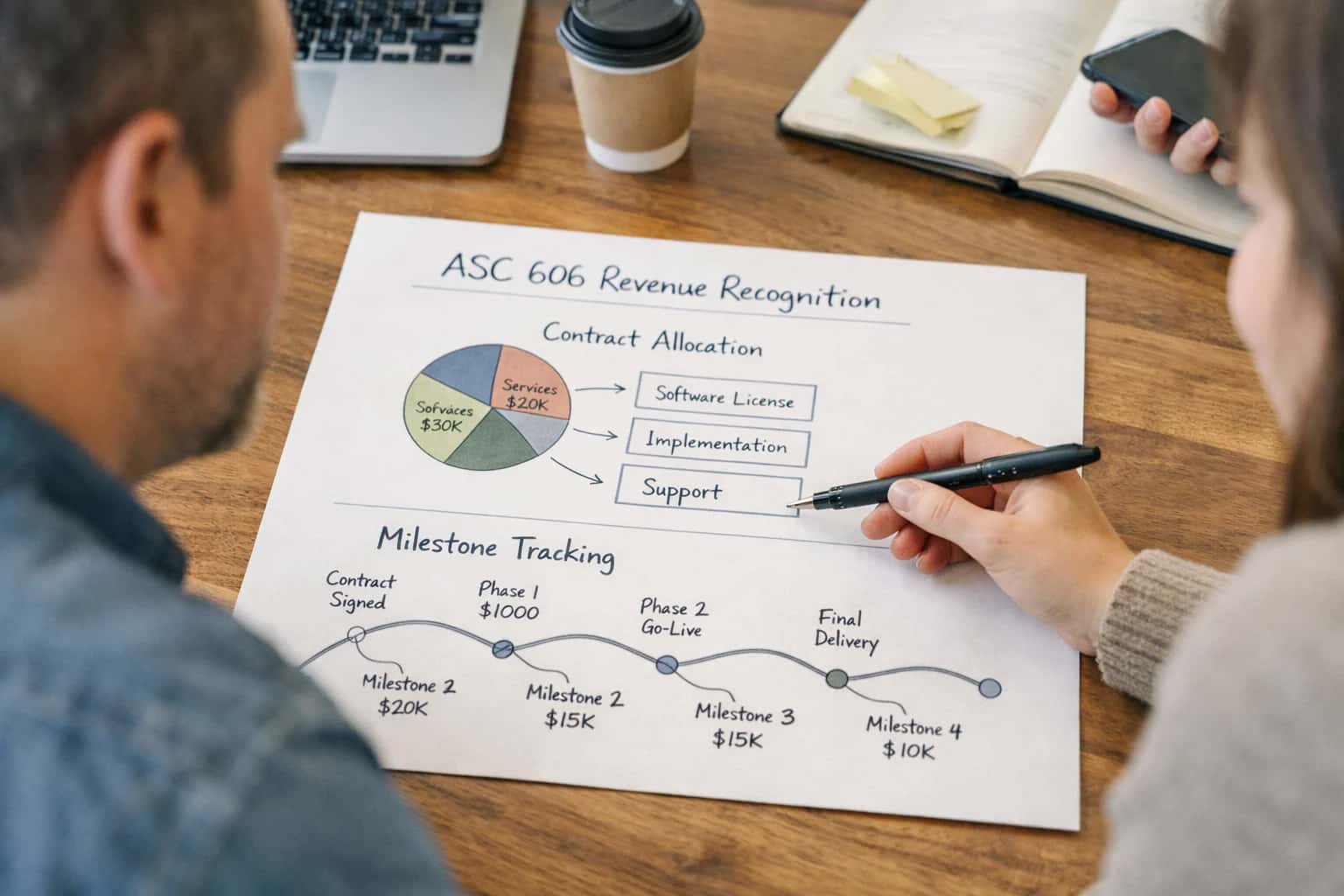
AI integration for Zuora Revenue focuses on three core surfaces: the Revenue Schedules and Revenue Contracts objects for automated recognition, the Revenue Recognition Rules engine for compliance logic, and the Revenue Waterfall and reporting modules for predictive analytics. The primary workflow involves using AI agents to ingest contract modifications, usage amendments, or new orders from Zuora Billing or an external CPQ, then automatically generating or adjusting the corresponding revenue schedules. This eliminates manual data entry and reduces the risk of human error in applying ASC 606/IFRS 15 standards.

Integration
AI Integration for Zuora Revenue Management
A technical blueprint for using AI to automate complex revenue recognition workflows, forecast recognized revenue, and ensure compliance within Zuora Revenue, reducing manual effort from days to hours.
ARCHITECTURE AND IMPLEMENTATION
Where AI Fits into Zuora Revenue Management
Integrating AI with Zuora Revenue automates complex accounting workflows, enhances forecast accuracy, and ensures continuous compliance.
Implementation typically involves an AI layer that sits between your transactional systems and Zuora's REST API. For example, an agent can be triggered by a Contract Amendment webhook, analyze the modified terms (new line items, price changes, term extensions), and call Zuora Revenue's API to create a Revenue Schedule Amendment with the appropriate recognition pattern. For forecasting, another agent can periodically query the Revenue Waterfall and Deferred Revenue reports, vectorize the time-series data, and run predictive models to forecast recognized revenue under different renewal or churn scenarios, surfacing insights directly in tools like Tableau or a custom RevOps dashboard.
Rollout requires careful governance. Start with a pilot on a single product line or business unit, using the AI to generate draft schedules for human accountant review and approval within Zuora's workflow tools. Implement strict audit logging for all AI-generated transactions, tagging them with the source prompt and data payload. This creates a clear lineage for compliance audits. The final architecture should treat the AI as a co-pilot to the finance team, automating the repetitive data processing while reserving complex judgments and final approvals for qualified personnel, ensuring both efficiency and control.
ARCHITECTURAL BLUEPOINTS FOR AI
Key Integration Surfaces in Zuora Revenue
Automating ASC 606 / IFRS 15 Compliance
AI can be integrated with Zuora Revenue's Revenue Recognition Schedule objects to automate the creation, adjustment, and forecasting of revenue schedules. This is critical for handling contract modifications, renewals, and performance obligations.
Key integration points:
- Schedule Generation: Use AI to analyze new sales contracts from Zuora CPQ or CRM systems, automatically mapping line items to performance obligations and generating initial recognition schedules via Zuora Revenue API.
- Modification Handling: When a subscription amendment occurs, an AI agent can assess the impact (e.g., price change, term extension), calculate the contract modification under the prospective or cumulative catch-up method, and post the necessary adjusting journal entries.
- Forecasting & Anomaly Detection: By querying scheduled revenue data, AI models can forecast recognized revenue for future periods and flag anomalies—such as a schedule failing to post—for immediate review.
Implementation typically involves listening to Subscription and Amendment webhooks from Zuora Billing, processing contract data, and calling Zuora Revenue's POST /revenue-schedules and PUT /revenue-schedules/{rs-number}/adjustment endpoints.
AUTOMATE COMPLIANCE & FORECASTING
High-Value AI Use Cases for Zuora Revenue
Integrate AI with Zuora Revenue to automate complex revenue recognition schedules, forecast recognized revenue, analyze contract modifications, and ensure continuous compliance with ASC 606 and IFRS 15 standards.
01
Automated Revenue Schedule Generation
Use AI to ingest new sales contracts and automatically generate compliant revenue recognition schedules within Zuora Revenue. The agent parses contract terms, identifies performance obligations, and determines the appropriate recognition pattern (ratable, point-in-time, variable consideration), reducing manual setup from hours to minutes and minimizing human error in critical financial data.
Hours -> Minutes
Schedule creation
02
Forecast Recognized Revenue
Build predictive models that analyze historical recognition patterns, contract pipelines, and seasonality to forecast future recognized revenue. This AI-driven forecast integrates with Zuora Revenue data to provide Finance and RevOps with forward-looking visibility for cash flow planning, board reporting, and investor communications, moving beyond simple backlog analysis.
Real-time
Forecast updates
03
Intelligent Contract Modification Analysis
Deploy an AI agent to assess the financial impact of contract modifications (e.g., upgrades, downgrades, term extensions). The system reviews the change against the original POBs in Zuora Revenue, calculates the required cumulative catch-up adjustment or prospective change, and drafts the journal entry logic for accountant review, ensuring modifications are handled accurately and auditably.
1 sprint
Implementation cycle
04
Continuous Compliance Monitoring
Implement an AI copilot for the finance team that continuously monitors revenue transactions and schedules in Zuora Revenue for compliance risks. It flags anomalies like unrecognized variable consideration, misapplied contract combinations, or missing disclosures. The agent can generate preliminary audit trails and suggest remediation steps, shifting compliance from a quarterly scramble to an ongoing managed process.
Proactive
Risk detection
05
AI-Powered Revenue Reconciliation
Automate the tedious reconciliation between billed revenue in Zuora Billing and recognized revenue in Zuora Revenue. An AI workflow matches invoices to recognition schedules, identifies and classifies discrepancies (e.g., timing differences, errors), and generates reconciliation reports. This closes the loop between billing operations and accounting, ensuring the general ledger is always accurate.
Batch -> Real-time
Reconciliation
06
Natural Language Revenue Reporting
Empower financial analysts with a natural language interface to query Zuora Revenue data. Instead of building complex reports, users can ask questions like "What was recognized revenue for Product X in EMEA last quarter?" or "Show me deferred revenue by customer segment." The AI agent translates the query, fetches the data via API, and returns a formatted answer or chart, democratizing access to complex revenue data.
ZUORA REVENUE MANAGEMENT
Example AI-Powered Revenue Workflows
These workflows demonstrate how AI agents can automate complex revenue recognition tasks, analyze contract modifications, and generate predictive forecasts within Zuora Revenue, reducing manual effort and improving compliance.
Trigger: A new subscription contract is created or amended in Zuora Billing, generating a Contract or Amendment object.
AI Agent Action:
- The agent retrieves the full contract/amendment details, including line items, pricing, start/end dates, and performance obligations.
- It analyzes the contract terms against configured revenue recognition policies (e.g., ASC 606, IFRS 15).
- Using a reasoning model, the agent determines the appropriate recognition pattern (ratable, point-in-time, variable consideration) and calculates the revenue schedule.
- It drafts the schedule in the required Zuora Revenue data format.
System Update: The agent posts the draft schedule to the Zuora Revenue API (POST /revenue-schedules). For amendments, it calculates the catch-up adjustment and creates the necessary modifying journal entry.
Human Review Point: Before final posting, the schedule can be routed via webhook to a designated finance user's queue in a tool like Slack or Microsoft Teams for a final "approve/reject" based on the agent's reasoning summary.
FROM SCHEDULE TO FORECAST
Implementation Architecture: Data Flow & Guardrails
A production-ready AI integration for Zuora Revenue connects to core objects, automates compliance-heavy workflows, and requires specific data governance.
The integration architecture centers on Zuora Revenue's Revenue Schedules, Revenue Events, and Contract Amendments. An AI agent, typically deployed as a containerized service, polls the GET /revenue-schedules and GET /revenue-events APIs to ingest new or modified records. For forecasting, the system also pulls historical Recognized Revenue data and related Subscription and Invoice objects from Zuora's central tenant. This data is transformed, with key fields (like performance obligation, allocation, and recognition start/end dates) embedded into a vector store to enable semantic search and pattern matching for similar contracts.
Core AI workflows operate on this enriched data: Automated Schedule Generation parses new contract amendments to propose updated revenue schedules, Anomaly Detection flags recognition entries that deviate from historical patterns or company policy, and Forecast Agent uses time-series analysis on recognized revenue to project future recognized amounts under various renewal and churn scenarios. Each workflow generates a proposed action (e.g., a new schedule, an audit flag, a forecast adjustment) that is posted back to Zuora Revenue via the POST /revenue-schedules or PUT /revenue-events APIs, but only after passing through a configurable approval queue or rule engine.
Governance is critical. All AI-generated proposals are logged with a full audit trail, including the source data snapshot, the prompt used, and the model's reasoning. A human-in-the-loop step is mandated for any schedule creation or modification exceeding a materiality threshold before the API call is executed. Access is controlled via Zuora's existing Role-Based Access Control (RBAC), ensuring only authorized finance users can approve AI actions. The system is designed for phased rollout: start with anomaly detection and read-only forecasting, then progress to automated draft schedule generation for low-risk amendments, ensuring compliance controls evolve with operational comfort.
ZUORA REVENUE API INTEGRATION PATTERNS
Code & Payload Examples
Automating ASC 606/IFRS 15 Compliance
Use AI to interpret contract modifications and automatically generate or adjust revenue schedules via Zuora's Revenue API. This pattern is ideal for handling amendments, renewals, or terminations, ensuring schedules are updated without manual finance team intervention.
Example Python payload to create a revenue schedule for a new subscription contract. The AI agent would generate this after parsing a signed order form.
pythonimport requests # Payload to create a revenue schedule for a 12-month, $12,000 contract schedule_payload = { "data": [{ "type": "revenueSchedule", "attributes": { "contractEffectiveDate": "2024-01-01", "revenueStartDate": "2024-01-01", "initialAmount": 12000.00, "accountingCode": "REV-SUBSCRIPTION", "recognitionRule": "Straight-line over term", "numberOfPeriods": 12, "periodType": "Month" }, "relationships": { "revenueItem": { "data": { "type": "revenueItem", "id": "RI-7e3c8a2b" # Linked to the subscription line item } } } }] } response = requests.post( 'https://rest.zuora.com/v1/revenue-schedules', json=schedule_payload, headers={'Authorization': 'Bearer YOUR_TOKEN'} )
ZUORA REVENUE MANAGEMENT
Realistic Time Savings & Operational Impact
How AI integration transforms manual, time-intensive revenue accounting workflows into automated, auditable processes.
| Workflow | Before AI | After AI | Implementation Notes |
|---|---|---|---|
Revenue Schedule Generation | Manual entry from contract amendments | Automated extraction & schedule creation | AI reviews contract PDFs and Zuora amendments to update schedules |
ASC 606 / IFRS 15 Compliance Check | Quarterly manual audit by finance team | Continuous automated policy validation | AI flags non-standard terms and suggests corrective journal entries |
Contract Modification Impact Analysis | Spreadsheet modeling, 4-8 hours per change | Automated P&L impact report in <30 minutes | AI simulates revenue recognition impact of plan changes, upgrades, and cancellations |
Deferred Revenue Reconciliation | Monthly manual reconciliation to GL | Daily automated sync and variance reporting | AI matches Zuora Revenue data to ERP (NetSuite/SAP) and explains discrepancies |
Revenue Forecasting for Recognized Revenue | Manual roll-up from spreadsheets | AI-generated forecasts with driver analysis | Model considers contract backlog, renewal probability, and seasonality trends |
Audit Trail and Documentation | Manual compilation for external auditors | Automated audit package generation | AI assembles change logs, rationale for adjustments, and compliance evidence |
Exception and Error Handling | Reactive investigation of failed postings | Proactive alerting with root cause | AI monitors posting queues, classifies errors, and suggests fixes or routes tickets |
ARCHITECTING CONTROLLED AI FOR REVENUE OPERATIONS
Governance, Security, and Phased Rollout
Integrating AI into Zuora Revenue requires a controlled approach that prioritizes data integrity, auditability, and incremental value delivery.
A production-ready integration is built on a secure, event-driven architecture. AI agents typically subscribe to Zuora's webhooks for key events like RevenueSchedule.Created or RevenueSchedule.Updated. These events, containing the relevant RevenueSchedule and RevenueEvent object data, are placed on a secure internal queue. An orchestration layer then processes these events, calling the AI model (e.g., for forecasting or anomaly detection) and posting results back to Zuora via its REST API, often writing insights into custom fields on the RevenueSchedule or creating related RevenueScheduleComment records for auditability. All API calls use role-based access control (RBAC) with scoped OAuth tokens, and all AI-generated outputs are logged with the source transaction ID for full traceability.
Rollout follows a phased, risk-managed path. Phase 1 focuses on assistive intelligence: deploying a read-only agent that analyzes completed revenue schedules to identify potential compliance deviations or unusual patterns, presenting findings in a dashboard for analyst review. Phase 2 introduces predictive workflows: using AI to forecast recognized revenue for open schedules based on historical patterns, with forecasts stored in a custom object and flagged for manual verification before any system-of-record updates. Phase 3 enables controlled automation: for low-risk, high-volume scenarios (e.g., standard monthly subscriptions), allowing the AI to automatically apply forecasted adjustments within a pre-defined, narrow tolerance band, with all actions logged and requiring weekly supervisory approval.
Governance is embedded into the workflow. Every AI-generated recommendation or adjustment is tagged with a confidence score and the key data points used in its reasoning. A human-in-the-loop (HITL) approval step is configured for any action exceeding a defined materiality threshold or affecting key accounts. Regular model performance is evaluated against actual outcomes (e.g., forecast vs. actual recognized revenue), with drift detection triggering a review. This structured approach ensures the AI augments—rather than disrupts—critical financial controls, turning Zuora Revenue into a system of intelligence while maintaining its role as the system of record. For related architectural patterns, see our guide on AI Integration for Billing Platforms and ERP Systems.
Enabling Efficiency, Speed & Accuracy
Intelligent Analysis, Decision & Execution
We build AI systems for teams that need search across company data, workflow automation across tools, or AI features inside products and internal software.
Talk to Us
Search across company data
Give teams answers from docs, tickets, runbooks, and product data with sources and permissions.
Useful when people spend too long searching or get different answers from different systems.
Enterprise searchRAGPermissions
Read more
Automate internal workflows
Use AI to route work, draft outputs, trigger actions, and keep approvals and logs in place.
Useful when repetitive work moves across multiple tools and teams.
AI agentsWorkflow automationGovernance
Read more
Add AI to products and internal tools
Build assistants, guided actions, or decision support into the software your team or customers already use.
Useful when AI needs to be part of the product, not a separate tool.
AI integrationDecision supportModel routing
Read moreZUORA REVENUE AI INTEGRATION
Frequently Asked Questions
Common questions from finance, RevOps, and IT teams planning AI integration for Zuora Revenue to automate recognition, forecasting, and compliance workflows.
AI integration connects primarily through Zuora's REST API and Data Query endpoints to access the core objects required for revenue intelligence.
Key data sources include:
- Revenue Schedules & Items: For analyzing recognition timelines and amounts.
- Revenue Contracts & Rules: To understand the configured ASC 606/IFRS 15 policies.
- Revenue Events & Adjustments: To process modifications, cancellations, and performance obligations.
- General Ledger Details: For mapping recognized revenue to accounts.
A typical integration architecture involves:
- Scheduled Extraction: Using Zuora's API or a pre-built connector to pull revenue data into a secure data store.
- Contextual Retrieval: Creating vector embeddings of contract summaries, rule descriptions, and amendment notes for semantic search.
- Agent Tool Calling: Enabling AI agents to call specific Zuora Revenue API endpoints (e.g.,
POST /v1/revenue-events) to post adjustments or generate reports, using OAuth 2.0 for authentication. - Webhook Processing: Subscribing to webhooks for events like
revenueSchedule.completedto trigger real-time AI analysis.
This approach keeps the core Zuora system as the source of truth while enabling AI-powered analysis and automation on a synchronized data layer.

About the author
Prasad Kumkar
CEO & MD, Inference Systems
Prasad Kumkar is the CEO & MD of Inference Systems and writes about AI systems architecture, LLM infrastructure, model serving, evaluation, and production deployment. Over 5+ years, he has worked across computer vision models, L5 autonomous vehicle systems, and LLM research, with a focus on taking complex AI ideas into real-world engineering systems.
His work and writing cover AI systems, large language models, AI agents, multimodal systems, autonomous systems, inference optimization, RAG, evaluation, and production AI engineering.
LinkedIn
Limited slotsGet a Free AI Consultation
Partnered with leading AI, data, and software stack.





How We Work
Custom AI workflows for your Business
One-fit-all AI don't work for modern businesses. At Inferensys, we aim to understand your business & custom requirements; which we use to define most efficient agentic workflows, the data, and the tools for your business.
01
Review the use case
We understand the task, the users, and where AI can actually help.
Read more02
Pick the right approach
We define what needs search, automation, or product integration.
Read more03
Build the first useful version
We implement the part that proves the value first.
Read more04
Improve from there
We add the checks and visibility needed to keep it useful.
Read moreThe first call is a practical review of your use case and the right next step.
Talk to Us