AI integration for Ivalua Services Procurement targets three primary surfaces: the Statement of Work (SOW) intake and review workflow, the services invoice submission and validation process, and the underlying supplier rate card and master agreement repository. The goal is to inject intelligence at the points of highest manual review—where procurement, legal, and finance teams manually cross-reference contract terms, validate billed hours against deliverables, and enforce rate compliance. This is achieved by connecting LLMs to Ivalua's APIs for SOW objects, invoice lines, and contract documents, enabling real-time analysis and automated routing.

Integration
AI Integration with Ivalua Services Procurement
A technical guide to embedding AI agents into Ivalua's services procurement module for automated statement of work review, rate card compliance, and services invoice validation.
ARCHITECTURE FOR AUTOMATING SOW AND SERVICES INVOICE WORKFLOWS
Where AI Fits in Ivalua Services Procurement
A technical blueprint for integrating AI agents into Ivalua's services procurement module to automate statement of work review, rate card compliance, and invoice validation.
A production implementation typically involves a middleware agent that listens to Ivalua webhooks for new SOW drafts or invoice submissions. The agent retrieves the relevant documents (PDF SOW, Excel timesheets) and master agreement data, then uses a configured LLM to perform specific validations: comparing resource roles and rates against approved supplier rate cards, checking payment milestones against deliverable descriptions, and flagging out-of-scope work or non-standard terms. Results are written back to custom fields in Ivalua (e.g., AI_Validation_Score, Flagged_Clauses) to trigger approval path changes or kick-off collaborative review tasks for category managers.
Rollout focuses on incremental automation, starting with a co-pilot model where AI provides summarized findings and recommendations within the existing Ivalua user interface, allowing teams to retain control. Governance is critical; all AI actions should be logged to an audit trail linked to the Ivalua record ID, and high-stakes decisions (like auto-rejecting an invoice) should require human-in-the-loop approval workflows configured in Ivalua's process engine. This architecture reduces cycle times from days to hours for services procurement operations while maintaining the contractual and financial controls that enterprise procurement requires.
ARCHITECTURE FOR AI-DRIVEN SERVICES AUTOMATION
Key Integration Surfaces in Ivalua Services Procurement
Automating SOW Analysis and Compliance
The Services Procurement module is the primary surface for AI integration, specifically the SOW intake and approval workflows. AI agents can be triggered via Ivalua's REST API or configured Business Rules to analyze uploaded SOW documents.
Key Integration Points:
- Document Management API: Extract text from uploaded SOW PDFs or Word files.
- Custom Object API: Store AI-generated analysis (e.g., risk score, missing clauses, rate compliance) as linked records to the SOW request.
- Workflow Engine: Use AI outputs to automatically route high-risk SOWs for legal review or flag non-compliant rate cards for procurement intervention.
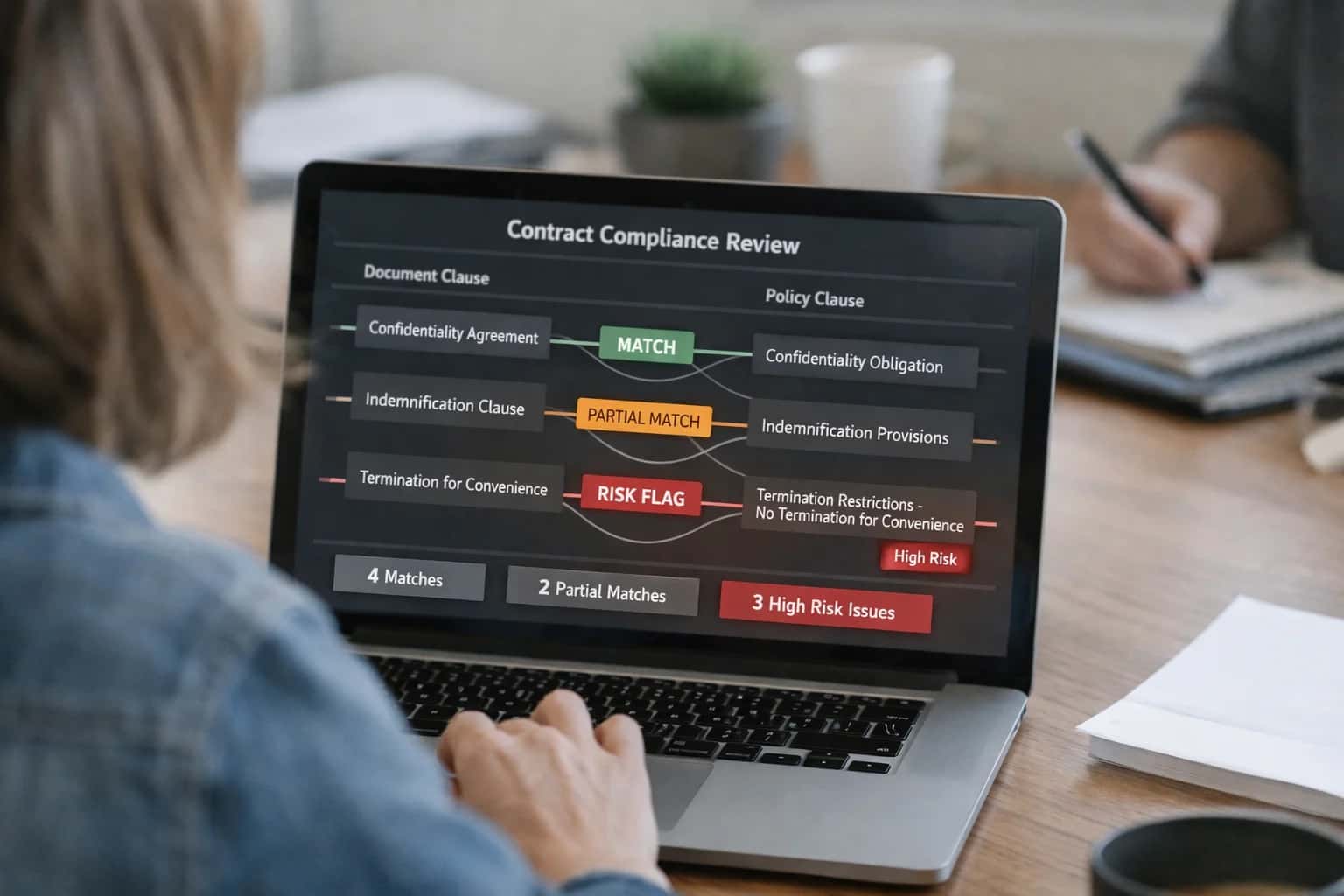
Example Workflow: An AI agent reviews a new SOW against a master services agreement (MSA) stored in Ivalua's Contract Management module, highlighting deviations in termination clauses or indemnification language, reducing legal review time from days to hours.
IVALUA SERVICES PROCUREMENT MODULE
High-Value AI Use Cases for Services Procurement
Integrate AI directly into Ivalua's services procurement workflows to automate manual reviews, enforce compliance, and accelerate service delivery cycles from statement of work to final payment.
01
Automated SOW Review & Risk Analysis
AI agents ingest draft Statements of Work (SOWs) via Ivalua's APIs, extracting key terms, deliverables, and pricing. The system cross-references against master service agreements (MSAs) and rate cards to flag non-compliant clauses, missing SLAs, or pricing deviations before routing for legal or procurement approval.
Days -> Hours
Review cycle
02
Intelligent Rate Card Compliance
For every services invoice, an AI workflow validates billed roles, rates, and hours against the approved supplier rate card stored in Ivalua. It automatically flags overages, mismatched job titles, or unauthorized blended rates, creating a detailed variance report for the AP team to resolve.
100% Automated
Initial check
03
Services Invoice Validation & 3-Way Matching
Extends Ivalua's invoice matching to complex services. AI parses line-item descriptions on invoices, maps them to SOW deliverables or time entries, and performs a semantic match against the PO and goods receipt. Handles partial deliveries, milestone billing, and validates supporting timesheets or deliverable acceptance documents.
Batch -> Real-time
Exception detection
04
Supplier Performance & Deliverable Tracking
An AI copilot monitors active service POs, analyzing status updates, deliverable submissions, and communication threads from Ivalua's collaboration module. It generates automated performance summaries, predicts at-risk milestones, and prompts supplier relationship managers for check-ins based on sentiment or delay signals.
Proactive Alerts
For SRM teams
05
Services Catalog Intelligence & Recommender
Enhances Ivalua's services catalog by using AI to analyze historical engagement data. For new requisitions, it recommends pre-approved statement of work templates, suggests qualified suppliers based on past performance and category, and provides benchmark rate guidance to buyers, enforcing policy at the point of request.
Guided Buying
Policy compliance
06
Milestone Payment Automation
Automates the invoice-to-cash cycle for milestone-based projects. AI reviews deliverable acceptance evidence (documents, sign-offs in Ivalua), confirms milestone completion criteria are met, and automatically generates the approved invoice for payment processing within the Ivalua workflow, releasing AP from manual verification.
Same day
Payment trigger
IVALUA SERVICES PROCUREMENT
Example AI-Automated Workflows
These concrete workflows illustrate how AI agents and models connect to Ivalua's Services Procurement module to automate high-effort, high-value tasks. Each flow is designed to plug into existing Ivalua objects, APIs, and approval chains.
Trigger: A new or updated Statement of Work document is uploaded to an Ivalua services requisition or contract.
Context/Data Pulled: The AI agent retrieves the SOW document text, the associated supplier record, historical contract data for that supplier/category, and any configured compliance rules from a connected policy repository.
Model/Agent Action:
- A multi-modal LLM (or specialized extraction model) parses the SOW to identify key clauses: scope, deliverables, payment milestones, termination terms, liability caps, and IP ownership.
- The agent compares these clauses against a library of approved, standard language and flags deviations.
- It cross-references the supplier against risk databases (if integrated) and calculates a composite risk score based on clause risk, supplier financial health, and category criticality.
System Update/Next Step:
- The agent creates a summary report in the Ivalua object (e.g., a comment, a custom field update, or an attached analysis document).
- The requisition or contract is automatically routed based on the risk score:
- Low Risk/Green: Routes for standard approval.
- Medium Risk/Yellow: Routes to the procurement category manager with highlighted clauses for review.
- High Risk/Red: Routes to Legal and the senior procurement director, attaching the full analysis.
Human Review Point: The flagged clauses and risk rationale are presented to the human reviewer within Ivalua's UI, allowing them to accept the AI's assessment or override it with comments.
ARCHITECTING AI FOR SERVICES PROCUREMENT WORKFLOWS
Implementation Architecture & Data Flow
A practical blueprint for connecting AI agents to Ivalua's Services Procurement module to automate SOW review, rate validation, and invoice auditing.
The integration connects to Ivalua's Services Procurement APIs and document management layer, focusing on three key data objects: Statement of Work (SOW) documents, rate card records, and services invoices. An AI agent acts as a pre-approval layer, ingesting SOW attachments via webhook, extracting key terms (scope, deliverables, milestones, rates), and cross-referencing them against approved supplier rate cards stored in Ivalua. For invoices, the system pulls line-item details and matches them against the approved SOW and time/expense submissions, flagging discrepancies in hours, rates, or out-of-scope work.
Implementation typically uses a queue-based architecture. When a new SOW is uploaded or an invoice is submitted in Ivalua, an event triggers a webhook to a secure API endpoint. The AI workflow retrieves the document, parses it (using OCR for PDFs or reading structured XML/JSON from integrated time-tracking tools), and executes a series of validation checks. Findings—such as non-compliant rate detected, milestone deliverable missing, or hours exceed SOW allowance—are written back to a custom object or a dedicated AI Validation field in Ivalua, triggering a conditional approval path. Approved items proceed automatically; flagged items route to a human reviewer with the AI's annotated summary.
Rollout should start with a pilot category (e.g., IT consulting) to refine prompt logic for rate card logic and scope clause detection. Governance requires maintaining an audit trail of all AI decisions, model versioning for the extraction and validation logic, and a clear human-in-the-loop process for overrides. This architecture reduces manual review from hours to minutes for each SOW or invoice, cuts payment cycle times, and enforces contracting compliance at scale. For a deeper look at integrating AI across Ivalua's broader suite, see our guide on AI Integration with Ivalua.
SERVICES PROCUREMENT INTEGRATION PATTERNS
Code & Payload Examples
Automating Statement of Work Review
Integrate an AI agent to analyze uploaded SOW documents in Ivalua, extracting key terms, deliverables, and rate structures. The agent validates content against master service agreements and internal rate cards, flagging non-compliant clauses for procurement or legal review before contract creation.
A typical workflow uses Ivalua's Document Management API to fetch the SOW file, processes it through a vision-enabled LLM for data extraction, and posts validation results back as a custom object or comment for the buyer.
python# Example: Call AI service to analyze SOW document from Ivalua import requests # Fetch document metadata from Ivalua ivalua_doc_response = requests.get( f"{IVALUA_BASE_URL}/api/v1/documents/{document_id}", headers={"Authorization": f"Bearer {api_token}"} ) doc_url = ivalua_doc_response.json()['downloadUrl'] # Send to AI analysis service analysis_payload = { "document_url": doc_url, "analysis_type": "sow_review", "validation_rules": { "require_termination_clause": true, "max_billing_rate": 250, "required_deliverables_section": true } } ai_result = requests.post( AI_SERVICE_URL + "/analyze/contract", json=analysis_payload ).json() # Post results back to Ivalua as a custom validation object requests.post( f"{IVALUA_BASE_URL}/api/v1/objects/sowValidation", json={ "documentId": document_id, "isCompliant": ai_result['is_compliant'], "flaggedSections": ai_result['flagged_sections'], "recommendedAction": ai_result['recommended_action'] } )
AI-ENHANCED SERVICES PROCUREMENT
Realistic Time Savings & Operational Impact
This table illustrates the operational impact of integrating AI agents into Ivalua's Services Procurement module, focusing on automating high-effort, manual workflows for statement of work (SOW) review, rate card compliance, and services invoice validation.
| Process / Metric | Before AI Integration | After AI Integration | Implementation Notes |
|---|---|---|---|
Statement of Work (SOW) Initial Review | 2-4 hours manual analysis per document | 10-15 minutes for AI-assisted summary & risk flagging | AI extracts key terms, rates, deliverables, and non-standard clauses for human review |
Rate Card Compliance Check | Manual line-by-line comparison against master agreements | Automated validation in <1 minute with exception report | AI matches labor categories and bill rates, flags discrepancies for procurement approval |
Services Invoice Validation (against SOW) | Hours spent cross-referencing hours, deliverables, and milestones | Automated 3-way matching (PO, SOW, Invoice) in minutes | AI validates billed hours against approved SOW deliverables and milestones, highlights mismatches |
Contractor Onboarding Document Review | Manual check of certificates, insurance, and background checks | AI pre-screens documents for completeness & expiry dates | Reduces administrative burden on supplier managers; final approval remains manual |
Services Spend Classification | Manual coding of invoices to GL accounts & cost centers | AI suggests classification with >90% accuracy based on SOW & vendor history | Dramatically reduces month-end close effort for finance; requires initial training set |
Renewal & Amendment Workflow Trigger | Calendar-based reminders often missed; manual contract review | AI monitors SOW end dates & spend thresholds, auto-generates renewal packet | Proactive management improves negotiation position and avoids service lapses |
Audit Trail & Change Documentation | Manual compilation of email threads and version history | AI auto-generates activity log for key SOW changes and approvals | Built-in compliance for SOX and internal audits; integrates with Ivalua's native audit features |
IMPLEMENTING AI IN A REGULATED PROCUREMENT ENVIRONMENT
Governance, Security & Phased Rollout
A practical framework for deploying AI in Ivalua Services Procurement with control, auditability, and minimal disruption.
Integrating AI into Ivalua's Services Procurement module requires a security-first architecture that respects the platform's existing role-based access controls (RBAC), audit trails, and data segregation. Our implementations treat the AI as a governed service layer that interacts with Ivalua objects—like Statement of Work (SOW) documents, rate cards, service entries, and supplier records—via its secure APIs. All AI-generated outputs (e.g., compliance flags, extracted terms) are written back as annotated metadata or linked comments, preserving the original document and creating a clear lineage for review. API calls are scoped to the minimum necessary permissions, and sensitive data can be pseudonymized or processed in a private cloud environment before analysis to meet internal data residency and privacy policies.
A phased rollout is critical for user adoption and risk management. We recommend starting with an assistive, human-in-the-loop phase focused on a single, high-volume workflow, such as SOW rate card compliance checking. In this phase, the AI agent reviews incoming SOWs against approved supplier rate cards and highlights potential discrepancies in labor categories or billing rates within Ivalua's user interface, but requires a procurement specialist's approval before any system action is taken. This builds trust and generates a labeled dataset of exceptions for model refinement. Subsequent phases can introduce greater automation, such as auto-populating service entry lines from validated SOWs or triggering approval workflows for non-compliant terms, each gated by predefined confidence thresholds and business rules configured within Ivalua's workflow engine.
Governance is maintained through a combination of technical and operational controls. Technically, we implement prompt versioning, output logging, and performance monitoring (e.g., precision/recall on flagged exceptions) to detect model drift or regressions. Operationally, a cross-functional steering group—including procurement operations, legal, IT security, and category management—should define the escalation paths for AI exceptions and regularly review the agent's impact on key metrics like cycle time reduction and error rates. This controlled approach ensures the AI integration enhances Ivalua's capabilities without compromising the governance and compliance rigor required for services spend.
Enabling Efficiency, Speed & Accuracy
Intelligent Analysis, Decision & Execution
We build AI systems for teams that need search across company data, workflow automation across tools, or AI features inside products and internal software.
Talk to Us
Search across company data
Give teams answers from docs, tickets, runbooks, and product data with sources and permissions.
Useful when people spend too long searching or get different answers from different systems.
Enterprise searchRAGPermissions
Read more
Automate internal workflows
Use AI to route work, draft outputs, trigger actions, and keep approvals and logs in place.
Useful when repetitive work moves across multiple tools and teams.
AI agentsWorkflow automationGovernance
Read more
Add AI to products and internal tools
Build assistants, guided actions, or decision support into the software your team or customers already use.
Useful when AI needs to be part of the product, not a separate tool.
AI integrationDecision supportModel routing
Read moreIMPLEMENTATION AND WORKFLOW DETAILS
Frequently Asked Questions
Practical questions for teams planning to integrate AI into Ivalua's Services Procurement module to automate SOW review, rate card compliance, and invoice validation.
The integration is API-first, connecting to Ivalua's Services Procurement module and Supplier Portal APIs. A typical architecture involves:
- Trigger: A webhook from Ivalua fires when a new Statement of Work (SOW) document is uploaded, a services invoice is submitted, or a rate card is updated in the supplier portal.
- Context Pull: The AI agent calls Ivalua's REST APIs to fetch the relevant document (PDF, Word), associated PO data, master service agreement (MSA) terms, and the approved rate card for the supplier and role.
- Agent Action: A configured LLM (e.g., GPT-4, Claude 3) with retrieval-augmented generation (RAG) analyzes the document against the contract and rate card.
- System Update: The agent posts results back to a custom object in Ivalua or updates the workflow task via API, flagging discrepancies, suggesting approval/denial, and providing a summary.
- Human Review Point: High-confidence matches can auto-approve; all flagged discrepancies or low-confidence analyses are routed to a human buyer or AP specialist within Ivalua's task queue for final review.

About the author
Prasad Kumkar
CEO & MD, Inference Systems
Prasad Kumkar is the CEO & MD of Inference Systems and writes about AI systems architecture, LLM infrastructure, model serving, evaluation, and production deployment. Over 5+ years, he has worked across computer vision models, L5 autonomous vehicle systems, and LLM research, with a focus on taking complex AI ideas into real-world engineering systems.
His work and writing cover AI systems, large language models, AI agents, multimodal systems, autonomous systems, inference optimization, RAG, evaluation, and production AI engineering.
LinkedIn
Limited slotsGet a Free AI Consultation
Partnered with leading AI, data, and software stack.





How We Work
Custom AI workflows for your Business
One-fit-all AI don't work for modern businesses. At Inferensys, we aim to understand your business & custom requirements; which we use to define most efficient agentic workflows, the data, and the tools for your business.
01
Review the use case
We understand the task, the users, and where AI can actually help.
Read more02
Pick the right approach
We define what needs search, automation, or product integration.
Read more03
Build the first useful version
We implement the part that proves the value first.
Read more04
Improve from there
We add the checks and visibility needed to keep it useful.
Read moreThe first call is a practical review of your use case and the right next step.
Talk to Us