AI integration for SAP Ariba Sourcing targets the event lifecycle—from RFx creation through bid analysis and award recommendation. The primary architectural touchpoints are the Sourcing Project and Sourcing Event objects, managed via the Ariba Network APIs and webhooks. AI agents can be triggered to automate key manual processes: drafting complex RFQ/RFP documents by analyzing historical event data and category requirements, generating intelligent bid invitations by scoring and segmenting the supplier list from Supplier Management (SIM), and performing real-time bid analysis during eAuctions to provide scenario modeling and alerting to the sourcing manager.

Integration
AI Integration for SAP Ariba Sourcing Events
A technical guide for sourcing managers and procurement engineers on automating complex sourcing event workflows in SAP Ariba using AI agents for RFx generation, bid analysis, and supplier scoring.
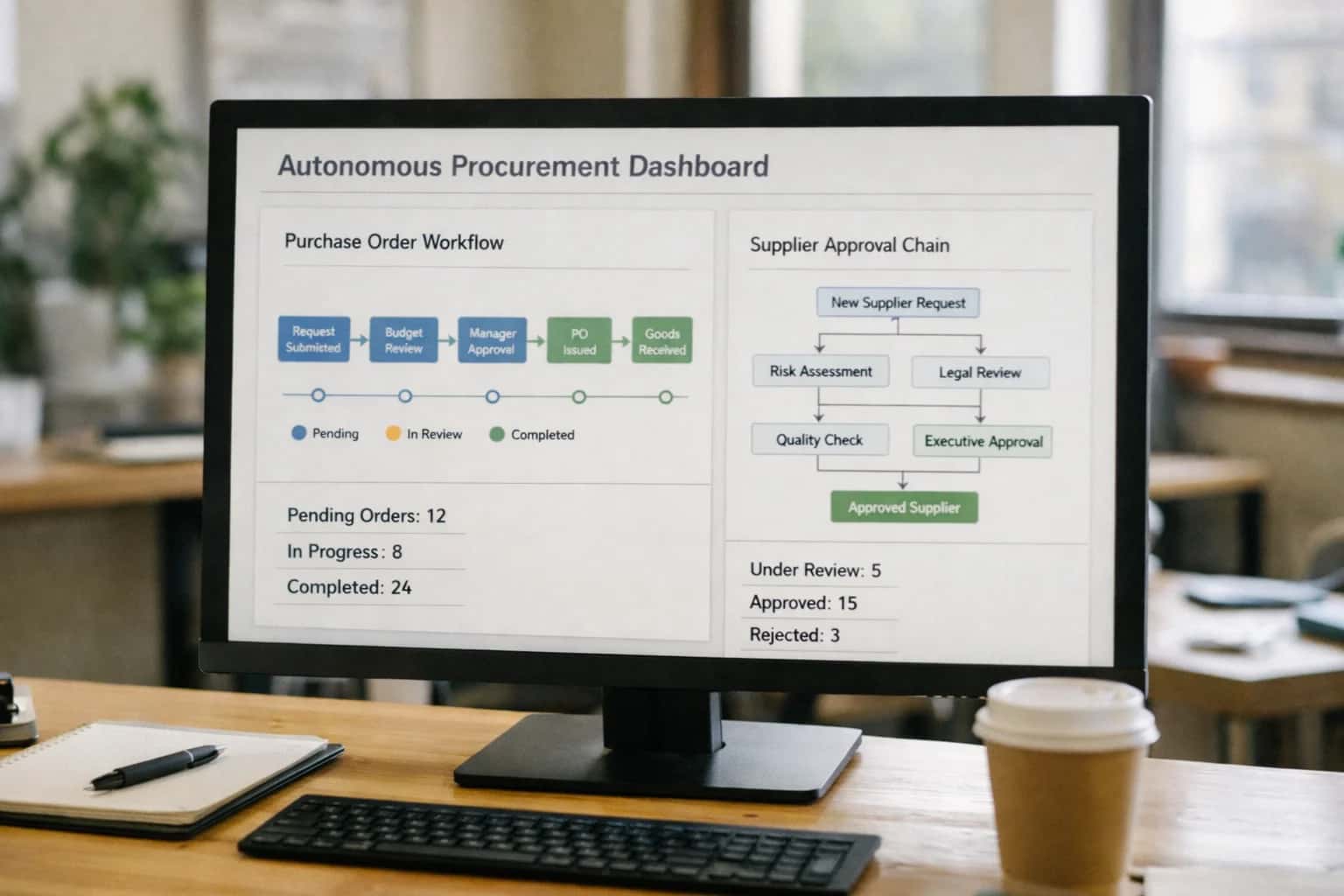
ARCHITECTURE FOR EVENT AUTOMATION
Where AI Fits into SAP Ariba Sourcing
A technical blueprint for integrating AI agents into the core workflows of SAP Ariba Sourcing to automate event creation, execution, and analysis.
Implementation focuses on creating a middleware layer that listens for events like Project Created, Bid Submitted, or Event Closed. For example, when a new sourcing project is initiated, an AI agent can be invoked via webhook to analyze the spend category, pull relevant clause libraries from SAP Ariba Contracts, and generate a first-draft RFP with evaluation criteria. During the event, another agent can monitor the Ariba Sourcing Cockpit, using the Bid API to ingest incoming responses, perform multi-criteria bid analysis (price, delivery, terms), and surface anomalies or non-compliant bids for immediate review, drastically compressing evaluation cycles from days to hours.
Rollout requires a phased approach, starting with a single event type (e.g., simple RFQs) and a controlled supplier group. Governance is critical: all AI-generated content and recommendations must be logged as Activity Records within the sourcing project for audit trails, and final award decisions must remain with the sourcing manager, with the AI acting as a copilot. This integration doesn't replace Ariba's native logic but augments it, plugging into the existing approval workflows and user interfaces that sourcing teams already use. For a deeper dive into connecting AI to SAP Ariba's broader procurement suite, see our guide on AI Integration with SAP Ariba.
AI AGENT WORKFLOW TOUCHPOINTS
Key Integration Surfaces in SAP Ariba Sourcing
Automating RFx and Auction Creation
The initial planning and configuration of a sourcing event is a prime target for AI automation. Agents can be triggered via the Ariba Sourcing API or webhooks to initiate projects based on demand signals from ERP or planning systems.
Key integration surfaces include:
- Project Templates & Cloning: Use the
ProjectAPI to clone from a master template, pre-populating sections, scoring criteria, and timelines. - Item & Lot Definition: Agents can analyze historical spend data or a bill of materials to automatically structure the event into logical lots for bidding.
- Supplier Shortlisting: Integrate with the
SupplierAPI and external risk/performance data to generate a qualified bidder list, auto-inviting suppliers via theInvitationendpoint. - Document Assembly: AI can draft RFP/RFQ narratives by pulling from clause libraries and past successful events, attaching them via the
Documentservice.
This automation transforms event setup from a multi-day manual process to a same-day operation.
SAP ARIBA INTEGRATION PATTERNS
High-Value AI Use Cases for Sourcing Events
Targeted AI agents can automate the most time-intensive, manual, and data-heavy stages of the sourcing lifecycle. This guide details practical integration points within SAP Ariba Sourcing to accelerate event execution and improve outcomes.
01
Automated RFP/RFQ Drafting
An AI agent uses historical event data and category-specific templates to generate a first draft of complex RFx documents. It pulls in approved boilerplate clauses, pre-populates technical and commercial sections, and ensures alignment with corporate procurement policies, reducing manual drafting from days to hours.
Days -> Hours
Document creation
02
Intelligent Supplier Shortlisting & Invitation
Integrate AI to analyze the supplier master and past performance data against new event requirements. The agent scores and ranks potential suppliers, automatically generates personalized invitation emails via Ariba's messaging APIs, and tracks response status, ensuring the right suppliers are engaged without manual research.
Batch -> Targeted
Supplier outreach
03
Real-Time Bid Analysis During eAuctions
During live eAuctions or multi-round bidding, an AI co-pilot monitors incoming bids in real-time. It analyzes bidder behavior, identifies outliers or collusion patterns, and provides the sourcing manager with dynamic scenario analysis (e.g., 'Awarding to Supplier B saves 2.4% but increases risk score by 15%'), enabling data-driven negotiation.
Real-time
Scenario modeling
04
Post-Event Award Recommendation & Justification
After bid closing, an AI workflow ingests all response data (commercial, technical, compliance). It applies pre-configured weighted scoring models, performs total cost of ownership (TCO) analysis, and generates a structured award recommendation memo with justification, ready for stakeholder review and audit trails. Connects to Ariba's analysis APIs.
1-2 Hours
Analysis & reporting
05
Supplier Q&A Triage & Response
Automate the management of the supplier Q&A process. An AI agent classifies incoming questions from the supplier portal, routes technical queries to SMEs, drafts standardized answers for common policy questions, and posts approved responses back to the event, keeping the process moving outside of business hours.
24/7
Process coverage
06
Contract Generation from Award Terms
Bridge the gap between sourcing award and contract execution. An AI agent extracts key commercial terms, SLAs, and pricing from the finalized bid response within Ariba Sourcing, maps them to the appropriate contract template in SAP Ariba Contracts or a connected CLM, and generates a first-pass contract for legal review.
Same day
Contract kickoff
IMPLEMENTATION PATTERNS
Example AI-Powered Sourcing Workflows
These concrete workflows illustrate how AI agents can be integrated into SAP Ariba Sourcing to automate complex, manual tasks. Each pattern connects to specific Ariba APIs and data objects, providing a blueprint for technical implementation.
Trigger: A sourcing manager initiates a new sourcing project in SAP Ariba Sourcing for a defined category (e.g., IT Hardware).
Workflow:
- Context Pull: An AI agent is triggered via webhook. It retrieves the project's category, historical award data, and incumbent supplier performance scores from the Ariba Sourcing and Supplier Management APIs.
- Market Intelligence Synthesis: The agent calls external APIs (e.g., market reports, commodity indices) and internal knowledge bases to gather current pricing benchmarks, lead times, and technology trends.
- Document Generation: Using a structured prompt, the LLM generates a first draft of the RFP/RFQ document, including technical specifications, commercial terms, and evaluation criteria. It references relevant clauses from the Ariba contract clause library.
- Supplier Recommendation: The agent analyzes the supplier master for qualified vendors matching the category, location, and diversity requirements. It scores and ranks them based on past performance, risk data, and capability.
- System Update: The agent uses the Ariba Sourcing API to:
- Create the RFx event shell with the generated document attached.
- Pre-populate the invited supplier list with the top-ranked recommendations.
- Post a summary of its analysis and recommendations as a note in the project workspace for the manager's review.
Human Review Point: The sourcing manager reviews and finalizes the RFx document and supplier list before publishing the event to the Ariba Network.
PRODUCTION INTEGRATION PATTERN
Implementation Architecture & Data Flow
A practical blueprint for connecting AI agents to SAP Ariba Sourcing to automate event creation, execution, and analysis.
The integration is built on a decoupled, event-driven architecture where AI agents act as orchestration layers between your data sources and SAP Ariba's APIs. A typical flow begins with an AI agent ingesting sourcing requirements—often from a project brief in SharePoint, an email, or a Jira ticket—via a webhook or message queue. The agent uses an LLM to structure this input, then calls the SAP Ariba Sourcing API (or the Ariba Network Cloud Integration Toolkit) to create a new sourcing project, define lots, and populate key fields in the RFx or Auction event template. For complex bids, the agent can also retrieve historical award data from your data warehouse or previous Ariba events via the Analytics API to inform lot structuring and baseline pricing.
During the event execution phase, AI agents monitor the Ariba Sourcing Event Management APIs for new supplier responses (BidLineItem, QuestionResponse). As bids arrive, an agent processes each submission to perform real-time analysis: comparing terms against contract benchmarks, flagging non-compliant responses, and scoring suppliers based on predefined, weighted criteria (cost, delivery, sustainability scores). This analysis is appended to the sourcing event as internal notes or custom attributes via the API, providing the sourcing manager with a ranked, annotated bidder list. For interactive eAuctions, agents can be configured to trigger automated communications to suppliers—such as prompting for best-and-final offers—based on bidding activity thresholds.
Post-event, the architecture supports automated award recommendation and contracting workflows. The AI agent synthesizes all quantitative and qualitative bid data, generates a summary report with a justification for the recommended award, and pushes this into the Ariba Contracts module via its API to initiate contract drafting. Governance is maintained through an audit log of all agent actions, human-in-the-loop approval gates for critical decisions (like final award), and RBAC ensuring agents only interact with events and data scoped to their configured permissions. Rollout typically follows a phased approach, starting with automated RFQ creation for tail spend categories before progressing to complex multi-round RFPs.
SAP ARIBA SOURCING EVENTS
Code & Payload Examples
Automating Sourcing Event Setup
Use AI to analyze historical data and category requirements to draft comprehensive RFx documents and configure event parameters. This agent workflow calls the Ariba Sourcing API to create the event shell and populate key fields.
Example Python Payload for Event Creation:
pythonimport requests # Payload to create a new sourcing event via Ariba API event_payload = { "event": { "title": "Annual IT Hardware Procurement 2025", "type": "RFQ", "categoryCode": "IT_HARDWARE", "currency": "USD", "buyer": "[email protected]", "eventSchedule": { "startDate": "2025-06-01T08:00:00Z", "closeDate": "2025-06-15T17:00:00Z", "questionDeadline": "2025-06-10T17:00:00Z" }, "items": [ { "itemNumber": "IT-001", "description": "Enterprise Laptop - High Performance", "quantity": 500, "uom": "EA", "specifications": "AI-generated spec summary from historical bids" } ], "evaluationCriteria": { "priceWeight": 60, "deliveryWeight": 20, "warrantyWeight": 10, "sustainabilityWeight": 10 } } } # API call to Ariba Sourcing response = requests.post( "https://api.ariba.com/v2/sourcing/events", json=event_payload, headers={"Authorization": "Bearer <token>", "APIKey": "<key>"} )
This payload structures the core event, leveraging AI to pre-fill specifications and evaluation criteria based on learned category patterns.
AI-ENHANCED SOURCING EVENTS
Realistic Time Savings & Operational Impact
This table illustrates the measurable impact of integrating AI agents into key SAP Ariba Sourcing workflows, focusing on reducing manual effort, accelerating cycle times, and improving decision quality for sourcing managers and category leads.
| Workflow / Task | Before AI | After AI | Key Notes & Impact |
|---|---|---|---|
RFP/RFQ Document Creation | Manual drafting and assembly from templates: 4-8 hours | AI-assisted drafting with clause suggestions and market data: 1-2 hours | Reduces administrative burden; ensures compliance and inclusion of key terms. |
Supplier Shortlisting & Invitation | Manual review of supplier catalogs and past performance: 2-3 hours per event | AI-scored supplier recommendations based on past bids, risk, and category fit: 30 minutes | Improves bid competitiveness and reduces risk of omitting qualified suppliers. |
Bid Analysis & Initial Scoring | Manual spreadsheet analysis for price and non-price factors: 1-2 days | AI-powered multi-criteria analysis with automated scoring and outlier detection: 2-4 hours | Provides objective, consistent scoring; highlights top candidates and anomalies for review. |
Auction Strategy & Parameter Setting | Historical analysis and manual calculation for reserve prices and bid decrements: 3-5 hours | AI-driven scenario modeling and price elasticity recommendations: 1 hour | Data-driven strategy increases savings capture and reduces risk of auction failure. |
Real-time Auction Monitoring | Manual dashboard monitoring and supplier communications during live events | AI agent monitors for collusion patterns, bid stagnation, and sends automated nudges | Allows manager to focus on strategic intervention; maintains auction momentum. |
Post-Event Award Recommendation | Manual compilation of scores, pricing, and qualitative notes for stakeholder review: 4-6 hours | AI-generated summary report with weighted scoring, savings breakdown, and risk flags: 1 hour | Accelerates decision-making; provides auditable rationale for award decisions. |
Contract Generation from Award | Manual transfer of bid terms into contract templates: 3-4 hours | AI auto-populates key clauses, pricing schedules, and SLAs from the finalized bid: 30 minutes | Reduces errors and accelerates time-to-contract, speeding up supplier onboarding. |
Sourcing Event Analytics & Reporting | Manual data pull and report building in Excel/PPT: 1-2 days post-event | Automated insights on savings, supplier engagement, and process efficiency: Same day | Enables faster lessons learned and continuous improvement for future events. |
ARCHITECTING FOR ENTERPRISE CONTROL
Governance, Security & Phased Rollout
A production-ready AI integration for SAP Ariba Sourcing requires a governance-first architecture that respects procurement controls, data sensitivity, and change management.
A secure integration connects to SAP Ariba's APIs—such as the Sourcing Project API, Supplier API, and Event Management APIs—within a dedicated middleware layer. This layer acts as a policy enforcement point, handling authentication via OAuth 2.0, applying role-based access controls (RBAC) mapped to Ariba user roles (Sourcing Manager, Category Lead, Analyst), and logging all AI agent actions (e.g., 'drafted RFQ clause', 'analyzed bid deviation') to a dedicated audit trail. Sensitive bid data, supplier financials, and internal cost models are never sent directly to a third-party LLM; instead, retrieval-augmented generation (RAG) is performed against a private vector store containing only approved, anonymized reference data, ensuring intellectual property and competitive information remain within your environment.
Implementation follows a phased, risk-aware rollout. Phase 1 (Assistive Drafting) might deploy an AI agent to help sourcing managers generate RFx content and scoring criteria, operating in a 'co-pilot' mode where all outputs require human review and approval within the Ariba UI before publication. Phase 2 (Analytical Augmentation) introduces agents for real-time bid analysis during eAuctions, flagging outlier submissions or potential collusion patterns, with findings presented as alerts in the event dashboard for manager decision. Phase 3 (Prescriptive Automation) could enable closed-loop actions, such as auto-escalating a non-responsive supplier or triggering a contract template based on award logic, but these steps should be gated by multi-level approval workflows native to Ariba.
Governance is continuous. Establish a cross-functional steering committee (Procurement, IT, Legal) to review the AI agent's performance metrics—like time saved per event or bid quality scores—and its adherence to sourcing policies. Implement a feedback loop where sourcing managers can flag incorrect agent suggestions, which are used to retune prompts and retrieval logic. This controlled, iterative approach de-risks the integration, aligns with procurement's mandate for rigor, and allows the organization to capture efficiency gains without compromising control. For related architectural patterns, see our guides on AI Governance and LLMOps Platforms and secure Data Integration and ETL Platforms.
Enabling Efficiency, Speed & Accuracy
Intelligent Analysis, Decision & Execution
We build AI systems for teams that need search across company data, workflow automation across tools, or AI features inside products and internal software.
Talk to Us
Search across company data
Give teams answers from docs, tickets, runbooks, and product data with sources and permissions.
Useful when people spend too long searching or get different answers from different systems.
Enterprise searchRAGPermissions
Read more
Automate internal workflows
Use AI to route work, draft outputs, trigger actions, and keep approvals and logs in place.
Useful when repetitive work moves across multiple tools and teams.
AI agentsWorkflow automationGovernance
Read more
Add AI to products and internal tools
Build assistants, guided actions, or decision support into the software your team or customers already use.
Useful when AI needs to be part of the product, not a separate tool.
AI integrationDecision supportModel routing
Read moreAI INTEGRATION FOR SAP ARIBA SOURCING EVENTS
Frequently Asked Questions
Practical questions for sourcing managers, category leads, and IT teams planning to augment SAP Ariba Sourcing with AI agents and workflows.
An AI agent integrates with SAP Ariba Sourcing primarily through its RESTful APIs and webhook subscriptions. The typical architecture involves:
- Authentication & Connection: The agent authenticates using OAuth 2.0 with appropriate scopes (e.g.,
sourcing.project.readwrite,supplier.invitation.manage). - Event Listening: The agent subscribes to webhooks for key sourcing lifecycle events, such as:
Project.CreatedRFx.PublishedBid.SubmittedAuction.Started
- Data Retrieval: When triggered, the agent calls APIs like
GET /sourcing/v1/projects/{projectId}to fetch full project context, line items, and participant data. - Action Execution: The agent performs its logic (e.g., bid analysis, supplier scoring) and uses APIs like
POST /sourcing/v1/projects/{projectId}/messagesto communicate with buyers or suppliers, orPATCHendpoints to update project attributes. - Audit Trail: All agent actions are logged back to Ariba as system notes or custom field updates for full auditability.
This creates a closed-loop system where the AI agent acts as an active participant in the sourcing workflow, governed by the platform's existing security and data model.

About the author
Prasad Kumkar
CEO & MD, Inference Systems
Prasad Kumkar is the CEO & MD of Inference Systems and writes about AI systems architecture, LLM infrastructure, model serving, evaluation, and production deployment. Over 5+ years, he has worked across computer vision models, L5 autonomous vehicle systems, and LLM research, with a focus on taking complex AI ideas into real-world engineering systems.
His work and writing cover AI systems, large language models, AI agents, multimodal systems, autonomous systems, inference optimization, RAG, evaluation, and production AI engineering.
LinkedIn
Limited slotsGet a Free AI Consultation
Partnered with leading AI, data, and software stack.





How We Work
Custom AI workflows for your Business
One-fit-all AI don't work for modern businesses. At Inferensys, we aim to understand your business & custom requirements; which we use to define most efficient agentic workflows, the data, and the tools for your business.
01
Review the use case
We understand the task, the users, and where AI can actually help.
Read more02
Pick the right approach
We define what needs search, automation, or product integration.
Read more03
Build the first useful version
We implement the part that proves the value first.
Read more04
Improve from there
We add the checks and visibility needed to keep it useful.
Read moreThe first call is a practical review of your use case and the right next step.
Talk to Us