AI integration for SAP Ariba contract compliance focuses on three primary surfaces: the Contract Management module's repository, the Supplier Lifecycle and Performance (SLP) data model, and the Procurement and Sourcing workflows that generate transactions. The core integration connects to Ariba's APIs to pull contract documents, structured metadata (like Supplier, EffectiveDate, TerminationClause), and transactional data (POs, invoices) for continuous, automated analysis. This creates a closed-loop system where AI monitors for deviations between agreed terms in the contract repository and actual execution in the P2P cycle.

Integration
AI Integration for SAP Ariba Contract Compliance
A practical guide to automating contract term monitoring, pricing compliance, and SLA tracking in SAP Ariba using AI agents, reducing manual review from days to hours.
ARCHITECTURE AND ROLLOUT
Where AI Fits in SAP Ariba Contract Compliance
A technical blueprint for integrating AI into SAP Ariba's contract management workflows to automate compliance monitoring, obligation tracking, and risk alerting.
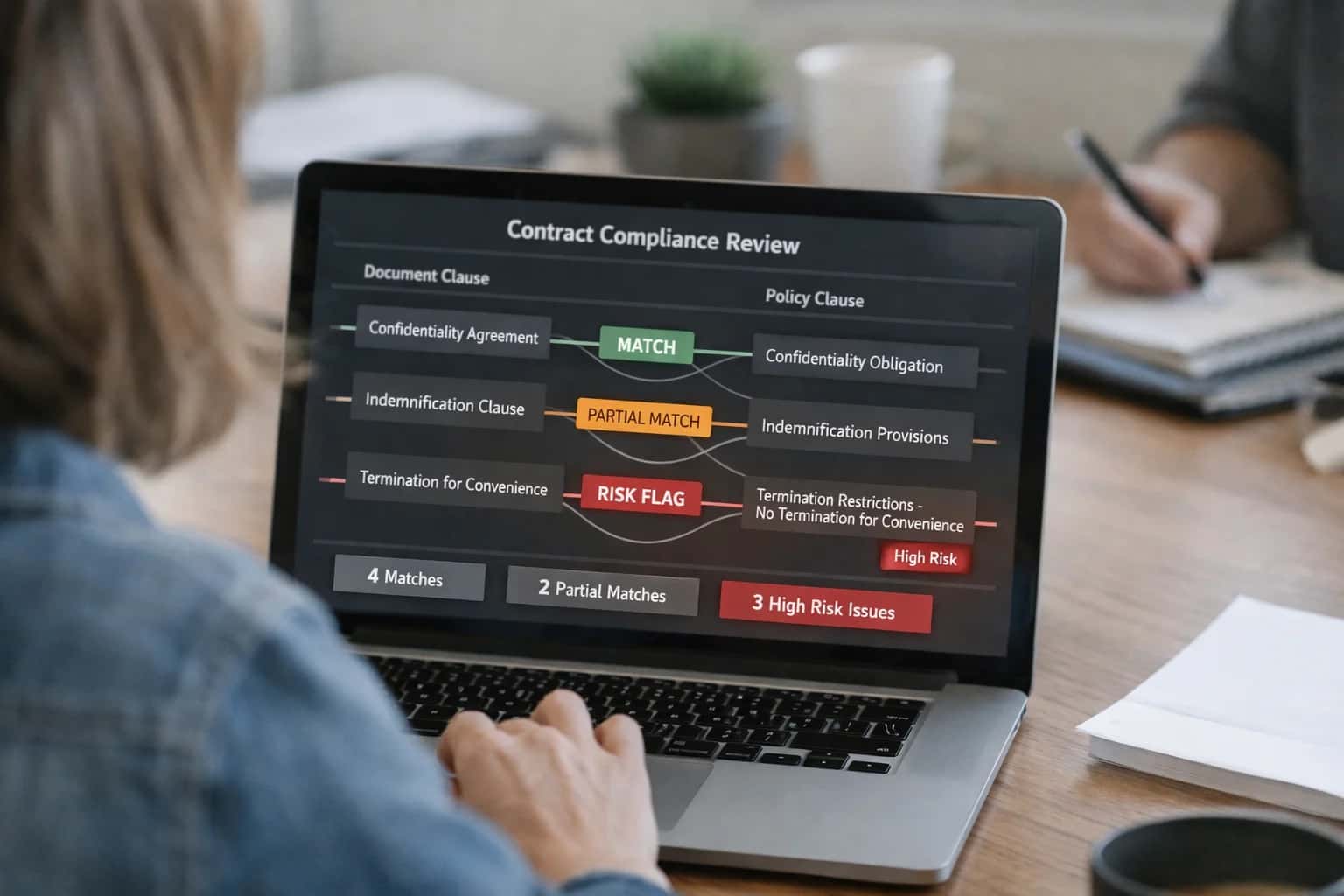
Implementation typically involves an event-driven architecture. A webhook or scheduled job triggers when a new contract is uploaded or a procurement transaction is created. The AI agent extracts key terms—pricing schedules, service level agreements (SLAs), auto-renewal clauses, and liability limits—using a combination of OCR for scanned PDFs and NLP for clause identification. It then cross-references these against live data: invoice line-item prices, delivery dates from ASNs, or performance metrics from SLP. Discrepancies, such as an invoice charging above contracted price or a missed SLA, are logged as compliance events in a dedicated object and can trigger alerts via Ariba's notification framework or create tasks in Ariba Supplier Management for resolution.
Governance and rollout require careful scoping. Start with a pilot on a single, high-spend category (e.g., IT hardware or professional services) where contract terms are well-defined. Implement a human-in-the-loop review for the AI's flagged exceptions initially, logging override reasons to refine the model. Key to production readiness is integrating with Ariba's role-based access control (RBAC) to ensure alerts are routed to the correct contract owners, category managers, or legal reviewers. A successful deployment shifts compliance from a quarterly manual audit to a real-time monitoring function, reducing leakage and strengthening supplier accountability. For related architectural patterns, see our guide on [/integrations/spend-management-and-procure-to-pay-platforms/ai-integration-with-ivalua-contract-management](AI Integration with Ivalua Contract Management).
CONTRACT COMPLIANCE
Key Integration Surfaces in SAP Ariba
Core Document Intelligence
The SAP Ariba Contracts module serves as the system of record for supplier agreements. AI integration here focuses on the document repository and authoring workflows. Key surfaces include:
- Clause Library & Templates: Use AI to analyze historical contracts and suggest optimal, compliant clauses during drafting, reducing legal review cycles.
- Document Ingestion APIs: Connect AI models to the repository via
Ariba Contract Management APIsto perform bulk analysis on existing contracts for term extraction and risk scoring. - Version Comparison: Automate redline analysis between contract versions, highlighting material changes in pricing, SLAs, or liability terms for procurement and legal teams.
This layer transforms static document storage into an active intelligence hub, enabling proactive compliance management.
SAP ARIBATARGETED INTEGRATIONS
High-Value AI Use Cases for Contract Compliance
Transform SAP Ariba from a contract repository into an active compliance engine. These AI-powered workflows connect to Ariba's Contract Management and Supplier Management modules to monitor obligations, pricing, and SLAs in real-time, alerting procurement and legal teams to deviations before they impact performance or cost.
01
Automated Obligation & SLA Tracking
AI agents continuously scan executed contracts in Ariba Contracts to extract key obligations, service levels (SLAs), and delivery milestones. The system cross-references these with data from Ariba Supplier Performance and purchase orders, automatically flagging missed deadlines or performance dips for supplier managers.
Batch -> Real-time
Monitoring cadence
02
Dynamic Pricing & Term Compliance
Integrate AI to validate every invoice and purchase order against the contracted price, discount tiers, and payment terms stored in Ariba Contract Workspaces. The system detects off-contract pricing, unapproved surcharges, or incorrect rebate calculations, routing exceptions to category managers for review before payment.
Hours -> Minutes
Audit cycle
03
Risk-Based Contract Review Prioritization
Before renewal, an AI model scores contracts in the Ariba repository based on spend volume, supplier risk profile, regulatory exposure, and change frequency. It prioritizes the highest-risk agreements for legal and procurement review, summarizing key clauses and historical amendments to accelerate the redline process.
1 sprint
Review planning
04
AI-Powered Supplier Communication Portal
Deploy a chatbot within the Ariba Supplier Network portal that answers supplier queries about contract terms, submission requirements, and compliance status. It pulls real-time data from Ariba to resolve common issues, freeing up procurement teams for strategic conversations and reducing dispute volumes.
Same day
Query resolution
05
Automated Regulatory Clause Updates
For global portfolios, AI monitors regulatory changes (e.g., GDPR, ESG disclosures) and scans the Ariba contract library for non-compliant language. It suggests updated clause language and identifies contracts nearing renewal that require amendment, creating tasks in Ariba for legal teams to action.
Proactive vs. Reactive
Compliance posture
06
Spend Leakage Detection from Non-Compliant Spend
AI analyzes P2P transactions in Ariba Guided Buying and Invoice Management to identify spend with non-contracted suppliers or for out-of-scope items. It correlates this with contract records to quantify leakage, providing category managers with a prioritized list of maverick spend to recapture through compliance or contract expansion.
Batch -> Real-time
Leakage visibility
SAP ARIBA CONTRACT COMPLIANCE
Example AI-Powered Compliance Workflows
These workflows demonstrate how AI agents can be integrated into SAP Ariba's contract management and procurement modules to automate compliance monitoring, reduce manual oversight, and proactively manage supplier performance and risk.
Trigger: A new invoice is submitted in SAP Ariba Invoice Management or a purchase order is created in Guided Buying.
Context Pulled: The AI agent retrieves the relevant contract from SAP Ariba Contracts using the supplier and item/SKU data. It extracts key pricing, payment term, and SLA clauses.
Agent Action: The agent compares the invoice line items or PO details against the contracted terms. It uses an LLM to interpret nuanced language (e.g., "volume discounts apply after 1000 units") and calculate expected pricing.
System Update: If a deviation exceeds a pre-defined tolerance (e.g., unit price >5% off contract), the agent:
- Creates a Compliance Case in a custom object or Ariba's CIG (Cloud Integration Gateway) for tracking.
- Sends an alert via Ariba's notification system or email to the designated contract manager and procurement buyer.
- Optionally places a payment hold on the invoice via API, pending review.
Human Review Point: The contract manager reviews the case in the Ariba UI, sees the AI's analysis highlighting the specific clause and deviation, and can approve, reject, or escalate.
A BLUEPRINT FOR PRODUCTION
Typical Implementation Architecture
A practical architecture for connecting AI to SAP Ariba's contract data and workflows to automate compliance monitoring.
The integration is built on a secure middleware layer that orchestrates between SAP Ariba APIs, your chosen LLM (e.g., OpenAI, Anthropic, Azure OpenAI), and a vector database. The core flow begins by synchronizing contract documents and metadata from the SAP Ariba Contracts module (via the Ariba Network API or Sourcing/Contracts API) into a secure data store. Key objects like Contract, Clause, Supplier, PricingTerm, and ServiceLevelAgreement are extracted and indexed. A dedicated ingestion pipeline normalizes this data, chunking documents for semantic search and embedding key terms, obligations, and pricing tables into a vector store like Pinecone or Weaviate to power the retrieval-augmented generation (RAG) layer.
For real-time monitoring, the system listens for procurement events via Ariba webhooks or polls the API for updates to linked records like Purchase Orders, Invoices (cXML), and Goods Receipts. An AI agent workflow is triggered by these events or on a scheduled basis. It queries the vector index for relevant contract terms, then uses an LLM to perform compliance checks—comparing invoice line items to contracted pricing, validating delivery dates against SLA windows, or flagging non-standard payment terms. Findings are structured into actionable alerts and posted back to Ariba as tasks in the Contract Workspace or via the Ariba Collaboration API to notify the responsible procurement or legal owner. High-confidence deviations can automatically trigger approval workflows or place holds on related payments in the P2P cycle.
Governance is embedded throughout: all LLM calls are logged with prompts, sources, and responses for audit trails; a human-in-the-loop review step can be configured for high-risk or low-confidence findings before creating system actions; and RBAC syncs with Ariba user roles to ensure alerts are routed appropriately. The rollout typically starts with a single high-volume contract type (e.g., IT services) and a focused use case like automated price variance checking, then expands to other clauses and document types. This staged approach de-risks implementation and delivers measurable ROI by reducing manual audit hours and preventing revenue leakage from undetected non-compliance.
SAP ARIBA CONTRACT COMPLIANCE
Code and Payload Examples
Extracting Key Terms for Monitoring
Use the SAP Ariba Contracts API to retrieve contract documents, then pass them to an LLM for structured extraction. The goal is to parse clauses related to pricing, SLAs, and deliverables into a machine-readable format for your compliance database.
Example Python payload for a batch extraction job:
pythonimport requests import json # 1. Fetch contract from Ariba Contracts API ariba_headers = { 'Authorization': 'Bearer YOUR_ARIBA_TOKEN', 'Accept': 'application/json' } contract_response = requests.get( 'https://api.ariba.com/v2/contracts/{contractId}/documents/{versionId}/content', headers=ariba_headers ) contract_text = contract_response.text # 2. Structure a prompt for the LLM extraction_prompt = { "model": "gpt-4-turbo", "messages": [ { "role": "system", "content": "Extract the following from the contract: 1) Pricing terms and escalation clauses. 2) Key performance indicators (KPIs) and SLA thresholds. 3) Delivery schedules and milestones. 4) Renewal and termination terms. Return as JSON." }, { "role": "user", "content": contract_text[:12000] # Truncate for context limits } ], "temperature": 0.1 } # 3. Call LLM and parse JSON output llm_response = requests.post( 'https://api.openai.com/v1/chat/completions', headers={'Authorization': 'Bearer YOUR_OPENAI_KEY'}, json=extraction_prompt ) extracted_terms = json.loads(llm_response.json()['choices'][0]['message']['content']) # 4. Post structured data to your compliance monitoring system compliance_payload = { "contract_id": "CON-2024-001", "supplier_name": "Global Supplies Inc.", "extracted_terms": extracted_terms, "extraction_timestamp": "2024-05-15T10:30:00Z" } # Save to your vector DB or compliance warehouse
AI-ENHANCED CONTRACT COMPLIANCE
Realistic Time Savings and Operational Impact
This table illustrates the operational impact of integrating AI into SAP Ariba's contract management workflows, focusing on compliance monitoring, deviation detection, and stakeholder alerting.
| Compliance Workflow | Manual Process | AI-Assisted Process | Key Impact & Notes |
|---|---|---|---|
Contract Deviation Detection | Manual review of 100+ contracts quarterly | Continuous automated monitoring with weekly summaries | Shifts from periodic audit to real-time oversight; flags pricing, SLA, and term deviations. |
Price & Discount Compliance | AP team matches invoices to contract terms post-payment | AI validates invoice line items against contract pricing at PO/invoice entry | Prevents overpayment before funds are released; reduces recovery efforts. |
SLA & Deliverable Tracking | Project managers track milestones via spreadsheets/emails | AI parses delivery reports and updates, alerts on missed SLAs | Proactive alerts to procurement/legal; reduces relationship friction with suppliers. |
Renewal & Expiry Management | Calendar reminders; manual extraction of key dates | Automated extraction of all key dates; 90/60/30-day alerts with summary | Eliminates missed renewals; provides negotiation lead time with obligation summaries. |
Obligation & Clause Reporting | Legal team manually searches contracts for specific clauses | Natural language query across contract repository for instant clause retrieval | Ad-hoc compliance checks drop from hours to minutes for legal and procurement. |
Supplier Performance Linkage | Manual correlation of supplier scorecards to contract terms | AI links performance data (quality, delivery) to specific contractual obligations | Enables data-driven contract renegotiations and corrective action plans. |
Audit & Regulatory Response | Weeks to gather and redact contracts for audit requests | AI assembles relevant contract packages and highlights pertinent sections in days | Dramatically reduces legal and admin burden during internal/external audits. |
Stakeholder Alert Routing | Email blasts or manual ticketing for issue escalation | AI routes alerts to correct stakeholder (procurement, legal, AP) based on issue type | Ensures faster resolution by notifying the team equipped to act; creates audit trail. |
CONTROLLED DEPLOYMENT FOR ENTERPRISE CONTRACT INTELLIGENCE
Governance, Security, and Phased Rollout
A practical approach to deploying AI for contract compliance in SAP Ariba, balancing automation with control.
A production AI integration for SAP Ariba contract compliance must be built on a secure, governed architecture. This typically involves a dedicated middleware layer that sits between your Ariba instance and the LLM provider (e.g., OpenAI, Anthropic). This layer handles secure API calls to Ariba's Contract Management APIs to fetch agreement documents and metadata, applies role-based access controls (RBAC) to ensure users only analyze contracts they are authorized to see, and maintains a full audit log of all AI interactions—including the original contract ID, the prompt used, the generated analysis, and the user who initiated it. Sensitive data is never sent to an LLM without proper anonymization or redaction protocols in place.
Rollout should follow a phased, risk-based approach. Phase 1 begins with a pilot on a single, non-critical contract category (e.g., office supplies NDAs) in a single business unit. AI agents are configured to run in 'human-in-the-loop' mode, where all compliance findings—like deviations from standard pricing terms or missing SLA clauses—are presented as recommendations to a procurement or legal analyst within the Ariba interface for review and approval before any system alerts are triggered or records are updated. Phase 2 expands to more complex categories (IT services, facilities management) and introduces automated, low-risk alerts for well-defined issues like upcoming renewal dates, while maintaining manual review for subjective clauses. Phase 3 enables fully automated monitoring for pre-approved, high-volume contract types, with exceptions automatically creating tasks in Ariba's Supplier Management or Sourcing Project modules for resolution.
Governance is continuous. Establish a cross-functional steering committee (Procurement, Legal, IT, Security) to regularly review the AI's performance using precision/recall metrics on its findings, audit a sample of processed contracts, and update the library of compliance rules and clause definitions the AI uses. This ensures the system adapts to new regulations and internal policies. By architecting for security, rolling out with graduated autonomy, and maintaining active governance, you move from a reactive, manual audit process to a proactive, scalable compliance operation that augments—rather than replaces—your team's expertise.
Enabling Efficiency, Speed & Accuracy
Intelligent Analysis, Decision & Execution
We build AI systems for teams that need search across company data, workflow automation across tools, or AI features inside products and internal software.
Talk to Us
Search across company data
Give teams answers from docs, tickets, runbooks, and product data with sources and permissions.
Useful when people spend too long searching or get different answers from different systems.
Enterprise searchRAGPermissions
Read more
Automate internal workflows
Use AI to route work, draft outputs, trigger actions, and keep approvals and logs in place.
Useful when repetitive work moves across multiple tools and teams.
AI agentsWorkflow automationGovernance
Read more
Add AI to products and internal tools
Build assistants, guided actions, or decision support into the software your team or customers already use.
Useful when AI needs to be part of the product, not a separate tool.
AI integrationDecision supportModel routing
Read moreIMPLEMENTATION AND WORKFLOW DETAILS
Frequently Asked Questions
Practical questions for procurement, legal, and IT teams planning an AI integration for SAP Ariba contract compliance.
The integration connects via SAP Ariba's REST APIs and webhooks to create a secure, event-driven pipeline.
Typical Connection Points:
- Contract Object APIs: To pull contract metadata, document files (PDF, DOCX), and key fields like supplier, effective dates, and value.
- Webhook Subscriptions: To listen for events like
contract.created,contract.amended, orcontract.nearing.renewal. - Supplier & Performance APIs: To enrich contract analysis with supplier risk scores and performance data.
Data Flow:
- On a trigger (e.g., new contract upload), the system fetches the document via API.
- The document is processed by an AI pipeline for OCR (if scanned), text extraction, and analysis.
- Results (extracted clauses, obligations, risks) are written back to custom fields in Ariba or to a separate reporting database, linked by the Ariba contract ID.
- Alerts for deviations are created as tasks in Ariba or sent via email/Slack to designated owners.

About the author
Prasad Kumkar
CEO & MD, Inference Systems
Prasad Kumkar is the CEO & MD of Inference Systems and writes about AI systems architecture, LLM infrastructure, model serving, evaluation, and production deployment. Over 5+ years, he has worked across computer vision models, L5 autonomous vehicle systems, and LLM research, with a focus on taking complex AI ideas into real-world engineering systems.
His work and writing cover AI systems, large language models, AI agents, multimodal systems, autonomous systems, inference optimization, RAG, evaluation, and production AI engineering.
LinkedIn
Limited slotsGet a Free AI Consultation
Partnered with leading AI, data, and software stack.





How We Work
Custom AI workflows for your Business
One-fit-all AI don't work for modern businesses. At Inferensys, we aim to understand your business & custom requirements; which we use to define most efficient agentic workflows, the data, and the tools for your business.
01
Review the use case
We understand the task, the users, and where AI can actually help.
Read more02
Pick the right approach
We define what needs search, automation, or product integration.
Read more03
Build the first useful version
We implement the part that proves the value first.
Read more04
Improve from there
We add the checks and visibility needed to keep it useful.
Read moreThe first call is a practical review of your use case and the right next step.
Talk to Us