AI integration connects at three primary surfaces within Jaggaer's contract lifecycle management (CLM): Contract Authoring, Negotiation & Review, and Post-Signature Management. For authoring, AI agents can be triggered via Jaggaer's APIs or webhooks to generate first-draft agreements by pulling structured data from sourcing events, supplier records, and clause libraries. During the redline phase, AI reviews inbound markups against your approved fallback language and compliance rules, flagging high-risk deviations for legal review. Post-signature, the system automatically extracts key obligations, dates, and KPIs into structured fields for tracking in Jaggaer's obligation management module or syncing to downstream systems like ERP or supplier performance tools.

Integration
AI Integration for Jaggaer Contract Lifecycle
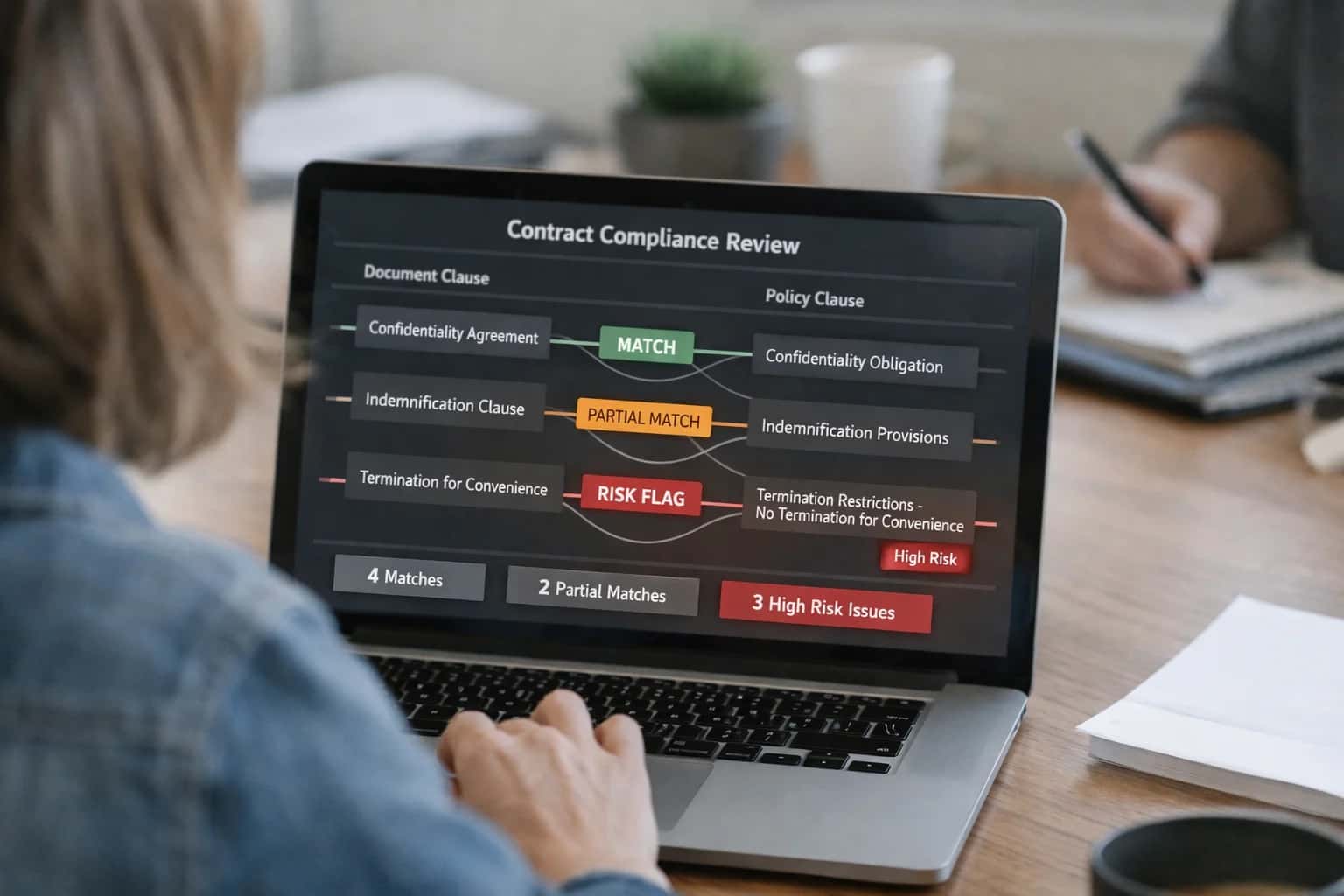
Where AI Fits into Jaggaer's Contract Lifecycle
A technical blueprint for embedding AI agents into Jaggaer's contract modules to automate drafting, review, and obligation management.
A production implementation typically involves a middleware layer (often an AI workflow platform like n8n or a custom service) that orchestrates between Jaggaer's REST APIs, a vector database (e.g., Pinecone) storing your clause library and past contracts, and LLMs like GPT-4 or Claude. Key workflows include:
- Automated Clause Selection: An AI agent analyzes the contract type, supplier risk tier, and jurisdiction to recommend the appropriate pre-approved clauses from Jaggaer's library.
- Risk Summary Generation: For each contract version, the system generates a plain-English summary of key changes, financial exposures, and non-standard terms, attached as a note to the Jaggaer contract record.
- Renewal & Deadline Orchestration: Extracted dates trigger Jaggaer workflow alerts and can initiate automated renewal RFPs or renegotiation projects in the sourcing module, creating a closed-loop lifecycle.
Rollout should be phased, starting with lower-risk, high-volume agreements like NDAs and simple order forms, where AI can deliver immediate cycle time reduction. Governance is critical: all AI-suggested clauses or redlines should be logged in Jaggaer's audit trail, and a human-in-the-loop approval step should be mandated for contracts above a certain value or risk threshold. This approach allows procurement and legal teams to scale their capacity while maintaining control, turning Jaggaer from a system of record into an intelligent system of execution. For related patterns, see our guides on AI Integration for Jaggaer Procurement and AI Integration with Ivalua Contract Management.
Key Integration Points in Jaggaer CLM
AI for Drafting and Clause Selection
Integrate AI at the point of contract creation within Jaggaer's template library and clause bank. An AI agent can analyze the procurement context—such as category, supplier risk tier, and spend value—to recommend the most appropriate template and pre-approved clauses. This reduces manual review cycles and ensures compliance from the first draft.
Key Integration Surfaces:
- Template selection UI and API
- Clause library management
- Metadata fields for category, value, and risk
Example Workflow: A buyer initiates a new IT services agreement. The AI reviews the RFP summary, suggests the Master Services Agreement - High Risk template, and auto-populates critical data protection and liability clauses based on the supplier's location and service type.
High-Value AI Use Cases for Jaggaer Contracts
Integrate AI directly into Jaggaer's contract lifecycle to automate manual reviews, extract obligations, and manage renewals. These patterns connect to Jaggaer's Contract Management APIs, webhooks, and data model to create touchless workflows for legal, procurement, and business teams.
AI-Powered Contract Redlining & Clause Analysis
Automate the initial review of third-party paper. An AI agent ingests incoming contracts via Jaggaer's document APIs, compares clauses against your approved library, and highlights deviations for legal review. It can suggest alternative language and flag non-standard terms like liability caps or auto-renewals, reducing manual review time by 60-80% on standard agreements.
Automated Obligation & Milestone Extraction
Transform executed contracts into actionable trackers. Using RAG (Retrieval-Augmented Generation) against your contract repository, AI extracts key obligations, delivery milestones, reporting requirements, and notice periods. These are mapped to Jaggaer's custom objects or external project management tools, creating a system of record for compliance and reducing missed deadlines.
Intelligent Contract Renewal & Risk Forecasting
Proactively manage contract lifecycles. An AI agent monitors Jaggaer's renewal date fields, analyzes historical performance data and current terms, and generates renewal risk scores. It can trigger workflows for renegotiation, termination, or auto-renewal approval within Jaggaer, shifting renewal management from reactive to strategic.
AI-Assisted Template Selection & First Draft Generation
Accelerate contract creation for business users. Integrate a copilot into Jaggaer's contract request workflow. Based on the procurement category, supplier risk tier, and value, the AI recommends the correct template, pre-populates key fields (parties, term, jurisdiction), and drafts initial clauses, reducing back-and-forth and ensuring policy compliance from the start.
Conversational Contract Q&A for Stakeholders
Democratize contract intelligence. Embed a secure chatbot within the Jaggaer contract record interface. Authorized users (e.g., project managers, budget owners) can ask natural language questions like "What's the termination notice period?" or "Are there any price escalation clauses?" The AI, grounded in the specific contract text, provides instant, cited answers, eliminating manual searches and legal ticket volume.
Supplier Performance & Contract Compliance Monitoring
Close the loop between contracts and operations. Connect AI to Jaggaer's supplier performance data and external systems (e.g., delivery logs, quality reports). The system continuously compares actual performance against contractual SLAs and KPIs extracted from the agreement, generating automated alerts for breaches and populating supplier scorecards in Jaggaer, enabling data-driven SRM (Supplier Relationship Management).
Example AI-Powered Contract Workflows
These workflows illustrate how AI agents can be integrated into specific Jaggaer CLM modules to automate high-effort, high-value tasks. Each flow connects to Jaggaer's APIs, processes contract data, and returns actionable insights or system updates.
Trigger: A user initiates a new contract from a template in Jaggaer CLM.
Workflow:
- Context Pull: The AI agent receives the template ID, selected metadata (counterparty, region, value), and any user-provided notes via a webhook from Jaggaer.
- Clause Analysis & Population: The agent retrieves the approved template and its tagged clauses from the connected document store. It uses an LLM to:
- Analyze the user notes to extract key business terms (e.g., "payment net 45", "governing law New York").
- Match these terms to the correct template fields and fallback clause options from the pre-approved library.
- Generate context-aware pre-population for variable fields (e.g., party names, addresses, effective dates).
- System Update: The agent calls the Jaggaer CLM API to create a new contract draft with the pre-populated clauses and fields, flagging any terms that require mandatory legal review.
- Human Review Point: The draft is routed in Jaggaer to the initiator and legal reviewer with an AI-generated summary of changes made and key commercial terms highlighted for validation.
Implementation Architecture: Data Flow and Guardrails
A secure, phased approach to injecting AI into the Jaggaer CLM workflow without disrupting existing compliance and approval chains.
A production-ready integration connects to Jaggaer's Contract Management APIs and webhook system to create a parallel AI processing layer. Inbound contract documents (e.g., third-party paper, redlined MSAs) are routed via a secure queue to an extraction service. This service uses a multi-model approach: a vision model for OCR and layout analysis, followed by an LLM fine-tuned on legal clauses to identify parties, dates, termination clauses, liability caps, and auto-renewal terms. The extracted data is structured into a JSON payload that maps directly to Jaggaer's custom object fields—like Contract_Terms__c, Obligation_Start_Date__c, and Renewal_Notice_Period__c—for automated population, reducing manual data entry from hours to minutes.
The architecture is designed for controlled rollout. Phase one typically focuses on post-signature obligation extraction, where AI populates a structured obligation register linked to the master contract record. This allows legal and procurement teams to validate AI output before any automated actions are taken. For pre-signature support, a separate workflow can be triggered from the Jaggaer Contract Workspace, where an AI agent suggests redlines based on a pre-approved clause library and historical negotiation data, presenting them as comments for reviewer approval. All AI interactions are logged with a full audit trail, linking suggestions to the specific user, model version, and source prompt for compliance.
Governance is enforced through a human-in-the-loop approval layer before any system-of-record updates are committed. For high-risk clauses (e.g., indemnification, IP ownership), the system can be configured to flag for mandatory legal review. The integration runs in Inference Systems' secure VPC, ensuring that sensitive contract data is never used for model training. This phased, guardrailed approach allows organizations to start with low-risk, high-volume extraction tasks, build trust in the system, and gradually expand AI's role into more complex drafting and negotiation support workflows within the familiar Jaggaer interface.
Code and Payload Examples
Extracting Obligations and Red Flags
Use AI to parse uploaded contract documents, identify key clauses, and flag non-standard or risky terms against your approved playbook. This transforms unstructured PDFs into structured, queryable data within Jaggaer's contract repository.
Typical Workflow:
- A new supplier agreement is uploaded to a Jaggaer contract record.
- A webhook triggers an AI service, sending the document text.
- The LLM extracts clauses (e.g.,
termination_for_convenience,liability_cap,auto_renewal). - Results are posted back to Jaggaer as custom field updates or linked analysis records.
Example Payload to AI Service:
json{ "contract_id": "JAG-CONT-2024-00123", "document_text": "...TERMINATION. Either party may terminate this Agreement upon thirty (30) days written notice...", "playbook_id": "supplier-services-playbook-v2", "callback_url": "https://your-jaggaer-instance.com/api/webhooks/ai-analysis" }
Realistic Time Savings and Operational Impact
How AI integration accelerates key Jaggaer CLM workflows, reduces manual review cycles, and improves compliance oversight.
| Contract Workflow | Before AI | After AI | Implementation Notes |
|---|---|---|---|
Template Selection & Drafting | Manual search of clause library; copy-paste drafting | AI-recommended templates & clauses based on deal type | Integrates with Jaggaer's template repository; human lawyer reviews final draft |
Initial Redlining & Risk Flagging | Legal team manually reviews all incoming redlines | AI highlights non-standard clauses & suggests fallbacks | Flags high-risk deviations for immediate legal attention; reduces first-pass review by ~70% |
Obligation & Milestone Extraction | Manual extraction to spreadsheets or separate trackers | AI auto-extracts key dates, deliverables, and obligations | Populates Jaggaer obligation tracking fields; syncs with project management tools |
Renewal & Expiration Management | Periodic manual report runs; email reminders to owners | AI-powered dashboard with predictive renewal alerts | Triggers Jaggaer workflows 90/60/30 days out; includes summary of key terms |
Contract Query & Search | Keyword searches across document titles and metadata | Semantic search across full contract text & attachments | Uses RAG on Jaggaer's document store; answers questions in natural language |
Approval Routing & Escalation | Static rules based on value thresholds | Dynamic routing based on AI analysis of contract risk & type | Integrates with Jaggaer's workflow engine; reduces misrouted contracts |
Post-Signature Compliance Spot-Check | Sample-based manual audits | AI continuously monitors executed contracts for policy drift | Flags potential non-compliance for legal/Procurement review; runs on a schedule |
Governance, Security, and Phased Rollout
A practical framework for deploying AI in Jaggaer CLM with control, security, and measurable impact.
A production-ready integration for Jaggaer Contract Lifecycle Management (CLM) is built on a secure, event-driven architecture. This typically involves deploying a dedicated microservice that listens to Jaggaer's webhooks for lifecycle events—such as contract.created, clause.updated, or renewal.alert—and processes them via a secure API gateway. The AI service, which can be a Retrieval-Augmented Generation (RAG) system for clause libraries or an extraction agent for obligations, should operate with strict role-based access control (RBAC) mirroring Jaggaer's user permissions. All AI-generated suggestions, redlines, or summaries must be written to a dedicated audit log within Jaggaer or a linked system, creating a clear lineage from the original contract version to the AI-assisted output for compliance and review.
Rollout follows a phased, risk-aware approach. Phase 1 often targets a low-risk, high-volume workflow like automated contract summarization for non-disclosure agreements (NDAs) or standard order forms, providing immediate time savings for legal and sales ops. Phase 2 introduces AI-assisted clause extraction and obligation tracking for a specific supplier category, allowing the procurement team to validate accuracy and refine prompts in a controlled environment. Phase 3 expands to intelligent redlining support for master service agreements, where AI suggests fallback language from a pre-approved clause library, but all changes require a human-in-the-loop approval step within Jaggaer's native review workflow before commitment.
Governance is anchored in continuous evaluation and human oversight. Establish a weekly review cadence where a cross-functional team (Legal, Procurement, IT) samples AI outputs against a quality rubric, measuring accuracy rates for entity extraction and user acceptance of suggested edits. This feedback loop is used to retrain models or adjust prompts. Security mandates that no contract data is persisted in external AI model training sets; all processing should occur through secure, compliant endpoints with data residency adherence. By starting with assistive, non-autonomous use cases and embedding controls directly into Jaggaer's existing approval queues, organizations can drive efficiency while maintaining contractual integrity and auditability.
Enabling Efficiency, Speed & Accuracy
Intelligent Analysis, Decision & Execution
We build AI systems for teams that need search across company data, workflow automation across tools, or AI features inside products and internal software.
Talk to Us
Search across company data
Give teams answers from docs, tickets, runbooks, and product data with sources and permissions.
Useful when people spend too long searching or get different answers from different systems.

Automate internal workflows
Use AI to route work, draft outputs, trigger actions, and keep approvals and logs in place.
Useful when repetitive work moves across multiple tools and teams.

Add AI to products and internal tools
Build assistants, guided actions, or decision support into the software your team or customers already use.
Useful when AI needs to be part of the product, not a separate tool.
Frequently Asked Questions
Practical questions for teams planning to integrate AI into Jaggaer's contract lifecycle management (CLM) workflows, from technical architecture to rollout strategy.
Secure integration typically follows a server-to-server pattern using Jaggaer's REST APIs and OAuth 2.0 for authentication.
Key Steps:
- Service Account Setup: Create a dedicated service account in Jaggaer with scoped permissions (e.g.,
contracts.read,contracts.write,clause-library.read). - API Gateway & Webhooks: Deploy a lightweight integration service (e.g., in your cloud) that:
- Listens for Jaggaer webhooks on events like
contract.created,contract.sent_for_review, orrenewal.reminder_triggered. - Makes authenticated API calls to fetch contract documents, metadata, and clause libraries.
- Listens for Jaggaer webhooks on events like
- Data Flow: The integration service sends relevant payloads to your AI processing layer. Never send raw documents directly to a public LLM endpoint.
- Secure AI Processing: Process documents within your secure VPC or via a private endpoint for services like Azure OpenAI or AWS Bedrock. Use the integration service to post analysis results (e.g., extracted obligations, redlines) back to specific Jaggaer contract fields or as linked annotations.
Governance Note: Maintain an audit log in your integration layer of all data sent/received for compliance.

About the author
Prasad Kumkar
CEO & MD, Inference Systems
Prasad Kumkar is the CEO & MD of Inference Systems and writes about AI systems architecture, LLM infrastructure, model serving, evaluation, and production deployment. Over 5+ years, he has worked across computer vision models, L5 autonomous vehicle systems, and LLM research, with a focus on taking complex AI ideas into real-world engineering systems.
His work and writing cover AI systems, large language models, AI agents, multimodal systems, autonomous systems, inference optimization, RAG, evaluation, and production AI engineering.
Partnered with leading AI, data, and software stack.





How We Work
Custom AI workflows for your Business
One-fit-all AI don't work for modern businesses. At Inferensys, we aim to understand your business & custom requirements; which we use to define most efficient agentic workflows, the data, and the tools for your business.
01
Review the use case
We understand the task, the users, and where AI can actually help.
Read more02
Pick the right approach
We define what needs search, automation, or product integration.
Read more03
Build the first useful version
We implement the part that proves the value first.
Read more04
Improve from there
We add the checks and visibility needed to keep it useful.
Read moreThe first call is a practical review of your use case and the right next step.
Talk to Us