
Inferensys

Integration

AI Integration for Jaggaer Contract Analytics

A technical blueprint for adding AI-powered contract intelligence to Jaggaer, automating term extraction, obligation management, and renewal forecasting to reduce manual review and improve compliance.
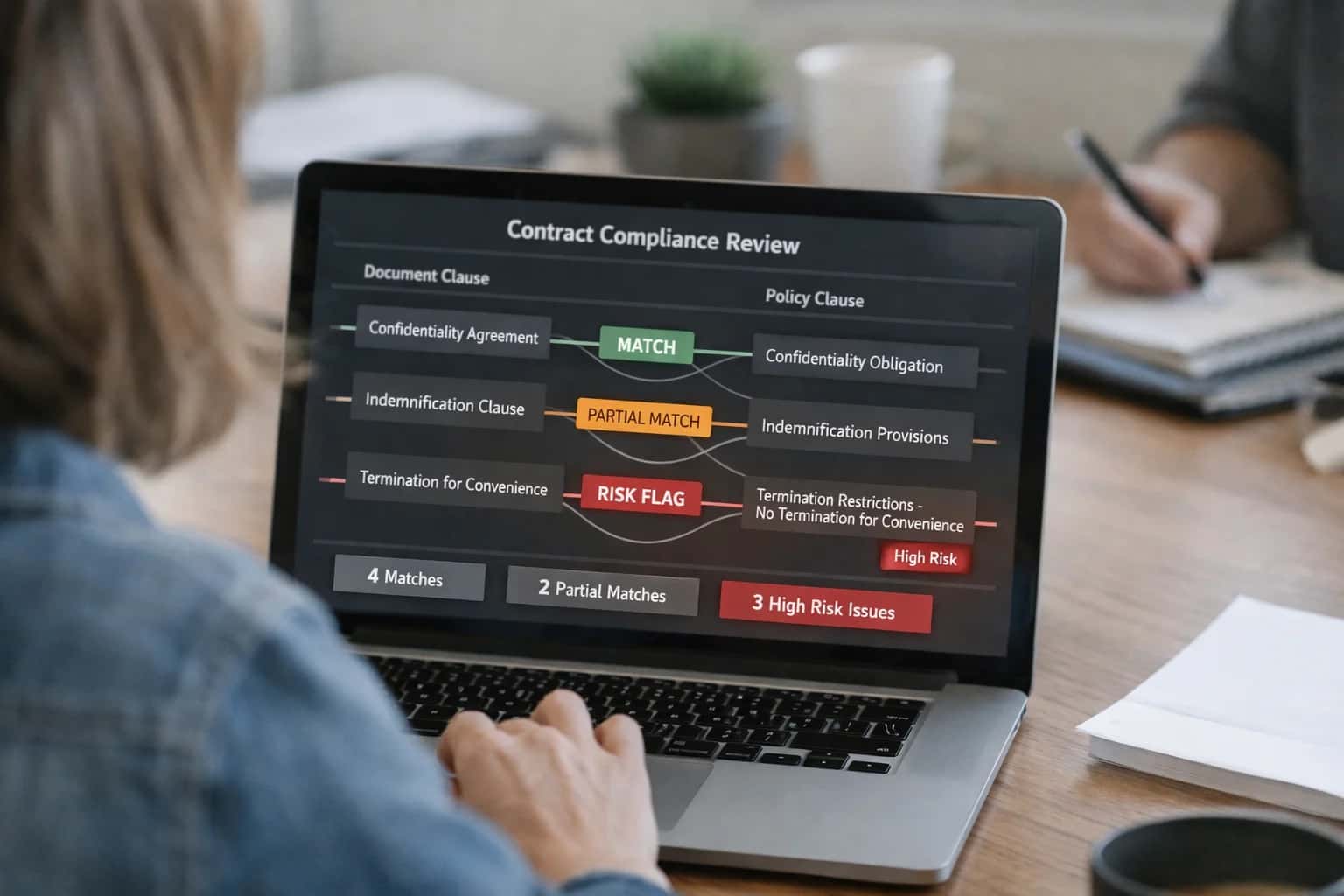
Legal team reviewing AI contract compliance agent on laptop, contract documents visible, modern WeWork meeting room.
ARCHITECTURE AND ROLLOUT

Where AI Fits into Jaggaer's Contract Repository

A technical blueprint for embedding AI into Jaggaer's contract data model to automate analysis, tracking, and forecasting.

AI integration for Jaggaer contract analytics connects at the document repository layer and the contract object's metadata fields. The primary surfaces are:

  • Contract Document Storage: Where unstructured PDFs, Word files, and scanned agreements are stored, typically in modules like Jaggaer Contract Lifecycle Management (CLM).
  • Contract Master Data: Structured fields for vendor, effective/expiration dates, value, and status that serve as the orchestration layer for AI-extracted insights.
  • Jaggaer APIs & Webhooks: Key endpoints like the Contract API for fetching documents and updating metadata, and Event Subscription webhooks to trigger AI analysis on contract upload or status change.
  • Approval & Obligation Workflows: Existing routing and task management engines where AI can inject summarized clauses, highlight risks, or flag upcoming renewals for review.


Implementation typically follows a synchronous enrichment pattern: when a contract is finalized or uploaded, a webhook triggers an AI agent. This agent:

  1. Extracts the document via the API.
  2. Processes it through a vision/OCR and LLM pipeline for clause identification, term extraction, and obligation mapping.
  3. Writes back structured data to custom fields in the contract record (e.g., AI_Extracted_Termination_Notice_Days, AI_Identified_Auto_Renewal).
  4. Creates tasks or alerts for stakeholders in Jaggaer's workflow engine based on extracted dates or risk scores. High-value use cases include automated renewal forecasting (reducing manual calendar tracking), obligation tracking dashboards (linking clauses to Jaggaer's supplier performance modules), and risk scoring for non-standard terms during the redline phase.

Rollout requires a phased approach, starting with read-only analysis of historical contracts to build confidence in extraction accuracy, followed by write-back to sandbox fields. Governance is critical: all AI updates should be logged in Jaggaer's audit trail, and a human-in-the-loop review step should be mandated for high-value or high-risk contracts initially. The integration's value is not in replacing Jaggaer's native CLM but in making its repository actively intelligent, turning static documents into a searchable, alert-driven system of record. For teams managing thousands of supplier agreements, this shifts contract management from reactive filing to proactive portfolio oversight.

AI-POWERED CONTRACT ANALYTICS

Key Integration Surfaces in Jaggaer Contract Management

Intelligent Document Retrieval

The Jaggaer contract repository is the primary surface for AI integration, housing executed agreements, amendments, and related documents. AI agents connect via Jaggaer's Document Management APIs to ingest, index, and analyze unstructured contract text.

Key integration workflows include:

  • Semantic Search Enhancement: Moving beyond keyword matching to allow users to ask questions like "Show all contracts with automatic renewal clauses in the next 90 days."
  • Automated Metadata Tagging: Using LLMs to extract and populate critical metadata fields (parties, effective/expiration dates, governing law, value) that may be missing or incomplete.
  • Clause Library Population: Identifying and cataloging standard and non-standard clauses across the repository to build a searchable knowledge base for legal and procurement teams.

This layer transforms the repository from a passive archive into an active intelligence system, enabling faster due diligence and compliance audits.

INTELLIGENT CONTRACT REPOSITORY OPERATIONS

High-Value AI Use Cases for Jaggaer Contract Analytics

Transform your static Jaggaer contract repository into an active intelligence hub. These AI integration patterns connect directly to Jaggaer's APIs and data model to automate extraction, analysis, and action on contractual terms, obligations, and risks.

01

Automated Clause & Obligation Extraction

Deploy an AI agent to ingest newly uploaded contracts via Jaggaer's Document Management API, extract key clauses (termination, liability, SLA), and map obligations to specific supplier records. Automatically populates custom fields in the Jaggaer contract object for structured search and reporting.

Batch -> Real-time
Extraction speed
02

Dynamic Renewal & Expiry Forecasting

Build a forecasting model that analyzes contract end dates, auto-renewal terms, and notice periods stored in Jaggaer. The AI generates a prioritized dashboard and automated alerts via Jaggaer workflow triggers, enabling procurement and legal teams to proactively renegotiate or terminate.

Same day
Renewal visibility
03

Supplier Risk Scoring from Contract Terms

Create a composite risk score by analyzing extracted contract terms (e.g., liability caps, indemnification, termination for convenience) alongside Jaggaer supplier performance data. Scores are written back to the supplier master, enabling high-risk suppliers to be flagged in sourcing events and purchase orders.

1 sprint
Implementation timeline
04

Natural Language Contract Q&A

Implement a RAG (Retrieval-Augmented Generation) layer over the Jaggaer contract repository. Enables users to ask questions like "Show all contracts with non-standard payment terms for Supplier X" via a chat interface. Responses are grounded in actual contract text, with citations.

Hours -> Minutes
Research time
05

Spend Commitment vs. Actual Analysis

Connect AI-extracted pricing, volume commitments, and discount terms from contracts to Jaggaer's transactional spend data. The system identifies variances and potential savings leakage, generating cases in Jaggaer's supplier management module for category managers to address.

Batch -> Real-time
Compliance monitoring
06

Automated Contract Summarization for Stakeholders

For every contract, an AI agent generates a consistent executive summary highlighting key commercial terms, obligations, and risks. This summary is stored in a Jaggaer contract note field, providing non-legal stakeholders (e.g., budget owners, project managers) instant clarity without reviewing the full document.

Hours -> Minutes
Stakeholder onboarding
JAGGAER CONTRACT ANALYTICS

Example AI-Powered Contract Workflows

These workflows demonstrate how to connect LLMs and AI agents to Jaggaer's contract repository and lifecycle management modules. Each example outlines a concrete automation, from trigger to system update, designed to reduce manual review and surface hidden obligations.

Trigger: A new contract document (PDF, DOCX) is uploaded to a designated Jaggaer contract folder or via the Contracts API.

Workflow:

  1. A webhook or scheduled job detects the new document and passes it to an AI processing pipeline.
  2. The pipeline uses an LLM with a retrieval-augmented generation (RAG) system over your clause library and playbooks to:
    • Extract key metadata (parties, effective/expiration dates, governing law).
    • Identify and classify critical clauses (Termination, Liability, IP, Renewal, SLA).
    • Flag non-standard or risky language against approved templates.
  3. The extracted data is structured into a JSON payload.
  4. System Update: The payload is posted back to Jaggaer via the Contracts API to:
    • Populate custom fields on the contract record.
    • Create linked Obligation or Milestone records for key dates and deliverables.
    • Tag the contract with risk scores and clause categories for filtering.

Human Review Point: The system can route contracts with high-risk scores or missing critical clauses to a legal review queue in Jaggaer.

PRODUCTION-READY INTEGRATION PATTERNS

Implementation Architecture: Data Flow and Guardrails

A practical blueprint for connecting AI to Jaggaer's contract data, focusing on secure extraction, analysis, and actionable insight delivery.

The integration architecture connects to Jaggaer's Contract Management APIs and document repository to establish a secure data pipeline. A primary agent, often deployed as a containerized service, polls for new or updated contracts, extracts text and metadata (like ContractID, SupplierName, EffectiveDate), and sends this payload to a processing queue. For unstructured documents (PDFs, Word files), a secondary extraction agent uses OCR and layout analysis to convert them into clean text. This raw contract data is then chunked, embedded using a model like text-embedding-3-small, and indexed into a vector database (e.g., Pinecone, Weaviate) that is colocated with your Jaggaer instance for low-latency retrieval. The system creates a unified search layer across all contract clauses, terms, and obligations.

Analytical workflows are built on top of this indexed data. A Query & Analysis Agent handles natural language requests from Jaggaer users—like "show all auto-renewal clauses for Supplier X" or "list contracts expiring in Q3 with volume discounts." It performs semantic search against the vector store, retrieves relevant chunks, and uses a reasoning LLM (e.g., GPT-4, Claude 3) to synthesize answers, extract specific fields, or generate summaries. For proactive intelligence, a Monitoring Agent runs scheduled jobs to scan the index for key terms (e.g., termination for convenience, price escalation), tracks obligation deadlines against MilestoneDate fields, and posts findings back to Jaggaer as tasks in the Contract Workspace or alerts via email/webhook. All agent actions are logged with a UserID and ContractID for a full audit trail.

Governance is enforced at multiple layers. Role-Based Access Control (RBAC) from Jaggaer is mirrored, ensuring agents only analyze contracts the querying user is authorized to view. A Prompt Guardrail Layer validates all LLM calls against policies to prevent data leakage or off-topic generation. For high-stakes outputs—like a renewal forecast or risk score—the system can be configured for human-in-the-loop review, creating a task in Jaggaer for a category manager or legal counsel to approve before the insight is finalized. The entire data flow is designed for incremental rollout: start with read-only analysis on a single contract category, validate accuracy, then expand to automated obligation tracking and renewal workflows.

JAGGAER CONTRACT ANALYTICS INTEGRATION PATTERNS

Code and Payload Examples

Ingesting Contracts via Jaggaer APIs

Before analysis, contracts must be extracted from Jaggaer's repository. Use the Contract Management API to fetch document metadata and binary content (PDF, DOCX). A common pattern is to listen for webhooks on contract creation or status change, then retrieve the finalized document for processing.

python
import requests
# Example: Fetch contract document after a webhook trigger
def fetch_contract_document(contract_id, api_key):
    headers = {'Authorization': f'Bearer {api_key}'}
    # Get contract metadata
    meta_url = f'https://your-instance.jaggaer.com/api/v2/contracts/{contract_id}'
    meta_resp = requests.get(meta_url, headers=headers)
    doc_id = meta_resp.json()['primaryDocumentId']
    
    # Download the document binary
    doc_url = f'https://your-instance.jaggaer.com/api/v2/documents/{doc_id}/download'
    doc_resp = requests.get(doc_url, headers=headers)
    return doc_resp.content  # Returns bytes

Once retrieved, use a document intelligence service (like Azure Form Recognizer or AWS Textract) to extract text and logical chunks (sections, clauses) for vector embedding, preserving metadata like contract_id, effective_date, and party_names.

AI-POWERED CONTRACT ANALYTICS

Realistic Time Savings and Operational Impact

This table illustrates the practical impact of integrating AI into Jaggaer's contract management workflows, focusing on measurable time savings and operational improvements for legal, procurement, and finance teams.

Workflow / TaskBefore AIAfter AIKey Impact & Notes

Contract term extraction & summarization

Manual review: 30-60 minutes per contract

Automated extraction: 2-5 minutes per contract

Enables rapid due diligence for M&A, renewals, and compliance audits.

Obligation tracking & deadline monitoring

Spreadsheet-based tracking; manual calendar reminders

Automated obligation registry with proactive alerts

Reduces risk of missed deliverables, penalties, and auto-renewals.

Renewal forecasting & risk assessment

Quarterly manual report compilation (2-3 days)

Real-time dashboard with predictive scoring

Provides 90-day visibility for negotiation planning and budget allocation.

Clause library compliance & deviation analysis

Side-by-side manual comparison against templates

AI-powered redlining with deviation highlighting

Accelerates legal review by flagging non-standard terms for attention.

Spend linkage & financial impact analysis

Manual cross-reference between contracts and POs/invoices

Automated linkage of contract terms to transactional data

Unlights realized savings, leakage, and pricing compliance in real-time.

Supplier performance against SLAs

Periodic manual audits based on sampled data

Continuous monitoring with automated scorecard updates

Shifts supplier management from reactive to proactive, data-driven conversations.

Ad-hoc contract query (e.g., 'NDA expiry dates')

Manual search across repository; may take hours

Natural language search returns results in seconds

Empowers non-legal teams (sales, procurement) with self-service intelligence.

Regulatory change impact assessment

Manual review of new regulations against contract library

AI scans for clauses affected by regulatory updates

Dramatically reduces compliance risk and the effort required for impact analysis.

ARCHITECTING FOR PRODUCTION

Governance, Security, and Phased Rollout

A production-ready AI integration for Jaggaer Contract Analytics requires a secure, governed architecture and a phased rollout to manage risk and demonstrate value.

A secure integration architecture treats the Jaggaer contract repository as the system of record, with AI agents operating as a read-only analysis layer. This is typically implemented by connecting to Jaggaer's REST APIs or leveraging its data export capabilities to create a secure, mirrored vector store. This separation ensures the core CLM system's integrity while enabling high-speed semantic search and analysis. All AI-generated insights—like extracted obligations or renewal flags—are written back to designated custom objects or notes fields within Jaggaer, maintaining a full audit trail and keeping actionable intelligence within the procurement team's primary workflow.

Governance is built into the workflow design. For high-stakes analyses, such as identifying non-standard liability clauses, the system can be configured to route findings to a legal or procurement specialist for review before updating the contract record. Access to the AI analysis layer should be controlled via Jaggaer's existing Role-Based Access Control (RBAC), ensuring that contract visibility and AI-powered insights are permissioned appropriately. All AI interactions, including prompts, source document references, and generated outputs, should be logged to a separate audit system to support compliance reviews and model performance monitoring.

A phased rollout mitigates risk and builds confidence. Start with a non-invasive discovery phase: deploy the AI to analyze a subset of historical contracts to surface insights like common missing clauses or renewal patterns, providing immediate analytical value without altering live data. Next, pilot assistive workflows, such as an AI copilot that helps category managers quickly summarize contract terms during sourcing events. Finally, scale to automated monitoring, where the system continuously scans the contract repository for risk triggers or upcoming renewals and creates automated alerts or tasks in Jaggaer. This incremental approach allows procurement, legal, and IT teams to validate accuracy, refine prompts, and adapt processes at each step.

IMPLEMENTATION AND WORKFLOW DETAILS

Frequently Asked Questions

Practical questions about integrating AI with Jaggaer's contract repository, covering technical architecture, data handling, and rollout strategies.

The integration is built on a secure, API-first architecture that never stores your raw contract data. Here’s the typical flow:

  1. Authentication & Authorization: The AI service uses OAuth 2.0 or API keys with scoped permissions, connecting via Jaggaer's REST API. Access is restricted to the specific contract repository folders or modules you designate.
  2. Data Extraction: For analysis, contracts are retrieved via API. Text is extracted from PDFs, Word docs, or native Jaggaer fields. No documents are permanently copied; they are processed in memory for the specific task.
  3. Secure Processing: Text is sent to your chosen AI model (e.g., Azure OpenAI, Anthropic, a fine-tuned open model) over a private endpoint. All data is encrypted in transit.
  4. Result Posting: Insights (like extracted clauses, obligations, or risk scores) are written back to custom fields in the Jaggaer contract object or to a linked reporting database. The original document remains untouched in Jaggaer.

This approach maintains Jaggaer as the system of record and leverages its existing RBAC for governance.

Prasad Kumkar

About the author

Prasad Kumkar

CEO & MD, Inference Systems

Prasad Kumkar is the CEO & MD of Inference Systems and writes about AI systems architecture, LLM infrastructure, model serving, evaluation, and production deployment. Over 5+ years, he has worked across computer vision models, L5 autonomous vehicle systems, and LLM research, with a focus on taking complex AI ideas into real-world engineering systems.

His work and writing cover AI systems, large language models, AI agents, multimodal systems, autonomous systems, inference optimization, RAG, evaluation, and production AI engineering.


