AI integration for the QRadar Suite is not a single-point solution; it's a platform-wide augmentation of its core workflows. The primary surfaces for integration are the Offense pipeline, the Ariel Query Layer, and the Flow/Event Collector infrastructure. AI acts as a co-processor at each stage: pre-filtering raw logs before indexing to reduce EPS costs, triaging and summarizing Offenses at creation for analyst context, and generating high-fidelity AQL queries for threat hunting based on behavioral hypotheses. This transforms QRadar from a rules-based correlation engine into a cognitive security operations hub where AI handles pattern recognition and narrative assembly, allowing human analysts to focus on validation and response decisions.

Integration
AI Integration for IBM QRadar Suite
A platform-wide approach to integrating AI across QRadar SIEM, XDR, and Cloud Pak for Security, focusing on shared entity behavior analytics and a unified AI-driven investigation plane.
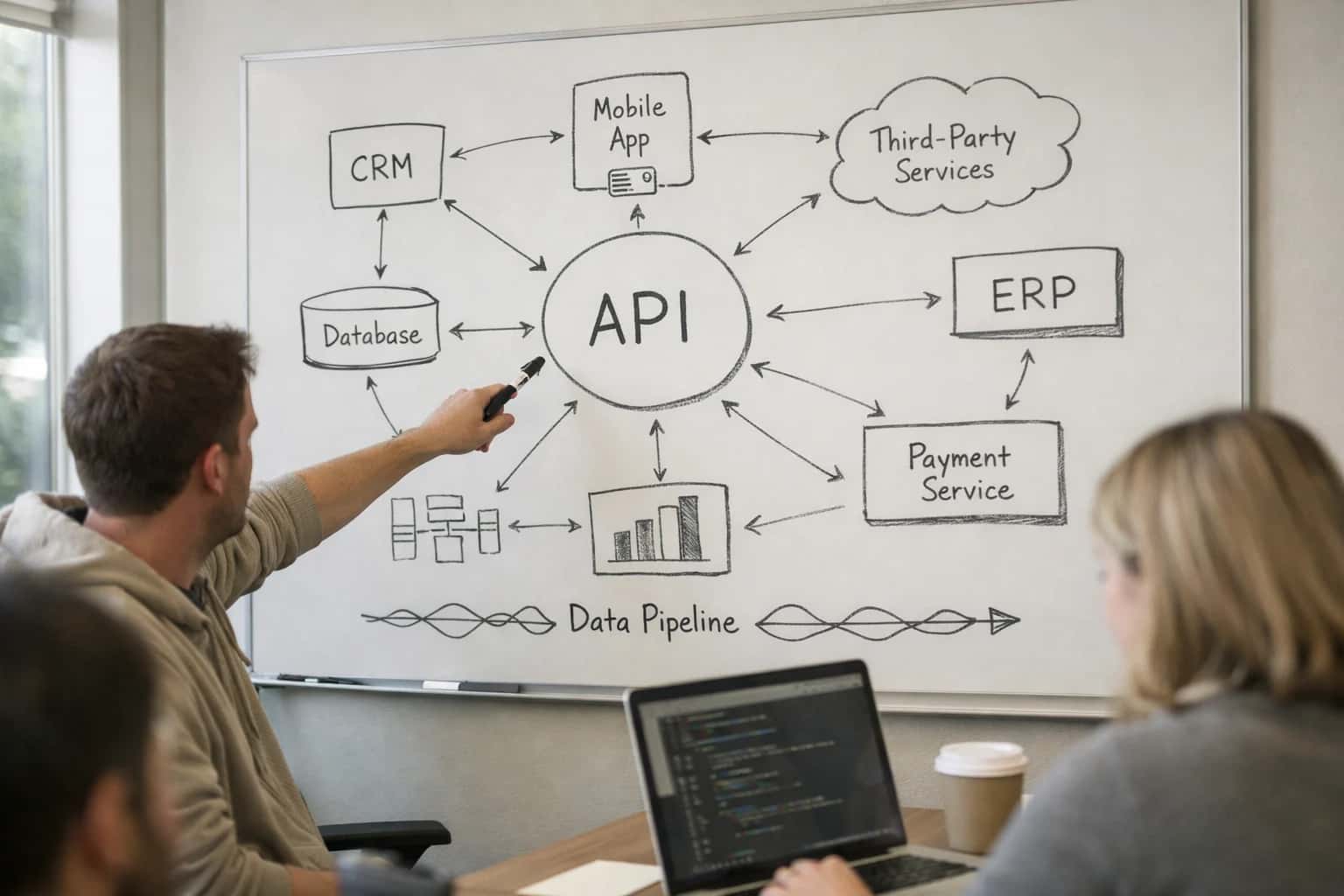
PLATFORM-WIDE INTEGRATION ARCHITECTURE
Where AI Fits into the QRadar Suite
A practical blueprint for embedding AI across the QRadar SIEM, XDR, and Cloud Pak for Security components to create a unified, intelligent investigation plane.
Implementation focuses on a shared entity behavior analytics layer that sits atop QRadar SIEM, QRadar on Cloud, and integrated XDR data. By applying AI models to the unified log and flow data in Cortex Data Lake (or QRadar's own Data Store), you can detect subtle, multi-stage campaigns that span network, endpoint, and identity events—patterns traditional rules miss. For example, an AI model can analyze Offense records, correlated Flow data, and endpoint process trees from an integrated EDR to reconstruct a lateral movement attack chain, automatically populating the Incident Forensics tab with a plain-language summary and recommended containment steps via Response Orchestration. This requires secure API calls from QRadar's backend to inference endpoints, with results written back to Offense notes or custom fields for auditability.
Rollout should be phased, starting with AI-driven Offense triage to demonstrate immediate SOC efficiency gains (reducing manual review time from hours to minutes), then expanding to predictive log source management to optimize EPS allocation, and finally implementing autonomous investigation agents for high-confidence, low-risk scenarios. Governance is critical: all AI-generated actions (like suggested AQL queries or playbook recommendations) should be logged as QRadar Activities and require analyst approval before execution in production. This ensures the integration enhances analyst judgment without creating ungoverned automation risks. For teams using IBM Cloud Pak for Security, the AI layer can be deployed as a containerized service within the same OpenShift environment, ensuring low-latency data access and consistent policy enforcement across the security toolchain.
PLATFORM SURFACES
AI Touchpoints Across the QRadar Suite
Core SIEM and Log Management
AI integration for QRadar SIEM focuses on augmenting its core log analysis and correlation engine. Key surfaces include:
- Offense Lifecycle: Automatically triage and enrich new offenses at creation by pulling context from CMDBs, vulnerability scanners, and threat intel to assign preliminary severity and ownership.
- Ariel Query Language (AQL): Use AI to assist analysts in writing, optimizing, and explaining AQL searches for hunting and investigation, suggesting indexing strategies and efficient time ranges.
- Log Source Intelligence: Apply AI to optimize the performance and parsing of the QRadar Event Collector, intelligently allocating resources based on log source criticality and volume spikes.
- Anomaly Detection: Extend QRadar's built-in capabilities with AI for multi-dimensional behavioral analysis (e.g., correlating login time, location, and accessed resource) to surface more contextual, high-fidelity anomalies.
This layer transforms raw telemetry into prioritized, context-rich security intelligence.
PLATFORM-WIDE INTEGRATION PATTERNS
High-Value AI Use Cases for QRadar
Integrating AI across the QRadar Suite transforms reactive security operations into a proactive, intelligence-driven investigation plane. These patterns focus on augmenting core QRadar workflows with contextual analysis, automated reasoning, and unified entity behavior analytics.
01
AI-Powered Offense Triage & Enrichment
Automatically enrich new QRadar Offenses at creation by pulling context from CMDBs, vulnerability scanners, and threat intel feeds. AI evaluates asset criticality, attack progression, and external threat context to assign a preliminary severity, ownership, and recommended investigation steps, moving triage from hours to minutes.
Hours -> Minutes
Triage time
02
Unified Entity Behavior Analytics
Augment QRadar's behavioral analytics by applying AI models that correlate user, host, and network activity across SIEM, endpoint (via integrations), and identity data. This creates sophisticated, peer-group-based baselines to detect subtle insider threat campaigns and living-off-the-land techniques that evade rule-based detection.
Multi-Dimensional
Behavior modeling
03
Intelligent Threat Hunting with AQL Co-Pilot
Empower threat hunters with an AI co-pilot that translates natural language hypotheses into optimized Ariel Query Language (AQL). The agent suggests related log sources, explores complex attack chains, and visualizes results, dramatically reducing the time to investigate advanced threats across the QRadar data lake.
1 sprint
Query development
04
AI-Enhanced Flow Analysis for Lateral Movement
Apply AI to network flow data from the QRadar Flow Collector to detect beaconing, data exfiltration, and lateral movement patterns traditional thresholds miss. Models learn normal east-west traffic baselines to flag anomalous internal communication indicative of compromised assets, providing critical context for incident response.
Batch -> Real-time
Detection mode
05
Automated Response Orchestration
Integrate AI with QRadar's response workflows to evaluate containment actions. For high-confidence offenses, AI assesses asset criticality and attack stage to recommend or automate steps like isolating endpoints via integrated EDR or blocking IPs at the firewall, ensuring responses are proportional and context-aware.
Same day
Containment activation
06
Predictive Performance & Tuning
Use AI to monitor and optimize QRadar performance. Models analyze EPS usage, search head workload, and data retention patterns to recommend tuning parameters, forecast capacity needs, and intelligently allocate resources based on log source criticality, ensuring the platform scales efficiently with security demand.
PLATFORM-WIDE AUTOMATION
Example AI-Driven Workflows
These workflows demonstrate how AI agents can be embedded across the QRadar Suite—from SIEM alert triage to XDR investigation—creating a unified, intelligent investigation plane that reduces manual effort and accelerates response.
Trigger: A new QRadar Offense is created.
Context Pulled: The AI agent retrieves the offense details, including:
- Offense source and destination IPs, usernames, and QID.
- Related events and flows from the Ariel database.
- Asset context from the QRadar Asset Model or external CMDB.
- Vulnerability data for involved assets from integrated scanners.
Agent Action: A multi-step LLM agent analyzes the data to:
- Summarize the offense into a concise, plain-language narrative.
- Enrich with external threat intelligence via API calls to TI platforms.
- Score Severity dynamically, adjusting the QRadar magnitude based on asset criticality, exploit availability, and active threat context.
- Recommend Ownership, suggesting the most appropriate SOC analyst or team based on skillset and current workload.
System Update: The agent automatically updates the Offense with:
- The AI-generated summary in the description field.
- Adjusted magnitude score.
- Recommended owner and priority tags.
- Enriched TI context attached as a reference.
Human Review Point: The enriched offense is presented in the analyst's queue. The analyst reviews the AI's summary and context before accepting ownership, ensuring a high-confidence starting point.
PLATFORM-WIDE AI INTEGRATION
Typical Implementation Architecture
A practical architecture for embedding AI across the IBM QRadar Suite to create a unified, intelligent investigation layer.
A production-ready AI integration for the QRadar Suite typically involves a centralized AI service layer that interacts with multiple platform components via their APIs. This layer ingests and processes data from QRadar SIEM (Offenses, Events, Flows), QRadar XDR (Endpoint Telemetry), and auxiliary sources like IBM Guardium or IBM Security Verify. The core architectural pattern is to use this service to enrich, correlate, and generate insights that are then injected back into the suite's native workflows, such as Offense notes, XDR investigation trees, or custom dashboard widgets. Key integration points include the QRadar API for offense and event context, the Cortex Data Lake API (for Palo Alto telemetry if integrated), and the IBM Cloud Pak for Security data fabric for cross-tool queries.
The implementation focuses on three primary workflows: 1) Offense Triage & Enrichment, where incoming QRadar offenses are automatically summarized, assigned a dynamic risk score based on asset context and threat intel, and routed to the appropriate analyst queue; 2) Cross-Component Correlation, where the AI service identifies links between a SIEM offense, endpoint alerts from XDR, and network anomalies from QRadar Flow Collector, constructing a unified attack narrative; and 3) Assisted Investigation, where an AI co-pilot within the analyst console suggests next investigative steps, generates AQL queries to hunt for related activity, and drafts closure reports. This is typically deployed as a containerized microservice using event-driven webhooks from QRadar and message queues for asynchronous processing to avoid impacting real-time detection performance.
Governance and rollout require careful planning. A phased approach starts with read-only enrichment of low-severity offenses to validate AI outputs and build analyst trust. Role-based access controls (RBAC) are essential to govern which AI-suggested actions (like adding a reference set entry) can be auto-executed versus those requiring manual approval. All AI-generated content and recommendations should be audit-logged with traceability back to the source data and model version. Finally, the architecture must account for data residency and privacy, ensuring PII within logs is handled appropriately, often by using on-premises or VPC-deployed model endpoints rather than public cloud AI services for sensitive data processing.
AI INTEGRATION PATTERNS FOR QRadar
Code and Payload Examples
Automating Initial Offense Analysis
When a new QRadar Offense is created, an AI agent can be triggered via webhook to perform immediate triage. The agent fetches the offense details via the QRadar API, analyzes the included events, and enriches the record with context from external sources.
Typical Payload to AI Service:
json{ "offense_id": 12345, "severity": 8, "description": "Multiple Failed Logins", "start_time": "2024-05-15T14:30:00Z", "source_addresses": ["192.168.1.100"], "destination_addresses": ["10.0.0.25"], "categories": ["Authentication Failure"], "magnitude": 4 }
The AI service returns a structured summary and recommended actions, which are posted back to the Offense's notes via POST /api/siem/offenses/{id}/notes. This pre-processing reduces analyst cognitive load by providing a narrative of what happened, likely intent, and suggested first investigative steps, all before a human touches the ticket.
AI INTEGRATION FOR IBM QRADAR SUITE
Realistic Time Savings and Operational Impact
A conservative, module-by-module view of how AI integration can shift analyst workflows and operational cadence across the QRadar Suite, focusing on measurable efficiency gains and improved decision velocity.
| Metric | Before AI | After AI | Notes |
|---|---|---|---|
Offense Triage & Enrichment | Manual review of raw logs and events | AI-generated summary with entity context and risk score | Analyst reviews pre-digested narrative, not raw data |
Threat Hunting Hypothesis Generation | Manual brainstorming based on experience and intel | AI suggests high-probability AQL queries from offense patterns | Reduces time to first investigative query by 60-80% |
Incident Report Drafting | Manual compilation of timeline, IOCs, and actions | AI auto-generates structured draft from case notes and logs | Analyst edits and finalizes, saving 1-2 hours per major case |
Log Source Onboarding & Parsing | Manual mapping and regex creation for new sources | AI recommends DSM/LEEF mappings and parses sample logs | Reduces setup time from days to hours for common log types |
Rule Tuning & Noise Reduction | Periodic manual review of false-positive offenses | AI analyzes offense history to suggest rule adjustments | Proactively flags low-yield rules for retirement or tuning |
Compliance Evidence Collection | Manual searches and screenshots for audit reports | AI maps controls to relevant AQL, runs searches, and formats evidence | Cuts preparation time for quarterly audits by 30-50% |
Case Assignment & Workload Balancing | Manual dispatch based on team lead's judgment | AI routes new offenses based on analyst expertise and current queue | Optimizes SOC throughput and reduces analyst context-switching |
PLATFORM-WIDE AI INTEGRATION
Governance, Security, and Phased Rollout
A structured approach to deploying AI across the QRadar Suite that prioritizes control, compliance, and measurable impact.
A production-grade AI integration for the QRadar Suite must be governed by the same security principles as the platform itself. This means AI workflows should operate within the existing QRadar role-based access control (RBAC) framework, with all AI-generated insights, actions, and data retrievals logged to the QRadar Audit Log for a complete chain of custody. For instance, an AI agent that queries the Ariel database for related offenses or enriches a case with external threat intelligence must impersonate a dedicated service account with explicitly defined permissions, ensuring the principle of least privilege. All prompts, model inferences, and data sent to external LLM APIs (like OpenAI or Azure OpenAI) should be scrubbed of sensitive PII or confidential internal data through a pre-processing layer before leaving the network, with responses cached within the QRadar ecosystem to maintain data sovereignty.
A phased rollout is critical for adoption and risk management. Start with a read-only, analyst-assist phase focused on the QRadar SIEM investigation plane. Deploy AI to summarize complex offenses, generate natural language explanations for risk scores from QRadar Risk Manager, or draft initial incident descriptions for the Offenses tab. This provides immediate value without altering security workflows. Phase two introduces orchestrated actions within QRadar SOAR (or integrated tools), where AI can recommend and, with analyst approval, execute containment playbooks—such as isolating an asset via an integrated endpoint tool. The final phase integrates AI across the suite for predictive operations, like using behavioral analytics from QRadar XDR telemetry to forecast potential attack paths and proactively adjust Network Insights policies.
Governance is maintained through a continuous feedback loop. Establish a review board that regularly evaluates AI-generated outputs against SOC analyst decisions, tuning prompts and logic to reduce drift. Use QRadar's own dashboarding to monitor key metrics: AI suggestion adoption rates, time saved per investigation, and false-positive/false-negative rates for AI-prioritized alerts. This closed-loop system ensures the AI integration remains a compliant, effective force multiplier, transforming the QRadar Suite from a reactive console into a proactive, intelligence-driven command center. For related architectural patterns, see our guide on AI Governance for Security Platforms.
Enabling Efficiency, Speed & Accuracy
Intelligent Analysis, Decision & Execution
We build AI systems for teams that need search across company data, workflow automation across tools, or AI features inside products and internal software.
Talk to Us
Search across company data
Give teams answers from docs, tickets, runbooks, and product data with sources and permissions.
Useful when people spend too long searching or get different answers from different systems.
Enterprise searchRAGPermissions
Read more
Automate internal workflows
Use AI to route work, draft outputs, trigger actions, and keep approvals and logs in place.
Useful when repetitive work moves across multiple tools and teams.
AI agentsWorkflow automationGovernance
Read more
Add AI to products and internal tools
Build assistants, guided actions, or decision support into the software your team or customers already use.
Useful when AI needs to be part of the product, not a separate tool.
AI integrationDecision supportModel routing
Read moreAI INTEGRATION FOR IBM QRADAR SUITE
Frequently Asked Questions
Practical questions for security leaders and architects evaluating AI integration across QRadar SIEM, XDR, and the broader security intelligence platform.
AI can be injected at multiple points in the QRadar offense lifecycle to automate triage and enrichment.
Typical Integration Flow:
- Trigger: A new QRadar Offense is created via a Building Block or Rule.
- Context Pull: An AI agent is triggered via webhook or API call. It pulls the offense details, related events, and flows via the QRadar API (
/api/siem/offenses/{id}and related endpoints). - AI Action: The agent uses an LLM (e.g., via OpenAI, Anthropic, or a private model) to analyze the data. Key tasks include:
- Summarization: Generating a concise, plain-language narrative of the offense.
- Enrichment: Correlating internal IPs with asset data from a CMDB (via REST API) and checking external IPs against threat intelligence feeds.
- Severity & Priority Recommendation: Suggesting an adjusted severity based on asset criticality and threat context.
- System Update: The agent uses the QRadar API to update the Offense with the AI-generated summary, a custom property for the recommended priority, and links to enriched data.
- Human Review Point: The enriched offense is presented in the QRadar console. Analysts can review the AI's summary and recommendations before taking action. The system can be configured to auto-assign offenses with high-confidence AI scores to specific analyst groups.

About the author
Prasad Kumkar
CEO & MD, Inference Systems
Prasad Kumkar is the CEO & MD of Inference Systems and writes about AI systems architecture, LLM infrastructure, model serving, evaluation, and production deployment. Over 5+ years, he has worked across computer vision models, L5 autonomous vehicle systems, and LLM research, with a focus on taking complex AI ideas into real-world engineering systems.
His work and writing cover AI systems, large language models, AI agents, multimodal systems, autonomous systems, inference optimization, RAG, evaluation, and production AI engineering.
LinkedIn
Limited slotsGet a Free AI Consultation
Partnered with leading AI, data, and software stack.





How We Work
Custom AI workflows for your Business
One-fit-all AI don't work for modern businesses. At Inferensys, we aim to understand your business & custom requirements; which we use to define most efficient agentic workflows, the data, and the tools for your business.
01
Review the use case
We understand the task, the users, and where AI can actually help.
Read more02
Pick the right approach
We define what needs search, automation, or product integration.
Read more03
Build the first useful version
We implement the part that proves the value first.
Read more04
Improve from there
We add the checks and visibility needed to keep it useful.
Read moreThe first call is a practical review of your use case and the right next step.
Talk to Us