AI integration for a salon POS system focuses on enhancing the transactional surfaces where staff and clients interact directly with the register. This includes the checkout screen, product lookup, payment processing, and receipt generation within platforms like Fresha, Zenoti, Mangomint, and Vagaro. The integration typically connects via the platform's Order API, Product Catalog API, and Transaction Logs to inject intelligence into three key workflows: smart product discovery (e.g., 'find a moisturizer for color-treated hair'), voice-enabled or conversational checkout for hands-free operation during busy periods, and automated receipt summarization that itemizes services, products, and loyalty points earned in plain language.

Integration
AI Integration for POS Systems in Salons
A technical blueprint for embedding AI into the salon point-of-sale experience. Enhance transaction speed, accuracy, and client engagement by connecting AI models directly to your POS software's product, client, and transaction APIs.
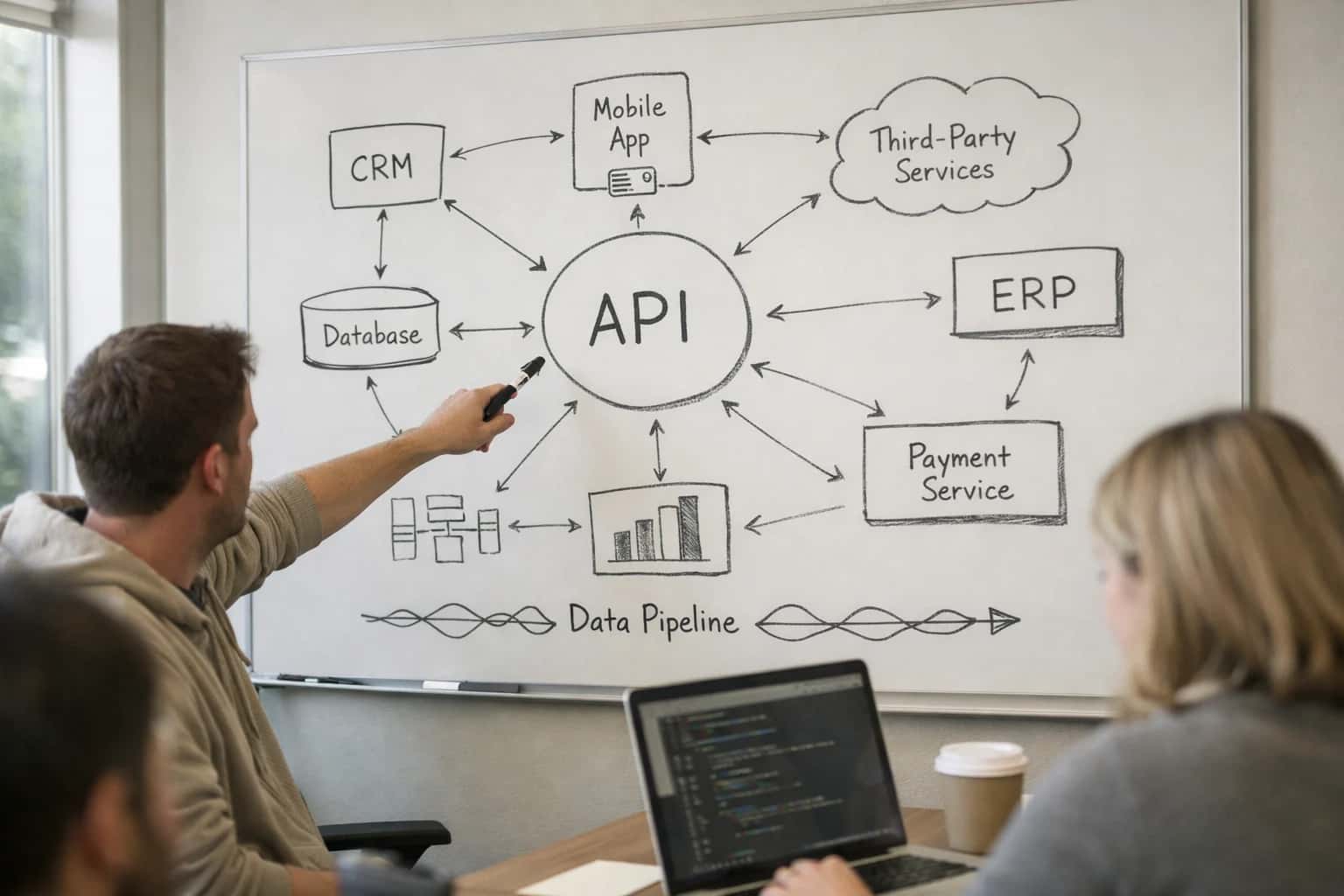
ARCHITECTURE AND ROLLOUT
Where AI Fits in the Salon POS Workflow
A practical blueprint for integrating AI into the core transaction layer of salon and spa management platforms.
Implementation centers on deploying a lightweight AI agent that sits between the POS interface and the platform's backend. For example, when a stylist scans a retail item, the agent can call a RAG (Retrieval-Augmented Generation) system indexed on the salon's product catalog and client purchase history to suggest complementary items or flag low stock. At payment, the agent can integrate with the payment gateway's webhooks to analyze transaction patterns in real-time, providing smart tip suggestions based on service type or alerting to potential fraud anomalies. Post-transaction, the agent uses the Receipt API to generate a client-friendly summary, which can be sent via SMS or email, enhancing clarity and reducing front-desk inquiries about charges.
Rollout requires a phased approach, starting with a single-location pilot focused on non-critical workflows like receipt summarization. Governance is crucial: all AI-generated suggestions (e.g., product upsells) should be logged in the platform's audit trail with a clear attribution to the AI agent, and a human-in-the-loop approval step should be configured for any automated actions affecting inventory or pricing. By embedding AI directly into the POS workflow, salons can reduce average transaction time, increase retail attachment rates, and provide a more seamless, informative checkout experience—without replacing the trusted POS software they rely on daily.
ARCHITECTURE FOR AI-ENHANCED TRANSACTIONS
Key POS Integration Surfaces and APIs
The Core Register Interface
Integrating AI at the point of sale requires a direct connection to the transaction lifecycle. Key surfaces include the Sale/Cart API for real-time item lookups and the Payment/Tender API for finalizing transactions. This is where AI can inject intelligence into the checkout flow.
Primary Integration Points:
- Sale Creation/Update Endpoints: To add AI-suggested products or services to a live cart before payment.
- Product Catalog API: For retrieving detailed SKU information, pricing, and inventory levels to ground AI recommendations.
- Tender/Close Sale Endpoint: To apply smart tip suggestions or dynamic discounts calculated by an AI model before the sale is closed.
Example AI Workflow: An AI agent listens for a cart creation webhook, analyzes the client's purchase history via the Client API, and uses the Sale Update endpoint to add a relevant retail product (e.g., a matching shampoo) before the cashier processes payment.
INTEGRATION PATTERNS
High-Value AI Use Cases for Salon POS
The point-of-sale is the revenue engine of a salon or spa. Integrating AI directly into the POS workflow automates complex tasks, personalizes client interactions, and unlocks data-driven decisions at the moment of transaction. Below are key integration patterns for platforms like Fresha, Zenoti, Mangomint, and Vagaro.
01
Voice-Enabled & Conversational Checkout
Integrate a voice AI layer with the POS API to allow staff to process transactions, apply discounts, or look up client notes using natural speech. This keeps hands free for product demonstration and reduces training time for new front-desk staff. The AI agent parses voice commands, calls the appropriate POS endpoints, and confirms actions audibly.
Batch -> Real-time
Transaction speed
02
Smart Product Lookup & Recommendation Engine
Connect an AI model to the POS product catalog and client purchase history. At checkout, the system analyzes the current service ticket and past behavior to surface highly relevant retail product recommendations (e.g., "Client purchased Kerastase shampoo last visit, suggest the matching conditioner"). This integration uses the platform's API to fetch real-time inventory levels to ensure suggestions are in stock.
1 sprint
Implementation timeline
03
Automated Receipt Summarization & Client Communication
After a transaction is finalized via the POS API, an AI workflow is triggered. It reads the detailed receipt data, generates a plain-language summary (e.g., "Your highlights with Sarah, plus Olaplex No.3"), and drafts a personalized follow-up email or SMS with care instructions and product usage tips. This integrates with the platform's native communication modules or a connected CRM.
Hours -> Minutes
Manual comms work
04
Intelligent Tip & Gratuity Guidance
Integrate an AI model at the tip prompt screen. The model analyzes transaction variables (service type, service provider, client history, local norms) and suggests a context-aware tip range or amount. This provides gentle guidance to clients, ensures fair compensation for staff, and can be configured to align with the platform's commission tracking rules.
05
Real-Time Fraud & Anomaly Detection
Deploy an AI service that monitors the stream of POS transactions via webhook or log integration. It learns normal patterns for discounts, refunds, and voided transactions, flagging anomalies in real-time (e.g., an unusual spike in high-value refunds from a single terminal). Alerts are sent to managers via the platform's notification system or a separate dashboard, protecting revenue.
Same day
Alerting on new patterns
06
Dynamic Pricing & Package Optimization
Integrate AI with the POS service menu and pricing APIs. The system analyzes historical sales data, appointment book density, and local competitor pricing to suggest dynamic adjustments to service packages or retail bundles at the point of sale. For example, it might recommend creating a 'Summer Glow' package by bundling slow-moving retail with a popular facial, with pricing calculated to optimize margin.
FROM CHECKOUT TO CLOSEOUT
Example AI-Powered POS Workflows
These workflows illustrate how AI agents integrate directly with your salon POS system's APIs to automate tasks, reduce errors, and enhance the client and staff experience at the point of sale.
Trigger: A client is at the checkout counter after a service.
Context/Data Pulled: The AI agent calls the POS API to retrieve:
- The client's profile and purchase history.
- The service(s) just completed (e.g., highlights, keratin treatment).
- Current retail inventory levels and product details.
Agent Action: A RAG-based model cross-references the service data with a knowledge base of product ingredients, benefits, and compatibility rules. It generates a concise, personalized recommendation (e.g., "For your new highlights, the Color Protect Shampoo will help maintain vibrancy. You last purchased it 4 months ago and we have 12 in stock.").
System Update: The recommendation is displayed on the POS screen for the staff member. If accepted, the staff member adds the product to the sale. The agent can also log the recommendation and its outcome (accepted/declined) for future model training.
Human Review Point: The staff member presents the recommendation and can override or adjust based on client conversation.
CONNECTING AI TO THE REGISTER
Implementation Architecture and Data Flow
A practical blueprint for wiring AI into your salon's point-of-sale system to enhance checkout speed, accuracy, and client experience.
The integration connects to the POS platform's core transaction APIs—typically the Sale, Payment, and Product objects—and the client profile database. An AI agent, deployed as a secure microservice, listens for key events via webhooks (e.g., sale.created, payment.initiated) or polls the API for new transactions. This allows the AI to act in real-time during the checkout flow or to analyze completed transactions for summarization and insights. For voice-enabled features, the architecture includes a secure speech-to-text gateway that forwards transcribed requests to the AI service, which then queries the POS API for product details or executes lookups before returning a voice or on-screen response.
A primary use case is the smart product lookup. When a client asks for a product by description (e.g., "the purple shampoo for blonde hair"), the AI agent queries the POS's product catalog using vector search on product descriptions and attributes, cross-references with the client's purchase history from their profile, and returns the exact SKU, price, and inventory status to the cashier's screen in seconds. For automated receipt summarization, after a transaction is finalized, the AI parses the line items, applies tax and tip logic, and generates a plain-language summary ("1 haircut, 2 retail products, 20% tip") sent via SMS or email using the platform's communication APIs, enhancing clarity and reducing support calls.
Rollout should begin in a pilot mode, where AI suggestions are presented as non-blocking recommendations to staff, with clear audit logs of all AI interactions with the POS data. Governance is critical: access must be scoped using the POS platform's native RBAC to ensure the AI service only reads/writes to permitted data objects. Implement a human review queue for any AI-generated actions (like applying discounts) before they are committed via the API. This phased approach minimizes disruption while proving value through metrics like reduced average transaction time and increased retail attachment rates. For a deeper dive on connecting AI to specific financial data streams, see our guide on AI Integration with Accounting Software for Salons.
AI INTEGRATION FOR POS SYSTEMS
Code and Payload Examples
Querying the Catalog with Natural Language
Integrate an AI agent into the POS interface to allow staff to search for products using conversational language instead of SKUs or exact names. The agent calls the salon platform's product API, uses semantic search to find matches, and returns enriched details for the cashier.
Example Python Payload to AI Service:
python# Payload sent from POS client to your AI integration layer query_payload = { "session_id": "pos_session_abc123", "user_query": "the purple shampoo for blonde hair we got last month", "context": { "business_id": "biz_789", "default_category": "hair_care" } } # Your integration service would: # 1. Call an LLM to extract key product attributes. # 2. Query the salon platform's product catalog API (e.g., GET /v1/products). # 3. Use vector similarity or keyword matching on product descriptions. # 4. Return a structured list of candidate products to the POS UI.
This reduces training time for new staff and speeds up checkout during busy periods.
AI-ENHANCED POS OPERATIONS
Realistic Time Savings and Business Impact
How AI integration transforms key point-of-sale workflows in salon and spa management platforms, moving from manual effort to intelligent assistance.
| POS Workflow | Before AI | After AI | Key Impact |
|---|---|---|---|
Product Lookup & Price Check | Manual search in catalog or ask manager | Voice or typed natural language query | Reduces checkout friction by 60-80% |
Receipt Summarization & Emailing | Manual copy/paste or re-entry for client records | Automated generation and send post-transaction | Saves 2-3 minutes per client, ensures consistency |
Upsell/Cross-sell Suggestions | Staff memory or generic prompts | Real-time, personalized recommendations based on service history | Increases average ticket size by 5-15% |
Payment & Tip Processing | Standard terminal flow, manual fraud review | Smart tip prompts, automated anomaly flagging | Speeds queue, reduces chargeback investigation time |
Inventory Reconciliation | End-of-day manual count vs. system | AI predicts discrepancies, flags likely causes | Cuts daily closing time by 30-50% |
Loyalty Point Application | Staff manually checks tier, applies rules | Automated calculation and application at POS | Eliminates errors, improves client perception |
Complex Service Bundling | Manual calculation of package pricing | AI applies correct rules, suggests optimal bundles | Reduces pricing errors and client disputes |
ARCHITECTING FOR PRODUCTION
Governance, Security, and Phased Rollout
A practical guide to deploying AI at the point of sale with security, control, and measurable impact.
Integrating AI into a salon's POS system requires careful consideration of data flows and permissions. The AI agent must operate within a least-privilege access model, interacting only with specific API endpoints for product catalogs, transaction logs, and client profiles—never raw payment card data. All AI-generated suggestions (like product lookups or receipt summaries) should be logged in the platform's native audit trail, tagged with a source: ai_assistant flag for full traceability. Voice-enabled transactions should use a secure, ephemeral session token, validating the staff member's role permissions before executing any register action.
A phased rollout is critical for adoption and risk management. Phase 1 typically involves a silent pilot: deploying the AI to a single register or location in a monitoring-only mode. Here, it generates product lookup suggestions or receipt summaries but does not execute voice commands, allowing staff to build familiarity while you validate accuracy. Phase 2 enables voice commands for non-financial actions, like applying a standard discount or looking up a client's past purchases, with a required verbal confirmation before the POS executes the action. Phase 3, after trust is established, introduces conditional automation, such as AI-suggested retail add-ons at checkout, which still require a single tap from the cashier to finalize.
Governance focuses on continuous oversight and containment. Establish a weekly review of the AI's interaction logs, sampled from platforms like Fresha or Zenoti, to catch hallucination patterns (e.g., suggesting out-of-stock products) and refine the underlying prompts or retrieval logic. Implement a human-in-the-loop kill switch—a simple button in the POS UI that immediately disables AI suggestions for that session, reverting to standard workflow. For enterprise salon chains, create a centralized dashboard to monitor AI performance metrics (suggestion acceptance rate, average transaction value impact) across all locations, enabling data-driven decisions to expand, pause, or retrain the integration.
Enabling Efficiency, Speed & Accuracy
Intelligent Analysis, Decision & Execution
We build AI systems for teams that need search across company data, workflow automation across tools, or AI features inside products and internal software.
Talk to Us
Search across company data
Give teams answers from docs, tickets, runbooks, and product data with sources and permissions.
Useful when people spend too long searching or get different answers from different systems.
Enterprise searchRAGPermissions
Read more
Automate internal workflows
Use AI to route work, draft outputs, trigger actions, and keep approvals and logs in place.
Useful when repetitive work moves across multiple tools and teams.
AI agentsWorkflow automationGovernance
Read more
Add AI to products and internal tools
Build assistants, guided actions, or decision support into the software your team or customers already use.
Useful when AI needs to be part of the product, not a separate tool.
AI integrationDecision supportModel routing
Read moreAI POS INTEGRATION
Frequently Asked Questions
Common technical and operational questions about embedding AI into salon and spa point-of-sale systems like those in Fresha, Zenoti, Vagaro, and Mangomint.
AI integrates via the platform's API layer, typically intercepting or augmenting key steps in the checkout process.
Typical Integration Points:
- Product Lookup: When a staff member searches for a product (e.g.,
Moroccan oil), an AI agent queries both the local inventory database and a semantic product knowledge base to suggest the correct SKU, alternatives, or relevant add-ons. - Transaction Enrichment: As items are added to the cart, AI can analyze the client's purchase history (pulled via API) to suggest personalized bundles (e.g., "Clients who bought this shampoo also bought the conditioner 80% of the time").
- Receipt Generation: Post-transaction, AI summarizes the sale into a client-friendly receipt note (e.g., "1x Keratin Treatment, 1x Take-Home Shampoo for color-treated hair") and appends it to the digital receipt, which is pushed back to the POS's receipt API.
Example Payload for a Smart Lookup:
json{ "action": "product_search", "query": "oil for frizzy hair", "client_id": "CLIENT_12345", "context": { "service_completed": "Keratin Treatment", "past_purchases": ["Shampoo_A", "Conditioner_B"] } }

About the author
Prasad Kumkar
CEO & MD, Inference Systems
Prasad Kumkar is the CEO & MD of Inference Systems and writes about AI systems architecture, LLM infrastructure, model serving, evaluation, and production deployment. Over 5+ years, he has worked across computer vision models, L5 autonomous vehicle systems, and LLM research, with a focus on taking complex AI ideas into real-world engineering systems.
His work and writing cover AI systems, large language models, AI agents, multimodal systems, autonomous systems, inference optimization, RAG, evaluation, and production AI engineering.
LinkedIn
Limited slotsGet a Free AI Consultation
Partnered with leading AI, data, and software stack.





How We Work
Custom AI workflows for your Business
One-fit-all AI don't work for modern businesses. At Inferensys, we aim to understand your business & custom requirements; which we use to define most efficient agentic workflows, the data, and the tools for your business.
01
Review the use case
We understand the task, the users, and where AI can actually help.
Read more02
Pick the right approach
We define what needs search, automation, or product integration.
Read more03
Build the first useful version
We implement the part that proves the value first.
Read more04
Improve from there
We add the checks and visibility needed to keep it useful.
Read moreThe first call is a practical review of your use case and the right next step.
Talk to Us