The most effective AI chat integration acts as a real-time extension of your salon software's API, not a disconnected FAQ bot. It connects to platforms like Fresha, Zenoti, Mangomint, or Vagaro to query live data from core modules: the service catalog, staff calendars, client profiles, and pricing rules. This allows the chatbot to answer specific, actionable questions like "Is Sarah available for a balayage next Thursday at 2 PM?" or "How much is a 90-minute deep tissue massage?" and book appointments directly into the system, closing the loop from inquiry to captured revenue without manual intervention.

Integration
AI for Website Chat Integration for Salons
Deploy a production-ready AI chatbot on your salon or spa website that connects directly to your management software's API for real-time booking, availability checks, and personalized client support.
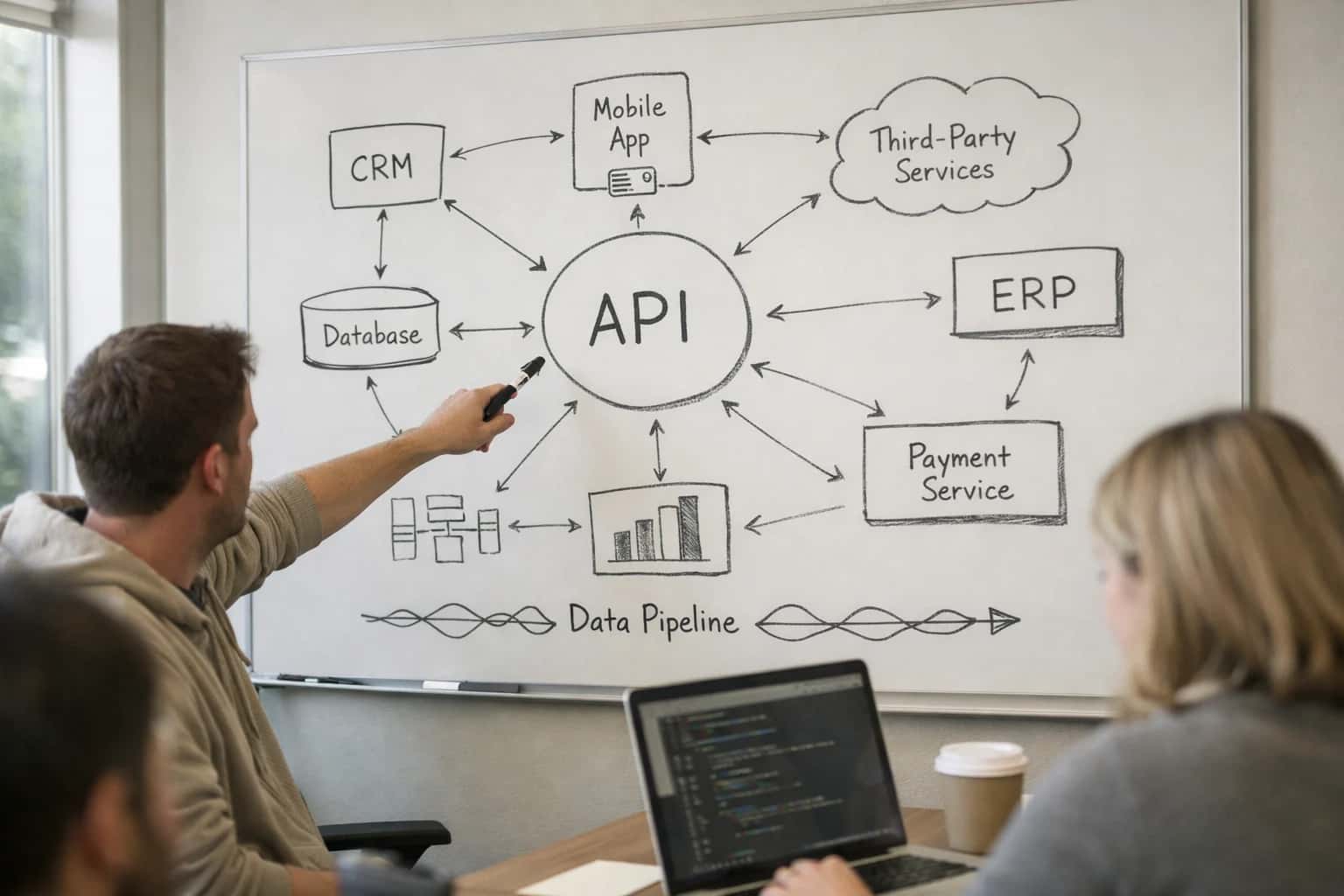
ARCHITECTURE BLUEPRINT
Where AI Fits into Your Salon's Website Experience
A technical guide for embedding a context-aware AI chatbot into your salon's website, directly connected to your backend management software.
Implementation typically involves a lightweight JavaScript widget embedded on your site that routes user queries to a secure orchestration layer. This layer calls your salon platform's RESTful APIs (e.g., Zenoti's GetAvailableSlots, Fresha's CreateBooking) to fetch live availability and execute bookings. For complex queries, the system can use a Retrieval-Augmented Generation (RAG) pattern, grounding its responses in your specific service descriptions, policies, and FAQ documents to avoid hallucinations. Key technical considerations include API rate limiting, OAuth token management, and webhook setup to confirm bookings back to the website visitor in real-time.
Rollout should be phased, starting with read-only queries (availability, pricing) before enabling booking execution. Governance is critical: all bookings should be logged with a full audit trail and, initially, flagged for human-in-the-loop confirmation via a dashboard or Slack alert before being finalized in the calendar. This allows staff to catch edge cases while training the AI's logic. The final architecture reduces front-desk call volume, captures after-hours bookings, and provides a 24/7 concierge experience that feels seamlessly integrated with your salon's actual operations.
ARCHITECTURE FOR CONTEXT-AWEARE WEBSITE CHAT
Key API Surfaces for Salon Platform Integration
Real-Time Availability and Scheduling
The core of a useful salon chatbot is its ability to interact with the platform's calendar. Integration focuses on two primary endpoints:
Service and Availability Queries: The AI agent calls GET /services to fetch the current service menu, pricing, and durations. It then queries GET /availability with parameters like service_id, staff_id, and date_range to retrieve real-time open slots. This allows the chatbot to answer "Do you have any openings for a haircut tomorrow?" with specific, bookable times.
Appointment Lifecycle Management: To complete a booking, the agent uses POST /appointments with a JSON payload containing client_id (or new client details), service_ids, staff_id, start_time, and any notes. Post-booking, it can trigger confirmation workflows via POST /appointments/{id}/confirm. For cancellations or modifications, endpoints like PUT /appointments/{id} or DELETE /appointments/{id} are used, often requiring the agent to first re-query availability.
json// Example payload for booking creation { "client": { "first_name": "Jamie", "phone": "+15551234567", "email": "[email protected]" }, "services": [{"id": "svc_12345"}], "staff_id": "emp_67890", "start_time": "2024-06-15T14:30:00Z", "location_id": "loc_abc" }
CONTEXT-AWARE WEBSITE AUTOMATION
High-Value Use Cases for AI Salon Chat
Deploying an AI chatbot on your salon or spa website is more than just answering FAQs. When integrated directly with your management platform's real-time API, it becomes an intelligent booking engine and front-desk assistant. These cards detail the specific workflows and operational value unlocked.
01
Real-Time Booking & Availability Check
The chatbot queries the salon software's calendar API to check live availability for specific services, stylists, and rooms. It processes natural language requests like "book a balayage with Sarah next Thursday afternoon" and presents available slots, collecting details to create a confirmed appointment via the platform's booking endpoint.
24/7 Booking
Capture after-hours revenue
02
Automated Pre-Appointment Intake
For new clients or specific services (e.g., color correction, medical spa treatments), the AI agent conducts a structured intake conversation. It collects essential details (hair history, skin concerns, allergies) and writes them directly to the client's notes or custom fields in the management software, saving front-desk time and reducing form abandonment.
Batch -> Real-time
Data entry workflow
03
Personalized Service & Pricing Inquiry
Leverages a RAG (Retrieval-Augmented Generation) pattern grounded in the salon's service menu, pricing tiers, and therapist bios. The chatbot answers detailed questions like "How much is a keratin treatment for long hair?" or "What's the difference between a classic and hybrid manicure?" with accurate, context-specific answers, driving informed bookings.
Reduce Call Volume
Deflect common inquiries
04
Policy FAQ & Appointment Management
Handles high-frequency operational questions by accessing the business's policy data. It can explain cancellation windows, late arrival rules, parking information, and COVID protocols. It also allows existing clients to reschedule or cancel appointments by verifying identity and executing changes via the platform's API, with appropriate confirmation messages.
Hours -> Minutes
Front-desk time saved
05
Post-Booking Upsell & Confirmation
After a booking is made, the AI can initiate a follow-up conversation to increase average ticket value. Using the booked service and client history, it suggests relevant add-ons (e.g., "Add a scalp treatment to your color service?") or retail products. It also sends automated, personalized confirmation details and pre-visit instructions.
Increase AOV
Targeted recommendations
06
Waitlist Automation & Cancellation Fill
Integrated with the platform's real-time waitlist and cancellation feed. When a client requests a fully booked time, the chatbot offers to add them to a waitlist. If a cancellation occurs, the AI can automatically message the first waitlisted client via SMS/email with a direct booking link, dynamically filling the slot to protect revenue.
Same day
Fill last-minute openings
IMPLEMENTATION PATTERNS
Example AI Chat Workflows for Salon Websites
These workflows illustrate how a context-aware AI chatbot connects to your salon management platform's API (like Fresha, Zenoti, Mangomint, or Vagaro) to handle real-world booking and service inquiries. Each flow shows the trigger, data exchange, AI action, and system update.
Trigger: A website visitor asks, "Can I book a haircut with Sarah tomorrow afternoon?"
Workflow:
- The AI chatbot parses the request for service type (haircut), staff member (Sarah), and timeframe (tomorrow afternoon).
- It calls the salon platform's Calendar API with the parsed parameters (e.g.,
GET /api/v1/staff/Sarah123/availability?date=2024-06-15&service_id=haircut). - The API returns available slots (e.g.,
['2:00 PM', '3:30 PM']). - The AI presents the available times to the user in a conversational format.
- If the user selects "3:30 PM," the chatbot collects the client's name and phone number (or matches an existing profile).
- It executes a booking API call (
POST /api/v1/appointments) with the payload:
json{ "client_id": "CLIENT_456", "staff_id": "Sarah123", "service_id": "haircut", "start_time": "2024-06-15T15:30:00Z", "notes": "Booked via AI Chatbot" }
- Upon successful booking, the AI confirms details and can trigger the platform's native confirmation SMS/email workflow.
Human Review Point: The AI is configured to escalate to a live agent if the requested staff is fully booked or if the client has a history of frequent cancellations.
BUILDING A PRODUCTION-READY AI AGENT
Implementation Architecture: Connecting Chat to Salon APIs
A technical blueprint for deploying a context-aware AI chatbot that integrates directly with your salon management platform's API to handle booking, availability, and pricing inquiries.
The core of the integration is a secure, serverless AI agent that acts as a middleware layer between your website's chat interface and your salon software's API (e.g., Fresha, Zenoti, Mangomint, or Vagaro). This agent is built to handle real-time queries by calling specific endpoints: it authenticates using OAuth 2.0 or API keys, queries the /services endpoint for pricing and duration, calls the /availability endpoint with service, staff, and date parameters, and finally, uses the /bookings endpoint to create or modify appointments. The agent's logic includes fallback handling for API rate limits, graceful degradation if the salon software is unreachable, and structured logging of all interactions for audit trails.
For a production rollout, the architecture separates concerns: a frontend chat widget captures natural language, a orchestration layer (using tools like LangChain or a custom Node.js service) parses intent, retrieves context, and calls tools, and a tool-calling layer executes the specific API requests to the salon platform. Critical implementation details include implementing a session memory to maintain conversation context across multiple turns (e.g., "I want a haircut" -> "With Maria" -> "Next Thursday afternoon") and setting up webhook listeners to subscribe to events from the salon software (like booking confirmations or cancellations) to keep the chatbot's knowledge synchronized. All PII and booking data is encrypted in transit and at rest, with access scoped to the minimum necessary salon software permissions.
Governance and monitoring are built-in. Every chatbot interaction generates an audit log linking the chat session to the resultant API call and the affected salon software records (e.g., appointment_id). A human-in-the-loop approval step can be configured for final booking confirmation before the /bookings POST request is sent, providing a safety net. For ongoing management, the integration includes a dashboard to monitor key metrics: deflection rate (inquiries that didn't need staff), booking conversion rate from chat, and API health status. This architecture ensures the AI chat is a reliable, secure extension of your core salon operations, not a disconnected feature. For related patterns on enhancing other communication channels, see our guide on /integrations/salon-and-spa-management-platforms/ai-sms-and-email-automation-for-salons.
INTEGRATION PATTERNS
Code and Payload Examples
Querying the Salon Platform API
The core function of a website chatbot is checking real-time availability. This requires a secure API call to the salon management platform (e.g., Fresha, Zenoti) to fetch open slots for a specific service, date, and staff member.
Example Python function using the Fresha API:
pythonimport requests def check_fresha_availability(service_id, staff_id, date): """ Calls Fresha's availability endpoint. Returns a list of available time slots. """ api_key = "YOUR_FRESHA_API_KEY" business_id = "YOUR_BUSINESS_ID" url = f"https://api.fresha.com/v2/businesses/{business_id}/availability" headers = { "Authorization": f"Bearer {api_key}", "Content-Type": "application/json" } payload = { "service_id": service_id, "staff_member_id": staff_id, "date": date, # Format: YYYY-MM-DD "duration_minutes": 60 } response = requests.post(url, json=payload, headers=headers) if response.status_code == 200: return response.json().get('available_slots', []) else: # Handle error, log, return fallback return []
The AI chatbot uses the user's natural language query (e.g., "I want a haircut with Sarah next Tuesday afternoon") to populate these parameters before making the call.
AI-ENHANCED WEBSITE CHAT
Realistic Time Savings and Business Impact
A comparison of manual front-desk operations versus an AI chatbot integrated with your salon management platform's real-time API for availability, pricing, and booking.
| Workflow / Metric | Before AI Integration | After AI Integration | Implementation Notes |
|---|---|---|---|
Initial Lead Qualification | Front-desk staff manually asks 3-5 questions per chat | AI chatbot qualifies intent, service, and preferred stylist automatically | Reduces repetitive questioning; staff handles complex queries only |
Service Availability Check | Staff switches between chat and software, takes 2-3 minutes | AI queries platform API in <10 seconds, displays real-time slots | Direct integration to calendar API (e.g., Fresha, Zenoti) required |
Price and Duration Inquiry | Manual lookup in service menu or memory-dependent | AI retrieves and quotes exact pricing, duration from product catalog | Ensures consistency and reduces misquotes |
Appointment Booking Completion | Staff manually enters all details; 5-7 minute process | AI pre-fills form from chat; guest confirms in <60 seconds | Booking API call finalizes appointment; sends platform confirmation |
After-Hours & Peak-Time Inquiry Handling | Missed chats or long wait times frustrate potential clients | AI provides 24/7 instant responses for common requests | Deflects ~40-60% of routine inquiries; captures leads always |
Client Profile Creation for New Guests | Staff manually inputs data post-booking, creating duplicate work | AI creates draft profile with chat-collected data for staff review | Profile API allows creation; staff verifies details before first visit |
Upsell/Cross-Sell Opportunity Identification | Relies on staff memory and time to make suggestions | AI analyzes chat for intent and suggests add-ons (e.g., conditioning treatment) | Rule-based initially; can integrate with client history for personalization |
ARCHITECTING FOR PRODUCTION
Governance, Security, and Phased Rollout
A practical guide to deploying, securing, and scaling an AI chatbot integrated with your salon management platform.
A production-grade AI chat integration is more than a widget on a website; it's a secure extension of your business logic. The core architecture connects your AI agent to your salon platform's real-time API—like Fresha's GET /availability or Zenoti's POST /appointments—via a secure, serverless middleware layer. This layer handles authentication, request validation, and prompt injection, ensuring the chatbot only accesses the specific endpoints and data scopes (e.g., service menus, staff calendars) it needs to function. All client data, such as names and appointment details, should be transient within the chat session and never stored in the AI provider's systems. Implement role-based access controls (RBAC) at the API gateway level to enforce that the integration operates with a service account possessing the minimum necessary permissions.
Rollout should follow a phased, measurable approach. Phase 1: Silent Pilot. Deploy the chatbot to a non-public page or a single location's site, logging all interactions without taking live actions. This validates the accuracy of API calls and the quality of natural language understanding for salon-specific terms (e.g., 'balayage,' 'hot stone massage'). Phase 2: Assisted Booking. Enable the chatbot to check real-time availability and provide answers, but require a final confirmation step via a traditional booking form or a human agent. This builds trust and creates a human-in-the-loop audit trail. Phase 3: Full Automation. After verifying >95% accuracy in intent classification and API success, allow the bot to create bookings directly. Even here, implement automated post-booking confirmation messages and a clear escalation path to a live agent via the platform's internal messaging or ticketing system.
Governance is continuous. Establish a weekly review of chat logs and failed transaction audits, using the salon platform's reporting modules to cross-reference AI-booked appointments. Set up alerts for unusual activity, such as a spike in booking cancellations originating from the bot. Plan for regular retraining of the AI's intent models using anonymized chat transcripts to adapt to new services or promotional language. By treating the chatbot as a managed component of your salon software stack—with clear ownership, monitoring, and rollback procedures—you ensure it reduces front-desk load reliably while protecting your client relationships and business data.
Enabling Efficiency, Speed & Accuracy
Intelligent Analysis, Decision & Execution
We build AI systems for teams that need search across company data, workflow automation across tools, or AI features inside products and internal software.
Talk to Us
Search across company data
Give teams answers from docs, tickets, runbooks, and product data with sources and permissions.
Useful when people spend too long searching or get different answers from different systems.
Enterprise searchRAGPermissions
Read more
Automate internal workflows
Use AI to route work, draft outputs, trigger actions, and keep approvals and logs in place.
Useful when repetitive work moves across multiple tools and teams.
AI agentsWorkflow automationGovernance
Read more
Add AI to products and internal tools
Build assistants, guided actions, or decision support into the software your team or customers already use.
Useful when AI needs to be part of the product, not a separate tool.
AI integrationDecision supportModel routing
Read moreIMPLEMENTATION AND OPERATIONS
Frequently Asked Questions
Common technical and operational questions about deploying an AI chatbot that integrates directly with your salon management software's real-time API.
The AI agent uses a secure, server-side integration with your management platform's API (e.g., Fresha, Zenoti, Mangomint, Vagaro).
Typical Integration Flow:
- User Query: A visitor on your website asks, "Do you have any openings for a haircut tomorrow afternoon?"
- API Call: The chatbot's backend securely calls your salon software's calendar API endpoint, passing parameters like service ID, date range, and staff/room filters.
- Real-Time Response: The API returns a structured list of available time slots.
- Natural Language Reply: The AI formulates a human-friendly response: "Yes! We have openings with Stylist Jane at 2:15 PM and 4:30 PM tomorrow. Would you like to book one of these?"
Key Technical Points:
- Uses OAuth 2.0 or API keys with minimal, read-only permissions (e.g.,
GET /appointments/availability). - Caches responses for 1-2 minutes to balance real-time accuracy with API rate limits.
- The integration layer handles platform-specific data models, so the core AI logic remains consistent.

About the author
Prasad Kumkar
CEO & MD, Inference Systems
Prasad Kumkar is the CEO & MD of Inference Systems and writes about AI systems architecture, LLM infrastructure, model serving, evaluation, and production deployment. Over 5+ years, he has worked across computer vision models, L5 autonomous vehicle systems, and LLM research, with a focus on taking complex AI ideas into real-world engineering systems.
His work and writing cover AI systems, large language models, AI agents, multimodal systems, autonomous systems, inference optimization, RAG, evaluation, and production AI engineering.
LinkedIn
Limited slotsGet a Free AI Consultation
Partnered with leading AI, data, and software stack.





How We Work
Custom AI workflows for your Business
One-fit-all AI don't work for modern businesses. At Inferensys, we aim to understand your business & custom requirements; which we use to define most efficient agentic workflows, the data, and the tools for your business.
01
Review the use case
We understand the task, the users, and where AI can actually help.
Read more02
Pick the right approach
We define what needs search, automation, or product integration.
Read more03
Build the first useful version
We implement the part that proves the value first.
Read more04
Improve from there
We add the checks and visibility needed to keep it useful.
Read moreThe first call is a practical review of your use case and the right next step.
Talk to Us