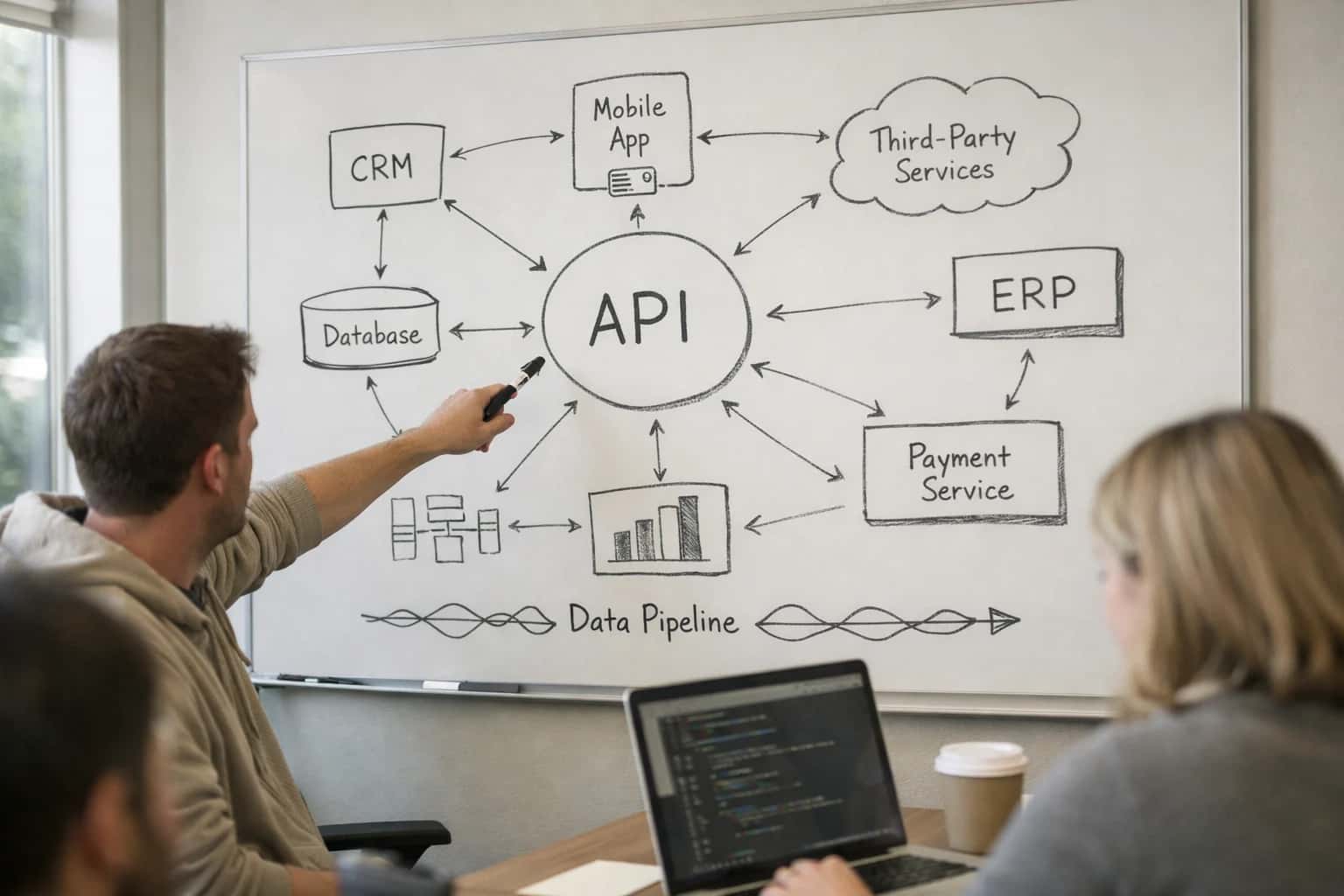
Traditional gamification in Mindtickle relies on pre-set rules for points, badges, and leaderboards. An AI integration layer connects to the Mindtickle API to ingest real-time data streams: user activity logs, assessment scores, content completion rates, and manager feedback. This data feeds a model that analyzes individual learning velocity, knowledge gaps, and engagement patterns against organizational goals like a new product launch or competitive battle.

Integration
AI Integration with Mindtickle Gamification
A technical guide to implementing AI-driven dynamic gamification in Mindtickle. Replace static point systems with adaptive challenges, real-time leaderboards, and personalized incentives that respond to organizational goals and individual learning paces.
ARCHITECTURE & ROLLOUT
From Static Rules to Adaptive Engagement
Integrating AI with Mindtickle transforms rigid gamification into a dynamic engine for sales readiness.
The AI system then makes adaptive adjustments via API calls back to Mindtickle. This can dynamically modify challenge difficulty, adjust point values for specific activities to reinforce weak areas, or surface personalized micro-challenges in a user's feed. For example, a rep struggling with competitive positioning might receive a targeted, point-boosted challenge to review updated battle cards and complete a short quiz, while a top performer is nudged with advanced scenario-based role-plays.
Rollout requires a phased approach: start with a pilot team and a single goal (e.g., ramp time for new hires). Implement a human-in-the-loop approval step where proposed gamification changes are reviewed by enablement managers before being pushed to Mindtickle, ensuring alignment. Governance is critical; maintain an audit log of all AI-driven adjustments and their correlation to key metrics like content engagement lift or assessment pass rates to validate the model's impact and avoid unintended demotivation.
ARCHITECTURAL BLUEPRINT
Mindtickle Gamification Surfaces for AI Integration
Dynamic Point Allocation with AI
The core points engine in Mindtickle can be driven by AI to move beyond static completion-based scoring. An AI integration layer analyzes the context, difficulty, and business impact of each learning activity or sales action to assign variable point values in real-time.
Example Workflow:
- A seller completes a product certification quiz. A traditional system awards 100 points.
- An AI-enhanced system evaluates the quiz results, the seller's historical performance in that area, and the strategic priority of the product. It might award 150 points for mastery or 50 points for a remedial pass, adjusting the incentive to close specific skill gaps.
Technical Integration: This requires intercepting completion events via Mindtickle webhooks, passing activity metadata and user context to an AI model for scoring, and using the Mindtickle API to write back the dynamic point value before the leaderboard updates.
FOR MINDTICKLE
High-Value AI Gamification Use Cases
AI transforms static point systems into adaptive engines that drive real behavioral change. By analyzing individual and team data in real-time, AI can dynamically adjust challenges, rewards, and leaderboards to maximize engagement and target specific business outcomes.
01
Dynamic Challenge Generation
Automatically creates and refreshes micro-challenges based on real-time sales performance data from the CRM. For example, if a new competitor emerges, AI can generate a same-day challenge for reps to complete a new battle card module, adjusting point rewards based on role and past engagement.
Batch -> Real-time
Challenge refresh
02
Personalized Learning Path Gamification
Integrates with Mindtickle's learning modules to adjust point multipliers and unlock badges based on an individual's learning pace and assessment scores. AI identifies knowledge gaps and creates tailored incentive paths, making mandatory training feel like a personalized achievement system.
1 sprint
Typical implementation
03
Predictive Leaderboard Curation
Moves beyond simple activity counts. AI analyzes quality signals (e.g., content usage linked to won deals, coaching feedback scores) to weight leaderboard rankings. It can also create sub-leaderboards for specific initiatives (e.g., 'New Product Launch Champions') to surface the right role models.
04
AI-Powered Nudge & Recognition Engine
Triggers automated, personalized recognition within the gamification layer. When AI detects a rep has mastered a complex skill or influenced a key deal stage, it can award bonus points and broadcast achievements to their team or manager, reinforcing positive behaviors at scale.
Same day
Recognition latency
05
Goal-Based Point System Calibration
Automatically calibrates the entire gamification point economy. AI monitors engagement metrics and business outcomes to suggest adjustments to point values, ensuring the system drives the right activities (e.g., practicing new pitches vs. just consuming content) without manual rebalancing.
06
Integration with Real-World Incentives
Connects Mindtickle's gamification API to external reward platforms (e.g., gift card vendors, merchandise catalogs). AI can recommend optimal reward tiers based on predicted motivation and past redemption data, creating a closed-loop system where virtual points translate to tangible recognition.
IMPLEMENTATION PATTERNS
Example AI-Driven Gamification Workflows
These workflows illustrate how to connect AI models to Mindtickle's gamification engine, using real-time data to dynamically adjust challenges, points, and leaderboards. Each pattern is designed to be triggered by system events, powered by contextual AI analysis, and executed via Mindtickle's APIs.
Trigger: A weekly analysis job runs against Mindtickle's assessment and content consumption data.
Context/Data Pulled:
- Aggregated assessment scores per learning module or skill tag.
- Content library metadata (topics, difficulty, estimated completion time).
- Individual user completion rates and historical challenge performance.
Model or Agent Action: An AI model analyzes the aggregated data to identify the top 3 organizational skill gaps for the week. For each gap, it generates a challenge brief:
- Challenge Objective: e.g., "Improve Discovery Questioning."
- Target Audience: e.g., "Reps with <70% on last discovery assessment."
- Recommended Actions: A curated list of 2-3 specific micro-learning assets (videos, documents) from the library.
- Point Structure: AI suggests a point value based on the estimated effort and strategic importance of closing the gap.
System Update or Next Step: The agent uses the Mindtickle API to:
- Create a new
Challengeobject with the generated parameters. - Assign the target audience via user segments.
- Automatically enroll eligible users.
- Post an announcement in the relevant team feed.
Human Review Point: The Enablement Manager receives a Slack notification with the proposed challenge details and can approve, modify, or reject the creation with one click before it goes live.
FROM STATIC RULES TO ADAPTIVE GAMIFICATION
Implementation Architecture: Data Flow & Model Layer
A technical blueprint for wiring AI models to Mindtickle's gamification engine to create dynamic, goal-aware challenges and leaderboards.
The core integration surfaces are Mindtickle's Gamification API and Activity Stream. The AI layer ingests two primary data types: 1) Organizational goals (e.g., 'increase product X certification by 30% this quarter') from leadership inputs or connected systems, and 2) Individual activity data (completion rates, assessment scores, time spent) from the platform. This data is processed in a real-time pipeline, where a scoring model evaluates both goal alignment and individual learning velocity to generate a personalized engagement score for each user.
This dynamic score feeds back into Mindtickle via API calls to adjust point values, badge thresholds, and challenge eligibility in real-time. For example, a user struggling with a specific module might receive a targeted 'micro-challenge' with a higher point bonus, while a top performer might be auto-enrolled in an advanced 'expert series' to maintain engagement. The system can also reconfigure leaderboard segments (team, role, region) based on shifting organizational priorities, ensuring gamification drives the right behaviors. Implementation typically uses a message queue (e.g., Kafka, AWS SQS) to handle activity stream events and a vector database for retrieving similar user patterns to inform challenge personalization.
Rollout requires a phased approach: start with a single, high-impact goal (e.g., new product launch certification) and a controlled user group. Governance is critical; all AI-adjusted point values and challenge rules should be logged to an audit trail, and a human-in-the-loop approval step can be configured for major gamification rule changes. This ensures the system remains aligned with sales leadership intent while automating the heavy lifting of personalization. For a deeper dive on connecting this to broader sales readiness analytics, see our guide on AI Integration for Sales Enablement Analytics.
IMPLEMENTATION PATTERNS
Code & Payload Examples
Dynamically Adjusting Challenge Points
A common integration point is the Mindtickle API for updating user scores or challenge completion status. This example uses a webhook handler that listens for events from a conversation intelligence platform (like Gong). When a seller successfully uses a new sales methodology in a call, the system calls Mindtickle to award bonus points.
pythonimport requests # Webhook payload from conversation intelligence tool webhook_payload = { "user_email": "[email protected]", "skill_demonstrated": "challenger_sale", "call_id": "call_abc123", "confidence_score": 0.92 } # Determine dynamic point value based on skill complexity and confidence skill_multiplier = {"challenger_sale": 50, "meddic": 30, "objection_handling": 20} base_points = skill_multiplier.get(webhook_payload["skill_demonstrated"], 10) bonus_points = int(base_points * webhook_payload["confidence_score"]) # Mindtickle API call to award points mindtickle_payload = { "userId": "user_12345", # Resolved from email via Mindtickle User API "points": bonus_points, "activityType": "skill_demonstration", "activityId": webhook_payload["call_id"], "metadata": { "skill": webhook_payload["skill_demonstrated"], "source": "gong_ai_analyzer" } } response = requests.post( "https://api.mindtickle.com/v2/gamification/activities", json=mindtickle_payload, headers={"Authorization": "Bearer YOUR_MT_TOKEN"} )
MINDTICKLE INTEGRATION
Realistic Operational Impact of AI-Powered Gamification
How AI integration transforms static gamification into a dynamic, goal-aligned system, measured by operational metrics for enablement leaders.
| Metric | Before AI | After AI | Notes |
|---|---|---|---|
Challenge & Goal Alignment | Quarterly manual updates by admins | Weekly dynamic adjustment | AI analyzes org priorities (e.g., new product launch) and seller performance to auto-suggest new challenges. |
Leaderboard Relevance | Generic, activity-based rankings | Role & goal-weighted rankings | AI weights points based on strategic skills (e.g., product knowledge vs. soft skills) for different seller segments. |
Point System Calibration | Fixed points per activity | Adaptive points based on difficulty & learner pace | AI adjusts point values for quizzes or content based on historical completion rates and assessment scores to maintain engagement. |
Badge & Reward Issuance | Manual review and awarding | Automated, predictive awarding | AI triggers badges for milestone achievements (e.g., 'Product Expert') and predicts which rewards will motivate individual learners. |
Engagement Drop-off Detection | Monthly report review | Real-time alerts with intervention suggestions | AI identifies learners at risk of disengagement and prompts managers with personalized nudge recommendations (e.g., 'Suggest a quick refresher module'). |
Gamification ROI Measurement | Correlation studies run quarterly | Continuous attribution dashboard | AI links gamification activity (points, challenges completed) to downstream metrics like assessment scores and pipeline influence. |
Program Rollout & Iteration | Pilot: 6-8 weeks, full launch: 1 quarter | Pilot: 2-3 weeks, continuous iteration | AI provides rapid feedback on challenge effectiveness, allowing for weekly tuning instead of quarterly program overhauls. |
IMPLEMENTING AI-DRIVEN GAMIFICATION WITH CONTROL
Governance, Security & Phased Rollout
A practical guide to deploying AI-powered gamification in Mindtickle with proper governance, data security, and a phased rollout strategy.
Integrating AI into Mindtickle's gamification engine requires careful control over data flows and model outputs. Key governance surfaces include:
- Point and Rule Engines: AI models that adjust challenge difficulty or point values must write back to Mindtickle's
Leaderboard,Challenge, andRewardobjects via secure API calls, with all modifications logged in an audit trail. - User Activity Data: AI models analyzing
LearningPathcompletion,Assessmentscores, andContentengagement for personalization must only access aggregated, anonymized data sets unless explicit consent is configured. - Approval Workflows: For high-stakes changes—like dynamically altering a team-wide competition's scoring rubric—implement a human-in-the-loop step using Mindtickle's webhooks to trigger manager approval in a separate system before applying the AI's suggestion.
A phased rollout minimizes risk and measures impact. Start with a pilot on a single, non-critical gamification module:
- Phase 1: Read-Only Analysis. Deploy AI to analyze historical Mindtickle activity and generate recommendations for rule adjustments (e.g., "suggest increasing points for completing advanced product training by 20%"). These are reviewed manually by enablement managers before any system changes are made.
- Phase 2: Controlled Automation. For a specific
Challengetype, allow the AI to make automatic, bounded adjustments (e.g., +/- 15% point values) based on real-time completion rates, with changes logged and notifications sent to admins. - Phase 3: Full Orchestration. Expand AI control to dynamically generate new
Challengesand adjustLeaderboardweightings across multiple programs, governed by a centralized policy engine that enforces fairness and compliance guardrails.
Security is paramount when connecting external AI models to Mindtickle's user data. Implementation must use:
- Mindtickle's OAuth 2.0 for secure, scoped API access, ensuring the integration only has permissions to necessary endpoints.
- A dedicated middleware layer (e.g., an Azure Function or AWS Lambda) to broker requests, apply data masking, and enforce rate limiting.
- Encryption for data in transit and at rest, especially for any PII or performance data used for model inference. All AI-generated content or rule changes should be tagged with a source identifier (
"ai_rule_engine_v1") for full traceability within Mindtickle's reporting. For broader architectural patterns, see our guide on AI Integration for Sales Enablement Platforms.
Enabling Efficiency, Speed & Accuracy
Intelligent Analysis, Decision & Execution
We build AI systems for teams that need search across company data, workflow automation across tools, or AI features inside products and internal software.
Talk to Us
Search across company data
Give teams answers from docs, tickets, runbooks, and product data with sources and permissions.
Useful when people spend too long searching or get different answers from different systems.
Enterprise searchRAGPermissions
Read more
Automate internal workflows
Use AI to route work, draft outputs, trigger actions, and keep approvals and logs in place.
Useful when repetitive work moves across multiple tools and teams.
AI agentsWorkflow automationGovernance
Read more
Add AI to products and internal tools
Build assistants, guided actions, or decision support into the software your team or customers already use.
Useful when AI needs to be part of the product, not a separate tool.
AI integrationDecision supportModel routing
Read moreAI-POWERED GAMIFICATION
Technical & Commercial FAQ
Practical questions for technical leaders and enablement managers planning to integrate AI with Mindtickle's gamification engine to drive adaptive engagement and measurable business impact.
This integration uses Mindtickle's APIs to create a feedback loop between AI logic and the gamification engine.
Typical Architecture:
- Trigger: A scheduled job (e.g., hourly) or a webhook from Mindtickle fires when new assessment scores, content completion, or activity data is available.
- Context Pull: The AI service calls Mindtickle's Reporting API to fetch aggregated team/individual metrics and the current gamification configuration (point values, active challenges, leaderboard settings).
- AI Action: A lightweight model or rules engine analyzes the data against organizational goals (e.g., "increase product certification rate by 20% this quarter"). It outputs adjustment recommendations, such as:
- Increase point value for completing new product training modules by 50%.
- Launch a new 7-day "spike" challenge focused on competitive battle card reviews.
- Temporarily weight leaderboards towards new hires to boost early engagement.
- System Update: The service uses Mindtickle's Gamification API to apply the new point values, create the new challenge, or adjust leaderboard parameters.
- Human Review Point: Major rule changes (like shifting 80% of points to a new initiative) can be routed to an enablement manager for approval via a Slack message or email before the API call is executed.
Key APIs: GET /api/v2/reports/leaderboard, POST /api/v2/gamification/rules, POST /api/v2/challenges.

About the author
Prasad Kumkar
CEO & MD, Inference Systems
Prasad Kumkar is the CEO & MD of Inference Systems and writes about AI systems architecture, LLM infrastructure, model serving, evaluation, and production deployment. Over 5+ years, he has worked across computer vision models, L5 autonomous vehicle systems, and LLM research, with a focus on taking complex AI ideas into real-world engineering systems.
His work and writing cover AI systems, large language models, AI agents, multimodal systems, autonomous systems, inference optimization, RAG, evaluation, and production AI engineering.
LinkedIn
Limited slotsGet a Free AI Consultation
Partnered with leading AI, data, and software stack.





How We Work
Custom AI workflows for your Business
One-fit-all AI don't work for modern businesses. At Inferensys, we aim to understand your business & custom requirements; which we use to define most efficient agentic workflows, the data, and the tools for your business.
01
Review the use case
We understand the task, the users, and where AI can actually help.
Read more02
Pick the right approach
We define what needs search, automation, or product integration.
Read more03
Build the first useful version
We implement the part that proves the value first.
Read more04
Improve from there
We add the checks and visibility needed to keep it useful.
Read moreThe first call is a practical review of your use case and the right next step.
Talk to Us