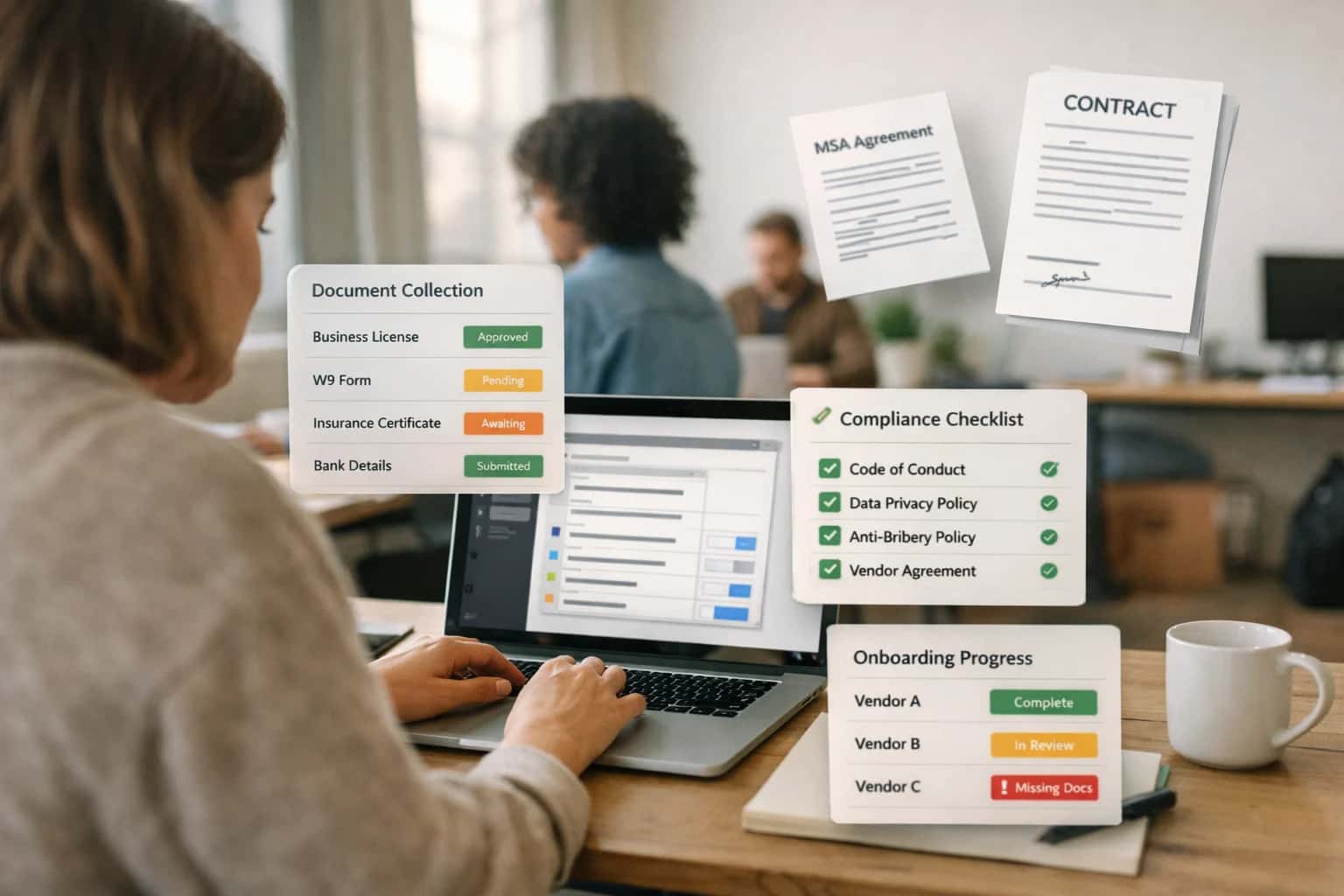
The integration architecture creates a real-time feedback loop between your CRM's opportunity records and Highspot's content and engagement surfaces. Key data objects are synchronized: Account/Contact/Opportunity data from Salesforce or Microsoft Dynamics flows into Highspot to power context-aware recommendations, while Content Engagement data—like which battle cards were viewed, shared, or presented—is written back to custom CRM objects for attribution and forecasting. This bidirectional flow is typically orchestrated via platform APIs (Highspot API, Salesforce REST API), webhooks for event-driven updates, and a middleware layer (often a lightweight service) that hosts the AI models and manages the data transformation.

Integration
AI Integration with Highspot and CRM
A technical blueprint for building bi-directional AI workflows between Highspot and CRM platforms (Salesforce, Microsoft Dynamics) to automate deal-specific content hubs and log content engagement back to opportunities.
ARCHITECTURE & DATA FLOW
Where AI Fits Between Highspot and Your CRM
A technical blueprint for bi-directional AI workflows that automate content personalization and capture deal intelligence.
AI injects intelligence at three primary integration points: 1) Deal-Space Curation: An AI agent analyzes the CRM opportunity stage, industry, and competitor fields to dynamically assemble a Highspot Deal Room or Playlist, pulling the most relevant case studies, battle cards, and one-pagers. 2) Content Generation: Using Retrieval-Augmented Generation (RAG) on your product and competitive knowledge bases, AI drafts first-pass content snippets or updates battle cards, which are routed to enablement managers for review before publishing to Highspot. 3) Engagement Intelligence: AI models process raw Highspot usage logs to infer content influence, scoring assets based on correlation with deal progression stages logged in the CRM, and surface these insights in a custom CRM dashboard or Highspot Analytics.
For governance, implement a human-in-the-loop approval step for any AI-generated content before it's published to Highspot libraries. Use the CRM's role-based access control (RBAC) to govern which AI insights (e.g., predicted content effectiveness) are visible to reps versus managers. Audit trails should log all AI-driven actions—like content suggestions made or auto-generated decks—linking them to the source CRM opportunity and the triggering user or rule. Start with a pilot on a single sales pod, focusing on automating the creation of deal-specific content hubs for a high-value segment, and measure the reduction in manual prep time and the increase in content usage per opportunity.
ARCHITECTURAL BLUEPOINTS
Key Integration Surfaces in Highspot and CRM
The AI-Ready Content Hub
Highspot's core value is its centralized content repository and deal-specific "Spaces." AI integration surfaces here focus on dynamic content curation and intelligent room assembly.
Key APIs & Objects:
- Content Items & Collections: Assets (PDFs, videos, decks) and their metadata (tags, topics, personas).
- Spaces API: For creating and updating deal-specific content hubs.
- Activity Stream: Tracks content views, downloads, and shares by opportunity.
AI Workflow: An AI agent listens for CRM opportunity stage changes (e.g., Proposal). It queries the CRM for deal attributes (industry, competitor, pain points), then uses the Spaces API to automatically assemble a curated Space with the most relevant battle cards, case studies, and pricing templates. This replaces manual seller curation, ensuring consistency and relevance.
BI-DIRECTIONAL WORKFLOW AUTOMATION
High-Value AI Use Cases for Highspot + CRM
Integrating AI between Highspot and your CRM (Salesforce, Dynamics) automates the flow of deal intelligence and content engagement, creating a closed-loop system for seller productivity and content ROI.
01
Automated Deal-Specific Content Hub Assembly
AI analyzes the CRM opportunity (industry, deal stage, champion role, competitor) and automatically assembles a personalized Highspot deal room. It pulls relevant battle cards, case studies, and playbooks from the library, saving sellers 30+ minutes of manual curation per deal.
30+ Minutes Saved
Per deal room
02
CRM Activity Logging from Content Engagement
When a buyer engages with content in a Highspot deal room (views, downloads, time spent), AI automatically logs a structured activity to the CRM opportunity. This creates a timeline of buyer interest, informing next steps without manual seller data entry.
Batch -> Real-time
Insight sync
03
AI-Powered Battle Card Generation & Updates
AI monitors competitive news, earnings calls, and win/loss data from the CRM. It drafts or updates Highspot battle cards with new differentiators, vulnerabilities, and talk tracks, ensuring sellers always have current intelligence without manual research.
Same Day
Competitive update
04
Predictive Content Recommendation in CRM
An AI model sits between systems, analyzing the CRM context (deal attributes, email sentiment, call transcripts) to surface the single most relevant Highspot asset directly within the CRM record. This reduces context-switching and drives content usage.
05
Content Influence on Pipeline Forecasting
AI correlates Highspot content engagement data with CRM pipeline velocity and win rates. It generates insights for sales leaders on which assets most influence deal progression, enabling data-driven decisions for content strategy and seller coaching.
1 Sprint
Insight delivery
06
Automated Post-Call Briefing & Next Steps
After a sales call, AI ingests the conversation transcript (from Gong/Chorus) and CRM updates. It generates a Highspot briefing note summarizing key points, updating the deal room with new content, and suggesting next-step tasks logged to the CRM.
HIGHSPOT + CRM INTEGRATION PATTERNS
Example AI Automation Workflows
These are production-ready, bi-directional workflows that connect AI models to Highspot and your CRM (Salesforce, Microsoft Dynamics) to automate content operations and enrich deal intelligence.
Trigger: A sales rep creates or updates an Opportunity record in the CRM, moving it to a new stage (e.g., from 'Discovery' to 'Proposal').
Context Pulled:
- AI agent queries the CRM for:
- Opportunity details (Account Name, Industry, Deal Size).
- Key stakeholder roles and titles from Contact records.
- Competitors identified.
- Recorded pain points from Activity/Note objects.
- Agent queries Highspot's Content API for metadata on existing assets.
AI Agent Action:
- Uses a Retrieval-Augmented Generation (RAG) model over the Highspot content library to find the most relevant assets for this specific deal context.
- Generates a brief narrative for the seller explaining why these assets were selected.
- Calls the Highspot Spaces API to create a new, private Deal Room (Space).
- Automatically populates the Space with the selected assets, organized by stakeholder role (e.g., 'Assets for Technical Evaluator', 'Case Studies for Economic Buyer').
System Update:
- The new Highspot Space link is automatically written back to a custom field on the CRM Opportunity.
- The sales rep receives a notification in Slack/Teams with the Space link and the AI-generated context.
Human Review Point: The rep can review the auto-curated Space, add or remove assets, and modify the narrative before sharing with the buyer.
BUILDING A BI-DIRECTIONAL AI PIPELINE
Implementation Architecture: Data Flow and APIs
A production-ready integration between Highspot, your CRM, and AI models requires a secure, event-driven architecture that respects both platforms' data models and governance.
The core integration pattern is a bi-directional sync orchestrated by a middleware layer. This layer, often built as a set of microservices, listens for key events: a new Opportunity stage change in Salesforce (via Change Data Capture or Platform Events) or a new content view in a Highspot Deal Room. These events trigger AI workflows. For example, a stage progression can prompt the system to query Highspot's Content API and CRM data to automatically assemble a personalized content hub. Conversely, when a buyer engages with content in Highspot, the integration logs this activity back to the corresponding CRM Opportunity as a custom object or timeline event, using the CRM's REST API. This creates a closed-loop system where AI recommendations are informed by live deal context, and content influence is directly attributed to pipeline.
Implementation hinges on secure, governed API calls and data hydration. The middleware must authenticate to both systems using OAuth 2.0, manage API rate limits, and handle partial failures with retry logic. A typical AI agent workflow involves: 1) Receiving a trigger payload with the Opportunity ID, 2) Enriching the context by fetching account details, competitor fields, and past email threads from the CRM, 3) Querying Highspot's Search API with a semantically built prompt (e.g., "case studies for manufacturing companies overcoming integration challenges"), 4) Using an LLM to evaluate, rank, and format the returned assets into a concise briefing, and 5) Posting the AI-generated hub back to Highspot via its Spaces or Guided Selling APIs. All prompts, model calls, and data transformations should be logged to an audit trail for compliance and tuning.
Rollout and governance are critical. Start with a pilot focused on a single high-value workflow, like auto-generating the first deal room for opportunities over $250k. Implement a human-in-the-loop approval step where the seller reviews the AI-curated hub before it's shared with the buyer. Use feature flags to control the integration's activation by sales segment. Establish monitoring for data freshness (ensuring CRM and Highspot content metadata are in sync), AI inference costs, and user adoption metrics. This architecture not only automates manual curation but turns the sales enablement platform into an intelligent system that learns from what content actually advances deals.
BI-DIRECTIONAL AI WORKFLOWS
Code and Payload Examples
Automating Deal-Specific Content Assembly
This workflow triggers when a Salesforce opportunity reaches a specific stage. An AI agent analyzes the CRM record (industry, deal size, competitor) and queries the Highspot API to assemble a personalized deal room.
Example Payload to Highspot API:
jsonPOST /api/v2/spots { "name": "Acme Corp - Cloud Migration Q3", "description": "AI-curated content hub for 500K ACV opportunity. Primary competitor: LegacyTech Inc.", "customFields": { "opportunityId": "0064x00000A1b2cC", "dealStage": "Solution Development", "primaryContactRole": "CTO" }, "contentItems": [ { "id": "asset_cloud_roi_whitepaper", "recommendationReason": "AI-matched based on 'cloud migration' pain point and 500K+ deal size." }, { "id": "battlecard_legacytech", "recommendationReason": "Competitor identified in CRM. Battle card highlights key differentiators." } ] }
The AI determines content relevance using vector similarity search across Highspot's asset metadata and historical engagement data for similar deals.
AI FOR HIGHSOOT AND CRM
Realistic Time Savings and Business Impact
How bi-directional AI workflows between Highspot and your CRM transform manual content and data management into automated, deal-specific intelligence.
| Metric | Before AI | After AI | Notes |
|---|---|---|---|
Deal-specific content hub creation | Manual research & assembly (1-2 hours/deal) | Automated generation from CRM data (5-10 minutes) | AI pulls opportunity details, buyer roles, and stage to curate assets |
Content usage logging to CRM | Manual entry or batch uploads (next-day visibility) | Real-time sync via API/webhook (within minutes) | Automatically logs asset views/downloads to opportunity timeline |
Battle card & competitive intel updates | Quarterly reviews, often outdated | Triggered by market news/RFP intake (same-day updates) | AI monitors sources, drafts updates for enablement review |
Post-call briefing & follow-up | Seller notes and manual next steps | Automated summary & task creation (meeting end +15 min) | AI analyzes call transcript, suggests content for follow-up |
Content performance analysis | Monthly reports on top downloads | Predictive scoring & asset recommendations (continuous) | AI correlates content use with deal velocity and win rates |
New seller onboarding to content | Generic library tour, self-discovery | Personalized 30-60-90 day content path (dynamic) | AI assesses role/territory, surfaces relevant assets and training |
RFP/Proposal first draft assembly | Copy-paste from past documents (3-4 hours) | RAG-generated draft from approved library (30-45 minutes) | AI pulls compliant language, case studies, pricing based on RFP questions |
ARCHITECTING CONTROLLED AI OPERATIONS
Governance, Security, and Phased Rollout
A practical guide to deploying and governing AI integrations between Highspot and your CRM with security, compliance, and measurable impact in mind.
A production-grade integration requires a clear data governance model. Define which objects and fields from your CRM (e.g., Salesforce Opportunity, Account, Contact records) and which content libraries from Highspot (e.g., battle cards, presentations, playbooks) are accessible to AI agents. Implement role-based access control (RBAC) at the integration layer to ensure AI-generated content and insights respect existing user permissions in both systems. All AI interactions—such as content suggestions generated, assets logged to an opportunity, or automated briefing documents created—should be written to a dedicated audit log in your data warehouse for traceability and compliance reviews.
Start with a pilot focused on a single, high-value workflow, such as automated call prep briefing generation. In this phase, an AI agent uses the CRM's opportunity stage and contact role to query Highspot for relevant battle cards and case studies, assembling a first-draft briefing document. Roll this out to a small cohort of sellers, using Highspot's analytics to measure engagement and CRM fields to track manual time saved. This controlled test validates the data pipeline, user experience, and business impact before scaling.
For broader rollout, adopt a phased approach by workflow complexity: 1) Content Retrieval & Logging (semantic search in Highspot, automatic logging of used assets to CRM), 2) Content Assembly (AI-generated deal rooms, personalized proposals), and 3) Predictive Guidance (next-best-action suggestions based on content engagement and deal health). Each phase should include a human-in-the-loop review step, especially for externally-facing generated content. Establish a regular model evaluation cycle using feedback from Highspot usage reports and CRM win/loss data to tune prompts and retrain retrieval models, ensuring the integration drives consistent seller productivity gains.
Enabling Efficiency, Speed & Accuracy
Intelligent Analysis, Decision & Execution
We build AI systems for teams that need search across company data, workflow automation across tools, or AI features inside products and internal software.
Talk to Us
Search across company data
Give teams answers from docs, tickets, runbooks, and product data with sources and permissions.
Useful when people spend too long searching or get different answers from different systems.
Enterprise searchRAGPermissions
Read more
Automate internal workflows
Use AI to route work, draft outputs, trigger actions, and keep approvals and logs in place.
Useful when repetitive work moves across multiple tools and teams.
AI agentsWorkflow automationGovernance
Read more
Add AI to products and internal tools
Build assistants, guided actions, or decision support into the software your team or customers already use.
Useful when AI needs to be part of the product, not a separate tool.
AI integrationDecision supportModel routing
Read moreAI INTEGRATION WITH HIGHSPOT AND CRM
Frequently Asked Questions
Practical questions for architects and RevOps leaders planning to connect AI workflows between Highspot and CRM systems like Salesforce or Microsoft Dynamics.
A production integration typically uses a central orchestration layer (often a lightweight microservice or serverless function) to manage the flow.
Typical Architecture:
- CRM → AI → Highspot: The orchestration layer listens for CRM events (e.g.,
Opportunity Stage Changed,Contact Role Added) via webhooks or polls the CRM API. - Context Enrichment: The event payload is enriched with related data (account details, past notes).
- AI Processing: This enriched context is sent to an LLM (like GPT-4) or a RAG pipeline with instructions to generate a deal-specific content brief or curate an existing asset list.
- Highspot Update: The AI output is used to create or update a Highspot SmartSpot or Deal Room via the Highspot API, associating it with the CRM opportunity ID.
- Highspot → CRM: When content in the Deal Room is viewed or downloaded by the seller, the Highspot API emits an engagement event. The orchestration layer captures this and writes a Content Usage custom object or activity record back to the CRM opportunity, creating a closed-loop attribution system.
Key APIs:
- CRM: Salesforce REST/Bulk API or Microsoft Dynamics Web API.
- Highspot: Content API for asset management, Engagements API for usage tracking.

About the author
Prasad Kumkar
CEO & MD, Inference Systems
Prasad Kumkar is the CEO & MD of Inference Systems and writes about AI systems architecture, LLM infrastructure, model serving, evaluation, and production deployment. Over 5+ years, he has worked across computer vision models, L5 autonomous vehicle systems, and LLM research, with a focus on taking complex AI ideas into real-world engineering systems.
His work and writing cover AI systems, large language models, AI agents, multimodal systems, autonomous systems, inference optimization, RAG, evaluation, and production AI engineering.
LinkedIn
Limited slotsGet a Free AI Consultation
Partnered with leading AI, data, and software stack.





How We Work
Custom AI workflows for your Business
One-fit-all AI don't work for modern businesses. At Inferensys, we aim to understand your business & custom requirements; which we use to define most efficient agentic workflows, the data, and the tools for your business.
01
Review the use case
We understand the task, the users, and where AI can actually help.
Read more02
Pick the right approach
We define what needs search, automation, or product integration.
Read more03
Build the first useful version
We implement the part that proves the value first.
Read more04
Improve from there
We add the checks and visibility needed to keep it useful.
Read moreThe first call is a practical review of your use case and the right next step.
Talk to Us