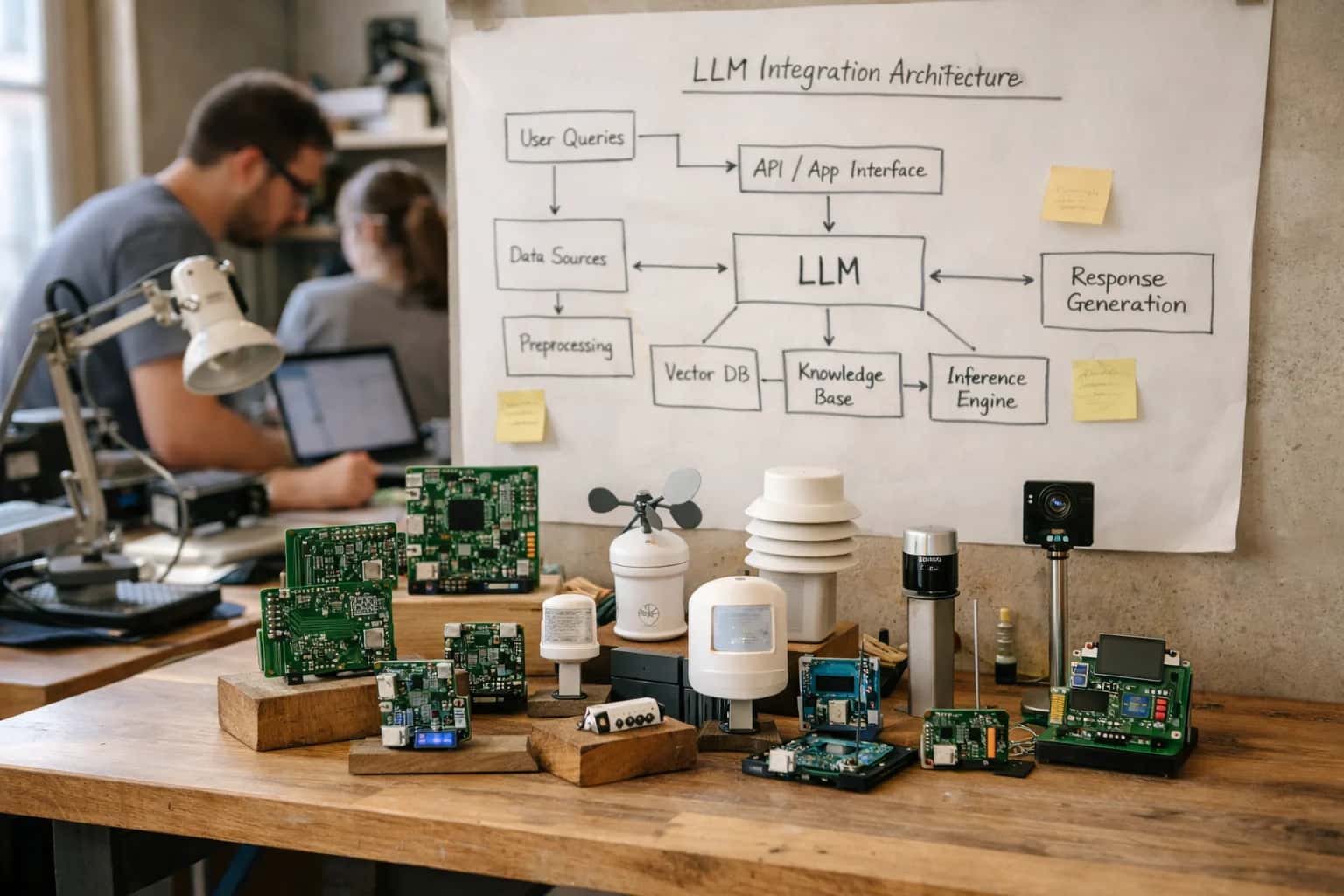
AI integrates into a Digital Sales Room (DSR) by connecting to its content repository, engagement analytics API, and user permission layer. The core architectural pattern involves an AI orchestration service that sits between the DSR platform (e.g., Highspot) and your LLM/vector infrastructure. This service listens for events—like a new stakeholder joining the room, a document being viewed, or a period of inactivity—and triggers AI workflows. Key integration surfaces include the room configuration API to dynamically curate content panels, the activity feed to inject AI-generated insights or next-step suggestions, and the embedded widget framework to host a conversational copilot directly within the room interface.

Integration
AI Integration for Digital Sales Rooms
A technical guide to architecting intelligent digital sales rooms by integrating AI with platforms like Highspot and Seismic. Learn where to connect models, which workflows to automate, and how to implement personalized buyer journeys at scale.
ARCHITECTURE AND ROLLOUT
Where AI Fits into Digital Sales Rooms
A technical blueprint for embedding AI into platforms like Highspot to transform static deal rooms into intelligent, adaptive buyer experiences.
High-value implementation workflows focus on personalization and predictive guidance. For example, an AI agent can use the DSR's visitor metadata and past engagement history to assemble a personalized content journey at room creation, pulling relevant case studies, pricing guides, and demo videos tailored to the buyer's industry and role. During the deal, a separate workflow can analyze engagement signals—time spent on pages, download patterns, comment sentiment—to predict risk of disengagement. This triggers automated, personalized follow-up communications from the seller or suggests high-impact content to re-engage the buyer. Technically, this requires building a retrieval-augmented generation (RAG) pipeline over your sales asset library and configuring webhooks from the DSR platform to your AI service for real-time event processing.
Rollout and governance require a phased approach. Start with a pilot on a single deal room template, using AI to automate the initial room setup based on CRM opportunity data. Implement strict human-in-the-loop approvals for any AI-generated content or communications before they are shared with buyers. Audit trails are critical; log all AI actions—content suggestions made, predictions generated, emails drafted—back to a dedicated audit object in the DSR or your CRM. For scaling, establish a model evaluation framework to continuously measure the AI's impact on key metrics like buyer engagement duration and deal velocity, ensuring the integration drives tangible operational lift before broader deployment. For related architectural patterns, see our guides on AI Integration with Highspot for Deal Rooms and AI Integration for Sales Content Automation.
ARCHITECTURAL BLUEPRINT
Key Integration Surfaces in Digital Sales Room Platforms
The Centralized Content Layer
The digital sales room's content hub is the primary surface for AI integration. This is where all customer-facing assets—proposals, case studies, battle cards, and presentations—are stored and curated. AI models can be integrated here via platform APIs to automate tagging, generate summaries, and enforce lifecycle management.
Key integration points include:
- Asset Ingestion APIs: Automatically analyze and tag new content with topics, sentiment, and intended buyer roles using computer vision and NLP.
- Metadata Enrichment: Use AI to append competitive intelligence, product relevance scores, and compliance flags to each asset.
- Dynamic Assembly: Trigger AI workflows to assemble personalized proposal drafts or one-pagers by retrieving relevant clauses, pricing, and case studies from the hub based on RFP data or opportunity stage.
This transforms a static repository into an intelligent, queryable knowledge base that powers real-time personalization.
INTEGRATION PATTERNS
High-Value AI Use Cases for Digital Sales Rooms
Digital sales rooms in platforms like Highspot are rich with data and user interactions. Integrating AI transforms these static content hubs into intelligent deal environments that predict, personalize, and automate the buyer journey. Below are key technical integration patterns to implement.
01
Dynamic Content Curation
Use AI to analyze CRM stage, buyer role, and engagement history to automatically assemble and prioritize content within the deal room. Instead of a static folder, sellers get a room that evolves, surfacing the right case study, battle card, or pricing guide at the right moment.
Batch -> Real-time
Content refresh
02
Engagement Drop-Off Prediction
Integrate AI models with the sales room's analytics API to monitor buyer activity patterns. The system can flag stalled deals, predict which stakeholders are disengaging, and trigger automated or manual follow-up workflows to re-engage.
Same day
Risk identification
03
Automated Follow-Up Communications
Connect AI to the room's activity webhooks and email systems. When a buyer views key content, AI can draft personalized follow-up emails summarizing what was shared, asking targeted questions, or scheduling the next meeting—all logged back to the CRM.
Hours -> Minutes
Follow-up drafting
04
Stakeholder Intelligence & Mapping
Use AI to ingest data from the CRM, LinkedIn, and room interactions to build and maintain a dynamic stakeholder map. Visualize influence, sentiment, and content consumption per role to guide the seller's outreach strategy directly within the room interface.
1 sprint
Initial implementation
05
AI-Powered Room Analytics for Sellers
Move beyond basic view counts. Build an AI layer that synthesizes room activity into narrative insights for the seller: 'The economic buyer reviewed the ROI calculator twice, but the technical stakeholder hasn't opened the security docs,' prompting specific next actions.
06
Compliance & Governance Automation
For regulated industries, integrate AI to monitor content within active deal rooms. Automatically flag outdated or non-compliant materials, ensure the latest approved versions are present, and generate audit trails of all content accessed—critical for pharma, finance, or public sector sales.
HIGH-VALUE AUTOMATION PATTERNS
Example AI-Powered Workflows for Intelligent Deal Rooms
These workflows illustrate how to architect AI agents that connect to Highspot's APIs and data model, transforming static deal rooms into dynamic, intelligent environments that guide the seller and engage the buyer.
Trigger: A new opportunity reaches a defined stage in Salesforce, triggering the creation of a Highspot deal room via API.
AI Agent Action:
- The agent ingests the opportunity record (industry, deal size, key stakeholders, competitor mentions).
- It performs a semantic search across the Highspot content library, using a RAG pipeline with a vector store of all asset metadata and summaries.
- It ranks and selects the top 5-7 most relevant assets (case studies, battle cards, whitepapers) based on contextual relevance, not just tags.
System Update: The agent calls the Highspot API to automatically populate the new deal room with the curated asset bundle, applying a logical folder structure.
Human Review Point: The sales rep receives a notification with the AI's reasoning for each selected asset and can manually add or remove items before sharing the room with the buyer.
BUILDING AN INTELLIGENT DATA PIPELINE
Implementation Architecture: Data Flow and Model Orchestration
A production-ready AI integration for digital sales rooms requires a secure, event-driven architecture that connects your enablement platform's data to specialized AI models.
The core integration pattern is an event-driven pipeline. When a buyer interacts with a Highspot or Seismic deal room—viewing a document, spending time on a pricing page, or downloading an asset—the platform emits a webhook. This event payload, containing the user_id, content_id, deal_stage, and engagement_metadata, is routed to a secure API gateway. Here, the data is enriched in real-time by pulling the full opportunity context from your CRM (Salesforce, HubSpot) and the buyer's firmographic profile from your data warehouse. This unified context object is then queued for processing by orchestrated AI agents.
Model orchestration is key. A routing agent analyzes the enriched context to determine the optimal AI workflow. For predicting engagement drop-off, a classification model processes historical interaction sequences. For personalizing the journey, a RAG pipeline queries a vector database (Pinecone, Weaviate) indexed with your sales content, case studies, and win/loss interviews to retrieve the most relevant next-step assets. For automated follow-up, a generation model drafts personalized communications, which are passed through a human-in-the-loop approval queue before being sent via the platform's native email or Slack integration. All model inputs, outputs, and user actions are logged to an audit trail for compliance and continuous model retraining.
Rollout follows a phased governance model. Start with a pilot read-only integration that surfaces AI-generated insights (e.g., 'Buyer likely stalled') as non-intrusive notifications within the deal room interface. After validating accuracy and user feedback, progress to assistive automation, such as draft follow-up emails requiring rep approval. The final phase enables prescriptive automation for low-risk tasks, like auto-archiving stale content from a room. This architecture, built on secure APIs and governed workflows, ensures AI augments the seller-buyer dialogue without disrupting trusted processes. For related patterns, see our guides on /integrations/sales-enablement-platforms/ai-integration-with-highspot-for-deal-rooms and /integrations/customer-relationship-management-platforms/ai-integration-for-crm-embedded-sales-enablement.
INTEGRATION PATTERNS
Code and Payload Examples
Dynamically Curating the Deal Room
This pattern uses the deal's CRM data and real-time engagement signals to call an AI service, which returns a ranked list of content IDs for the room. The integration typically listens for webhooks from the CRM (e.g., opportunity stage change) or the DSR platform itself (e.g., new stakeholder added).
python# Example: Webhook handler to refresh a room's content from flask import request, jsonify import requests def handle_deal_update(): """Triggered when a deal's industry or stage changes in Salesforce.""" webhook_payload = request.json opportunity_id = webhook_payload['opportunityId'] room_id = webhook_payload.get('roomId') # Linked via custom field # 1. Fetch enriched deal context from your AI service ai_response = requests.post( 'https://api.your-ai-service.com/v1/context', json={'opportunity_id': opportunity_id} ) deal_context = ai_response.json() # Contains industry, roles, pain points # 2. Call DSR API to update room content dsr_payload = { 'roomId': room_id, 'contentOrder': deal_context['recommendedAssetIds'], 'personalizationNotes': deal_context['curationRationale'] } requests.patch(f'{DSR_API}/rooms/{room_id}/content', json=dsr_payload)
AI-ENHANCED DIGITAL SALES ROOMS
Realistic Time Savings and Business Impact
How integrating AI into platforms like Highspot transforms manual, reactive sales workflows into proactive, personalized buyer journeys.
| Workflow / Task | Before AI Integration | After AI Integration | Key Considerations |
|---|---|---|---|
Personalized Deal Room Assembly | Manual curation of content (30-60 mins per room) | AI-driven content curation based on deal stage & role (5-10 mins) | Human review for strategic nuance remains essential |
Engagement Drop-off Prediction | Manual review of analytics, often after the fact | Proactive alerts on stalled buyer activity | Requires integration of room activity data with AI models |
Follow-up Communication Drafting | Rep writes emails from scratch post-meeting | AI generates first drafts with relevant content snippets | Rep personalizes tone and adds specific next steps |
Content Performance Analysis | Monthly reporting to identify top assets | Weekly AI insights on asset influence per buyer segment | Shifts content manager focus from reporting to strategy |
Competitive Battle Card Updates | Quarterly manual updates by marketing | AI monitors news/earnings, suggests updates bi-weekly | Final approval and compliance check with product marketing |
Buyer Role & Stakeholder Mapping | Manual research via LinkedIn & CRM | AI suggests likely roles & interests from engagement patterns | Data is directional; seller validates in discovery calls |
Post-Meeting Recap & Next Steps | Seller manually logs notes and actions in CRM | AI summarizes key discussion points and suggests tasks | Integration with conversation intelligence tools amplifies accuracy |
ARCHITECTING FOR CONTROL AND ADOPTION
Governance, Security, and Phased Rollout
A practical framework for implementing AI in digital sales rooms with built-in oversight and measurable impact.
Integrating AI into platforms like Highspot or Seismic requires a governance-first approach. Key controls include:
- Data Access & RBAC: AI agents should operate under the same user permissions and role-based access controls as human users, ensuring they only surface content and insights the seller is authorized to see.
- Audit Trails: Every AI-generated insight, content suggestion, or automated follow-up must be logged with a clear lineage—which model, which prompt, and which source data were used—for compliance and continuous improvement.
- Content Lifecycle Gates: Implement approval workflows where AI-drafted battle cards, personalized email sequences, or deal room updates are routed to enablement managers for review before being published or sent, especially in regulated industries.
A phased rollout minimizes risk and maximizes user adoption. Start with a pilot cohort and a single, high-value workflow:
- Phase 1 (Read-Only Intelligence): Deploy AI to analyze engagement signals within digital sales rooms (e.g., which pages a buyer viewed, time spent) and provide predictive analytics dashboards to sales managers, highlighting accounts at risk of disengagement. No automated actions are taken.
- Phase 2 (Assisted Actions): Enable AI to suggest next-best-content within the deal room interface and draft personalized follow-up emails for the seller to review, edit, and send manually. This builds trust in the AI's judgment.
- Phase 3 (Guided Automation): Activate controlled automation, such as AI-triggered alerts to the seller's CRM when a key stakeholder re-engages with content, or the automatic population of a deal room with new, relevant assets based on a changed opportunity stage.
Security is paramount when connecting AI models to sensitive deal data. The integration architecture should treat the sales enablement platform as the system of record, with AI operating as a stateless service. All prompts and queries should be stripped of direct PII before being sent to external LLM APIs, using hashed identifiers instead. Vector embeddings for semantic search should be generated from content metadata and anonymized engagement patterns, not raw customer data. For a deeper dive on securing these data flows, see our guide on Secure AI Integrations for Enterprise Platforms.
Finally, define success metrics for each phase aligned to operational outcomes, not just AI accuracy. Track the reduction in manual content search time, increase in deal room engagement duration, or velocity improvement for deals where AI suggestions were used. This iterative, metrics-driven approach ensures the AI integration delivers tangible value and can be confidently scaled across the sales organization. For related patterns on measuring impact, review our framework on AI Integration Analytics.
Enabling Efficiency, Speed & Accuracy
Intelligent Analysis, Decision & Execution
We build AI systems for teams that need search across company data, workflow automation across tools, or AI features inside products and internal software.
Talk to Us
Search across company data
Give teams answers from docs, tickets, runbooks, and product data with sources and permissions.
Useful when people spend too long searching or get different answers from different systems.
Enterprise searchRAGPermissions
Read more
Automate internal workflows
Use AI to route work, draft outputs, trigger actions, and keep approvals and logs in place.
Useful when repetitive work moves across multiple tools and teams.
AI agentsWorkflow automationGovernance
Read more
Add AI to products and internal tools
Build assistants, guided actions, or decision support into the software your team or customers already use.
Useful when AI needs to be part of the product, not a separate tool.
AI integrationDecision supportModel routing
Read moreIMPLEMENTATION BLUEPRINT
Frequently Asked Questions (Technical & Commercial)
Common technical and commercial questions about architecting AI integrations for Digital Sales Rooms (DSRs) on platforms like Highspot, Seismic, and Showpad.
This workflow uses real-time signals to curate a unique buyer journey.
- Trigger: A buyer (identified by email or IP) accesses the Digital Sales Room.
- Context Pulled: The integration calls the DSR platform's API (e.g., Highspot's
Deal Roomor Seismic'sLiveSendAPIs) to get the opportunity ID, then fetches related CRM data (industry, deal stage, stakeholder roles) and past engagement metrics (documents viewed, time spent). - AI Action: A lightweight orchestration agent uses this context to query a RAG system over your content library. It retrieves and ranks the 3-5 most relevant assets (case studies, battle cards, spec sheets) for this specific buyer at this moment.
- System Update: The agent calls the DSR API to update the room's layout or a "Recommended For You" section, surfacing the personalized assets.
- Human Review Point: The sales rep receives a notification of the update and can override or approve the AI-curated selection before the buyer sees it, maintaining control.
Technical Note: This requires a vector database (Pinecone, Weaviate) for semantic asset search and an orchestration layer (n8n, custom service) to manage the API calls between CRM, DSR, and your AI models.

About the author
Prasad Kumkar
CEO & MD, Inference Systems
Prasad Kumkar is the CEO & MD of Inference Systems and writes about AI systems architecture, LLM infrastructure, model serving, evaluation, and production deployment. Over 5+ years, he has worked across computer vision models, L5 autonomous vehicle systems, and LLM research, with a focus on taking complex AI ideas into real-world engineering systems.
His work and writing cover AI systems, large language models, AI agents, multimodal systems, autonomous systems, inference optimization, RAG, evaluation, and production AI engineering.
LinkedIn
Limited slotsGet a Free AI Consultation
Partnered with leading AI, data, and software stack.





How We Work
Custom AI workflows for your Business
One-fit-all AI don't work for modern businesses. At Inferensys, we aim to understand your business & custom requirements; which we use to define most efficient agentic workflows, the data, and the tools for your business.
01
Review the use case
We understand the task, the users, and where AI can actually help.
Read more02
Pick the right approach
We define what needs search, automation, or product integration.
Read more03
Build the first useful version
We implement the part that proves the value first.
Read more04
Improve from there
We add the checks and visibility needed to keep it useful.
Read moreThe first call is a practical review of your use case and the right next step.
Talk to Us