Automation Anywhere IQ Bot excels at template-based document processing, but real-world workflows often involve unstructured documents, ambiguous fields, and exceptions that require contextual reasoning. This is where integrating a custom Large Language Model (LLM) creates a hybrid, more resilient pipeline. The integration typically sits at three key points: post-OCR enrichment, validation & exception handling, and adaptive learning feedback loops. Instead of replacing IQ Bot, the LLM acts as a co-processor for the steps where rigid rules or simple NLP fall short.

Integration
AI Integration with Automation Anywhere IQ Bot
Extend IQ Bot's cognitive capabilities with custom LLMs to handle unstructured data, reason through exceptions, and adaptively learn from document-heavy processes like claims, onboarding, and invoices.
ARCHITECTURE
Where AI Fits into IQ Bot's Document Processing Pipeline
A practical guide to augmenting IQ Bot's cognitive capture with LLMs for complex, unstructured document workflows.
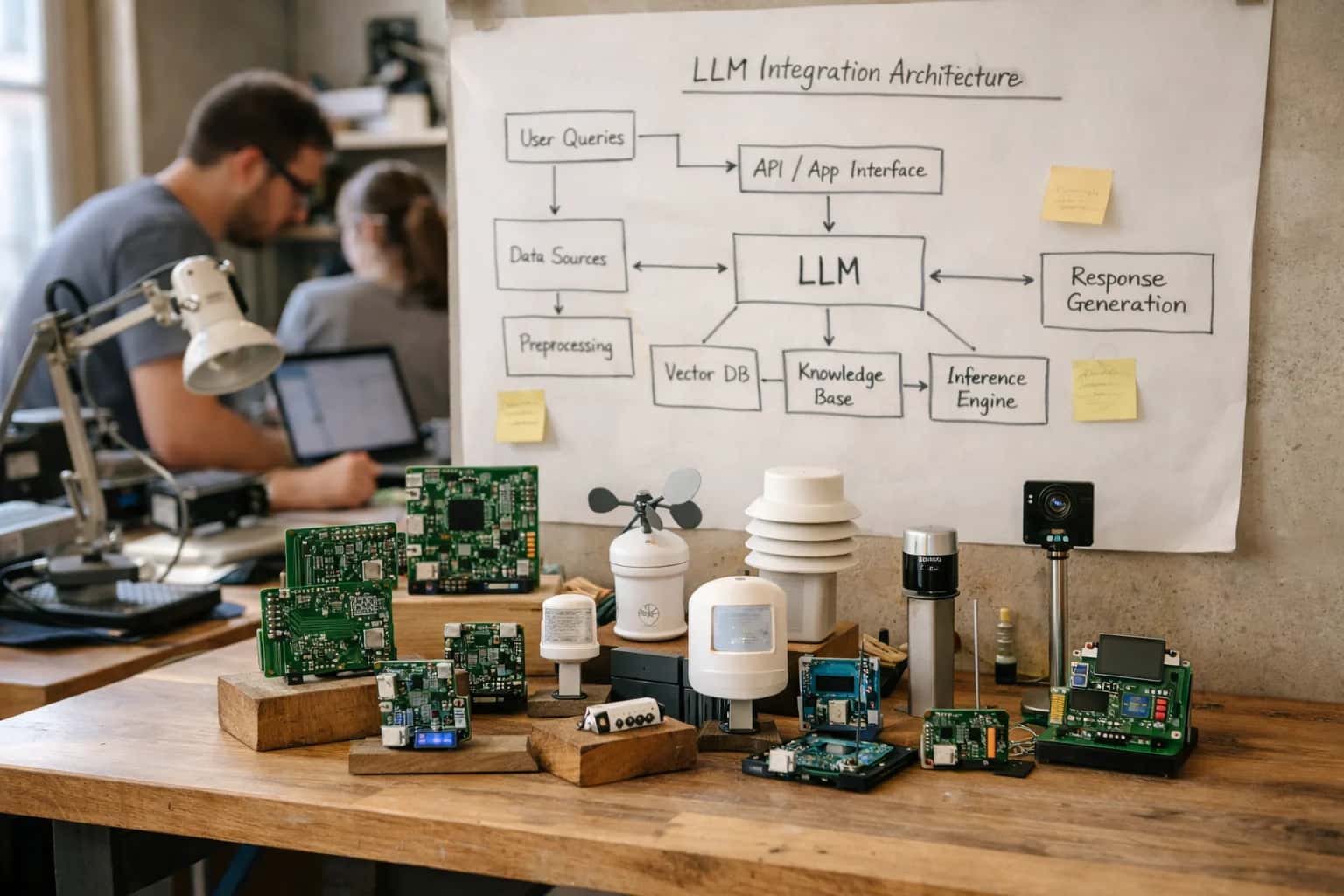
A common architecture wires the LLM into the workflow via IQ Bot's API Trigger or a post-process bot in the Control Room. For example, after IQ Bot extracts data from an insurance claim form, the raw text and extracted fields are sent to an LLM via a secure API call. The LLM can then: - Resolve ambiguous entries (e.g., is 'NYC' the 'City' or part of the 'Hospital Name' field?), - Infer missing data (e.g., calculating a total from itemized charges), and - Classify document subtypes (e.g., distinguishing a W-9 from a W-8BEN) beyond pre-trained classifiers. The enriched and validated data is returned to the bot to complete the workflow, such as updating a claims system or routing for human review.
For governance, this integration requires careful design. All LLM calls should be logged in the Control Room audit trail with the original document hash, prompt used, and model response. A human-in-the-loop approval queue can be configured in IQ Bot for low-confidence LLM suggestions. Over time, validated corrections from human reviewers can be fed back as few-shot examples to fine-tune the LLM or to retrain IQ Bot's own models via its learning interface, creating a closed-loop system that gets smarter with each exception handled. This approach keeps IQ Bot as the robust, governed orchestration layer while injecting LLM intelligence precisely where it's needed most.
ARCHITECTING LLM-AUGMENTED DOCUMENT WORKFLOWS
Integration Touchpoints Within the IQ Bot Ecosystem
Enhancing Unstructured Document Intake
IQ Bot's native classification can be augmented with LLMs to handle edge cases and complex document types. Instead of relying solely on template matching, you can integrate a custom classifier that uses an LLM to analyze document content, layout, and metadata for more accurate routing.
Integration Pattern:
- Pre-processing: IQ Bot extracts initial text and image snippets from an uploaded document batch.
- LLM Call: A secure API call sends document snippets to an LLM (e.g., GPT-4, Claude) with a prompt to classify the document type and intended workflow (e.g.,
Invoice,Claim Form,W-9,Exception - Manual Review). - Orchestrator Action: The classification result is passed back to Automation Anywhere Control Room, which routes the document to the appropriate IQ Bot learning instance or a human queue in AARI.
Use Case: Distinguishing between a Commercial Insurance Claim and a Personal Auto Claim based on narrative text when forms are visually similar.
BEYOND TEMPLATE-BASED OCR
High-Value Use Cases for AI-Augmented IQ Bot
Automation Anywhere IQ Bot excels at extracting structured data from documents using pre-trained models. Integrating custom LLMs unlocks reasoning, validation, and adaptation for complex, unstructured workflows. Here are key patterns to elevate your cognitive automation.
01
Context-Aware Exception Handling
When IQ Bot flags a low-confidence extraction or validation failure, an LLM analyzes the full document context and adjacent fields to infer the correct value. For example, in an invoice where the PO number is smudged, the LLM can cross-reference the vendor name and date from other fields to retrieve the likely PO from an ERP system, resolving exceptions without human review.
Batch -> Real-time
Exception resolution
02
Unstructured Document Reasoning
Process complex documents like insurance claim narratives, legal correspondence, or customer complaint letters that lack fixed templates. An LLM integrated via IQ Bot's API can summarize the document, extract key entities (e.g., claimant, incident date, damages), and classify the record for downstream routing, turning unstructured text into structured workflow triggers.
Hours -> Minutes
Document triage
03
Adaptive Learning from Corrections
Use LLMs to analyze human corrections made in the IQ Bot Validation Station. Instead of just updating a single field, the LLM identifies patterns in corrections (e.g., 'vendor name often appears in footer note') and generates natural language suggestions to improve the bot's extraction logic or to create a new document classifier, creating a continuous feedback loop.
1 sprint
Model improvement cycle
04
Multi-Document Synthesis
For processes like loan onboarding or claims that require data from multiple document types (ID, pay stub, bank statement), an LLM orchestrates across several IQ Bot extractions. It consolidates the data, identifies discrepancies (e.g., name mismatch), and generates a unified, validated data payload for system-of-record update, ensuring consistency across the packet.
Same day
Packet processing
05
Intelligent Field Validation
Move beyond format checks (e.g., date) to semantic and business rule validation. An LLM validates extracted data against external knowledge: e.g., verifying a medical procedure code against the patient's diagnosis from an EHR, or checking if an invoice amount aligns with contracted pricing in a CPQ system. Flags are sent back to IQ Bot with reasoning for reviewer.
06
Dynamic Workflow Triggering
Based on the content and sentiment analyzed by an LLM, dynamically route the document and extracted data to different Automation Anywhere bot queues or external systems. A high-severity complaint letter triggers an urgent service bot and pings a manager, while a routine application proceeds through standard processing. This moves workflows from linear to intelligent.
Batch -> Real-time
Document routing
AUGMENTING IQ BOT WITH LLMS
Example AI-Enhanced Document Processing Workflows
IQ Bot excels at structured data extraction from known document types. Integrating custom LLMs unlocks new capabilities for handling complex, variable, or novel documents. Below are concrete workflows that combine IQ Bot's process orchestration with generative AI for reasoning, validation, and adaptive learning.
Trigger: IQ Bot receives a document (PDF, scanned image, email attachment) in its designated input folder.
Context Pulled: IQ Bot performs initial classification. If identified as an 'Invoice', it extracts known fields (vendor name, invoice number, date, line items) using its trained skills.
Model Action: Extracted data is passed as a JSON payload to a configured LLM endpoint (e.g., Azure OpenAI, Anthropic Claude). The LLM is prompted to:
- Validate Consistency: Check if the line item descriptions match the vendor's typical goods/services.
- Flag Anomalies: Identify unusually high unit costs or quantities based on historical data provided in the prompt context.
- Extract Unstructured Notes: Parse any handwritten notes or special terms in the footer (e.g., "Net 60", "Includes freight").
System Update: The LLM's structured response (validation flags, confidence scores, extracted notes) is returned to the bot. The bot updates the IQ Bot data table, marking the record for human review if anomalies are found, or proceeding to the ERP posting step if validated.
Human Review Point: All invoices flagged by the LLM are routed to an Action Center queue with the LLM's reasoning displayed, allowing a human to quickly confirm or override.
FROM TEMPLATE-BASED OCR TO GENERATIVE DOCUMENT REASONING
Implementation Architecture: Connecting IQ Bot to AI Services
A practical blueprint for augmenting Automation Anywhere IQ Bot's cognitive capture with custom LLMs to handle complex, unstructured documents.
The core integration pattern involves using IQ Bot as the orchestration engine and data router. IQ Bot ingests documents (PDFs, scans, emails) via its standard channels, performs initial classification and basic OCR, and then passes the extracted text, images, and metadata to an external AI service via a secure API call. This external service—hosted on your cloud (Azure, AWS, GCP) or a private Inference Systems cluster—uses a Large Language Model (LLM) to perform tasks IQ Bot struggles with: interpreting ambiguous fields, reasoning about missing information, validating data against external knowledge bases, and summarizing lengthy, unstructured sections. The enriched, validated data is then returned to IQ Bot in a structured JSON payload, which IQ Bot maps to its data schema and pushes downstream to systems like SAP, Salesforce, or a claims database.
Key technical surfaces for integration are the IQ Bot API and webhook activities within Automation Anywhere's Bot Creator. For each document class (e.g., 'Insurance Claim Form', 'Supplier Invoice'), you configure a post-processing workflow that calls your AI service. The AI service's prompt engineering is critical: prompts are dynamically built using context from the IQ Bot session—document type, confidence scores, partially extracted fields—to ask the LLM specific, grounded questions (e.g., "Based on the narrative in Section 5, what is the probable cause of loss? Options: Water, Fire, Theft"). This turns generative AI from a creative tool into a deterministic, auditable reasoning layer for exception handling.
Rollout requires a phased governance model. Start with a human-in-the-loop design where the AI's 'reasoning' and proposed extractions are logged in the Control Room and presented for reviewer approval in AARI (Automation Anywhere Robotic Interface). As confidence metrics improve, workflows can shift to auto-accept for high-certainty outputs, with AI-only exceptions flagged for audit. This architecture doesn't replace IQ Bot's core OCR but creates a cognitive augmentation loop, allowing the system to learn from corrections and continuously improve prompt libraries and validation rules, turning document-heavy processes like claims triage or loan onboarding from a multi-day manual review into a same-hour automated workflow.
AUTOMATION ANYWHERE IQ BOT
Code and Payload Patterns for Common AI Tasks
Classify Unstructured Documents for Processing
IQ Bot can classify documents, but LLMs provide deeper contextual understanding for ambiguous or novel document types. Use an LLM to analyze the document's text and metadata, then return a classification to route the document to the correct IQ Bot learning instance or workflow.
Example Payload to LLM API:
json{ "model": "gpt-4o-mini", "messages": [ { "role": "system", "content": "Classify this document for RPA processing. Return ONLY the exact category name: 'Invoice', 'Insurance Claim', 'W-9 Form', 'Purchase Order', 'Employment Application', or 'Unknown'." }, { "role": "user", "content": "Document Text: {{Extracted_Text}}\n\nMetadata: FileName={{FileName}}, Pages={{PageCount}}" } ], "temperature": 0.0 }
In your Automation Anywhere bot, call this API after initial OCR, parse the response, and use the result to set the documentType variable that controls downstream workflow branching in the Control Room.
IQ BOT AUGMENTED WITH GENERATIVE AI
Realistic Time Savings and Operational Impact
This table illustrates the operational impact of integrating custom LLMs with Automation Anywhere IQ Bot, moving beyond template-based OCR to handle complex, unstructured documents with reasoning and adaptive learning.
| Process Step | Before AI (IQ Bot Alone) | After AI (IQ Bot + LLM) | Implementation Notes |
|---|---|---|---|
Invoice Data Extraction | 70-85% accuracy on complex layouts | 92-98% accuracy with contextual validation | LLM resolves vendor name variations and validates line items against PO data |
Exception Handling & Triage | Manual review of all low-confidence fields | AI suggests corrections; human reviews only flagged exceptions | Reduces human review volume by 60-75% for claims and onboarding docs |
Contract Clause Identification | Keyword search and rigid zone-based extraction | Semantic search for concepts like 'termination' or 'liability' | Enables dynamic extraction without pre-defined template zones |
Form Classification & Routing | Rule-based on document structure and keywords | Intent-based classification using document content and context | Handles new, unseen form types without manual rule updates |
Data Validation & Enrichment | Cross-field validation against static rules | Contextual validation against external databases and business logic | e.g., Validates patient ID against EHR or cross-references policy numbers |
Process Adaptation Learning | Manual retraining required for new document variants | Continuous feedback loop improves extraction models over time | System learns from human corrections in Action Center, reducing future exceptions |
End-to-End Processing Time | Hours (with multiple human touchpoints) | Minutes (with single human review checkpoint) | Time savings compound in high-volume processes like loan applications or insurance claims |
PRODUCTION ARCHITECTURE FOR IQ BOT + LLM
Governance, Security, and Phased Rollout
A practical framework for deploying and governing custom LLMs within Automation Anywhere IQ Bot workflows.
Integrating external LLMs with Automation Anywhere IQ Bot introduces new governance surfaces: prompt management, model versioning, input/output logging, and cost tracking. A production architecture typically places a secure API gateway (like Kong or Apigee) between the Control Room and the LLM provider. This gateway handles authentication, rate limiting, payload inspection, and audit logging for all IQ Bot-initiated calls. Sensitive data extracted by IQ Bot should be tokenized or redacted before being sent to external models, with PII fields stripped in the automation script. All LLM interactions, including the prompt sent, the full response, tokens used, and the associated bot run ID, should be logged back to the Automation Anywhere Bot Insight database or a dedicated audit store for compliance and performance analysis.
Rollout should follow a phased, risk-based approach. Phase 1 targets low-risk, high-volume documents where IQ Bot's confidence score is below a threshold (e.g., <85%), routing them to an LLM for reasoning and extraction assistance. Results are written to a validation queue in Automation Anywhere AARI for human review, creating a golden dataset for fine-tuning. Phase 2 enables fully automated processing for specific, validated document types, with the LLM acting as a co-pilot to handle complex fields or contextual ambiguity. Phase 3 introduces adaptive learning, where successful LLM-assisted extractions are used to retrain or prompt-engineer the system, gradually reducing exception rates. Each phase requires clear role-based access control (RBAC) in the Control Room to manage who can modify prompts, adjust routing rules, or approve model changes.
Continuous monitoring is critical. Establish dashboards that track key metrics: IQ Bot confidence score distribution, LLM-assisted processing rate, human-in-the-loop escalation rate, extraction accuracy by document type, and cost per document processed. Set alerts for anomaly detection, such as a spike in LLM usage costs or a drop in accuracy for a specific form variant. This operational data, combined with the audit trail, ensures the integrated system remains explainable, cost-effective, and compliant with internal AI policies and external regulations, turning a proof-of-concept into a governed production asset.
Enabling Efficiency, Speed & Accuracy
Intelligent Analysis, Decision & Execution
We build AI systems for teams that need search across company data, workflow automation across tools, or AI features inside products and internal software.
Talk to Us
Search across company data
Give teams answers from docs, tickets, runbooks, and product data with sources and permissions.
Useful when people spend too long searching or get different answers from different systems.
Enterprise searchRAGPermissions
Read more
Automate internal workflows
Use AI to route work, draft outputs, trigger actions, and keep approvals and logs in place.
Useful when repetitive work moves across multiple tools and teams.
AI agentsWorkflow automationGovernance
Read more
Add AI to products and internal tools
Build assistants, guided actions, or decision support into the software your team or customers already use.
Useful when AI needs to be part of the product, not a separate tool.
AI integrationDecision supportModel routing
Read moreIMPLEMENTATION BLUEPRINTS
Frequently Asked Questions on AI + IQ Bot Integration
Practical answers for architects and automation leads planning to augment Automation Anywhere IQ Bot with custom LLMs for complex document workflows.
The standard pattern is to use IQ Bot's REST API activity to call a secure, internal API gateway that proxies requests to your LLM provider (e.g., Azure OpenAI, AWS Bedrock). This isolates credentials and enables governance.
Typical Implementation Steps:
- Deploy a secure proxy service (e.g., using Azure API Management, Kong, or a simple serverless function) that handles authentication, rate limiting, and logging.
- Configure the API endpoint and headers in the IQ Bot workflow's REST API activity.
- Construct the prompt payload by combining extracted fields from the IQ Bot document with a system prompt for the specific task (e.g., validation, summarization).
- Parse the JSON response from the LLM using IQ Bot's JSON activities to extract the decision or generated content.
- Use the result to update the document's validation flags, populate a new field, or route the document for exception handling.
Security Note: Never embed LLM API keys directly in the bot. All calls should route through your internal gateway, which enforces data privacy policies and audit trails.

About the author
Prasad Kumkar
CEO & MD, Inference Systems
Prasad Kumkar is the CEO & MD of Inference Systems and writes about AI systems architecture, LLM infrastructure, model serving, evaluation, and production deployment. Over 5+ years, he has worked across computer vision models, L5 autonomous vehicle systems, and LLM research, with a focus on taking complex AI ideas into real-world engineering systems.
His work and writing cover AI systems, large language models, AI agents, multimodal systems, autonomous systems, inference optimization, RAG, evaluation, and production AI engineering.
LinkedIn
Limited slotsGet a Free AI Consultation
Partnered with leading AI, data, and software stack.





How We Work
Custom AI workflows for your Business
One-fit-all AI don't work for modern businesses. At Inferensys, we aim to understand your business & custom requirements; which we use to define most efficient agentic workflows, the data, and the tools for your business.
01
Review the use case
We understand the task, the users, and where AI can actually help.
Read more02
Pick the right approach
We define what needs search, automation, or product integration.
Read more03
Build the first useful version
We implement the part that proves the value first.
Read more04
Improve from there
We add the checks and visibility needed to keep it useful.
Read moreThe first call is a practical review of your use case and the right next step.
Talk to Us