AI integration connects at three key surfaces within the UiPath Communications Mining workflow: data ingestion, analysis enrichment, and automation triggering. During ingestion, LLMs can pre-process and normalize unstructured text from emails, chat logs, and support tickets before they enter the mining pipeline. Within the analysis layer, AI augments the platform's native sentiment and topic detection by extracting specific intents, entities (like product names, account IDs, or service levels), and urgency signals that standard models may miss. This enriched metadata is then written back to Communications Mining as custom labels or attributes, making the insights immediately usable for building more precise automation triggers in UiPath Orchestrator.

Integration
AI Integration for UiPath Communications Mining
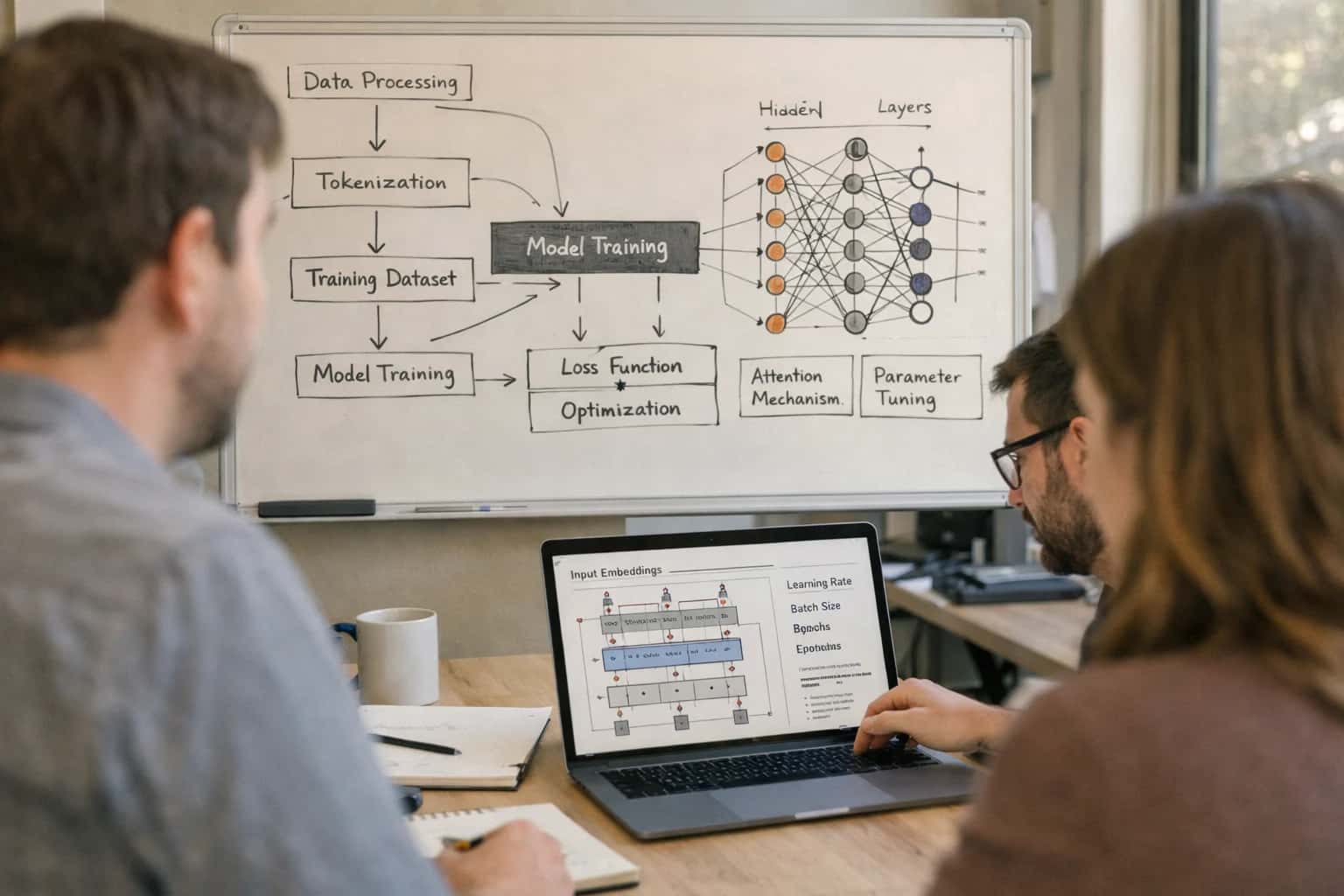
Where AI Fits into UiPath Communications Mining
Integrating generative AI with UiPath Communications Mining transforms raw customer interactions into structured, actionable triggers for service automation.
The production pattern involves deploying a secure inference service (e.g., an Azure OpenAI endpoint or a private LLM gateway) that the UiPath AI Center or a custom activity can call. For each communication processed by Communications Mining, a payload containing the conversation text and initial metadata is sent to the LLM with a structured prompt designed to extract the target insights. The response—formatted as JSON—is parsed and used to update the communication's profile. High-confidence findings, such as a customer's clear request to cancel service or escalate to a manager, can be configured to automatically publish a message to an Orchestrator queue, kicking off an unattended bot to execute the corresponding process in the CRM or billing system.
Rollout should be phased, starting with a single high-volume communication channel (e.g., support email) and a narrow set of intents. Governance is critical: implement a human-in-the-loop review step in UiPath Action Center for low-confidence AI extractions, and use Communications Mining's analytics to track the precision and recall of the AI-enriched labels over time. This approach doesn't replace Communications Mining's core engine but layers on deeper semantic understanding, turning it from an analysis tool into a real-time automation nervous system for customer operations.
Integration Touchpoints in the UiPath Stack
Core NLP Pipeline Enhancement
Communications Mining's native NLP models classify intents, entities, and sentiments from unstructured text. Integrating an LLM supercharges this pipeline for nuanced analysis.
Key Integration Points:
- Pre-labeling & Taxonomy Expansion: Use an LLM to generate initial label suggestions for new, unseen communication types (e.g., emerging customer complaint themes), accelerating taxonomy development.
- Ambiguous Intent Resolution: When native confidence scores are low between similar intents (e.g., 'Request Refund' vs. 'Request Exchange'), call an LLM with conversation context to make a final, reasoned classification.
- Complex Entity Extraction: Go beyond predefined entities to extract ad-hoc details, like specific product features mentioned in feedback or nuanced conditions described in a support ticket.
This layer makes the mining process more adaptive and reduces the manual review burden for taxonomy managers.
High-Value Use Cases for AI-Enhanced Communications Mining
Integrating large language models with UiPath Communications Mining transforms raw customer interactions into structured, actionable triggers for automation. These patterns show where to connect AI for maximum service and operational impact.
Automated Sentiment & Escalation Routing
Analyze email and chat sentiment in real-time to automatically tag, score, and route high-priority communications. Critical or frustrated customer messages are flagged and pushed to a senior support queue in your CRM (e.g., Salesforce Service Cloud) via UiPath Robots, while routine inquiries are handled by bots.
Intent-Based Workflow Triggering
Use LLMs to classify the underlying intent (e.g., cancel subscription, request refund, report bug) from unstructured text. The identified intent and extracted entities (order ID, amount) become a payload to trigger a specific UiPath automation—launching a cancellation bot, initiating a refund in NetSuite, or creating a Jira ticket.
Contract & Policy Clause Extraction
Mine support tickets and customer emails for references to specific contractual terms, SLAs, or policy numbers. An LLM extracts the relevant clause context and passes it to a Document Understanding workflow to retrieve the exact contract PDF from SharePoint, compare terms, and draft a response for agent review.
Product Feedback & Defect Aggregation
Continuously analyze communications to surface product feedback, feature requests, and defect mentions. The AI clusters similar feedback, summarizes trends, and automatically creates enriched tickets in your product management tool (e.g., Jira, Productboard) with sentiment scores and volume metrics attached.
Compliance & Risk Monitoring
Scan all customer-facing communications for potential compliance violations (e.g., unauthorized promises, privacy data leaks) or financial risk indicators. Flagged conversations are routed to a secure Action Center for legal or compliance officer review, with an audit trail maintained in the Orchestrator.
Automated Response Drafting
For common, well-understood intents, use the LLM to generate a first-draft response based on the customer's message and linked knowledge base articles. The draft, along with recommended next steps, is presented to the agent in their service console (e.g., Zendesk) for one-click approval and sending.
Example AI-Augmented Workflows
These workflows illustrate how to connect large language models to UiPath Communications Mining to move from insight to action. Each pattern combines sentiment/intent classification with generative reasoning to trigger automations, draft responses, or escalate cases.
This workflow identifies urgent customer emotions and automatically creates a high-priority case with context.
- Trigger: Communications Mining detects an email or chat with a
sentiment_scorebelow -0.7 (highly negative) and an intent likecomplaintorservice_issue. - Context Pulled: The full message text, customer ID, and detected entities (e.g.,
product_name,order_number) are passed to an LLM via a secure API call from an Automation Cloud workflow. - Model Action: The LLM performs two tasks:
- Summarization: Creates a concise, factual summary of the customer's core issue.
- Severity Assessment: Classifies the likely business impact (e.g.,
Churn Risk,Legal Exposure,Revenue Impact) based on the message tone and content.
- System Update: The RPA bot or integration uses the LLM's output to:
- Create a high-priority case in Salesforce Service Cloud or Zendesk.
- Populate the case description with the AI summary.
- Tag the case with the AI-assessed severity and relevant product/order entities.
- Assign it to the appropriate support queue based on intent and severity.
- Human Review Point: The agent receives the pre-populated case with clear context, reducing triage time from minutes to seconds. The original message and AI analysis are logged in the case timeline for auditability.
Production Implementation Architecture
A practical blueprint for integrating LLMs with UiPath Communications Mining to turn unstructured communications into automated workflows.
A production integration connects the UiPath Communications Mining API to a secure LLM gateway, creating a closed-loop system for analysis and action. The typical flow is: 1) Communications Mining ingests emails, chats, or tickets and applies its native NLP for initial entity extraction. 2) A custom activity in UiPath Studio calls an orchestration layer (often built with n8n or Azure Logic Apps) which routes the enriched conversation data—including metadata like customer ID, channel, and sentiment score—to a configured LLM endpoint (e.g., Azure OpenAI, Anthropic Claude, or a fine-tuned open-source model). 3) The LLM performs a deeper, contextual analysis based on a prompt library tuned for specific intents (e.g., escalation_required, refund_request, product_feedback). 4) The structured output, which includes a classification, confidence score, and extracted actionable data (like dollar amounts or issue codes), is posted back to UiPath Orchestrator as a queue item, ready to trigger an unattended bot or create a task in UiPath Action Center for human review.
Governance is critical. Implement a prompt registry to version and audit all LLM instructions used in production. Use the UiPath AI Center to manage model endpoints, track usage, and monitor for performance drift. For high-risk classifications (e.g., regulatory complaints), design a human-in-the-loop step where the LLM's analysis and suggested action are presented in Action Center for an agent's approval before any system update or outbound communication is made. Log all LLM inputs, outputs, and final dispositions to a dedicated audit table, linking back to the original Communications Mining document ID for full traceability.
Rollout should be phased. Start with a single, high-volume communication stream (e.g., customer support emails for a specific product line). Use the UiPath Insights platform to establish a baseline for manual processing time and quality. For the pilot, configure the LLM integration to run in 'shadow mode,' where its classifications and extracted data are logged but do not trigger automations, allowing you to measure accuracy against human-labeled data. Once confidence thresholds are met, gradually activate automations for the highest-confidence intents, such as auto-routing technical issues to the correct support queue or triggering a bot to schedule a callback for a service inquiry flagged as urgent.
Code and Payload Examples
Enriching Communications Mining Outputs with LLMs
After UiPath Communications Mining extracts entities and topics from emails or chat logs, you can call an LLM to generate deeper insights. This Python example shows how to take a mined communication and produce a sentiment-rich summary with actionable intent classification, which can be stored back in Communications Mining or sent to Orchestrator.
pythonimport requests import json from inference_systems_client import secure_llm_call # Hypothetical secure client # Example payload from UiPath Communications Mining webhook example_mined_comm = { "communication_id": "email_12345", "source": "[email protected]", "recipient": "[email protected]", "extracted_text": "The new update broke the reporting feature. I need this fixed urgently for my client meeting tomorrow.", "entities": [{"type": "PRODUCT", "value": "reporting feature"}], "topics": ["software issue", "urgent"] } # Prepare LLM prompt for deeper analysis prompt = f""" Analyze this customer communication: Text: {example_mined_comm['extracted_text']} Extracted Topics: {', '.join(example_mined_comm['topics'])} Provide a JSON with: 1. primary_sentiment (positive, negative, neutral, frustrated) 2. urgency_score (1-5) 3. inferred_customer_intent 4. a one-sentence summary for a support agent. """ # Securely call the LLM via Inference Systems' orchestration layer analysis_result = secure_llm_call( model="gpt-4o-mini", prompt=prompt, temperature=0.1, response_format={ "type": "json_object" } ) # Enrich the original mined data enriched_data = {**example_mined_comm, "llm_analysis": json.loads(analysis_result)} print(json.dumps(enriched_data, indent=2))
This enriched data can trigger a high-priority workflow in Orchestrator or update a CRM case.
Realistic Operational Impact and Time Savings
How integrating LLMs with UiPath Communications Mining transforms the analysis of customer emails, chats, and support tickets, shifting from manual review to assisted intelligence.
| Workflow / Metric | Before AI Integration | After AI Integration | Implementation Notes |
|---|---|---|---|
Customer Intent Categorization | Manual tagging by agents; inconsistent labels | AI-assisted multi-label classification | Human review for edge cases; model retrained weekly on new data |
Sentiment Triage for Escalation | Supervisor reviews random sample daily | Real-time alerting for negative sentiment spikes | Triggers workflow in Orchestrator to assign high-priority cases |
Extracting Actionable Feedback | Monthly manual report compilation | Automated weekly insight digest with key themes | Insights feed into Productboard or Jira via API for product teams |
Service Request Routing | Agent reads full email to determine queue | AI predicts correct support queue with 85%+ accuracy | Agent approves routing suggestion; reduces misroutes by ~40% |
Compliance & Policy Violation Detection | Ad-hoc manual audits | Continuous scanning for PII, profanity, or policy terms | Flags for human review in Action Center; audit trail maintained |
Trend Analysis for Process Mining | Quarterly business reviews with static data | Monthly automated trend reports linked to process deviations | Feeds data into UiPath Process Mining to identify automation candidates |
Response Time for High-Volume Periods | Manual backlog triage takes 4-6 hours | Priority scoring cuts triage time to 1-2 hours | AI model uses historical resolution time and sentiment to score urgency |
Governance, Security, and Phased Rollout
Deploying LLMs on customer communications requires a secure, auditable architecture that integrates with UiPath's governance model.
A production integration for UiPath Communications Mining must treat customer emails and chat logs as sensitive PII. We architect this by keeping the Communications Mining data plane within your cloud tenant, using its native Data Service for storage, and calling LLMs via a secure proxy layer. This ensures data never leaves your controlled environment for processing. The LLM's role is to act as a stateless analysis engine: Communications Mining sends a batch of anonymized or redacted text for analysis, and the LLM returns structured insights—like sentiment scores, intent classifications, and actionable topics—which are then written back to the Communication and Topic objects within the platform. All API calls are logged to UiPath Orchestrator's Audit Logs for a complete lineage of which models analyzed which data, when, and by which process.
Governance is enforced at multiple levels. First, access to the AI-enhanced insights is controlled by Communications Mining's existing role-based permissions, ensuring only authorized analysts or automation bots can view the enriched data. Second, we implement a human-in-the-loop approval step for any automated action triggered by AI analysis—such as creating a high-priority case in ServiceNow or assigning a sentiment alert. This approval can be routed through UiPath Action Center, creating a clear audit trail. Third, we set up regular reviews of the AI's topic clustering and intent labeling accuracy within the Communications Mining console, using its feedback mechanisms to retrain or adjust the underlying prompts, preventing model drift from affecting business decisions.
A phased rollout mitigates risk and demonstrates value. Phase 1 focuses on a single, high-volume communication channel (e.g., customer support emails) and uses the LLM for non-operational insights, like generating weekly sentiment dashboards. Phase 2 integrates the insights into an attended automation: an agent in the Communications Mining console sees AI-suggested topics and can one-click to apply them, speeding up manual tagging. Phase 3 enables closed-loop automation, where specific intents (e.g., billing_dispute) automatically trigger an RPA bot to pull the invoice and create a pre-populated case in the CRM, all logged in Orchestrator. This crawl-walk-run approach builds trust in the AI's output, aligns with change management, and ties each phase to a measurable efficiency gain, such as reducing manual topic tagging time from hours to minutes per analyst.
Enabling Efficiency, Speed & Accuracy
Intelligent Analysis, Decision & Execution
We build AI systems for teams that need search across company data, workflow automation across tools, or AI features inside products and internal software.
Talk to Us
Search across company data
Give teams answers from docs, tickets, runbooks, and product data with sources and permissions.
Useful when people spend too long searching or get different answers from different systems.

Automate internal workflows
Use AI to route work, draft outputs, trigger actions, and keep approvals and logs in place.
Useful when repetitive work moves across multiple tools and teams.

Add AI to products and internal tools
Build assistants, guided actions, or decision support into the software your team or customers already use.
Useful when AI needs to be part of the product, not a separate tool.
Frequently Asked Questions
Common questions about integrating large language models with UiPath Communications Mining to automate customer insight extraction and service workflows.
Integration typically occurs via the UiPath Communications Mining API and a secure middleware layer. The workflow is:
- Trigger: A scheduled Orchestrator job or a webhook from Communications Mining signals that new communications (emails, chat logs) are ready for deep analysis.
- Data Pull: The integration layer calls the Communications Mining API to retrieve the raw text and existing metadata (like basic sentiment or category) for a batch of conversations.
- Enrichment Call: This data is sent to a configured LLM endpoint (e.g., Azure OpenAI, Anthropic Claude) via a secure API call. The payload includes a system prompt defining the analysis task and the conversation text.
- Contextual Analysis: The LLM performs the deep analysis—extracting specific intents, summarizing complex issues, detecting escalation signals, or identifying cross-sell opportunities—that goes beyond pre-trained classifiers.
- System Update: The enriched insights (as structured JSON) are posted back to the Communications Mining dataset via API, creating new custom fields or tags. This makes the AI-generated insights visible and filterable within the Communications Mining dashboard.
- Downstream Automation: These new, high-confidence tags can then trigger UiPath Robots in Orchestrator to execute workflows—like auto-creating a high-priority case in Salesforce Service Cloud or sending an alert to a manager.
Key technical points:
- API calls must handle authentication (OAuth for UiPath, API keys for LLM provider).
- The middleware manages rate limiting, retries, and cost tracking.
- All PII can be redacted or pseudonymized before leaving your environment, depending on the LLM deployment model (cloud vs. private).

About the author
Prasad Kumkar
CEO & MD, Inference Systems
Prasad Kumkar is the CEO & MD of Inference Systems and writes about AI systems architecture, LLM infrastructure, model serving, evaluation, and production deployment. Over 5+ years, he has worked across computer vision models, L5 autonomous vehicle systems, and LLM research, with a focus on taking complex AI ideas into real-world engineering systems.
His work and writing cover AI systems, large language models, AI agents, multimodal systems, autonomous systems, inference optimization, RAG, evaluation, and production AI engineering.
Partnered with leading AI, data, and software stack.





How We Work
Custom AI workflows for your Business
One-fit-all AI don't work for modern businesses. At Inferensys, we aim to understand your business & custom requirements; which we use to define most efficient agentic workflows, the data, and the tools for your business.
01
Review the use case
We understand the task, the users, and where AI can actually help.
Read more02
Pick the right approach
We define what needs search, automation, or product integration.
Read more03
Build the first useful version
We implement the part that proves the value first.
Read more04
Improve from there
We add the checks and visibility needed to keep it useful.
Read moreThe first call is a practical review of your use case and the right next step.
Talk to Us