For a retail chain with hundreds or thousands of stores, AI cannot be deployed as a point solution on each Lightspeed Retail, Shopify POS, Square Retail, or Clover instance. A centralized orchestration layer is required. This architecture typically involves a central AI service that ingests real-time event streams (via webhooks or APIs) for key POS objects: Transaction, Customer, InventoryItem, and Employee. The service processes these events to trigger workflows—like dynamic reordering or fraud scoring—and pushes actionable commands (e.g., apply_discount, generate_po) back to the appropriate store's POS via its REST API, all while maintaining a unified audit log.

Integration
AI Integration for Enterprise POS AI Solutions
Architecting large-scale, secure AI integrations for enterprise retail chains, covering data governance, multi-tenant models, and centralized AI orchestration across thousands of POS endpoints.
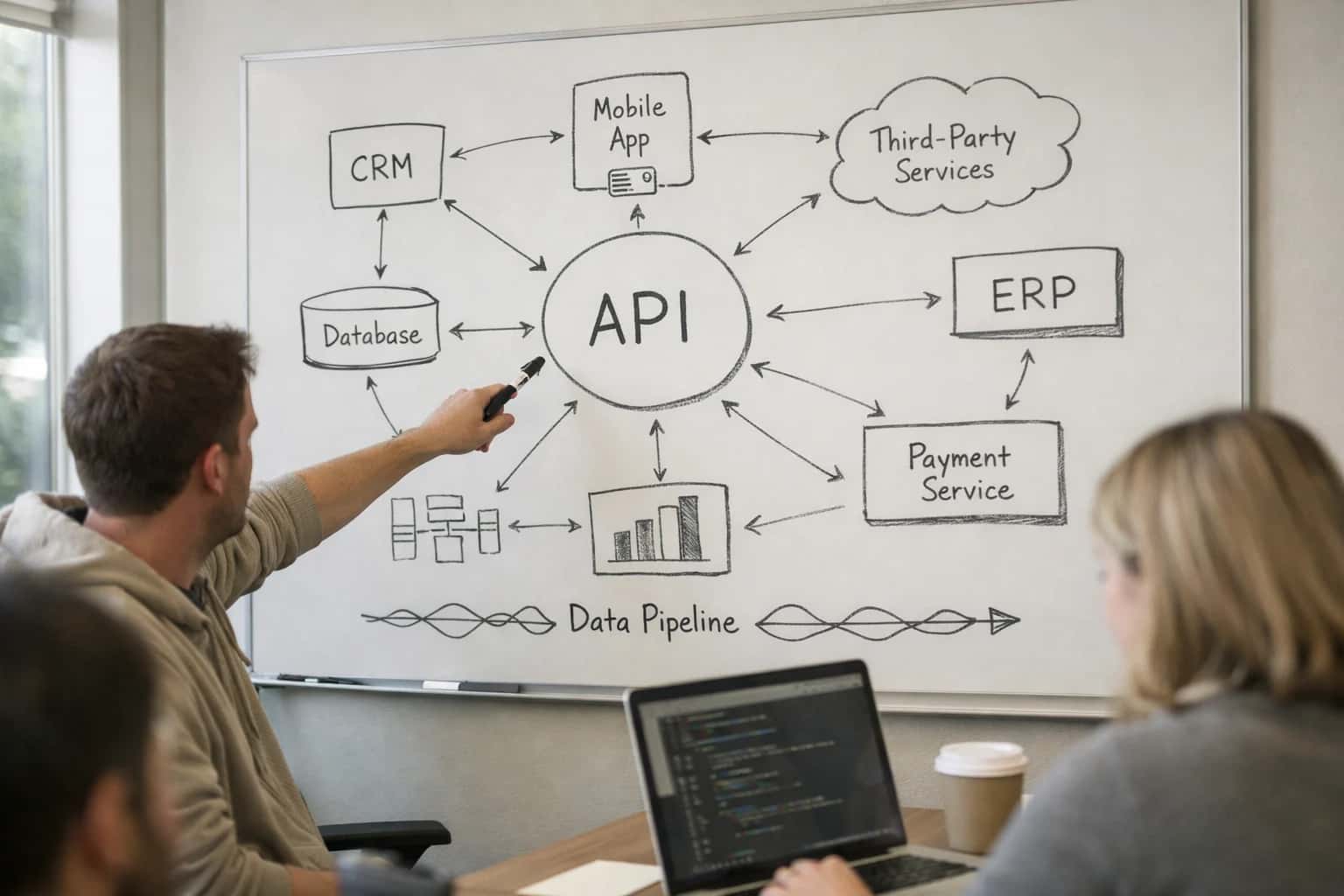
ENTERPRISE ARCHITECTURE
Centralized AI Orchestration for Multi-Store Retail Chains
A technical blueprint for deploying a single, governed AI layer across thousands of POS endpoints in enterprise retail.
Implementation requires a multi-tenant data model where each store's data is logically isolated, but AI models are trained on aggregated, anonymized trends. High-value workflows include cross-store anomaly detection (flagging a store with abnormal void rates), centralized inventory intelligence (pooling demand signals to negotiate with vendors), and chain-wide customer recognition (enabling loyalty benefits across all locations). The AI layer sits between the POS fleet and core enterprise systems like the ERP and CDP, acting as the 'brain' for real-time, automated decision-making.
Rollout follows a phased, store-group pilot. Governance is critical: define which AI actions (e.g., auto-approving refunds under $50) are fully automated, which require store-manager approval via a mobile alert, and which are merely recommendations in a daily digest. Implement strict RBAC so headquarters can configure prompts and models, while regional managers can only view insights for their territory. This centralized approach turns a fragmented POS estate into a cohesive, intelligent network, reducing operational latency from days to minutes while maintaining enterprise control.
For related architectural patterns, see our guide on AI Integration for POS Chain Store Operations and our foundational AI Integration for Retail Point of Sale Platforms.
ARCHITECTING AI FOR MULTI-STORE OPERATIONS
Key Integration Surfaces for Enterprise POS Platforms
Real-Time Decisioning at the Register
The POS transaction stream is the richest real-time signal for in-store AI. Integrations here focus on augmenting the cashier experience and securing revenue.
Key APIs & Hooks:
- Pre-Transaction Webhooks: Trigger AI for cart analysis, dynamic discount/promotion application, or fraud scoring before payment finalization.
- Post-Transaction Events: Use sale completion webhooks to trigger receipt summarization, next-best-offer generation, or loyalty point accrual.
- Line Item Data: Access detailed SKU, quantity, and modifier data to power real-time recommendations or compliance checks (e.g., age-restricted products).
Example Workflow: An AI service listens for sale.completed webhooks. It enriches the transaction data with customer history, generates a personalized thank-you message with a relevant product suggestion, and queues it for delivery via SMS or email, turning a receipt into a retention tool.
Governance Note: Transactions contain PII and PCI data. Architect integrations to pass only tokenized customer IDs and non-sensitive metadata to AI services, keeping full payment details within the POS provider's secure boundary.
CENTRALIZED AI ORCHESTRATION
High-Value Use Cases for Enterprise Retail Chains
For chains managing thousands of endpoints, AI integration must be secure, governed, and consistent. These patterns show where to inject intelligence across Lightspeed, Shopify POS, Square, and Clover to drive chain-wide efficiency.
01
Centralized Inventory Replenishment
AI models consume real-time sales data from all POS endpoints to predict stockouts at the SKU-store level. Automatically generates and routes purchase orders to vendors, adjusting for lead times and seasonal trends. Integrates via POS REST APIs and webhooks.
Days -> Hours
Replenishment cycle
02
Chain-Wide Anomaly Detection
Monitors transaction streams across all registers for fraud patterns, pricing errors, or unusual voids/returns. Flags exceptions in a central dashboard for LP and ops teams. Built on a real-time event pipeline from POS webhooks.
Batch -> Real-time
Alerting
03
Dynamic Labor Scheduling
AI analyzes forecasted sales (from POS history), foot traffic data, and local events to build optimized, labor-law-compliant schedules for thousands of employees. Outputs sync back to POS workforce modules or HCM systems.
5-7%
Typical labor cost optimization
04
Unified Customer Intelligence
Creates a single customer view by deduplicating and enriching profiles from disparate POS systems. Enables chain-wide loyalty personalization and targeted retention campaigns. Uses vector search for similarity matching across transactions.
05
Automated Compliance Reporting
AI classifies POS transactions for sales tax, age-restricted products, and regulatory audits. Generates accurate reports for hundreds of jurisdictions automatically, reducing manual finance team workload and audit risk.
Hours -> Minutes
Report generation
06
Predictive Maintenance for POS Hardware
Ingests device health data from registers, scanners, and printers to predict failures before they impact checkout. Automatically creates service tickets and dispatches parts. Critical for uptime across large fleets.
Reactive -> Proactive
Support model
MULTI-STORE, GOVERNED IMPLEMENTATIONS
Example Enterprise AI Workflows
For enterprise retail chains, AI integration must be secure, scalable, and governable. These workflows illustrate how to orchestrate AI across thousands of POS endpoints from a centralized platform, ensuring consistent data handling, role-based access, and audit trails.
Trigger: Hourly batch job from the central data lake ingesting transaction summaries from all store POS systems.
Context Pulled: For each store, the system retrieves the last 24 hours of sales data, compares it to the forecasted range (based on historical patterns, day of week, promotions), and fetches recent exception logs.
AI Action: A classification model flags stores with a sales deviation beyond a configured threshold (e.g., >30% below forecast). A second agent analyzes the flagged store's transaction mix, average ticket, and void rates to generate a probable root cause summary (e.g., "Likely register outage after 2 PM based on transaction halt and increased void rate").
System Update: An alert is created in the central retail operations platform (e.g., ServiceNow, Jira) with severity tagged. The alert payload includes the store ID, deviation summary, AI-generated root cause, and links to the raw POS logs.
Human Review Point: Alerts are routed to the regional manager's dashboard. The AI's root cause is presented as a "Suggested Diagnosis" which the manager can confirm, reject, or annotate, providing feedback to improve the model.
SCALABLE GOVERNANCE FOR RETAIL CHAINS
Implementation Architecture: Central Hub & Store-Level Agents
A hub-and-spoke model that centralizes AI governance while enabling localized, real-time intelligence at thousands of store endpoints.
For enterprise retail chains, a monolithic AI integration is a non-starter. The architecture must separate centralized AI orchestration from distributed, store-level execution. A central hub—hosted in your cloud or ours—manages core LLM calls, prompt governance, model versioning, audit logs, and global data aggregation. At each store, a lightweight store-level agent runs on-premises or in a regional cloud, handling local POS API calls, real-time transaction processing, and low-latency interactions with devices like registers, scanners, and kiosks. This agent caches local product catalogs, customer preferences, and inventory snapshots, calling the hub only for complex reasoning or updates requiring global context.
The hub communicates with store agents via secure, message-based APIs (e.g., REST/webhooks over TLS) or a managed event stream (e.g., Kafka, AWS EventBridge). Each agent is authenticated via service principals and operates within a strict RBAC policy—a store in Miami cannot query another store's raw transaction data. High-value workflows follow this pattern: 1) A local trigger (e.g., a return scan at the POS) sends a context payload to the store agent; 2) The agent enriches it with local data and calls the hub for a governed decision (e.g., "Is this return high-risk?"); 3) The hub runs the prompt against the LLM, checks against global fraud patterns, and returns an action; 4) The agent executes the action via the local POS API (e.g., flag the transaction for manager review).
Rollout is phased by region or store tier. We start with a pilot agent deployed to a controlled group of stores, often targeting a single high-ROI workflow like automated purchase orders or dynamic discounting. The hub's observability stack—logging, tracing, and performance metrics—allows the central IT team to monitor agent health, LLM costs, and decision accuracy across the entire fleet. This architecture ensures compliance with data residency requirements (store data stays local unless aggregated), provides resilience against network outages (agents can operate with cached logic), and allows the chain to roll out new AI features store-by-store without a full platform upgrade.
ENTERPRISE INTEGRATION PATTERNS
Code & Payload Examples
Orchestrating AI Across Store Endpoints
For enterprise chains, AI logic should be centralized, not embedded in each POS. A headless AI service ingests events from all stores via a message queue, processes them, and returns instructions.
Example Architecture:
- Each POS publishes events (e.g.,
low_inventory_alert,complex_return) to a regional Kafka topic. - A central AI service consumes these events, calls the appropriate LLM or model with business context, and determines an action.
- The service publishes a command (e.g.,
generate_purchase_order,flag_fraud_review) back to a command topic, which store-level listeners act upon.
This pattern ensures consistent policy enforcement, centralized logging for compliance, and the ability to update AI models without touching thousands of POS endpoints.
CENTRALIZED AI ORCHESTRATION ACROSS 1000+ STORES
Plausible Operational Impact for Enterprise Chains
This table illustrates the directional impact of a governed, multi-tenant AI integration for large retail chains, focusing on operational efficiency, data quality, and centralized control.
| Operational Area | Before AI (Legacy State) | After AI (Integrated State) | Implementation Notes |
|---|---|---|---|
Multi-location Inventory Reconciliation | Manual spreadsheet consolidation, weekly | Automated daily sync with anomaly flags | AI model runs centrally, pushes alerts to regional managers |
Chain-wide Price Rule Updates | IT ticket, 2-3 day deployment per region | Policy-driven push in <4 hours with audit trail | Uses centralized governance layer to approve & deploy changes |
Loss Prevention & Fraud Review | Sample-based audits, post-incident analysis | Real-time transaction scoring at edge, centralized case queue | Low-latency model at POS, suspicious cases elevated to security team |
Labor Forecast for New Store Openings | Historical analogy, manual adjustment | Model-driven forecast using comparable store profiles | Leverages centralized data lake of launch performance |
Product Recall Execution | Email blast to managers, manual register overrides | Automated SKU blocking & customer notification workflows | Triggers are defined centrally, executed locally via POS APIs |
Regional Promotional Performance | End-of-week report from each district | Daily dashboard with AI-generated insights & next-step prompts | Centralized analytics engine consumes all POS data, serves role-based views |
Data Governance & PII Compliance | Periodic manual audits, inconsistent masking | Real-time data classification & policy enforcement at ingestion | Centralized policy engine ensures all AI models use anonymized or approved data only |
ARCHITECTING FOR ENTERPRISE SCALE
Governance, Security & Phased Rollout
Deploying AI across a retail chain's POS ecosystem requires a centralized, policy-first approach to data, access, and change management.
Enterprise POS integrations operate on a multi-tenant data model, where AI services must be orchestrated from a central control plane. This architecture ingests data from thousands of endpoints—Lightspeed Retail, Shopify POS, Square Retail, or Clover stores—via secure APIs and webhooks, but processes it within isolated, region-specific inference clusters. Critical governance starts with role-based access control (RBAC) tied to your existing IAM (e.g., Okta, Microsoft Entra), ensuring store managers, regional ops, and corporate analysts only trigger and view AI actions relevant to their scope. All AI-generated outputs—like dynamic pricing suggestions or automated purchase orders—are written back to the POS with a full audit trail, linking the action to the prompting user, model version, and source data.
A phased rollout is essential for managing risk and measuring impact. We recommend a three-stage deployment: 1) Pilot Phase: Select 2-3 representative stores to activate a single high-ROI workflow, such as AI-driven inventory replenishment. Instrument these endpoints to log all AI interactions, model confidence scores, and human overrides. 2) Controlled Expansion: Roll out the proven workflow to a region or store format, using the control plane to deploy different prompting strategies or LLM providers (e.g., OpenAI vs. Anthropic) for A/B testing on operational metrics like stockout reduction. 3) Chain-Wide Automation: Once the workflow's accuracy meets a predefined governance threshold (e.g., 95% auto-approval rate), enable it across the estate, with exception handling routed to a regional operations queue for manual review.
Security is enforced at every layer: data in transit is encrypted via POS vendor APIs; at rest, transaction data is anonymized or pseudonymized before being used for model training or analytics. The AI control plane should integrate with your Cloud Security Posture Management (CSPM) platform (e.g., Wiz, Prisma Cloud) to monitor for anomalous data egress or unexpected resource scaling. Finally, establish a continuous governance workflow where new AI use cases—like a checkout fraud detector—are reviewed against a compliance checklist covering data privacy regulations (PCI DSS, GDPR), required POS API permissions, and fallback procedures for POS system downtime.
Enabling Efficiency, Speed & Accuracy
Intelligent Analysis, Decision & Execution
We build AI systems for teams that need search across company data, workflow automation across tools, or AI features inside products and internal software.
Talk to Us
Search across company data
Give teams answers from docs, tickets, runbooks, and product data with sources and permissions.
Useful when people spend too long searching or get different answers from different systems.
Enterprise searchRAGPermissions
Read more
Automate internal workflows
Use AI to route work, draft outputs, trigger actions, and keep approvals and logs in place.
Useful when repetitive work moves across multiple tools and teams.
AI agentsWorkflow automationGovernance
Read more
Add AI to products and internal tools
Build assistants, guided actions, or decision support into the software your team or customers already use.
Useful when AI needs to be part of the product, not a separate tool.
AI integrationDecision supportModel routing
Read moreIMPLEMENTATION & GOVERNANCE
Frequently Asked Questions for Enterprise POS AI
Architecting AI for large retail chains involves unique challenges around scale, security, and centralized control. Below are answers to the most common technical and operational questions from enterprise CTOs and retail operations leaders.
Enterprise AI integrations require a zero-trust data architecture from the start.
Our standard pattern includes:
- Tokenization at Source: Before any transaction or customer data leaves the POS environment, we implement field-level tokenization for sensitive PII (e.g., credit card numbers, email). The AI system operates on tokens, not raw data.
- Centralized Policy Engine: A governance layer (often integrated with your existing IAM or data governance platform like Collibra or OneTrust) defines which AI models or agents can access which data types, based on role, location, and purpose.
- Audit Trail Generation: Every AI inference (e.g., "generate recommended upsell") is logged with a traceable ID, linking back to the original POS transaction ID, the data points used, the model version, and the user/terminal that initiated the call. This is essential for compliance (e.g., PCI DSS, GDPR).
- Data Residency Enforcement: For global chains, AI processing can be routed to region-specific endpoints to ensure data never crosses geopolitical boundaries unless explicitly permitted.
Example Payload to AI Service (Post-Tokenization):
json{ "transaction_id": "TXN-78910", "store_id": "STORE-555", "basket": [ { "sku": "APP-123", "qty": 1, "price": 999.99 }, { "sku": "CASE-456", "qty": 1, "price": 49.99 } ], "customer_token": "CUST-TOKEN-ABCXYZ", // Not raw email/name "total": 1049.98 }

About the author
Prasad Kumkar
CEO & MD, Inference Systems
Prasad Kumkar is the CEO & MD of Inference Systems and writes about AI systems architecture, LLM infrastructure, model serving, evaluation, and production deployment. Over 5+ years, he has worked across computer vision models, L5 autonomous vehicle systems, and LLM research, with a focus on taking complex AI ideas into real-world engineering systems.
His work and writing cover AI systems, large language models, AI agents, multimodal systems, autonomous systems, inference optimization, RAG, evaluation, and production AI engineering.
LinkedIn
Limited slotsGet a Free AI Consultation
Partnered with leading AI, data, and software stack.





How We Work
Custom AI workflows for your Business
One-fit-all AI don't work for modern businesses. At Inferensys, we aim to understand your business & custom requirements; which we use to define most efficient agentic workflows, the data, and the tools for your business.
01
Review the use case
We understand the task, the users, and where AI can actually help.
Read more02
Pick the right approach
We define what needs search, automation, or product integration.
Read more03
Build the first useful version
We implement the part that proves the value first.
Read more04
Improve from there
We add the checks and visibility needed to keep it useful.
Read moreThe first call is a practical review of your use case and the right next step.
Talk to Us