The modern retail store is a network of connected systems. AI doesn't replace this stack; it becomes an orchestration layer that connects them. The primary integration points are: 1) The POS Platform (Lightspeed, Shopify POS, Square Retail, Clover) for transaction, inventory, and customer data; 2) IoT Sensors & Cameras for foot traffic, dwell time, and queue analytics; 3) Digital Signage & Kiosks for dynamic content; 4) Back-Office Systems like ERPs and warehouse management for inventory sync; and 5) Staff Devices (mobile mPOS, tablets) for associate copilots. AI acts on the data flows between these nodes to automate decisions and surface insights.

Integration
AI Integration for AI in Physical Retail
A strategic technical guide for retail executives and architects on integrating AI across the entire in-store technology ecosystem—from POS and IoT sensors to digital signage and inventory systems—to automate operations, personalize experiences, and drive efficiency.
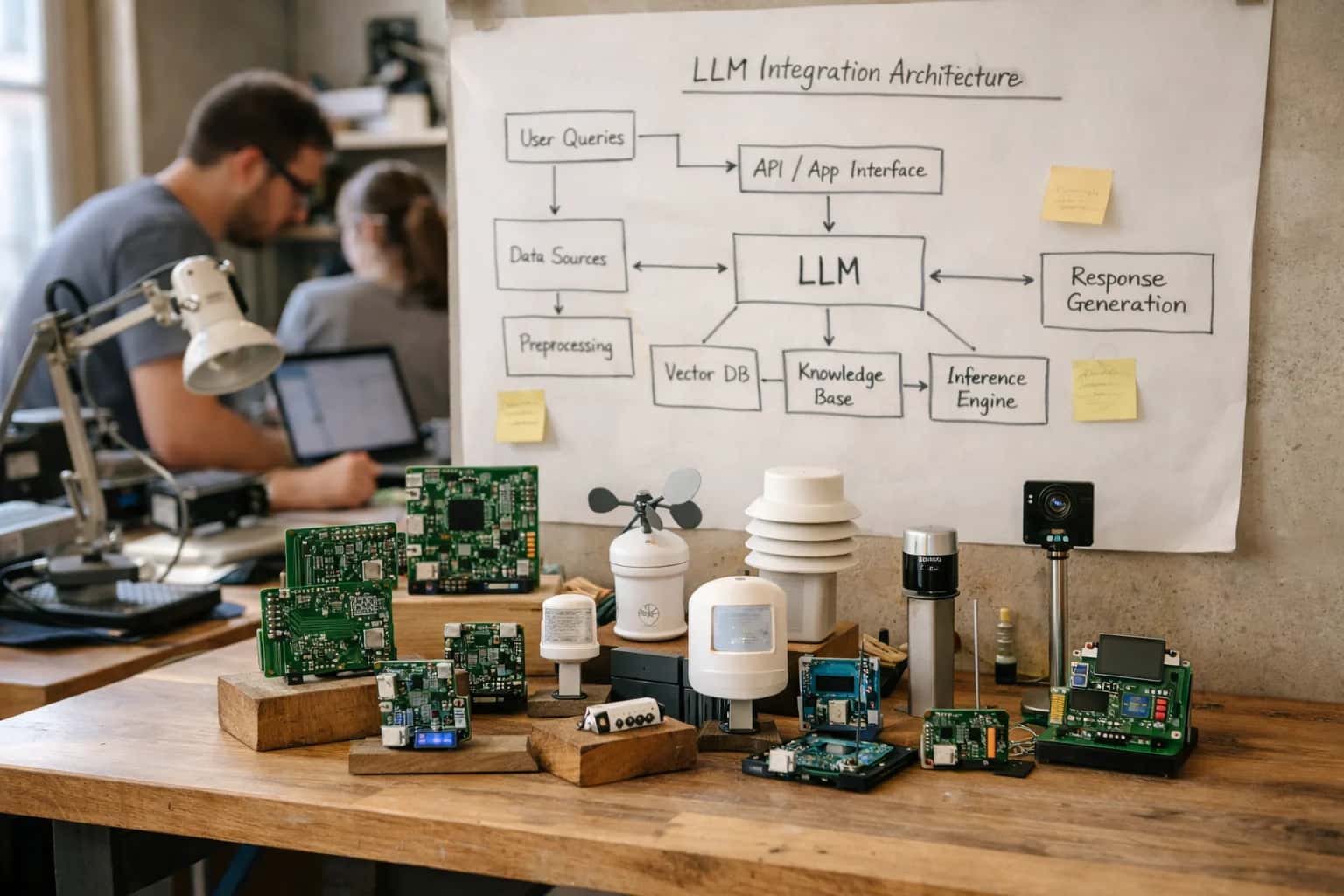
ARCHITECTURE OVERVIEW
Where AI Fits in the Modern Physical Retail Stack
A practical guide to wiring AI into the in-store technology ecosystem, from the point of sale to the edge.
Implementation follows a hub-and-spoke model. A central AI orchestration service (often cloud-based) ingests real-time events via POS APIs (/transactions, /inventory-levels) and sensor webhooks. It processes this data using a combination of LLMs for unstructured data (customer service notes, product descriptions) and traditional ML for forecasting and anomaly detection. The service then triggers actions back into the stack—for example, pushing a dynamic pricing update to the POS, sending a restock alert to a manager's tablet via a mobile push notification, or updating a promotional display on a digital sign through its CMS API. Key workflows include automated purchase order generation, real-time markdown optimization, and next-best-action prompts for associates during checkout.
Rollout requires a phased, use-case-led approach. Start with a single high-ROI workflow, like automated receipt summarization and CRM enrichment, which touches only the POS and a customer data platform. This validates the data pipeline and governance model. Phase two might introduce predictive labor scheduling, which combines POS sales forecasts with external data (weather, local events). Governance is critical: all AI-driven actions (e.g., auto-applying a discount) should be logged in an audit trail, and high-stakes decisions should include a human-in-the-loop approval step configured within the retail platform's native workflow engine. For a deeper dive on connecting these AI services to specific POS APIs, see our guide on AI Integration for Retail Point of Sale Platforms.
The business impact is operational precision: reducing out-of-stocks by 15-25%, cutting manual inventory count time from hours to minutes, and enabling same-day instead of next-day promotional responses. The goal isn't a 'smart store' for its own sake, but a more responsive and efficient one where AI handles exception-based workflows, allowing staff to focus on high-value customer interactions. For retailers planning multi-location deployments, a centralized AI layer also enables consistent policy enforcement and cross-store learning, turning individual store data into a chain-wide competitive advantage. Explore the specific technical patterns for unifying data across locations in our blueprint for AI Integration for POS Chain Store Operations.
WHERE AI CONNECTS TO IN-STORE OPERATIONS
Core Integration Surfaces in the Retail Tech Stack
The Transaction Core
The POS is the system of record for all in-store activity. AI integrates here to make checkout intelligent and turn transactions into insights.
Key Integration Points:
- Transaction APIs: Real-time hooks into sale completion, returns, and voids to trigger post-purchase workflows.
- Cart & Item-Level Data: Access to the SKU, quantity, price, and modifiers for each item, enabling real-time recommendation and validation.
- Tender & Payment Data: Analysis of payment methods for fraud detection and customer preference insights.
AI Use Cases:
- Dynamic Pricing & Discounts: Apply context-aware promotions (e.g., slow-moving inventory, loyalty status) before tender.
- Automated Fraud Screening: Score transactions in real-time for gift card abuse, return policy violations, or suspicious patterns.
- Receipt Intelligence: Generate smart digital receipts with personalized content, warranty registration prompts, or cross-sell offers.
Integration typically uses webhooks or streaming APIs from platforms like Lightspeed, Shopify POS, or Square to push data to an AI service layer.
INTELLIGENT STORE OPERATIONS
High-Value AI Use Cases for Physical Retail
AI integrates across the in-store tech stack—POS, sensors, signage, and back-office systems—to automate operations, personalize service, and turn physical data into actionable intelligence. These are the most impactful workflows to prioritize.
01
Intelligent Inventory & Replenishment
Connect AI to POS scan data and shelf sensors to predict stock-outs, automate purchase orders, and optimize safety stock levels. Models analyze sales velocity, seasonality, and supplier lead times to generate orders in Lightspeed Retail or Shopify POS, syncing with warehouse systems.
Days -> Hours
Replenishment cycle
02
Personalized In-Store Engagement
Use POS customer history to power associate-facing copilots on mobile devices. When a loyalty member checks out, the system surfaces past purchases, predicted preferences, and next-best-offer scripts to drive upsells and strengthen clienteling.
Batch -> Real-time
Recommendation timing
03
Automated Checkout & Fraud Support
Integrate AI agents with Square Retail or Clover transaction APIs to analyze cart contents in real-time. Automatically apply valid promotions, flag potential gift card fraud or return policy abuse, and generate plain-language receipt summaries emailed to the customer.
Manual -> Automated
Exception review
04
Dynamic Labor Scheduling
Feed POS sales forecasts, foot traffic data, and staff performance metrics into an AI scheduler. The system generates optimized, compliant schedules that align labor hours with predicted demand, reducing overstaffing and improving coverage during peak times.
1-2 hours
Weekly planning time
05
Unified Omnichannel Fulfillment
Orchestrate BOPIS, ship-from-store, and endless aisle workflows using AI. The system analyzes real-time inventory across all locations and channels via POS APIs, routes orders to the optimal fulfillment point, and updates all systems to prevent overselling.
Single system
Inventory view
06
Predictive Maintenance for Store Tech
Monitor the health of POS registers, scanners, and digital signage using AI. Analyze device logs and performance data to predict hardware failures before they happen, automatically generating service tickets in your helpdesk and alerting store managers.
Reactive -> Proactive
Support model
IMPLEMENTATION PATTERNS
Example AI-Powered Retail Workflows
These concrete workflows illustrate how AI agents connect to POS APIs, store sensors, and backend systems to automate operations, enhance customer experience, and provide real-time intelligence to store staff and managers.
Trigger: A transaction is finalized at the POS (e.g., Square, Lightspeed).
Context/Data Pulled: The agent receives a webhook with the transaction payload: SKUs, quantities, prices, customer ID (if available), tender type, and time.
Model/Agent Action:
- Dynamic Discounting: Checks inventory levels for purchased items. If an item is overstocked and nearing a markdown cycle, the agent can apply a micro-discount post-transaction and generate a revised digital receipt.
- Receipt Intelligence: Summarizes the purchase into categories (e.g., "Weeknight Dinner Ingredients") and extracts key product attributes.
- Next-Best-Offer: Queries the enriched customer profile to identify the most likely complementary item not in the cart.
System Update/Next Step:
- Sends a personalized SMS/email with the receipt summary and the single, highly-relevant product recommendation.
- Logs the discount reason ("inventory clearance trigger") for manager review.
- Updates the customer's profile in the CDP with new purchase intent signals.
Human Review Point: Discounts over a configured threshold (e.g., >15%) are flagged for manager approval before the revised receipt is sent.
SYSTEMS-LEVEL BLUEPRINT
Architecture for a Unified Retail AI Integration
A practical architecture for connecting AI across the in-store tech stack, from POS and sensors to digital signage, to create intelligent, responsive physical locations.
A unified retail AI architecture treats the store as a single, instrumented system. The core integration surfaces are: 1) the POS platform (Lightspeed, Shopify POS, Square, Clover) for transaction and customer data, 2) IoT sensors and cameras for traffic and dwell time, 3) inventory management systems for real-time stock levels, and 4) digital signage and associate devices for AI-driven actions. The goal is to create a closed-loop where AI models consume real-time data from these systems and trigger workflows back into them—like adjusting a digital promotion based on low shelf stock or routing a store associate to a high-intent customer zone.
Implementation follows a hub-and-spoke pattern. A central AI orchestration layer (often cloud-based) ingests events via APIs and webhooks from each system. It runs specialized agents: a demand forecasting agent that uses POS sales history and local weather data, a computer vision agent processing feed from overhead cameras for planogram compliance, and a customer service agent that can be queried via in-store kiosks or associate tablets. These agents write back to the systems-of-record—for example, the forecasting agent generates a recommended purchase order in the inventory system, while the service agent can pull up a customer’s online wishlist in the POS clienteling module.
Rollout is phased by workflow impact. Phase 1 typically automates a high-volume, rules-based task like receipt summarization for B2B customers or automated return reason coding. Phase 2 introduces predictive elements, like next-hour labor scheduling adjustments sent to the workforce management system. Phase 3 deploys interactive AI, such as associate copilots on mobile devices that suggest add-ons during checkout. Governance is critical: all AI-driven actions (e.g., dynamic pricing changes, automated discount applications) should flow through an audit and approval queue in a platform like ServiceNow or Jira before being executed in the POS, ensuring human oversight for brand and compliance risks.
This architecture matters because it turns disparate retail systems into a cohesive intelligence platform. Instead of a one-off "AI for inventory" project, you build a central nervous system that can continuously adopt new AI capabilities—from today's RAG-based product knowledge retrieval for associates to tomorrow's real-time personalized signage—all operating on a unified data model and integration framework. For a deeper dive on connecting these AI workflows to specific POS APIs and data models, see our foundational guide on AI Integration for Retail Point of Sale Platforms.
ARCHITECTING AI FOR THE PHYSICAL STORE
Code & Integration Patterns
Integrating AI at the Point of Sale
The POS is the system of record for transactions. AI integrations here focus on real-time decision support and post-purchase automation.
Key Surfaces:
- Checkout APIs: Inject AI logic for dynamic discounting, loyalty application, or fraud scoring before payment finalization.
- Webhook Handlers: Process
sale.completedevents to trigger personalized email receipts, inventory updates, or CRM enrichment. - Receipt Data: Use OCR or digital receipt APIs to extract line-item details for trend analysis and customer profiling.
Example Workflow: An AI service listens for new transactions, classifies the basket (e.g., "weekend DIY project"), and immediately queues a personalized cross-sell email with related items in stock.
Implementation Note: Use idempotent handlers to avoid duplicate processing from webhook retries.
INTELLIGENT PHYSICAL RETAIL
Realistic Operational Impact & Time Savings
This table illustrates how AI integration transforms key retail operations by connecting to POS data, store sensors, and operational systems, moving from reactive manual processes to proactive, assisted workflows.
| Retail Operation | Before AI Integration | After AI Integration | Implementation Notes |
|---|---|---|---|
Daily Sales Reporting & Anomaly Detection | Manual spreadsheet compilation by store manager, next-day review | Automated anomaly alerts within 15 minutes of store close | AI consumes POS transaction streams, flags outliers against forecast for immediate manager review |
Perishable Inventory Waste Forecasting | Weekly manual count, historical guesswork for markdowns | AI-driven daily waste predictions with markdown recommendations | Integrates POS sales, shelf-life data, and local event calendars; reduces spoilage by 15-30% |
In-Store Customer Service Triage | Associate-dependent; customer waits for available staff | AI-powered kiosk or associate tablet handles common queries instantly | Uses product catalog and policy data; escalates complex issues to human staff with context |
Planogram Compliance Auditing | Manual store walks with checklist, photos, monthly reviews | Computer vision on store cameras provides nightly compliance scores | AI compares fixture images to planogram specs; generates exception reports for field teams |
Labor Schedule Optimization | Manager creates weekly schedule based on intuition and fixed rules | AI generates schedules balancing forecasted traffic, sales goals, and labor laws | Integrates POS footfall forecasts and employee preferences; adjusts in real-time for call-outs |
Personalized In-Store Offers | Generic promotions or associate memory for loyal customers | Real-time next-best-offer at checkout based on basket and purchase history | AI engine connected to POS and loyalty CRM; offer printed on receipt or sent via SMS post-purchase |
Store Maintenance Request Routing | Phone call or paper log; delayed dispatch for non-urgent issues | AI triages sensor alerts (e.g., HVAC, lighting) and routes prioritized work orders | Integrates IoT platforms with facility management system; predicts preventative maintenance |
Multi-Store Performance Benchmarking | Monthly manual report consolidation across locations | Centralized AI dashboard with daily rankings, trend explanations, and action prompts | Unifies data from all POS instances; uses natural language to explain variance for district managers |
ARCHITECTING FOR SCALE AND CONTROL
Governance, Security & Phased Rollout
Deploying AI across the physical retail stack requires a deliberate approach to data security, operational control, and measured adoption.
A production AI integration for physical retail must be built on a secure, event-driven architecture. This typically involves deploying a central AI orchestration layer that consumes real-time events from your POS (Lightspeed, Shopify POS), IoT sensors, digital signage controllers, and inventory management systems via secure APIs or message queues. All AI tool calls—whether for dynamic pricing, inventory predictions, or personalized signage—should be routed through this governance layer, which enforces role-based access controls (RBAC), maintains comprehensive audit logs, and applies data masking to protect sensitive customer and transaction information before it's sent to external LLM APIs.
A phased rollout is critical for managing risk and proving value. Start with a low-risk, high-impact pilot, such as an AI agent that automates the generation of daily sales performance summaries from POS data for store managers. This validates the data pipeline and builds trust. Phase two might introduce real-time inventory intelligence, where AI analyzes POS scan data and warehouse feeds to suggest reorder points, initially in a "recommendation-only" mode for buyer review. The final phase rolls out customer-facing AI, like intelligent digital signage that personalizes promotions based on anonymized traffic analytics, beginning in a single flagship location with A/B testing to measure lift.
Governance extends to the AI models themselves. Implement a prompt registry and versioning system to manage the business rules driving in-store agents. For instance, the logic for a "next-best-offer" agent at checkout must be auditable and updatable without code deployments. Establish a human-in-the-loop review process for high-stakes AI actions, like automated markdowns on high-value electronics. Finally, ensure your architecture supports graceful degradation; if the AI service is unavailable, core POS and store operations must continue uninterrupted, with AI features failing silently or defaulting to pre-configured business rules.
Enabling Efficiency, Speed & Accuracy
Intelligent Analysis, Decision & Execution
We build AI systems for teams that need search across company data, workflow automation across tools, or AI features inside products and internal software.
Talk to Us
Search across company data
Give teams answers from docs, tickets, runbooks, and product data with sources and permissions.
Useful when people spend too long searching or get different answers from different systems.
Enterprise searchRAGPermissions
Read more
Automate internal workflows
Use AI to route work, draft outputs, trigger actions, and keep approvals and logs in place.
Useful when repetitive work moves across multiple tools and teams.
AI agentsWorkflow automationGovernance
Read more
Add AI to products and internal tools
Build assistants, guided actions, or decision support into the software your team or customers already use.
Useful when AI needs to be part of the product, not a separate tool.
AI integrationDecision supportModel routing
Read moreIMPLEMENTATION QUESTIONS
FAQs: AI Integration for Physical Retail
Practical answers for retail executives and technical leaders planning to embed AI into their in-store technology stack, from POS and sensors to digital signage and operations platforms.
Start with a high-impact, data-rich workflow that has a clear operational owner. Avoid "boil the ocean" projects.
Recommended first targets:
- Automated Inventory Reconciliation: Use AI to compare perpetual inventory (from your POS/WMS) with scheduled cycle counts or RFID scans, flagging discrepancies for immediate review. This solves a daily pain point with clear ROI.
- Intelligent Customer Service Triage: Route in-store service inquiries (via kiosk, associate tablet, or post-transaction survey) to an AI agent that can answer FAQs, check inventory, or escalate complex issues—freeing staff for high-value interactions.
- Dynamic Labor Scheduling: Feed POS sales forecasts, foot traffic data, and event calendars into an AI model to generate optimized weekly schedules that meet demand while controlling costs.
Key Integration Points: Your starting point dictates the primary system connection:
- For inventory: Your POS API (e.g., Lightspeed, Square) and Warehouse Management System.
- For service: Your POS customer/transaction API and potentially a unified communications platform like Zoom or Teams for escalations.
- For scheduling: Your POS reporting API and labor management module (often within the POS or an HRIS like UKG).

About the author
Prasad Kumkar
CEO & MD, Inference Systems
Prasad Kumkar is the CEO & MD of Inference Systems and writes about AI systems architecture, LLM infrastructure, model serving, evaluation, and production deployment. Over 5+ years, he has worked across computer vision models, L5 autonomous vehicle systems, and LLM research, with a focus on taking complex AI ideas into real-world engineering systems.
His work and writing cover AI systems, large language models, AI agents, multimodal systems, autonomous systems, inference optimization, RAG, evaluation, and production AI engineering.
LinkedIn
Limited slotsGet a Free AI Consultation
Partnered with leading AI, data, and software stack.





How We Work
Custom AI workflows for your Business
One-fit-all AI don't work for modern businesses. At Inferensys, we aim to understand your business & custom requirements; which we use to define most efficient agentic workflows, the data, and the tools for your business.
01
Review the use case
We understand the task, the users, and where AI can actually help.
Read more02
Pick the right approach
We define what needs search, automation, or product integration.
Read more03
Build the first useful version
We implement the part that proves the value first.
Read more04
Improve from there
We add the checks and visibility needed to keep it useful.
Read moreThe first call is a practical review of your use case and the right next step.
Talk to Us